climax
Pistachio (Pakistani)
pista (پستہ)
Pistacia vera
- balochistan highlands
International hardiness
- USDA 7-11
- RHS H4
- AU: Arid / semi-arid, Mediterranean, Warm temperate
Where it grows — regional guide
| Zones / rating | Regional notes |
|---|---|
USDA 7-11 | Grown in arid, low-humidity valleys across USDA zones 7 to 11 with long hot summers; requires winter chilling and companion male trees for wind-blown pollination. |
| Zones / rating | Regional notes |
|---|---|
H4 (-10 to -5C) | No region-specific data yet |
| Zones / rating | Regional notes |
|---|---|
Arid / semi-arid, Mediterranean, Warm temperate | Cultivated in arid, Mediterranean and warm-temperate districts with low summer humidity; needs a winter chill period and paired male trees to pollinate grafted female trees. |
| Zones / rating | Regional notes |
|---|---|
USDA 7-11 (USDA scale) Canada uses its own zone system; Canadian zones run roughly one lower than USDA. | No region-specific data yet |
| Zones / rating | Regional notes |
|---|---|
Balochistan highlands | Pakistan:Grown in the dry valleys of the Balochistan highlands where cold winters supply chill; plant grafted female cultivars alongside male trees for cross-pollination. |
Grows alongside
Species that appear with Pistachio (Pakistani) in 1 of our published guides — a starting list for a guild, not a planting plan.
Pistachio (Pistacia vera) is a small, long-lived nut tree in the cashew family (Anacardiaceae), grown for the edible seed inside its hard-shelled fruit. It is native to the arid country running from northeastern Iran across Central Asia and Afghanistan, taking in Turkmenistan and the surrounding regions, and it is the only species in its genus cultivated on a large scale for nuts. For a homesteader on dry, sun-baked ground with cold winters, that origin story is the practical hook: this is a tree built for hot, dry summers and cool winters, and it can turn arid land that defeats thirstier crops into a genuinely high-value harvest.
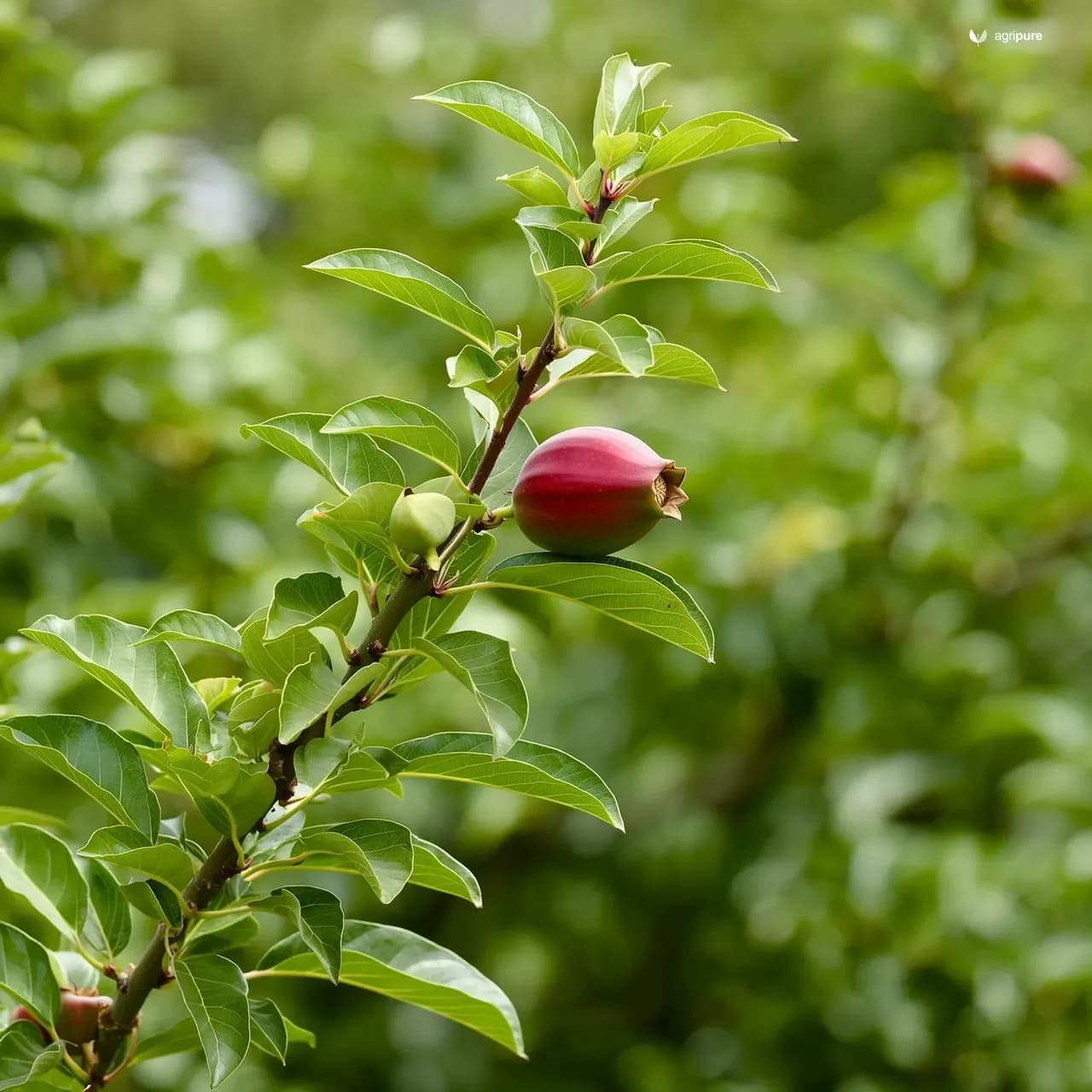
It grows as a small deciduous tree or large shrub, typically reaching about 5 to 10 m tall, and is long-lived, with trees bearing for decades. Like other members of its genus it is xerophytic (dry-adapted), with pinnate, leathery leaves usually made up of three to five thick leaflets, and a grey-to-brown trunk that becomes rough and fissured with age. The fruit is botanically a drupe: the part eaten as a “nut” is the seed within the hard endocarp. At maturity the fruit has a hard, cream-coloured outer shell, while the seed inside carries a mauve-coloured skin over light green flesh with its distinctive flavour. A signature trait is the “split shell” that opens naturally as the fruit ripens, exposing the seed.
How to identify it
Pistachio is easily confused with its wild relatives, including P. atlantica, P. terebinthus, and P. khinjuk, but the nuts give it away. Those wild species produce much smaller, soft-shelled seeds, whereas cultivated P. vera bears large, hard-shelled nuts, and it is the only species in the genus grown commercially for edible nuts. The combination to look for is a small deciduous tree with leathery pinnate leaves, a rough fissured trunk, and clusters (panicles) of flowers that appear before or with the spring leaf flush, maturing into cream-shelled drupes that split open on the tree.
Growing pistachio
The single most important design fact about pistachio is that it is dioecious: male and female flowers grow on separate trees. This is standard for P. vera and is routinely flagged in cultivar descriptors and production guides, because a block of female trees with no male nearby cannot set a crop. Plan for both sexes from the start.
- Propagation: Orchards are almost universally grafted. Named female cultivars are grafted onto rootstocks — often P. vera itself or other Pistacia species such as P. atlantica or P. integerrima. Seedling trees are genetically variable, which is why growers rely on grafted, known cultivars rather than raising trees from seed.
- Sun and heat: The tree needs long, hot summers to ripen its nuts properly, matching its origin in continental and Mediterranean arid climates.
- Cold: It also requires a real winter chilling period for reliable flowering and nut set — commonly cited in horticultural texts as roughly 600 to 1,500 chilling hours.
- Water and aridity: Pistachio is tolerant of drought and high summer temperatures but is sensitive to high humidity and excessive rainfall, which favour fungal disease. It belongs on dry, well-drained ground, not in damp or waterlogged conditions.
Sources here describe the climate by temperature and rainfall rather than by USDA zone. As applied horticultural guidance, not a strict botanical fact, pistachio is generally treated as suited to about USDA zones 7 to 9, sometimes marginal into warm zone 6 where winters are cold enough to supply chilling but not cold enough to kill the wood, consistent with its temperate-to-Mediterranean native range and the regions where it is produced. Precise sowing dates, spacing, and time-to-bearing figures vary by region and cultivar and are not reliably given in these botanical sources, so they are left out here rather than stated with false precision.
Harvest and uses
The harvest is the seed, taken from the drupe once the cream-coloured shell has hardened and split open to reveal the mauve-skinned, green-fleshed kernel inside. Pistachio is the only Pistacia species cultivated on a large scale for nut production, prized over its wild relatives precisely because its nuts are large and hard-shelled rather than small and soft. The split shell is more than a curiosity: it makes the ripe kernel easy to access and is one of the defining traits recorded in cultivar descriptors and genetic-resources literature. As a crop, then, this is a long-term planting: a tree that bears for decades once established, yielding a storable, high-value nut from arid land.
Sources
- Pistacia vera L. — GBIF (Global Biodiversity Information Facility)
- Pistacia vera research — PMC (National Library of Medicine)
- Pistacia vera genetic-resources record — AGRIS, FAO
- Pistacia vera — iNaturalist
- Pistachio (Pistacia vera) — Acta Horticulturae, ISHS
- Descriptors for Pistachio (Pistacia vera L.) — IPGRI / Bioversity International
- Pistacia vera L. — Plants of the World Online, Royal Botanic Gardens, Kew