pioneer
Purslane
kulfa
Portulaca oleracea
Also known as Kulfa (Pakistan).
- punjab plains
- sindh coast
- balochistan highlands
International hardiness
- USDA 9-11
- RHS H2
- AU: Tropical, Subtropical, Warm temperate, Mediterranean, Arid / semi-arid
Where it grows — regional guide
| Zones / rating | Regional notes |
|---|---|
USDA 9-11 | A summer annual grown across the country; eat young stems fresh or cooked, moderating intake if prone to kidney stones, and ensure wild plants do not leak the milky latex of toxic spurge. |
| Zones / rating | Regional notes |
|---|---|
H2 (1 to 5C) | A frost-tender summer annual grown in full sun; moderate intake if sensitive to oxalates, and check that wild plants do not leak the milky sap of toxic spurge. |
| Zones / rating | Regional notes |
|---|---|
Tropical, Subtropical, Warm temperate, Mediterranean, Arid / semi-arid | A drought-hardy summer annual of Mediterranean and arid zones; moderate intake if prone to kidney stones, and ensure wild plants lack the milky sap of toxic spurge. |
| Zones / rating | Regional notes |
|---|---|
USDA 9-11 (USDA scale) Canada uses its own zone system; Canadian zones run roughly one lower than USDA. | No region-specific data yet |
| Zones / rating | Regional notes |
|---|---|
Punjab plains, Sindh coast, Balochistan highlands | Pakistan:A summer annual leafy vegetable of the Punjab and Sindh plains; moderate intake if prone to kidney stones, and check that wild plants lack the milky sap of toxic spurge. |
Grows alongside
Species that appear with Purslane in 30 of our published guides — a starting list for a guild, not a planting plan.
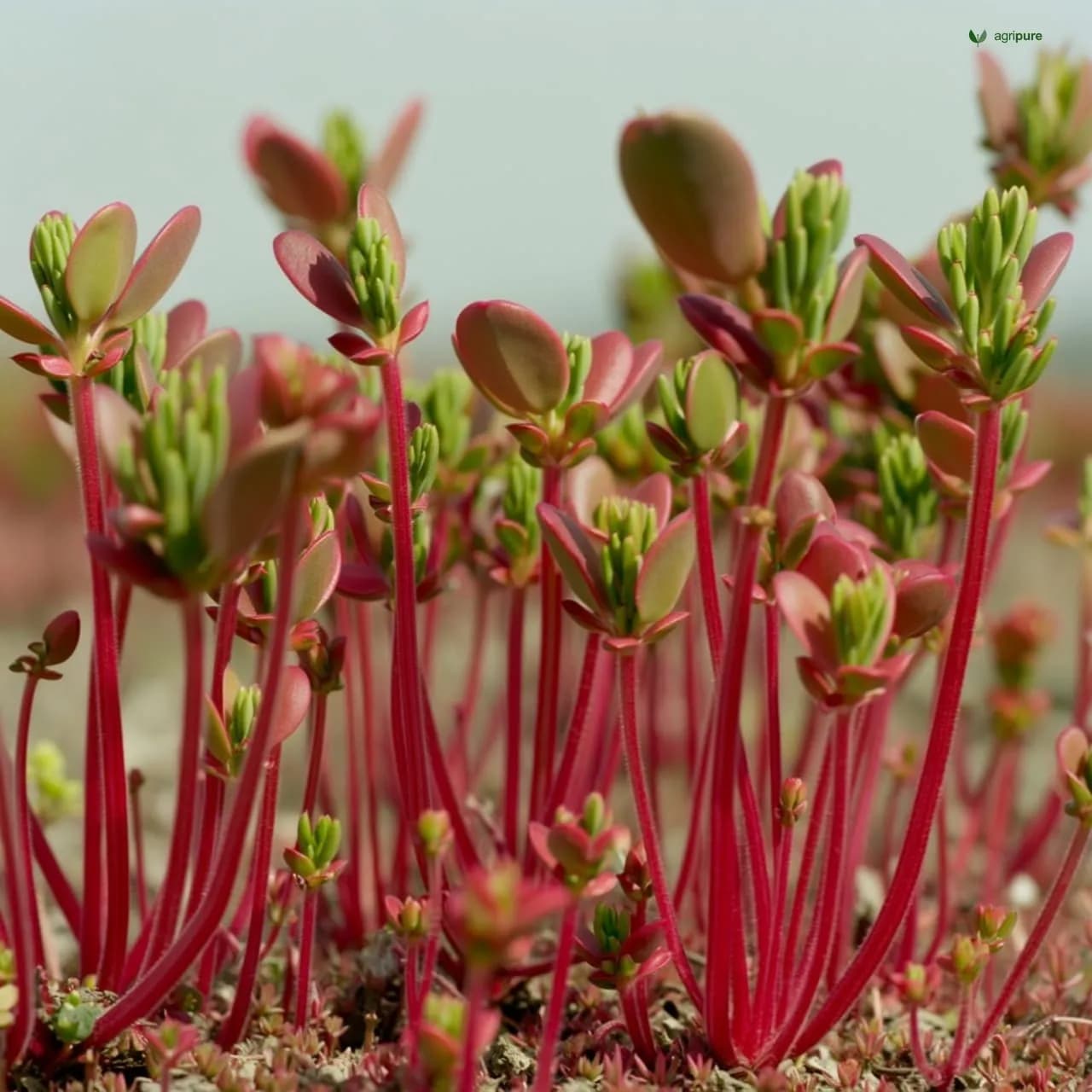
Purslane (Portulaca oleracea) is a low, sprawling annual succulent in the family Portulacaceae, also known as common purslane, little hogweed, or pursley. It is believed to be native to a broad belt running from Macaronesia and tropical Africa through the Mediterranean and the Arabian Peninsula east to Pakistan, and it has since spread to most of the world, absent only from some of the far north. For a homesteader the appeal is simple: the same toughness that makes it one of the most familiar garden “weeds” also makes it a fast, drought-hardy, self-seeding edible green that volunteers on bare, baked ground.
Purslane is easy to recognize once you learn its combination of traits. The stems are smooth, hairless, and succulent, usually reddish, and tend to lie flat against the soil, radiating from a central base and forming dense low mats up to about a metre across. The leaves are fleshy, smooth, and shiny, egg- to spatula-shaped (oval to teardrop), borne alternately but often clustered at the stem joints and tips. Small yellow flowers, typically five-petalled, appear singly or in small clusters at the stem tips and leaf axils and open mainly in bright sun. The fruits are tiny capsules holding numerous minute black seeds that are round to comma-shaped with a grooved surface.
The key identification check is against spurge (Euphorbia species), a toxic look-alike that grows in the same disturbed ground. Spurge has thin, non-succulent leaves and bleeds a white, milky latex when broken, whereas purslane is succulent throughout and its broken stems give only clear or faintly coloured sap, never milky. Always confirm with several characters together rather than any single feature.
Growing purslane
Purslane is a warm-season summer annual: it germinates in warm conditions, grows rapidly through late spring and summer, and is killed by hard frost. It reproduces primarily by seed, which it sets in great abundance and which can carpet open soil with seedlings; dislodged or cultivated plants will also re-root readily from stem fragments left on moist soil, a trait that matters both for weed control and for deliberate propagation. To start a patch on purpose, sow into warm soil once frost has passed, or simply lay cut stems on damp ground and let them root at the nodes.
It is unfussy about soil. Purslane grows in almost any soil, including wet organic ground and heavy clay, in disturbed areas, though in cultivated settings it does best in loose, nutrient-rich, sandy soil and competes strongly under irrigation. It is most common in warm soils and open, sunlit, disturbed sites, and its sun-following flowers reflect a clear preference for full light. As a succulent it is well adapted to dry conditions, yet it also responds to moisture, which is why it thrives both in neglected dry corners and in well-watered beds; it is found from sea level up to about 2,800 m in fields, gardens, lawns, ditches, roadsides, and other disturbed sites.
The cited sources do not assign formal USDA hardiness zones, and precise sowing temperatures, spacing, and exact days to maturity vary by region and are not consistently documented here, so they are left out rather than stated with false precision. What the evidence does support is straightforward: because purslane occurs throughout the continental United States (absent only from Alaska) and behaves as a summer annual in temperate climates, it can be grown during the frost-free season across most regions with warm summers.
Harvest and uses
Purslane is harvested as a leafy green, taking the soft, fleshy stems and leaves during active spring and summer growth before hard frost ends the season. Because it re-roots from fragments and self-seeds so freely, a single patch left to mature will renew and spread itself, giving a free, self-perpetuating supply once established — which is also why gardeners more often meet it as a weed than as a crop.
As a vegetable, purslane is widely eaten around the world as a leafy green, used both raw and cooked. Its readiness to colonize open, disturbed ground also makes it a classic pioneer of bare soil — a low living groundcover that knits across the gaps of a garden while more permanent plantings fill in. The cited sources do not provide reliable yield figures, so none are given here.
Safety and cautions
Purslane is a food plant, but it carries one genuine caution worth respecting: it can contain potentially harmful levels of soluble oxalates if eaten in excess or by susceptible people. For most people, eating it in normal culinary amounts is unremarkable, but those prone to kidney stones or otherwise sensitive to dietary oxalates should be moderate, and cooking is a sensible practice as with other oxalate-bearing greens such as spinach.
The other real risk is one of identification rather than the plant itself. Before eating any wild plant you believe to be purslane, rule out toxic spurge, which shares its disturbed-ground habitat: spurge leaks white milky latex and has thin, non-succulent leaves, while true purslane is succulent throughout with clear sap. If a plant does not match every purslane character, do not eat it.
Sources
- Portulaca oleracea — North Carolina State Extension Plant Toolbox
- Common Purslane — University of California Statewide IPM Program (UC ANR)
- Portulaca oleracea — Wikipedia
- Portulaca oleracea fact sheet — Seed ID Guide
- Purslane — University of Nevada, Reno Extension
- What’s That Weed? Edible Purslane — Fairchild Tropical Botanic Garden