support
Indian Kudzu
sural
Pueraria tuberosa
Also known as Sural (Pakistan).
- pothohar
- kpk hills
- punjab plains
International hardiness
- USDA 8-11
- RHS H3
- AU: Tropical, Subtropical
Where it grows — regional guide
| Zones / rating | Regional notes |
|---|---|
USDA 8-11 | No region-specific data yet |
| Zones / rating | Regional notes |
|---|---|
H3 (-5 to 1C) | No region-specific data yet |
| Zones / rating | Regional notes |
|---|---|
Tropical, Subtropical | No region-specific data yet |
| Zones / rating | Regional notes |
|---|---|
USDA 8-11 (USDA scale) Canada uses its own zone system; Canadian zones run roughly one lower than USDA. | No region-specific data yet |
| Zones / rating | Regional notes |
|---|---|
Pothohar, KPK hills, Punjab plains | Pakistan:A native woody climbing vine of the Pothohar and KPK hills; tubers show liver toxicity and are unsafe for food use, and medicinal preparations should be avoided during pregnancy or before surgery. India:A climbing vine native to India; its tubers show liver toxicity and are unsafe for food use, and medicinal preparations must be avoided during pregnancy, breastfeeding, or before surgery. |
Indian kudzu (Pueraria tuberosa) is a large perennial climbing vine in the pea family (Fabaceae), grown not for what it does above ground but for the enormous tuberous root it builds below it. It is native to the Indian subcontinent, recorded across India including the Himalayas and western India, and is best known as a long-used plant of Indian traditional medicine rather than as a food or forage crop. For a homesteader, its interest is honest and narrow: a vigorous, deep-rooting legume vine whose swollen tuber traditional practice has valued for centuries. It is not a casual edible, and the cautions below matter.
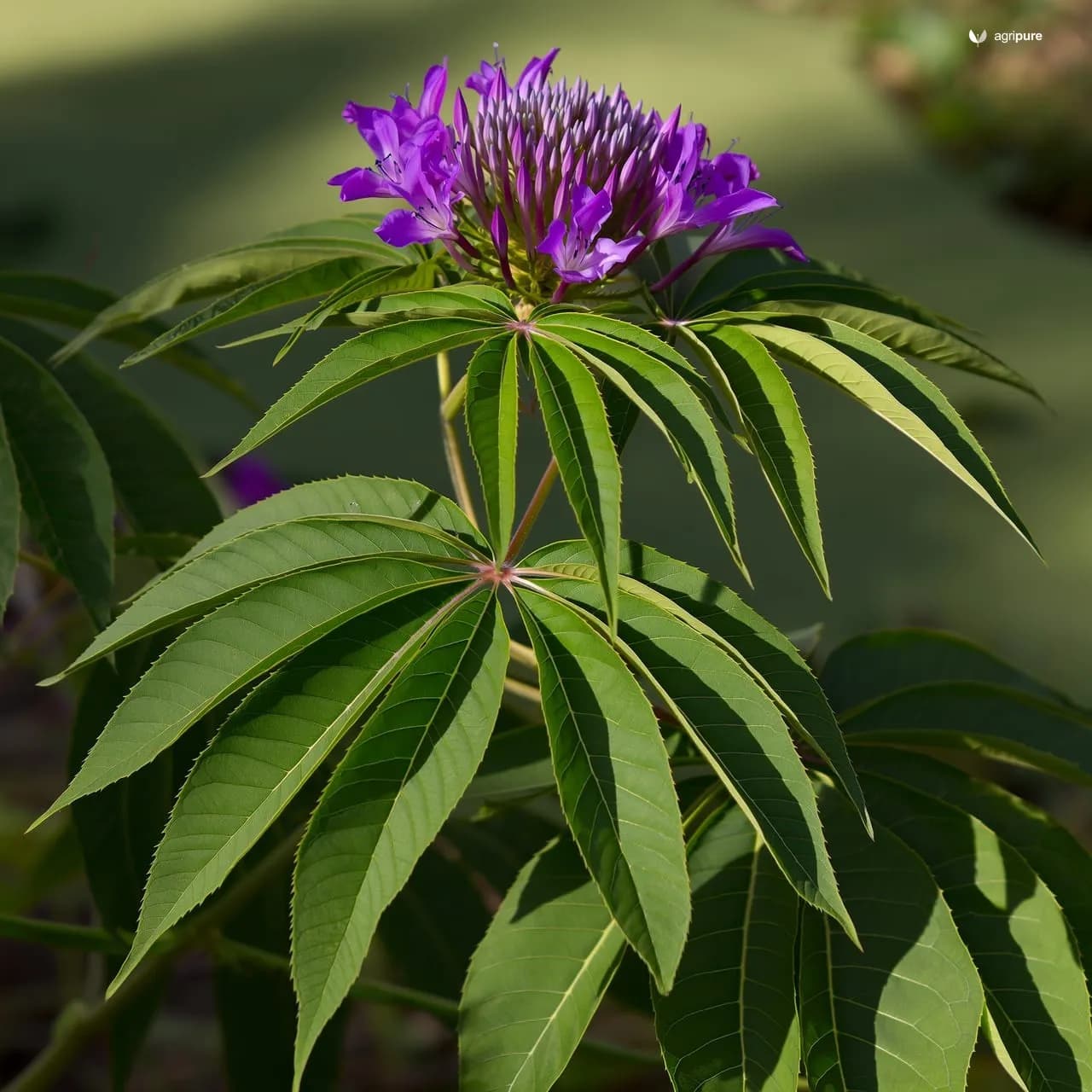
This is a tuberous, deciduous climber — a twining woody vine or liana that dies back and resprouts from its huge underground storage root. The leaves are trifoliate, alternate, with broadly ovate to rhomboid (egg-shaped) leaflets, and the flowers are the giveaway: blue to purplish-blue, papilionaceous (pea-shaped), fragrant, and carried in long racemes. The pods are flat, roughly 5 to 7.5 cm long, densely clothed in silky brown hairs, and hold only a few seeds. The defining feature is below ground: tubers can grow very large, with one report describing them up to 20 kg at 1 to 2 m depth.
Growing Indian kudzu
An honest profile has to flag what the sources do not cover. The literature here documents this plant’s identification, distribution, and chemistry, but gives no species-specific cultivation guidance for P. tuberosa — no documented propagation method, soil or sun preference, watering regime, spacing, or time to maturity. Rather than borrow figures from its invasive New World relatives or invent them, those details are left out.
What the sources do anchor is climate and range. P. tuberosa occurs naturally across India, including the Himalayas and western India, up to roughly 1,200 to 1,500 m elevation. That points to a warm climate and a plant at home from lowland to mid-elevation hill country. The sources assign no USDA hardiness zone for this species, so none is stated. As with any large twining legume, expect a vine that wants sturdy support and room, and a tuber that takes years, not one season, to reach the sizes reported.
Harvest and uses
The harvest is the tuber. The sources confirm very large underground storage roots (the 20 kg figure above is the headline), but supply no standardized home-garden yield data or harvest schedule for this species, so no harvest timing is claimed here.
Use of P. tuberosa in the sources is overwhelmingly medicinal. It is described as an important medicinal plant of Indian traditional medicine (Ayurveda). A botanical catalog records a long list of traditional uses: general tonic, headache, aphrodisiac, demulcent, refrigerant in fevers, cataplasm (poultice) for swelling of joints, and lactagogue or galactogogue. These describe historical and traditional use, not evidence that the plant treats or cures any condition. This profile makes no edibility claim: the one source calling kudzu leaves, flowers, and roots edible refers to the invasive Pueraria montana complex, a different plant. Species-specific ecological, agroforestry, or material uses were not found and are not asserted.
How to identify it
Use this combination of features to separate Indian kudzu from look-alike vines:124
- Habit: A large perennial twining climber or liana, deciduous, dying back to a massive underground tuber.
- Leaves: Trifoliate (three leaflets), alternate, with broadly ovate to rhomboid, egg-shaped leaflets.
- Flowers: Blue to purplish-blue, fragrant, pea-shaped (papilionaceous), in long racemes.
- Pods: Flat, about 5 to 7.5 cm long, densely covered in silky brown hairs, with few seeds.
- Root: Very large tuberous storage roots, reported up to around 20 kg at 1 to 2 m deep.
Safety and cautions
This is what separates Indian kudzu from an ordinary garden plant. The tuber is the traditional product, but it is not a casual vegetable, and the sources carry clear toxicity and safety signals.
- A rat study reported hepatotoxicity (liver toxicity) of the tubers of Indian kudzu (Pueraria tuberosa). The tubers should be treated as requiring caution; the sources do not establish safe food-use standards for home consumption.
- For kudzu used medicinally more generally, a clinical monograph warns it may slow blood clotting, act like estrogen, harm the liver, and affect blood sugar around surgery.
- That guidance advises avoidance during pregnancy and breastfeeding, with bleeding or clotting disorders, with hormone-sensitive conditions such as breast, uterine, or ovarian cancer, endometriosis, or fibroids, and with liver disease, and recommends stopping use at least 2 weeks before surgery.
Those cautions are stated for kudzu generally rather than as *P. tuberosa*\-only data, but they point the same way as the species-specific liver-toxicity finding. The conservative position is to grow and study this plant as a botanical and traditional-medicine subject, not to self-administer the tuber, and to seek qualified medical advice before any internal use.
Sources
- Pueraria tuberosa — iNaturalist
- Indian Kudzu — Flowers of India
- Pueraria tuberosa review — PMC (National Library of Medicine)
- Hepatotoxicity of tubers of Indian kudzu (Pueraria tuberosa) — ScienceDirect (Food and Chemical Toxicology)
- Kudzu — WebMD