pioneer
Sorghum
jowar
Sorghum bicolor
Also known as Jowar (Pakistan, India).
- punjab plains
- sindh coast
- balochistan highlands
International hardiness
- USDA 10-12
- RHS H1c
- AU: Tropical, Subtropical, Arid / semi-arid, Warm temperate
Where it grows — regional guide
| Zones / rating | Regional notes |
|---|---|
USDA 10-12 | A heat- and drought-hardy warm-season annual grown across the plains for grain and silage; avoid grazing drought-stressed or frosted stands due to prussic acid risk. |
| Zones / rating | Regional notes |
|---|---|
H1c (5 to 10C) | No region-specific data yet |
| Zones / rating | Regional notes |
|---|---|
Tropical, Subtropical, Arid / semi-arid, Warm temperate | Cultivated across subtropical and arid regions as a major summer grain and fodder crop; manage stressed forage carefully to prevent prussic acid poisoning in herds. |
| Zones / rating | Regional notes |
|---|---|
USDA 10-12 (USDA scale) Canada uses its own zone system; Canadian zones run roughly one lower than USDA. | No region-specific data yet |
| Zones / rating | Regional notes |
|---|---|
Punjab plains, Sindh coast, Balochistan highlands | Pakistan:A major summer kharif grain and fodder cereal across Punjab, Sindh, and Balochistan; never graze drought-stressed green stands due to dangerous prussic acid buildup. India:A staple dryland kharif grain and livestock feed across central and peninsular India; avoid feeding drought-stressed or stunted green plants due to prussic acid toxicity. |
Grows alongside
Species that appear with Sorghum in 7 of our published guides — a starting list for a guild, not a planting plan.
Sorghum (Sorghum bicolor) is a warm-season cereal grass in the family Poaceae, grown around the world for grain, forage, and biomass. It originated and was domesticated in northeastern Africa, particularly in the part of Sudan around the Atbara and Gash rivers, where it still occurs in a great diversity of wild and cultivated forms. From that African heartland it has spread to more than 120 countries across tropical, subtropical, arid, and semi-arid regions, grown roughly between 50°N in North America and Russia and 40°S in Argentina. For a homesteader, the appeal is simple: this is a heat- and drought-adapted grain and fodder crop that keeps producing on hot, dry ground where thirstier cereals struggle, and most of the plant can be put to use.
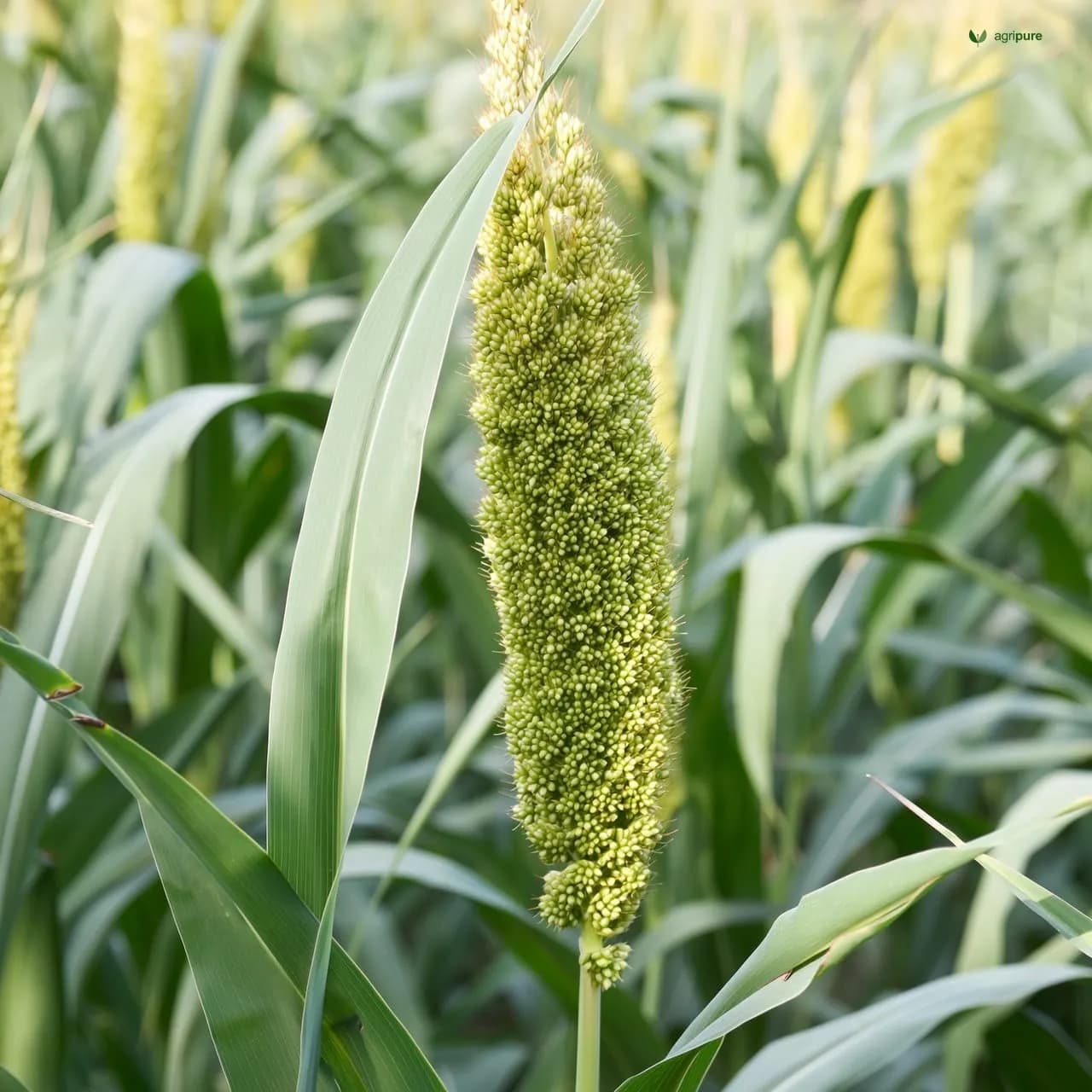
Sorghum is mainly a C4 annual grass, occasionally behaving as a short-lived perennial, and usually completes one generation per growing season. Its canelike culms typically stand 50 to 240 cm tall (about 1.5 to 8 ft), reaching over 4 m in some forms, with stems 1 to 5 cm thick that are often juicy in the sweet (sorgo) types. The leaves resemble those of maize, with long linear blades and a prominent midrib. The plant produces tillers, which are adventitious stems from the base, but it has no rhizomes, so it does not spread vegetatively. Flowers and seed are carried in a panicle, a branched flowerhead that may be compact or open and can bear up to about 3,000 seeds. The grain itself is a rounded caryopsis, 2 to 4 mm across, ranging from white and yellow through red and brown depending on the variety. Botanically it sits in the tribe Andropogoneae and has a chromosome number of 2n = 20.14
Growing sorghum
Sorghum is propagated only by seed, since it does not spread through rhizomes; even the weedy shattercane form (S. bicolor subsp. drummondii) reproduces solely by seed. It is a full-sun, warm-season crop, and as a C4 plant it performs best under high temperatures and bright light. The plant prefers well-drained soil and, in cover-crop and forage use, a slightly acid pH of about 6.0 to 6.5, but it grows successfully on a wide range of soils across dryland regions as long as drainage is adequate. Its standout trait is drought tolerance, which makes it well suited to arid and semi-arid ground, though it still needs enough soil moisture to establish and to fill grain or build biomass.
Because it is tropical in origin and needs a frost-free, warm growing season, sorghum is grown as a warm-season annual; sow into warm soil after frost danger has passed. The general botanical and extension sources here describe its climate adaptation rather than assigning precise row spacing, sowing depth, or days-to-maturity figures, and those details vary widely by variety and region, so they are left out rather than stated with false precision. Treat it as you would other warm-season dryland cereals: wait for warm ground, give it full sun and free drainage, and let its drought tolerance do the work once it is established.
Harvest and uses
Sorghum is a versatile crop grown for three main products: grain, forage, and biomass. Most parts of the plant are edible or usable, and the grain is generally safe for people when properly processed and cooked. Sorghum grain is rich in prolamin proteins, which is worth noting for anyone with specific grain allergies or intolerances. The sweet sorghum types, with their juicy canes, are grown for their sugary stems, while grain types are selected for filled, well-coloured heads; with up to roughly 3,000 seeds per panicle, a single mature head represents a substantial grain return. Beyond food, the crop is valued as a drought-tolerant, warm-season cover crop and as forage and biomass, making it a useful multi-purpose grass in a dryland rotation.
Safety and cautions
While the grain is a safe staple when properly handled, the green plant carries a real hazard for grazing animals. Stressed sorghum foliage can be toxic to livestock because it accumulates compounds that release prussic acid (hydrogen cyanide), and it also poses a high-nitrate risk under certain conditions. This is a livestock-poisoning concern in stressed green foliage, not a caution about the cooked grain eaten by people. Anyone planning to graze animals on sorghum or feed it green should treat young, drought-stressed, or frost-damaged plants with particular care and follow established forage-safety guidance rather than turning stock onto a stressed stand.
Sources
- The Biology of Sorghum bicolor (L.) Moench — Canadian Food Inspection Agency
- Sorghum bicolor Plant Guide — USDA NRCS PLANTS Database
- Sorghum — Wikipedia
- Sorghum bicolor genetics and genome — PMC (National Library of Medicine)