pioneer
Feather Speargrass (Bushman Grass)
lamb / pilchi-ghas
Stipagrostis plumosa
Also known as Lamb (Pakistan).
- balochistan highlands
- sindh coast
International hardiness
- USDA 8-11
- RHS H3
- AU: Arid / semi-arid
Where it grows — regional guide
| Zones / rating | Regional notes |
|---|---|
USDA 8-11 | No region-specific data yet |
| Zones / rating | Regional notes |
|---|---|
H3 (-5 to 1C) | No region-specific data yet |
| Zones / rating | Regional notes |
|---|---|
Arid / semi-arid | No region-specific data yet |
| Zones / rating | Regional notes |
|---|---|
USDA 8-11 (USDA scale) Canada uses its own zone system; Canadian zones run roughly one lower than USDA. | No region-specific data yet |
| Zones / rating | Regional notes |
|---|---|
Balochistan highlands, Sindh coast | Pakistan:A drought-hardy perennial sand grass of Balochistan and Thar dunes; graze herds early while green, as ripening awned seeds injure livestock and fleece. |
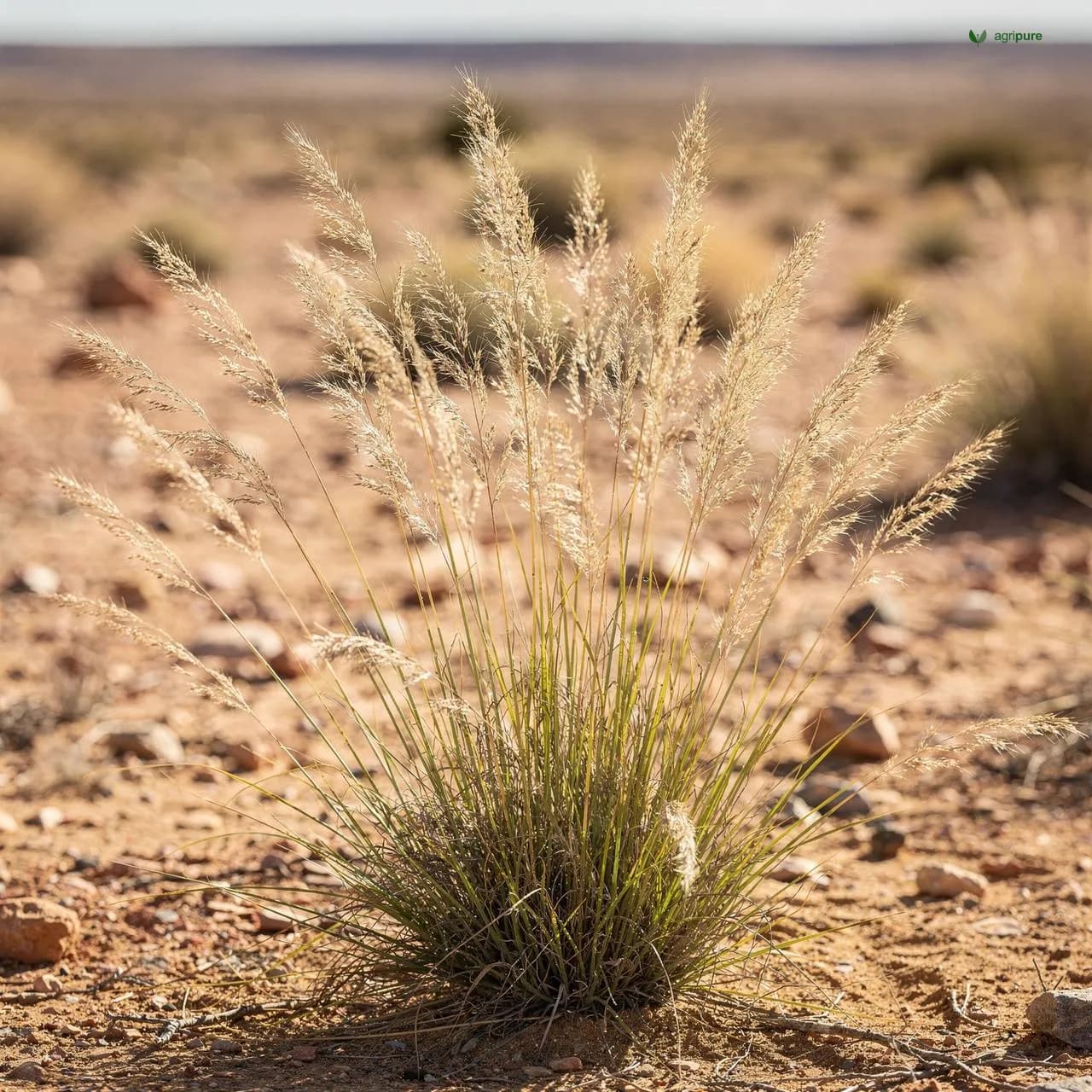
Feather speargrass (Stipagrostis plumosa, called lamb or pilchi-ghas in places) is the plumed desert grass that gives camels and sheep their first green bite of the season on the sands of Balochistan and the Thar. It is a drought-hardy perennial of arid sandy ground, growing in fine-leaved tufts topped with feathery seed heads, and it is native right across the belt from the Sahara to north-west India, Pakistan very much included. On loose desert sand it is both forage and sand-binder.
Where it thrives
This is a grass of the open desert and dry shrubland, at home on the sandy ground of the Balochistan highlands and the Sindh side of the Thar. It stands roughly 50–100 cm tall, with fine needle-like leaves and tall plume-like seed heads, and it is valued for dune stabilisation and erosion control on the same sandy soils where it feeds. Its native range — Sahara through Arabia, Iran, and Afghanistan to Pakistan and the West Himalaya — is a map of hot, dry, sandy country, which is exactly the niche it fills on a Pakistani desert farm.
Role in the system
Treat it as a sand-stage pioneer. The tufts hold loose sand and give shelter to small desert wildlife while supplying early-season feed, so the grass does soil-binding and forage work at once. Its standout trait is timing: it greens up and is grazed early in the season, ahead of much of the surrounding range, making it a valued early bite for camels and sheep before other grasses come away. Across the wider desert it is one of the culturally central camel-forage species, a sign of how much pastoralists rely on it. On a dune farm it is groundwork that also pays its way through the herd.
Grazing value
Feather speargrass is an important forage where other fodder is scarce, providing grazing for camels and sheep on sand that carries little else. It ranks among the most culturally salient forage grasses for camel management in the desert — in one Saharan study it was one of only five species, out of about 100 named, that herders treated as truly essential — prized precisely because it delivers feed early and on poor sandy ground. As a perennial of the true desert and dry-shrubland biome it persists through the dry season in place, so the same tufts come away again with the first rain rather than having to re-establish from seed each year.
Cautions
As an Stipagrostis, the seed carries a sharp point and a twisted awn; at the seeding stage the awned seed can work into wool and fleece and irritate grazing stock, so it is best grazed green before the heads ripen. Yields off open desert sand are modest, so it supplements a pastoral diet rather than replacing browse and richer feed. Like the other dune grasses here it is a sand specialist — lean on it to hold loose ground and feed the herd early, not to carry stock through the year on its own.
Sources
- Plants of the World Online. “Stipagrostis plumosa (L.) Munro ex T.Anderson.” Royal Botanic Gardens, Kew.
- Ornatec International. “Stipagrostis plumosa (plumed grass).” Species profile.
- Volpato, G. & Puri, R. K. (2014). “Dormancy and Revitalization: the fate of ethnobotanical knowledge of camel forage among Sahrawi nomads and refugees of Western Sahara.” Ethnobotany Research and Applications.
Sourcing notes
Native to Balochistan and Thar sands; seed is occasionally offered by specialist desert-grass and dune-restoration suppliers, otherwise collect mature plumed seed from local stands.