secondary
Anatherum Grass
ghorka
Themeda anathera
Also known as Ghorka (Pakistan).
- pothohar
- kpk hills
International hardiness
- USDA 7-9
- RHS H4
- AU: Cool temperate, Warm temperate
Where it grows — regional guide
| Zones / rating | Regional notes |
|---|---|
USDA 7-9 | No region-specific data yet |
| Zones / rating | Regional notes |
|---|---|
H4 (-10 to -5C) | No region-specific data yet |
| Zones / rating | Regional notes |
|---|---|
Cool temperate, Warm temperate | No region-specific data yet |
| Zones / rating | Regional notes |
|---|---|
USDA 7-9 (USDA scale) Canada uses its own zone system; Canadian zones run roughly one lower than USDA. | No region-specific data yet |
| Zones / rating | Regional notes |
|---|---|
Pothohar, KPK hills | Pakistan:A tufted native perennial grass of the Pothohar and KPK hill slopes; valuable for stabilizing erodible slopes and providing rangeland forage before monsoons. India:A perennial tussock grass native to the western Himalaya; useful for soil binding on mountain slopes and for providing early-season pastoral grazing. |
Loonder grass (Themeda anathera) is a tufted perennial grass in the family Poaceae, native to the mountains of Central and South Asia. Its range runs from Afghanistan eastward through Pakistan, Kashmir, the western and central Himalaya, and Nepal, on into Tibet, where it grows on hill slopes and open ground rather than in cultivated fields. It is best known as a wild hill fodder grass rather than a garden crop, and for a homesteader on dry, sloping, or marginal ground it is the kind of hardy native bunchgrass that holds soil and feeds stock where little else will thrive. It carries the English name Loonder grass, the Hindi name Loonder, and the Nepali name Dhaddee.
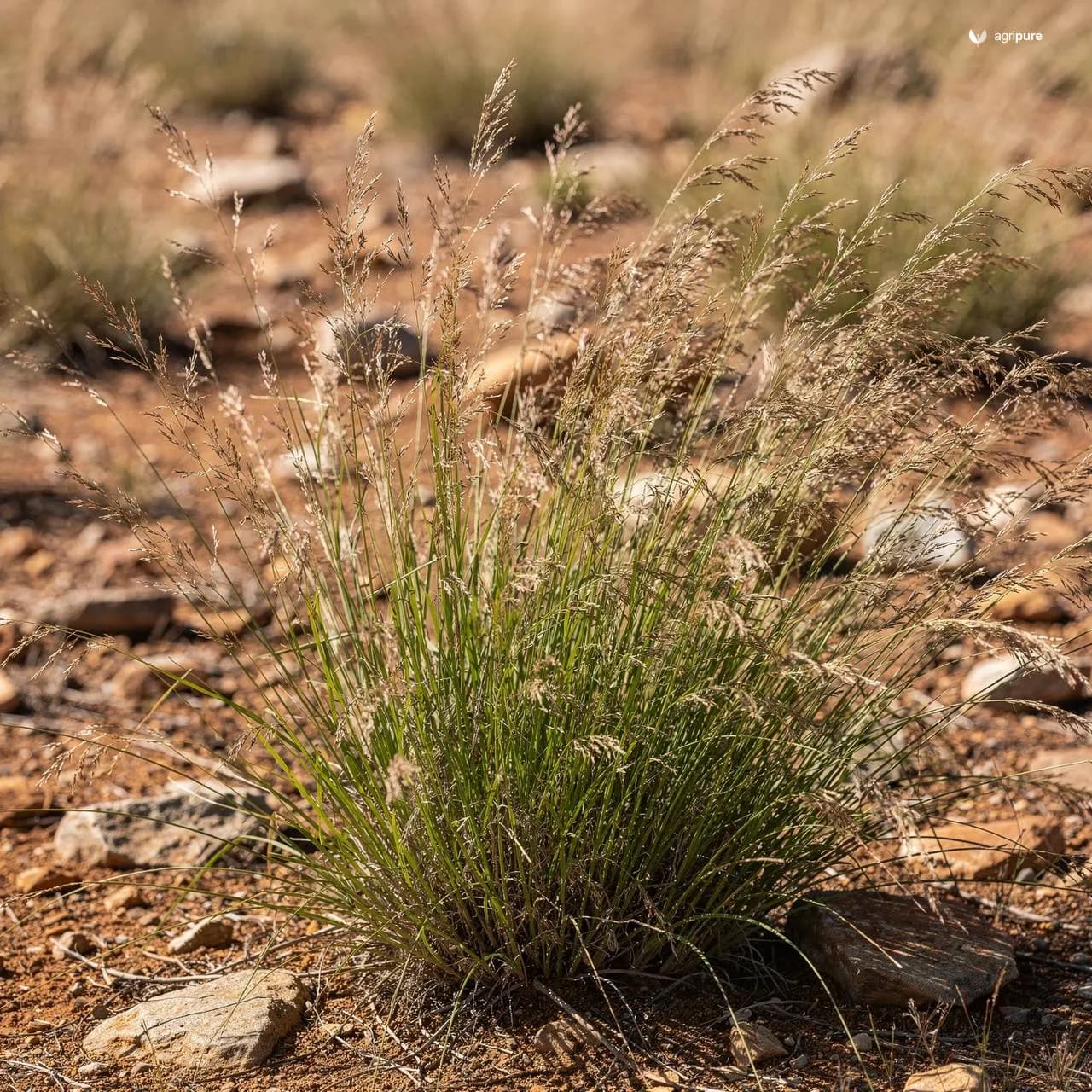
The plant forms dense tufts or clumps from a creeping rhizome, so a single stool spreads slowly into a tussock rather than a lawn. Its slender stems (culms) stand erect or lean and bend at the base, reaching roughly 30 to 120 cm tall. The leaf blades are flat, narrow, and rough to the touch, up to about 30 cm long and only 2 to 4 mm wide, tapering to a fine threadlike tip and bearing scattered long hairs on tubercle bases; the small ligule is around 2 mm with a fringed margin.
Growing Loonder grass
Loonder grass is a wild rangeland species rather than a domesticated crop, and the botanical sources describe where it grows naturally rather than a horticultural recipe. It is a montane plant, recorded at altitudes of roughly 700 to 2,300 m across Afghanistan, Pakistan, the western Himalaya, and Nepal, which tells you it is adapted to cool-to-temperate hill country with a strong seasonal rhythm rather than lowland heat. In that range it occupies open hillsides and grassland slopes, so on a homestead the natural fit is a sunny, open, free-draining bank or pasture edge rather than a rich, irrigated bed.
Because it is a clump-forming perennial with a creeping rhizome, an established plant persists year after year and slowly thickens at the base; mature tussocks can be lifted and divided to start new clumps, in addition to growing from its seed. The reliable botanical literature does not give standardised garden figures for sowing dates, soil pH, plant spacing, irrigation rates, or time to maturity for Themeda anathera, so those numbers are deliberately left out here rather than invented. In practice, treat it as you would other native tussock grasses of dry hill ground: give it full sun and open, well-drained soil, and let its deep, rhizomatous clump establish without coddling.
Harvest and uses
This grass flowers and sets seed in the warmer half of the year. Flowering and fruiting are reported from June to October in Pakistan and the western Himalaya, while Flora of China gives August to October for its range further east, so the seed harvest window falls in late summer into autumn. The flower head is a loose, branched, panicle-like cluster about 20 to 30 cm long, carrying short racemes wrapped in slender bracts (spatheoles) 1 to 2 cm long that are often tinged grey, red, or purple. Each little raceme holds two to four fertile spikelets, the seed-bearing units of the grass.
The plant’s documented value is as fodder: it is a Himalayan hill grass grazed where it grows, and the dense leafy tufts are its useful product, cut or grazed for livestock. Beyond its role as a grazing and soil-binding grass, the reliable sources do not record human food use, and there is no robust published data on yield, edibility, or medicinal use for this species, so this profile makes no such claims. For the homesteader, the honest summary is a tough, low-input native fodder and ground-holding grass for dry hill country, not a harvest crop.
How to identify it
Loonder grass is recognised by this combination of features:123
- Habit: a densely tufted perennial forming clumps from a creeping rhizome, with slender stems about 30 to 120 cm tall that stand upright or bend at the base.
- Leaves: flat, narrow blades up to 30 cm long and only 2 to 4 mm wide, rough-edged, with scattered long tubercle-based hairs and a fine drawn-out tip.
- Flower head: a loose, open panicle-like cluster 20 to 30 cm long, with short racemes sheathed in slender 1 to 2 cm bracts that are often grey, red, or purple tinged.
- Spikelets: mostly awnless (or only rarely with a much-reduced awn), which helps separate it from the many Themeda grasses that bear long, conspicuous awns.
The accepted botanical name is Themeda anathera; you may also see it under the older synonyms Anthistiria anathera and Androscepia anathera in older floras and herbarium records.
Sources
- Themeda anathera – Flora of Pakistan (eFloras.org)
- Themeda anathera – Flora of China (eFloras.org)
- Themeda anathera – eFlora of India
- Themeda anathera – Plants of the World Online, Royal Botanic Gardens, Kew
- Themeda – Wikipedia
Sourcing notes
Raised from seed sown before the summer rains, or by splitting established tussocks; it also regenerates naturally on rested hill grassland. Collect seed from local Pothohar or KPK rangeland stands when the heads ripen.