secondary
Cocoyam
tania
Xanthosoma sagittifolium
Also known as Malanga (United States), Tannia (Australia), Tania (Pakistan).
- sindh coast
- punjab plains
International hardiness
- USDA 8-10
- RHS H2
- AU: Tropical, Subtropical
Where it grows — regional guide
| Zones / rating | Regional notes |
|---|---|
USDA 8-10 | A tropical aroid grown in warm USDA zones 8 to 10 for starchy cormels; always cook corms and leaves thoroughly before eating, and contain beds to prevent invasive spread. |
| Zones / rating | Regional notes |
|---|---|
H2 (1 to 5C) | No region-specific data yet |
| Zones / rating | Regional notes |
|---|---|
Tropical, Subtropical | Suited to humid tropical and subtropical northern gardens for edible corms; always cook tubers and leaves fully before eating, and contain plants near wet areas. |
| Zones / rating | Regional notes |
|---|---|
USDA 8-10 (USDA scale) Canada uses its own zone system; Canadian zones run roughly one lower than USDA. | No region-specific data yet |
| Zones / rating | Regional notes |
|---|---|
Sindh coast, Punjab plains | Pakistan:A frost-tender tropical aroid suited to irrigated, fertile beds on the Sindh coast and warm plains; always cook corms thoroughly before eating, and contain beds to prevent invasive spread. |
Cocoyam (Xanthosoma sagittifolium), also widely known as tannia, yautia, or malanga, is a fast-growing, clump-forming aroid in the arum family (Araceae) grown chiefly for its starchy underground cormels and, secondarily, for its cooked leaves. It is native to tropical America (references point to northern South America, including Colombia, Peru, Ecuador, and Venezuela, and Central America as its center of origin and domestication), and is now cultivated across Africa, Southeast Asia, and the Pacific Islands as a staple root crop. For a homesteader working a warm, humid plot, its appeal is straightforward: it is a perennial carbohydrate crop that produces a cluster of edible corms below ground and a generous flush of edible greens above it, filling a niche where many sun-demanding annuals struggle.
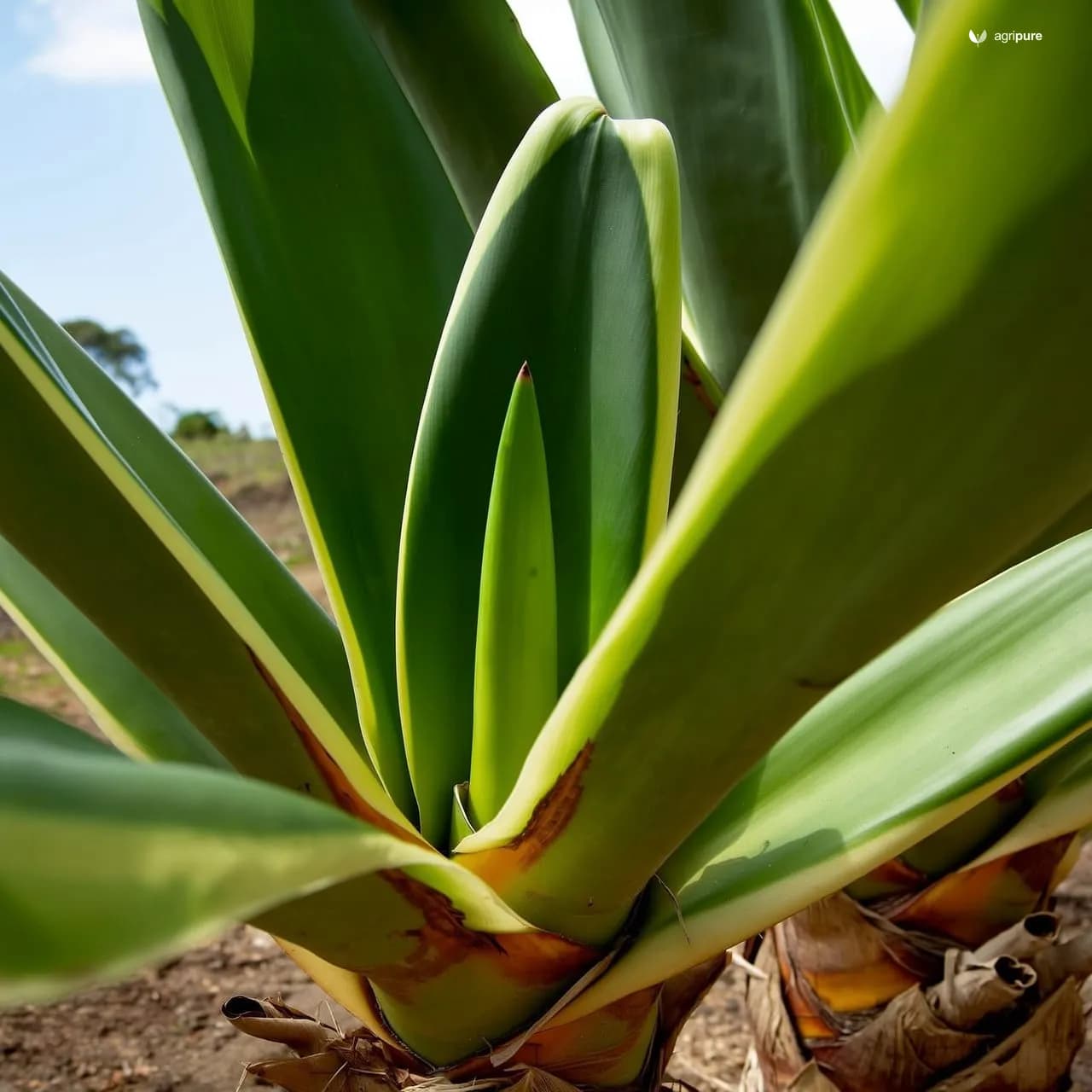
Cocoyam is a herbaceous perennial with a tuberous, cormous underground stem and no true above-ground woody trunk. In good tropical conditions it commonly reaches about 1.8 to 2.7 m (6 to 9 ft) tall with a spread of roughly 0.6 to 1.2 m (2 to 4 ft); PROSEA similarly describes plants up to 2 m or more, with a thick, sub-arborescent stem up to about 1 m long. The most recognizable feature is the foliage: large, arrowhead-shaped (sagittate) leaf blades up to about 1.2 m (4 ft) long and 0.9 m (3 ft) wide, carried on long stalks. A useful field cue separating it from many Colocasia taros is that the petiole attaches at the notch or cleft of the arrowhead leaf rather than away from the margin. When it flowers, it produces the classic arum inflorescence — a yellowish-white spadix wrapped in a green-yellow-white spathe about 12 to 15 cm tall.
Growing cocoyam
Cocoyam is propagated vegetatively rather than from true seed, which is just as well: it shows extreme protogyny (its female flowers are receptive for only a very short window), so viable seed is rarely set in cultivation. The standard approach is to plant corms and cormels. Because the swollen secondary shoots called cormels are the prime edible part, growers typically eat the cormels and reserve the larger main corm as planting material for the next cycle. From a suitable corm, plants can grow to maturity within about 14 to 20 weeks under favorable conditions.
For soil, cocoyam prefers rich, moist, well-drained ground; its underground organs are carbohydrate-dense and respond to fertile conditions. Crucially, despite its love of moisture and humidity, it is intolerant of prolonged waterlogging (tannia do poorly in consistently soaked soil), so the goal is steady moisture on free-draining land, not standing water. As a tropical, warm-humid crop it needs consistently warm, humid weather, with temperatures staying around 20 degrees Celsius or above; cool conditions damage the plant. Horticultural references list it as hardy as a perennial in roughly USDA zones 8 to 10, where winters are mild; in colder regions it is grown as a warm-season annual or under protection, the way many tropical root crops are handled.
Harvest and uses
The harvest centers on the underground organs: a main corm that produces a cluster of swollen lateral cormels, with the cormels being the principal edible part. They are starchy and carbohydrate-rich, and cocoyam flour made from the corms and cormels is noted as rich in carbohydrates, calcium, iron, and phosphorus. Beyond the roots, the plant earns its keep twice: the leaves are also eaten as a cooked vegetable, making it a dual-purpose staple grown for both cormels and greens. Across the tropics it is a reliable starch staple root crop.
Common problems and pests
The most relevant caution for a homesteader is the plant’s behavior outside its managed bed. Cocoyam has escaped cultivation and is recorded as invasive in parts of Florida, Puerto Rico, Costa Rica, the Galapagos, Micronesia, and French Polynesia. Because it spreads readily from corms and cormels, gardeners in warm, frost-free climates should plant it where it can be contained and should remove stray corms when lifting the crop, rather than letting volunteers naturalize into wet ground and watercourses.
Safety and cautions
Like other edible aroids, cocoyam should always be eaten cooked, never raw. The plant is grown specifically for its cormels and for cooked leaves — both are prepared by cooking before eating, and it is consistently described as a cooked vegetable and a cooked staple rather than a raw food. Treat the corms, cormels, and leaves as ingredients that require cooking, and introduce any unfamiliar root crop to your diet cautiously.
Sources
- Xanthosoma sagittifolium (cocoyam) datasheet – CABI Digital Library
- Xanthosoma sagittifolium: a starchy aroid staple – PMC (National Library of Medicine)
- Xanthosoma sagittifolium – ScienceDirect Topics
- Xanthosoma sagittifolium – Wikipedia
- Xanthosoma sagittifolium – PROSEA (Plant Resources of South-East Asia)
- Nutritional composition of cocoyam corm flour – Annals of Plant Sciences
- Xanthosoma sagittifolium (tannia, cocoyam) – Austin Botany