Key takeaways
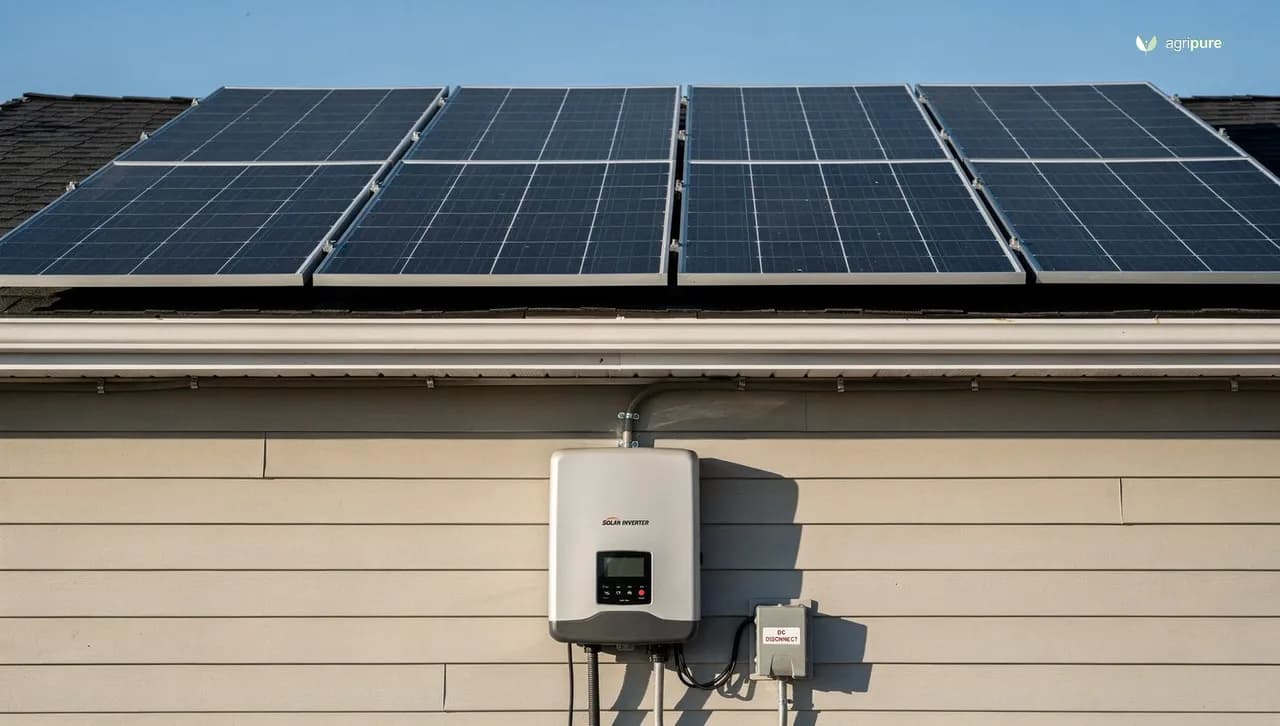
Sunlight beams down on several dark green solar panels installed on a light-colored rooftop. The panels reflect the blue sky.
From photon to power: Solar panels convert raw sunlight into the electricity that powers our homes.
- Sunlight knocks electrons loose in a silicon cell — the photovoltaic effect — and that flow is direct current (DC).
- Each cell makes only 1 to 2 watts; modules string dozens together to deliver useful voltage.
- An inverter turns the panels’ DC into the AC electricity your house and the grid actually use.
- Commercial silicon modules sit at 18-22% efficiency; the theoretical ceiling for single-junction silicon is about 32%.
- NREL data shows median degradation of 0.5% per year, so a 25-year panel still produces about 88% of day-one output.
A solar module is the quietest machine on a roof. It has no belts, no combustion, and no moving parts — just a sheet of silicon doing what the Department of Energy calls the photovoltaic effect: converting light into voltage. Understanding how a panel makes electricity is the difference between buying gear from a brochure and running an honest off-grid system. Whether you are sizing an off-grid kit or thinking about household decarbonisation, the physics is the same. Here is the path from photon to outlet in 6 steps, with the losses called out in plain numbers.
What a solar panel actually is
Underneath the glass, a solar panel is a sheet of wired-together silicon cells. The DOE puts it plainly: roughly 95% of commercial solar panels use two semiconductor types: monocrystalline silicon (one continuous crystal, electrons flow more freely) and polycrystalline silicon (many crystals, cheaper to make). An individual cell produces only 1 to 2 watts. Modules wire dozens together (60 or 72 cells is typical for residential) to push the voltage and current up to something a house can use.
Term | What it means |
|---|---|
Cell | A single silicon wafer, 1-2 W |
Module (or panel) | 60 or 72 cells wired together, 300-450 W |
String | Several modules in series, typically 4-20 kW |
Array | All the strings on a roof or ground mount |
The photovoltaic effect, step by step
That stack of cells does one job: the photovoltaic effect. The DOE describes it as the moment a semiconductor absorbs the light, transferring the energy to negatively charged particles called electrons. Those freed electrons follow the cell’s internal electrical field and start flowing as direct current (DC) through the metal contacts on the back of the panel. Sunlight in, electrons out. That is the whole trick.
Close-up of a blue monocrystalline solar cell showing the thin silver gridlines that carry electrons off the wafer
Why silicon? Silicon’s band gap (about 1.1 eV) is close to the energy of a visible-light photon, which is why it dominates the industry. Other materials like cadmium telluride (CdTe) and amorphous silicon work too, but at lower efficiencies.
From DC to AC: the inverter does the translation
Those electrons leaving the panel are DC, and almost nothing in your house runs on it. The DOE description is direct: the inverter converts the direct current (DC) to alternating current (AC), which flows into the electric grid. In a real install this is either a single string inverter mounted on the wall, or a microinverter bolted to the back of each module. The choice changes shading behavior, monitoring, and cost — not how the physics work.
A wall-mounted residential string inverter with a small LCD display, conduit running up to the roof, mounted on an exterior wall
Inverter type | Where it lives | Best for |
|---|---|---|
String inverter | One central unit, garage or exterior wall | Unshaded roofs, lower upfront cost |
Microinverter | One per module, behind each panel | Partial shading, per-panel monitoring |
Hybrid (battery-ready) | Wall unit with battery port | Off-grid or storage-paired systems |
Where the efficiency number comes from
A commercial silicon module sits between 18% and 22% efficient, per the DOE. The theoretical ceiling for single-junction silicon is about 32%. The gap between 32% and 22% is the physics tax. Photons too red to free an electron are wasted as heat; photons too blue have leftover energy that also dumps as heat; real cells have reflection losses, resistance losses, and wiring losses. The waterfall below shows roughly where each percent goes.
Technology | Typical module efficiency | Notes |
|---|---|---|
Monocrystalline silicon | 20-22% | Best output per square foot; higher cost |
Polycrystalline silicon | 15-17% | Budget option; lower output for the same area |
Thin-film (CdTe, a-Si) | 10-14% | Lightweight, flexible, lower efficiency |
Per the DOE, roughly 95% of commercial panels are silicon; the thin-film share is small but growing in utility-scale and weight-sensitive installs. The 32% Shockley-Queisser limit is why panel datasheets have stopped climbing fast — meaningful gains now require multi-junction or tandem-cell designs.
How long does a panel last?
That efficiency does not stay flat forever. NREL data shows a median degradation rate of about 0.5% per year for crystalline-silicon modules. Stacked across a 25-year warranty term, the math is unfussy: a panel rated 400 W on day one is producing around 88% of that, roughly 352 W, after 25 years.
A mature residential rooftop solar array in afternoon light, twelve panels in two rows, conduit visible at the edge
Most performance warranties promise 97-98% in year one and 80-84% in year 25, which the median panel beats. Thin-film tends to degrade at closer to 1% per year, so its 25-year math is worse. Sizing the system right at install time — covered for cabins in our solar-for-shed guide — is what keeps that 12% lifetime loss from biting you.
Putting the whole system together
Once those parts are clear, a residential solar system is just 6 boxes in a line: array, inverter, optional battery, breaker panel, meter, and the grid. An off-grid build swaps the grid for a battery bank and a backup generator. A grid-tied system net-meters surplus back to the utility. The cell, the photovoltaic effect, and the DC-to-AC inverter stay the same; only the last box changes. For tiny homes the array is smaller and lithium batteries usually replace lead-acid.
The takeaway
From the outside a solar module looks like a sheet of glass. Inside, a silicon wafer is converting photons into electrons, an inverter is turning DC into AC, and the rest of the house carries on as normal. Today’s 18-22% efficiency is what physics and 50 years of engineering have squeezed out of a 32% ceiling. The next gains come from multi-junction cells, perovskite tandems, and better module packaging, not from anything you can buy this year. The simple system you build today will still be producing about 88% of its rated power the year your mortgage is paid off.
Frequently asked questions
How does a solar panel actually make electricity?
Sunlight hits the silicon cells in the panel. The photons knock electrons loose, and the cell’s internal electric field pushes those electrons through the wires as direct current. The Department of Energy calls this the photovoltaic effect. An inverter then converts the DC into the AC electricity your home uses.
What is the difference between a solar cell, module and panel?
A cell is one silicon wafer producing 1 to 2 watts. A module (also called a panel) is 60 or 72 cells wired together, typically rated 300 to 450 W. A string is several modules in series, and an array is every string on the install. The terms are nested, not interchangeable.
Why are solar panels only about 20% efficient?
The theoretical ceiling for single-junction silicon is roughly 32%. The gap to 18-22% is mostly physics: photons too red to free an electron are wasted as heat, photons too blue have surplus energy that also dumps as heat, plus smaller losses from reflection, resistance, and wiring. Today’s commercial modules already sit close to silicon’s practical limit.
What does the inverter do?
It converts the direct current (DC) produced by the panels into the alternating current (AC) that runs almost everything in a North American or European home. Inverters come as one big central string inverter or one small microinverter behind each module; hybrid inverters add a battery port for storage-paired systems.
How long do solar panels last?
NREL data shows a median degradation rate of about 0.5% per year for crystalline silicon panels. A 25-year-old panel typically still produces about 88% of its original output, and quality manufacturers warranty 80-84% retention at year 25. Thin-film degrades faster, closer to 1% per year.
Monocrystalline, polycrystalline, or thin-film?
Monocrystalline tops the chart at 20-22% efficiency and is the best fit when roof space is tight. Polycrystalline (15-17%) is cheaper per panel but needs more area for the same output. Thin-film (10-14%) is lightweight and flexible, suited to curved or weight-sensitive surfaces; it degrades faster and produces less per square foot.
References
- U.S. Department of Energy. “How Does Solar Work?” energy.gov
- U.S. Department of Energy. “PV Cells 101: A Primer on the Solar Photovoltaic Cell.” energy.gov
- U.S. Department of Energy. “Solar Photovoltaic Technology Basics.” energy.gov
- NREL. “STAT FAQs Part 2: Lifetime of PV Panels.” nrel.gov
- U.S. Department of Energy. “Solar Photovoltaic Performance and Efficiency Basics.” energy.gov