Key takeaways

Off-grid living means producing your own power, water, and waste handling, without relying on utility hookups.
- Off-grid living means cutting 3 cords: grid power, municipal water, and the sewer.
- Solar is the usual power source: 1 to 3 kW for a tiny home, 8 to 12 kW for a house.
- Plan 50 to 100 gallons of water per person per day, or 200 to 400 for a family of 4.
- A composting toilet and a greywater system replace the septic connection.
- A basic off-grid setup runs $15,000 to $35,000; full systems reach well past $100,000.
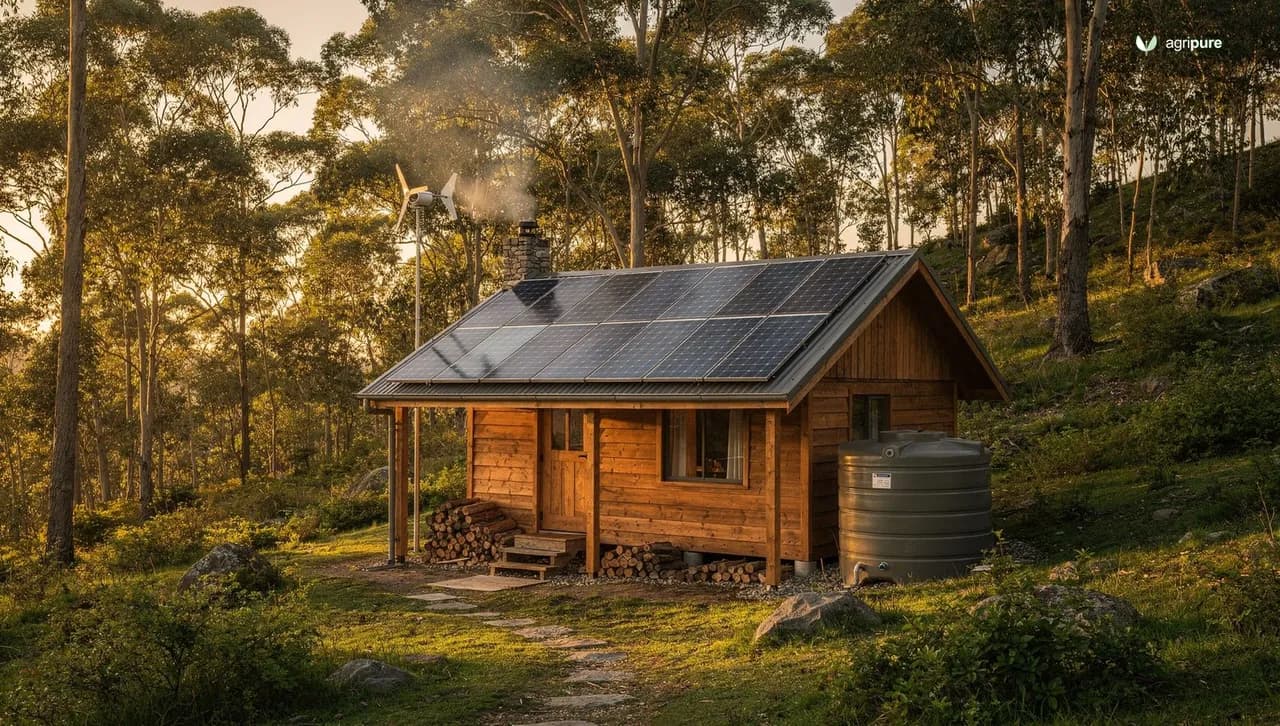
Off-grid living is the deep end of self-reliance: producing your own electricity, sourcing your own water, and handling your own waste, with no utility bill and no utility safety net. It is the most demanding branch of homesteading, and the one most worth taking slowly. The trick is to see it not as 1 leap but as 3 separate systems, each cut over when it is ready.
What off-grid living actually means
Strip away the romance and off-grid living is simply cutting 3 cords: the power line, the water main, and the sewer. You can cut them 1 at a time, which is exactly how most people do it, adding solar this year and a composting toilet the next. Going off-grid in 1 jump is how budgets blow past $100,000 and projects stall.
The 3 cords | What replaces it |
|---|---|
Grid electricity | Solar panels and a battery bank |
Municipal water | A well, a spring, or rainwater |
The sewer | A composting toilet and greywater reuse |
Power: almost always solar
That first cord, power, is usually solar. A tiny home runs on a 1 to 3 kW array, while a full house needs 8 to 12 kW plus a battery bank to carry the nights. Sizing is the whole game, and it is detailed enough to deserve its own guide: see solar panels for off-grid living for panel and battery math.

Water: a well, a spring, or rain
The second cord is water, and the numbers are bigger than people expect. Plan 50 to 100 gallons per person per day, or 200 to 400 for a family of 4, before any livestock or irrigation. A drilled well is the most reliable year-round source; a spring or rainwater can supplement, with every 1,000 square feet of roof yielding about 620 gallons per inch of rain.

Water source | Reliability |
|---|---|
Drilled well | Most reliable, year-round, needs a pump |
Spring | Good, but flow drops in late summer |
Rainwater | Supplemental, about 620 gallons per inch per 1,000 sq ft |
Waste: composting toilet and greywater
The third cord, waste, is the one newcomers dread and veterans shrug off. A composting toilet uses no water, separating liquids and mixing solids with sawdust or coir to break them down, while a greywater system routes sink and shower water to the garden. Together they replace a $10,000 septic connection with a few hundred dollars of kit.
The one-cord rule: cut a single utility at a time and live with it for a full season before cutting the next. Power first is usual, because you can run a pump and a fridge off solar while you still buy water. Stacking all 3 cords in 1 season is the fastest way to burn out and overspend.
What it costs and how to start
Those systems add up, and honesty about the bill matters. A basic off-grid setup for a tiny home runs $15,000 to $35,000, split across solar, water, and waste; a full off-grid house with 8 to 12 kW of solar and deep batteries can pass $100,000 installed. Many start under $50,000 on cheap raw land and scale from there. Before any of it, check local zoning, building codes, and health rules, since some counties still require a grid or septic hookup.
The takeaway
Those 3 cords are best cut slowly. Off-grid living rewards the household that treats it as 3 systems, not 1 lifestyle: solar for power, a well or rain for water, and a composting toilet for waste. Start with the power cord, prove it through a season, and let each system earn the next. A productive acre around the cabin makes the whole thing pay.
Frequently asked questions
What does off-grid living actually mean?
It means disconnecting from public utilities, producing your own electricity, sourcing your own water, and handling your own waste, so there is no utility bill and no utility backup. Most people cut these three cords one at a time rather than all at once.
How much does it cost to live off-grid?
A basic off-grid setup for a tiny home runs about $15,000 to $35,000, split across solar ($8,000 to $18,000), water ($3,000 to $8,000), and waste ($1,000 to $3,000). A full off-grid house with large solar and battery banks can exceed $100,000 installed.
How much water does an off-grid home need?
Plan for 50 to 100 gallons per person per day, or 200 to 400 gallons for a family of four, before livestock or irrigation. A drilled well is the most reliable year-round source, with rainwater and springs as supplements.
How do you handle waste off-grid?
A composting toilet replaces the flush toilet using no water, separating liquids and mixing solids with a carbon material like sawdust to decompose. A greywater system sends sink and shower water to the garden, together replacing a septic connection.
Is off-grid living legal?
Usually, but not always. Check local zoning, building codes, and health department rules first. Some counties require a grid connection or an approved septic system, and a few restrict composting toilets or rainwater harvesting, so verify before you build.
References
- Today’s Homeowner. “The Complete Guide to Off-Grid Water Systems.” todayshomeowner.com
- Little Houses for Sale. “Off-Grid Tiny House Living Guide.” littlehousesforsale.com
- Land Limited. “Off-Grid Living on Raw Land: Real Costs.” landlimited.com
- Family Handyman. “Off-Grid Water System Options.” familyhandyman.com
- Unbound Solar. “Solar Battery Bank Sizing.” unboundsolar.com