Key takeaways

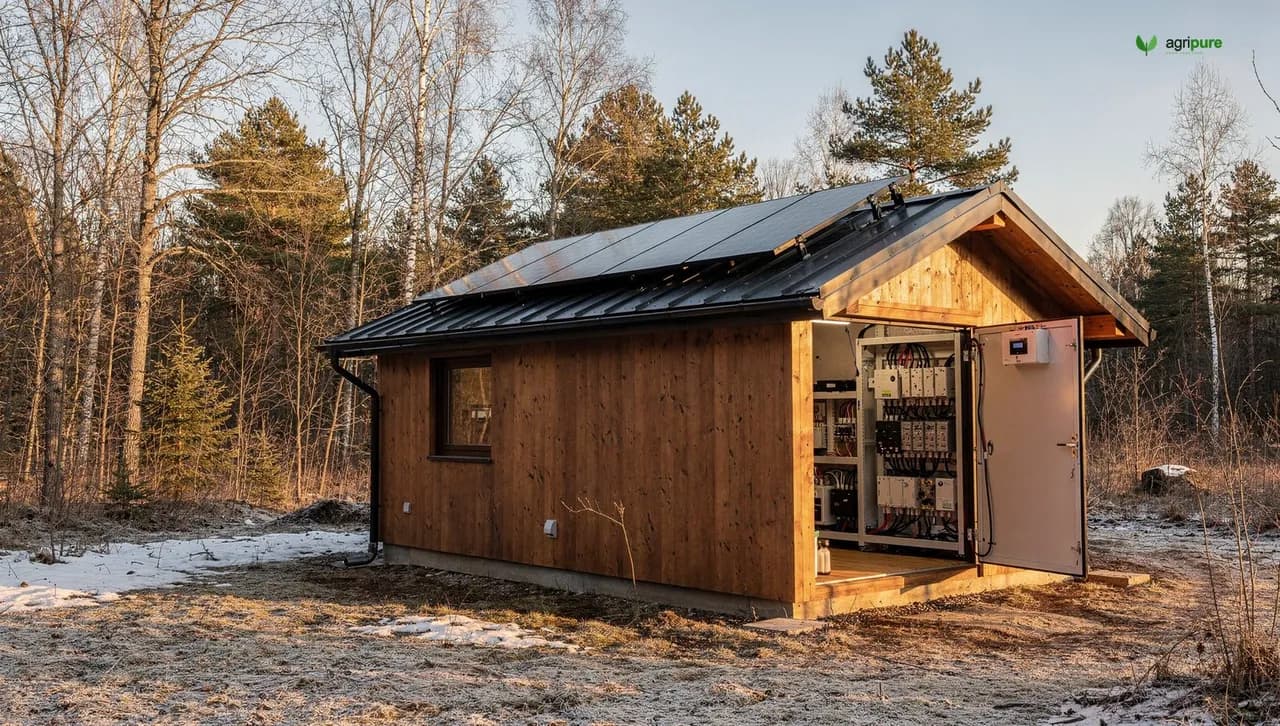
This tiny home uses both roof-mounted and ground-mounted solar panels to provide power off the grid.
- A typical tiny house draws 3-6 kWh/day, roughly 10% of the 30 kWh/day a conventional US home uses.
- Roof real estate caps you near 600 W of panels; anything above that goes on a ground mount or a pole.
- A 300 W system covers lights and devices; 600 W adds a small fridge; 1,200 W is the entry point for serious off-grid living.
- Switch from 12 V to 24 V around 1,000 W of array; 48 V starts to make sense above 2,000 W or with long wire runs.
- Winter peak sun hours in Montana run around 2.0 versus 4.0+ in central Texas: design for the worst month, not the annual average.
- Never charge a LiFePO4 battery below 0 deg C (32 deg F) without an integrated heater; lithium plating is permanent.
A tiny house is the awkward middle child of off-grid solar. It is too small to justify a ground-mounted array on most lots, and too big to run off the 100 W RV kit that worked on weekend trips. The roof realistically fits about 600 W of panels, which is enough for lights, devices, and a small fridge, but well short of what most tiny-home Instagram posts imply. This guide covers the three sizing tiers that map to tiny-house loads (300 / 600 / 1,200 W), the 12 V vs 24 V vs 48 V decision tree, the winter derate that shows up in Montana but not in Texas, and the cold-weather LiFePO4 charging rule that damages unheated batteries. For broader context, see the off-grid solar kit guide and our breakdown of solar for off-grid living. For shed-scale builds first, solar power for a shed is the easier place to learn.
What a tiny house draws
Most tiny-house solar guides start with the panel. They should start with the load. A long-term tiny-house owner running off-grid in North Carolina logs around 3 kWh/day for his household versus roughly 30 kWh/day for a typical American home. Alfred University’s engineering-program tiny house, with no electric heat, models out to about 5.8 kWh/day annually, close to a real-world cap once you include a small fridge, lights, devices, and a water pump. Add electric heating and the number climbs by a factor of 5 or more.
Load category | Watts (typical) | Hours / day | Wh / day |
|---|---|---|---|
LED interior lighting | 30 | 5 | 150 |
Phone, laptop, devices | 60 | 4 | 240 |
12 V water pump (on demand) | 60 | 0.5 | 30 |
12 V vent fan | 10 | 10 | 100 |
Small chest fridge (energy-star) | 60 avg | 24 | 1,440 |
Induction burner (cooking only) | 1,200 | 0.5 | 600 |
Laptop work / streaming | 50 | 4 | 200 |
The number that matters: total Wh/day at the worst month of the year, with a 1.2 – 1.3 safety margin for inverter, wiring, and battery losses. Design backwards from that, not from the panel-wattage sticker.
Three realistic system tiers
Those daily-load numbers sort almost every tiny house into 3 tiers. They map cleanly to roof real estate, battery cost, and what you can run without rationing. Pick the tier from the load list above and the rest of the build follows.

Tier | Panel total | Battery (LiFePO4) | Inverter | Covers |
|---|---|---|---|---|
300 W weekend | 1 – 2 panels | 100 Ah / 12 V (1.28 kWh) | 300 – 600 W | Lights, devices, vent fan |
600 W standard | 2 – 3 panels | 200 Ah / 12 V (2.56 kWh) | 1,000 W pure sine | Above + small fridge |
1,200 W full-time | 4 panels (roof + 1 ground) | 200 Ah / 24 V (5.1 kWh) | 2,000 W pure sine | Above + induction, work-from-home loads |
A documented tiny-house build in North Carolina notes a hard physical ceiling: “you can only fit around 2 solar panels on a tiny house roof” producing roughly 600 W. Beyond that, you are either ground-mounting or pole-mounting. There is no clever way around the roof itself.
12 V vs 24 V vs 48 V: the wire decides
The right system voltage is a function of how much current the wiring has to carry. Power equals volts times amps: at the same wattage, doubling the voltage halves the current and lets you halve the copper. For a 200 ft run between a ground-mounted array and a tiny house, that is the difference between #6 AWG and #10 AWG cable.
Array wattage | Recommended system voltage | Why |
|---|---|---|
Up to 1,000 W | 12 V | Cheap components, RV ecosystem, short runs |
1,000 – 2,000 W | 24 V | Halves current, allows smaller wire and breakers |
Above 2,000 W or long runs | 48 V | Lowest losses; same family as residential solar |
Practical note for tiny houses: if you might add an induction burner, a mini-split, or hot-water-on-demand later, start at 24 V. Upgrading from 12 V means replacing the inverter, charge controller, and most of the wire. The marginal cost of starting at 24 V is a few hundred dollars; the cost of changing voltage later is a weekend of demolition.
Lithium vs lead-acid in a cold climate
That voltage choice meets its first hard constraint at the battery. LiFePO4 is now the default for tiny-house solar (lighter, longer-lasting, and useable to 80% depth of discharge versus 50% for lead-acid), but it has one rule that lead-acid does not: you cannot charge it below freezing. Below 0 deg C (32 deg F), charging causes lithium plating: metallic lithium deposits on the anode, permanently reducing capacity and creating an internal short-circuit risk. A good BMS prevents charging when the cell is too cold, but the practical consequence is a tiny house in Montana that sees no battery charging on cold sunny mornings unless the battery box is heated.

Spec | AGM lead-acid | LiFePO4 |
|---|---|---|
Usable depth of discharge | 50% | 80% – 90% |
Cycle life @ rated DoD | 500 – 1,000 | 3,000 – 6,000 |
Weight per kWh usable | 30 – 40 kg | 10 – 12 kg |
Cold-charge floor | Tolerates 0 deg C and below | 0 deg C (32 deg F): hard stop |
10-year landed cost | Replaced 2 – 3 times | Once, often outlasts the tiny house |
Cold-weather workaround: use self-heating LiFePO4 batteries (built-in warmer drawing 30 – 80 W) or keep the battery bank inside the thermal envelope of the tiny house. Some owners trickle-discharge the bank to run a small heating pad on cold nights so morning charge can begin at first light.
The winter derate most articles skip
An LiFePO4 bank that is too cold to charge is one half of the winter problem. The other half is the panels. NREL’s PVWatts calculator, the standard tool the solar industry uses to model production, takes typical meteorological year (TMY) data from the National Solar Radiation Database and produces a month-by-month output estimate. Run the same array in Bozeman, Montana and Austin, Texas and the December numbers tell the story: winter peak sun hours in northern Montana drop to roughly 2.0 hours/day; central Texas stays above 4 hours. Designing off annual-average production gives you a system that works in October and fails in January.

Rule of thumb: take your worst-month peak sun hours (often December) and size from that. If the December number is 2 hours and you need 3 kWh/day, you need at least 1.5 kW of panel after derate factors, or about 5 standard 300 W panels. The same load in Texas needs 750 W.
Stationary vs trailer-mounted: the trade-off
That winter math gets more painful when the tiny house is on a trailer. Mobile tiny houses carry weight and aerodynamic penalties on every panel: a 300 W panel weighs 35 – 40 lb, and 4 of them on a metal roof shift the center of gravity. Stationary tiny houses have no such penalty: they can use heavier panels, deeper tilts, and a ground-mounted overflow array without compromise.
Decision | Mobile (on trailer) | Stationary (on foundation) |
|---|---|---|
Max practical panel count | 2 – 3 (roof only) | 4+ (roof + ground mount) |
Best mount type | Flush; low-profile rails | Tilted rails matched to latitude |
Tilt strategy | Fixed flat (aerodynamic) | Seasonal tilt: latitude + 15 deg in winter |
Battery placement | Inside thermal envelope | Inside or insulated outbuilding |
Realistic max system | 600 – 900 W | 2,000 – 4,000 W with ground array |
Costs and the honest payback math
A tiny-house solar system rarely pays back against a grid connection on its own. The case is stronger when you are paying for a utility hookup (sometimes USD 10,000 – 40,000 for a rural lot) that solar lets you skip entirely. A documented North Carolina build cost about USD 14,000 before federal tax credit, then an additional USD 5,000 for an expansion. After the 30% residential clean-energy credit, the net cost was closer to USD 13,000.
Tier | Hardware cost (USD, 2026) | Federal credit (30%) | Net cost |
|---|---|---|---|
300 W weekend | 1,800 – 2,500 | 540 – 750 | 1,260 – 1,750 |
600 W standard | 4,500 – 6,500 | 1,350 – 1,950 | 3,150 – 4,550 |
1,200 W full-time | 9,000 – 14,000 | 2,700 – 4,200 | 6,300 – 9,800 |
The takeaway
Tiny-house solar works inside narrower physical limits than most articles admit: about 600 W on the roof, 1,200 – 2,000 W if you can ground-mount, and a hard battery-charging floor at 0 deg C. Pick the tier from the loads you run, design the array off your worst-month sun hours, jump to 24 V the moment you cross 1,000 W of panel, and keep the battery bank above freezing. Do those four things and a tiny house off-grid in Montana is just as feasible as one in Austin; it just needs more panel and a heated battery box. For wiring this safely with permits, our shed guide covers the NEC side, and the off-grid living article scales the same playbook up to a small house.
Frequently asked questions
How many solar panels does a tiny house need?
For a typical full-time tiny house drawing 3 – 6 kWh/day, plan on 2 – 4 panels totaling 600 – 1,200 W. A weekend cabin with LED lights and device charging only needs a single 300 W panel. A North Carolina off-grid tiny house documented at about 3 kWh/day runs comfortably on 600 W of panel. Use your worst-month peak sun hours, not the annual average.
Can a tiny house go off-grid with rooftop solar alone?
In most climates, yes for a weekend or 4-season cabin; only sometimes for a full-time, work-from-home household. The roof realistically holds 600 W of panels. In Texas or Arizona that runs a small fridge and lights year-round. In Montana or the Pacific Northwest the December derate (down to roughly 2 peak sun hours) forces a ground-mounted overflow array.
12 V or 24 V for a tiny house?
12 V if your total panel array is under 1,000 W, because components are cheaper and the RV ecosystem is huge. Switch to 24 V above 1,000 W of panel or if you plan to add an induction burner or mini-split later. The wire savings alone pay back the slightly more expensive inverter and charge controller.
Is LiFePO4 worth the cost over lead-acid in a tiny house?
Almost always, yes, except in spaces that get below freezing for months. LiFePO4 has 3 to 6 times the cycle life, half the weight, and 60 – 80% more usable capacity per kWh nameplate. The exception is below 0 deg C (32 deg F): lithium plating during charging is permanent. Either heat the battery box or use self-heating LiFePO4 packs.
What is the winter derate for tiny-house solar?
It is region-specific. NREL PVWatts modeling shows December peak sun hours drop to roughly 2.0/day in Montana, 2 – 3 in the Pacific Northwest, and 4+ in central Texas, compared to annual averages of 4 – 5 nearly everywhere. Always size off the worst-month number for an off-grid tiny house. Designing off annual averages produces a system that works in October and fails in January.
Can I run an induction burner or mini-split on a tiny-house solar system?
An induction burner pulls 1,200 – 1,800 W for short bursts: you need a 2,000 W pure-sine inverter and at least 24 V battery bank to handle the surge. A mini-split at 600 – 900 W continuous demands 1,200 W or more of dedicated panel just to break even on a sunny day. Both push you into 1,200 W+ system territory and a ground-mounted overflow array.
References
- Mitchell, R. “Solar Panels for Tiny Houses: How I Went Off Grid With My Tiny House.” The Tiny Life. thetinylife.com
- Alfred University School of Engineering. “PV System & Battery Bank — Tiny House.” tinyhouse.alfred.edu
- NREL. “PVWatts Calculator — version 5 release notes (NSRDB / TMY data).” pvwatts.nrel.gov
- Anern. “LiFePO4 Temperature Range: Charge & Storage Guide.” anernstore.com
- REDARC Electronics. “Why you should not charge a lithium battery below 0 C or 32 F.” redarcelectronics.com
- Renogy. “12V, 24V, or 48V Solar Power System: Which Voltage Is Best for Your Situation.” renogy.com