Key takeaways
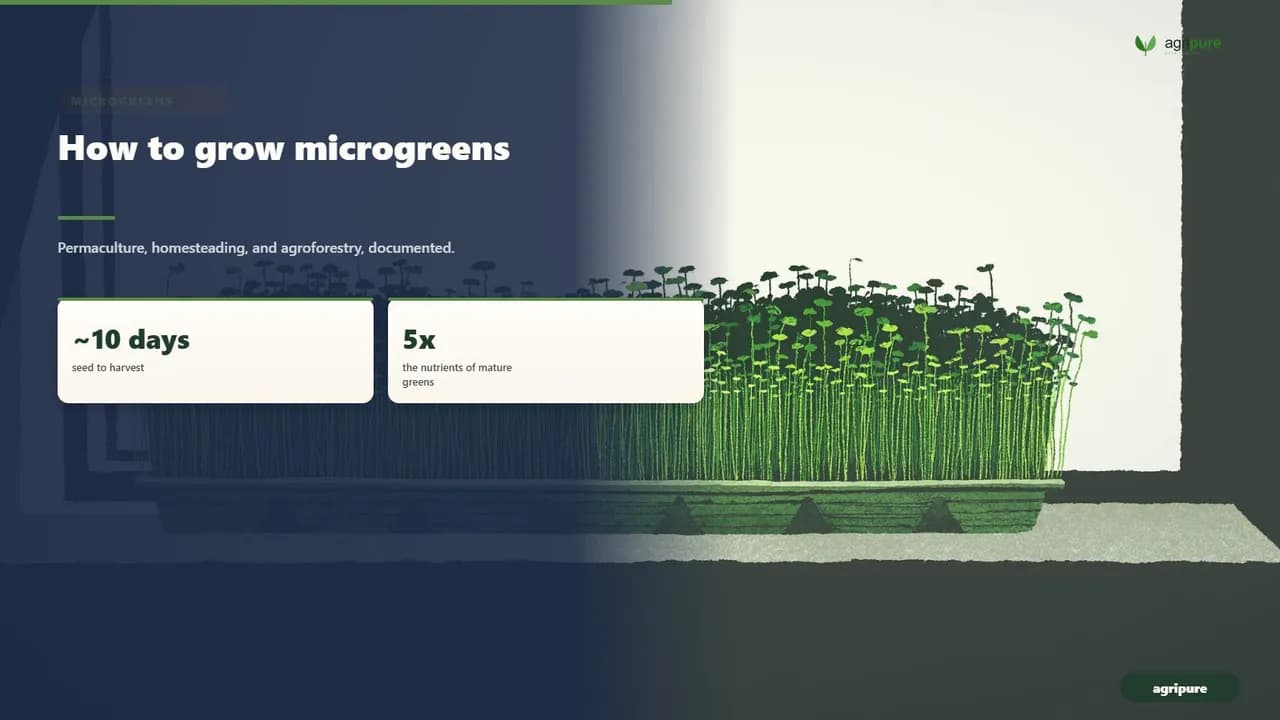
A close-up, natural light photo shows a shallow rectangular tray densely packed with bright green radish microgreens with tiny red stems, sitting on a light wooden windowsill. A small bag of planting mix and a few loose seeds are blurred in the background.
Freshly grown radish microgreens, thriving in a simple tray on a windowsill, demonstrate the ease and rapid bounty of home cultivation.
- Microgreens go from dry seed to harvest in roughly 7 to 14 days — radish, the fastest and most forgiving, is ready in about 10.
- The whole kit is a shallow 10×20 tray, a bag of sterile seed-starting mix or coconut coir, seed, and a sunny window or a cheap LED light run 12 to 16 hours a day.
- Run a 2 to 5 day blackout (covered, in the dark) to germinate, then uncover and green up under light until the first true leaves appear.
- Water from below and keep the air moving — overwatering and stagnant air, not pests, are what kill a tray (damping-off and mold).
- A 10×20 tray yields roughly 10 ounces of brassicas, about 20 ounces of pea shoots, and up to 27 ounces of sunflower.
- USDA researchers found microgreens carry about five times the vitamins and carotenoids of the mature plant — green daikon radish topped the list for vitamin E.
“You are not growing a plant to maturity. You are harvesting the seedling at the one moment it is most concentrated — then starting again.”
Microgreens are the cheapest fresh food you can grow indoors, and the fastest. A tray of radish microgreens sown on a Saturday is a peppery, knife-ready crop about 10 days later, grown on a windowsill with no garden, no warm season, and no equipment beyond a tray and a bag of seed-starting mix. They are the seedling stage of ordinary vegetables (radish, pea, beet, kale, mustard) cut at 1 to 3 inches, just after the first leaves open, when the flavor and nutrient density peak.
This guide takes you from a dry seed to a cut tray in roughly 10 days: the 4-item equipment list, the growing medium, the blackout-then-light cycle that every microgreen runs through, how to water without breeding mold, and a variety table so you know what to sow first. If you have started seeds before, the handling will feel familiar — and if you want to go deeper on germination, seed starting for beginners covers the seed side in detail. Microgreens are the most forgiving place to begin.
The setup: tray, medium, seed, light
That forgiving start comes down to a short equipment list: a shallow tray, a growing medium, seed, and light. The standard vessel is a 10×20 inch nursery tray (the '1020' tray), and you want two of them, one with drainage holes for the soil and seed, nested inside a second solid tray that holds water for bottom watering. University of California growers confirm the basic kit: a standard 10×20 seedling tray, a sterile seed-starting mix or coconut coir, and a sunny window or grow light.
For the growing medium, use a sterile seed-starting mix (peat or coir, vermiculite, and perlite) or pure coconut coir. Both hold water evenly and, crucially, are sterile — garden soil carries fungal spores that turn a warm, humid tray into a mold problem within 2 to 3 days. Spread the medium 1 to 2 inches deep and level it; an uneven surface gives you uneven germination. South Dakota State University Extension recommends a soilless potting mix for exactly this reason.
Soil or hydroponic?
Soil is not strictly required. Microgreens grow well on hydroponic mats (felt, hemp, or jute) sitting in a shallow 1/4-inch film of water, which keeps the harvest grit-free and the cleanup trivial. The tradeoff is that a soilless mat carries no buffer of nutrients or moisture, so the watering has to be more attentive, and mat-grown greens can be slightly less vigorous than soil-grown for hungry crops like sunflower. If you already run a soil-free hydroponic setup, microgreens slot straight onto a spare mat. For a first tray, though, a sterile mix is the more forgiving choice.
For light, a bright south-facing window works for the fast brassicas, but a cheap full-spectrum LED is more reliable and lets you grow year-round on a shelf. The UC growers’ target is 12 to 16 hours of light a day with the LED panel 6 to 12 inches above the trays. Microgreens are harvested before they need much light, so you do not need an expensive fixture — a basic shop light is plenty.
Two stacked 10x20 nursery trays filled with seed-starting mix on a shelf under a full-spectrum LED grow light bar, one tray densely sown with seed
The whole kit: a drainage tray nested in a solid tray, sterile mix, seed, and a shop-light LED overhead.
The blackout-then-light cycle
That light drives the second half of a two-phase cycle every microgreen runs, and understanding the cycle is most of the skill. Phase one is the blackout: the seeds germinate in the dark under a cover or a second inverted tray, which holds humidity near 100% and, by withholding light, makes the stems stretch and reach so they emerge tall and even. Phase two is the light period, when you uncover the tray and the pale stems green up and put out their seed leaves.
The blackout runs 2 to 5 days depending on the seed. Fast brassicas like radish, broccoli, kale, and mustard need only 2 to 3 days; larger soaked seeds like pea, sunflower, and beet take 3 to 5 days and benefit from a weight on top during the stack to force even rooting. South Dakota State University Extension’s version of the blackout is to bag the tray to hold humidity near 100% for germination, then gradually open and remove the cover over a couple of days as the seed comes up. Once greened up, most trays are ready to cut at around 10 days total, when they stand two to three inches tall with the first true leaves showing.
Soaking and seeding density
Small seeds (radish, kale, broccoli, mustard, beet) are sown dry and dense in a near-solid single layer across the surface, far thicker than you would ever sow in a garden. Large seeds (pea, sunflower) are pre-soaked 6 to 12 hours before sowing to speed and even out germination. The seeding rate runs from about 10 to 15 grams for fine mustard up to 150 grams for sunflower and 200 grams or more for peas per 1020 tray. Dense is the goal, but there is a ceiling, because seed packed too tight traps moisture and starves the stems of air, which is where mold begins.
Watering and the mold problem
Those mold problems begin at the watering can. More first trays are lost to water and stagnant air than to anything else, and the single most important rule is to water from below: pour into the lower solid tray and let the medium wick moisture up instead of spraying the greens from above. Bottom watering keeps the leaves dry, spreads moisture evenly, and denies fungus the wet canopy it needs. The UC method is about 1/2 cup of water into the lower tray, refilled 1 to 2 times a day. Keep the medium damp like a wrung-out sponge: never pooling, never dry.
The 2 failures to know are damping-off and mold. Damping-off is a fungal rot (usually Pythium or Fusarium) that pinches the stem at the soil line and topples seedlings in a spreading patch; Virginia Cooperative Extension flags it as the classic disease of densely sown trays, and the defense is moisture control, airflow, and not overwatering. Surface mold is a separate, more common scare, and most of the time the white fuzz a beginner panics over is not mold at all.
Mold or root hairs?
The white fuzz at the base of healthy seedlings is usually root hairs, fine featherlike cilia that grow off the roots to take up water, perfectly normal and nothing to act on. Real mold differs in 2 ways: it has an offensive, musty odor, and it grows above the medium directly on the stems and leaves instead of hugging the roots. Bootstrap Farmer’s quick test is to mist the tray with water: root hairs flatten and the fuzz visibly shrinks, while true mold does not reduce. Prevent both with the same three moves: keep air moving with a small fan, water from below, and do not sow so densely that the canopy can never dry. A hydrogen-peroxide seed soak helps with seed-borne fungus on troublesome batches.
Symptom | Root hairs (harmless) | Mold (act on it) |
|---|---|---|
Location | Only around the roots, at the base | Above the soil, on stems and leaves |
Odor | None | Musty, offensive smell |
Appearance | Fine, even halo of cilia on the root | Cobweb-like or spotty patches |
Spray test | Flattens and shrinks when misted | No change when misted |
The best varieties to start with
Those watering and airflow habits work for every variety, so the next choice is what to sow. Start with the fast, forgiving crops and add the slow specialty greens once you have a few trays behind you. Radish is the ideal first sow: no soak, a 2 to 3 day blackout, ready in about 10 days, and a bold peppery bite that earns its place in any kitchen. Pea shoots and sunflower are the crunchy, substantial crops: both soaked, both around 10 days, sweet and nutty respectively. Broccoli, kale, and mustard are quick, mild-to-spicy brassicas that behave much like radish.
The slow ones reward patience. Beet (including Bull’s Blood, prized for its deep-red stems) takes a longer 4 to 5 day stack and lands around 10 days with an earthy, mild flavor. Basil needs about three weeks and cilantro three to four, both worth it for the intensity. The boutique greens people ask about, including wasabi (hot, mustard-family), borage (cucumber-flavored), and carrot (slow, feathery, faintly sweet), are all real and growable, but they germinate slowly and unevenly, making them a second-season project instead of a first tray.
Variety | Days to harvest | Soak | Flavor | Difficulty |
|---|---|---|---|---|
Radish | ~10 | None | Bold, peppery | Easiest |
Broccoli | ~10 | None | Mild cabbage | Easy |
Kale | ~10 | None | Fresh, mild | Easy |
Mustard | ~10 | None | Spicy | Easy |
Pea shoots | ~10 | 6-12 h | Crunchy, mildly sweet | Easy |
Sunflower | ~10 | 6-12 h | Nutty, crunchy | Moderate |
Beet (Bull’s Blood) | ~10-12 | 4-8 h | Earthy, mild | Moderate |
Basil | ~22 | None | Intense basil | Slower |
Cilantro | 21-28 | 2-4 h | Intense cilantro | Slower |
Harvest, yield, and what to expect
Whichever variety you sow, the harvest moment is the same. Harvest when the seedlings stand 2 to 3 inches tall and the first true leaves are just emerging; past that point the fast crops turn fibrous and some, like sunflower, go bitter. Cut with clean scissors or a sharp knife just above the soil line, gathering a handful of stems and slicing in one pass. Microgreens do not regrow after cutting (peas are the partial exception), so each tray is a single harvest; you compost the spent medium and roots and sow the next tray.
The yield is generous for the footprint. A 10×20 tray returns roughly 10 ounces of brassicas (broccoli, kale, radish-family greens), about 20 ounces of pea shoots, and up to 27 ounces of sunflower, per grower yield logs. That is a steady supply of fresh greens off a single shelf, harvested in rotation so a new tray matures every few days. Eat them within a week of cutting, stored dry in a breathable container in the fridge.
Why bother: the nutrient case
Microgreens provide high nutrient density alongside fast harvests. A USDA Agricultural Research Service study led by plant physiologist Gene Lester analyzed 25 commercial microgreen varieties and found they carried, on average, about five times the vitamins and carotenoids of the mature plant. Among the standouts, green daikon radish topped the group for vitamin E, while red cabbage, cilantro, and garnet amaranth led for vitamin C, carotenoids, and vitamin K respectively. The reason is timing: you cut at the seedling’s peak, before the plant dilutes those compounds into stalks and structure. Microgreens can be eaten in volume instead of solely as a garnish. A windowsill of trays also pairs naturally with starting a herb garden for a full kitchen-greens setup.
A freshly cut handful of radish microgreens held over a harvested 10x20 tray, with scissors and a kitchen scale on the bench
One tray, one cut: a handful of radish microgreens at the two-to-three-inch true-leaf stage.
A first tray, step by step
That harvest is the payoff; the first sow that leads to it is a 15-minute job once you put the pieces together. The sequence below is the whole method for a fast crop like radish, the crop to start with before you branch into soaked peas or slow basil. Follow it once and the cycle becomes second nature.
- Fill and level. Add one to two inches of sterile seed-starting mix to a drainage tray, level it, and set it inside a solid bottom tray.
- Sow dense. Scatter radish seed in an even, near-solid layer across the surface (roughly 30 grams for a 1020 tray). No soak needed.
- Mist and cover. Mist the surface, then cover with an inverted tray or a humidity dome to start the blackout.
- Blackout 2-3 days. Keep it dark and humid until the seeds sprout and lift the cover; bottom-water if the medium dries.
- Uncover and light. Move to a sunny window or under an LED for 12 to 16 hours a day; switch fully to bottom watering, about half a cup as needed.
- Harvest at ~10 days. When the greens are two to three inches tall with the first true leaves, cut just above the soil with clean scissors.
Once radish is reliable, the same 6 steps grow every other variety: adjust the soak, the blackout length, and the days to harvest from the table above.
Frequently asked questions
How long do microgreens take to grow?
Most microgreens are ready to harvest in about 7 to 14 days from sowing. Fast crops like radish, broccoli, kale, and mustard finish in roughly 10 days; soaked crops like pea and sunflower are similar; beet runs a little longer, and slow specialty greens like basil and cilantro take three to four weeks.
Do you grow microgreens in soil or water?
Both work. A sterile seed-starting mix or coconut coir is the most forgiving choice and holds moisture evenly, while hydroponic mats in a shallow 1/4-inch film of water give a grit-free harvest with easier cleanup. Soilless mats need more attentive watering since they hold no nutrient or moisture buffer. For a first tray, a sterile mix is easiest.
Why are my microgreens growing mold?
Usually they are not: the white fuzz at the base is most often harmless root hairs, which have no smell and sit only around the roots. True mold smells musty and grows on the stems and leaves above the soil. Prevent both with 3 moves: water from below, keep a small fan running for airflow, and do not sow the seed too densely.
What is the easiest microgreen to grow for beginners?
Radish microgreens are the easiest starting point. They need no soaking, germinate fast under a 2 to 3 day blackout, are ready in about 10 days, and have a bold peppery flavor. Broccoli, kale, and mustard behave almost identically and are good second crops before you try soaked peas or slow basil.
Are microgreens healthier than regular vegetables?
Generally yes, by weight. A USDA Agricultural Research Service study of 25 varieties found microgreens averaged about five times more vitamins and carotenoids than the mature plant, because they are harvested at the seedling’s nutritional peak. Green daikon radish ranked highest for vitamin E among the group tested.
References
- Specialty Greens Pack a Nutritional Punch — USDA Agricultural Research Service, AgResearch Magazine
- Your Indoor Winter Garden: Fresh Microgreens for Gloomy Days — University of California ANR
- Growing Microgreens at Home — South Dakota State University Extension
- Introduction to Microgreen Production in Indoor Vertical Farms and Greenhouses (SPES-756) — Virginia Cooperative Extension
- The Ultimate Microgreen Cheat Sheet — Bootstrap Farmer
- Mold on Microgreens: How to Combat and Prevent Mold — Bootstrap Farmer
- What Do My Microgreens Yield Per Tray? — Home Microgreens