“Soil is one way plants feed themselves — not the only way. A nutrient solution and a net pot are enough.”
Hydroponics sounds like it belongs in a climate-controlled warehouse, but the three most practical beginner systems cost between $40 and $400 in materials and fit on a shelf, a countertop, or a basement workbench. The Kratky method uses no electricity at all. Deep water culture (DWC) needs only an air pump. Nutrient film technique (NFT) adds a small submersible pump and a slope. Each one feeds plant roots directly with a dissolved nutrient solution rather than relying on soil biology to release nutrients — and each one grows lettuce, herbs, and leafy greens faster than a comparable outdoor bed.
This guide covers all three systems: how they work, what you need to build them, what they cost, and where each one earns its keep. It also covers the two numbers — pH and electrical conductivity (EC) — that determine whether your plants thrive or stall. If you have never grown without soil before, start here and read seed starting for beginners to understand transplant timing before you put seedlings into a system.
All three methods fit the broader soil-free growing family that includes aquaponics, which pairs fish with plants in a closed nitrogen loop. Hydroponics skips the fish — you supply the nutrients directly — making it simpler to calibrate and faster to get running.
Key takeaways
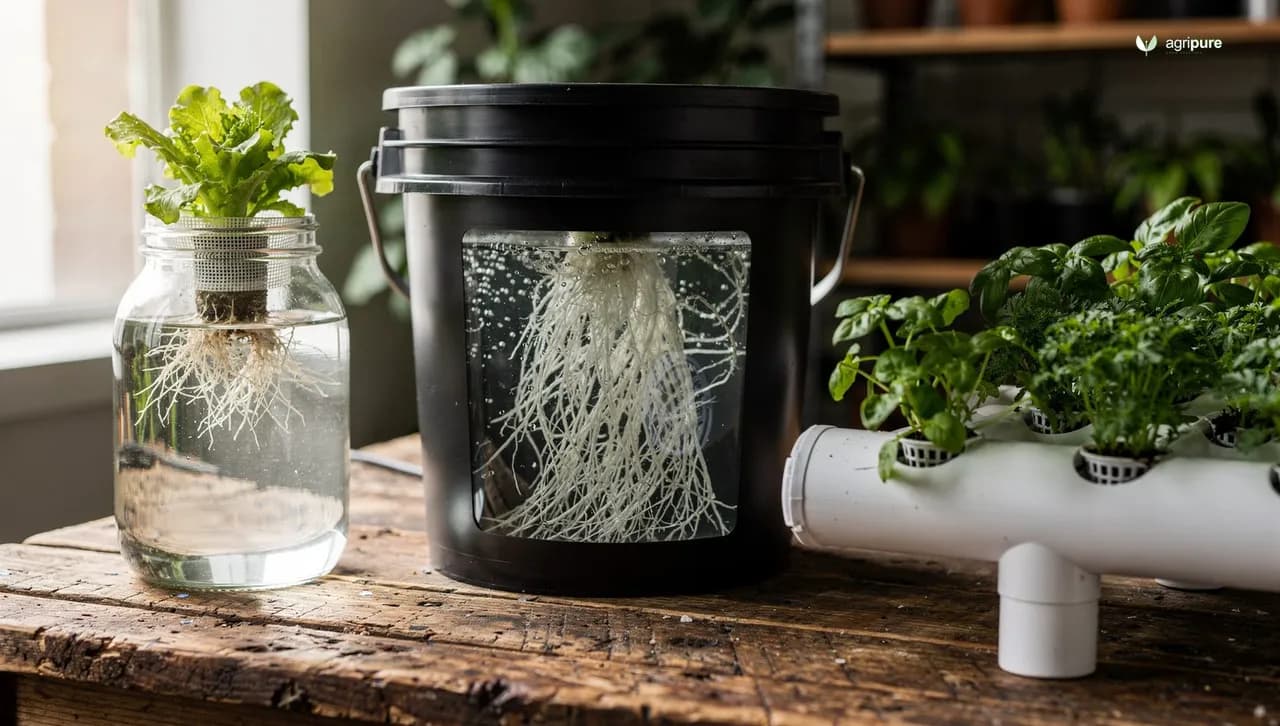
A photorealistic image showing vibrant green leafy lettuce and herbs growing in a DIY Kratky hydroponic system. The plants are in net pots submerged in a clear container, resting on a natural wood surface, emphasizing healthy growth and simple setup.
Vibrant, homegrown greens thriving in a simple, cost-effective DIY hydroponic setup. These systems offer a fast and efficient way to cultivate fresh produce without soil, right in your home.
- Kratky is fully passive — no electricity, no pump, under $65 to build — and it works well for lettuce and herbs in 28–35 days.
- DWC adds an air pump to aerate a submerged root zone, producing larger plants faster; a single-bucket system costs $80–$150 and draws roughly 5–10 watts of electricity.
- NFT recirculates a thin film of nutrient solution over bare roots in sloped channels; it uses 15–20% less water than DWC but is the most sensitive to pump failure.
- All three systems need pH held at 5.5–6.5 and EC dialed to the crop — lettuce wants 0.8–1.2 mS/cm, herbs 1.0–1.6, tomatoes 2.0–4.0.
- A quality digital pH meter and EC meter are the single most important purchases you can make — cheap test strips are not accurate enough for hydroponics.
How hydroponic systems work: the nutrient solution basics
Every hydroponic system — Kratky, DWC, NFT, or any other variant — delivers the same thing: a water-based solution that contains all the mineral nutrients a plant would otherwise extract from soil. The plant’s roots hang in, or are periodically bathed by, that solution, and the roots absorb nutrients directly. No soil biology required, no organic matter to decompose, no waiting for mineralization.
Two numbers govern whether your nutrient solution is doing its job. The first is pH. Oklahoma State University Extension is clear on this: the optimal pH range for most hydroponic crops is 5.5 to 6.5. Outside that window, nutrients become either chemically unavailable (locked out) or available at toxic concentrations. Check pH with a calibrated digital meter, not strips. To raise pH, use potassium bicarbonate. To lower it, use phosphoric or citric acid. Calibrate the meter weekly against pH 4 and pH 7 reference solutions — a meter that has drifted one unit is giving you readings a full unit off, and your plants are paying the price.
The second number is electrical conductivity (EC), measured in millisiemens per centimeter (mS/cm). EC tells you how much dissolved mineral salt is in the solution — which is a proxy for nutrient concentration. The University of Missouri Extension notes that your water source should register below 1 dS/m before you add any fertilizer, to leave room for nutrients. Crop-specific EC targets vary significantly: lettuce wants a gentle 0.8–1.2 mS/cm, herbs run 1.0–1.6, and fruiting crops like tomatoes prefer 2.0–4.0. Never guess EC — buy a digital meter alongside your pH meter.
Mix nutrient concentrates carefully. Calcium fertilizers react with phosphorus and sulfate to form insoluble precipitates if combined in concentrate form — so always dissolve each fertilizer in separate water before combining. Most beginner two-part fertilizer kits (Part A and Part B) handle this separation for you, and they are the easiest starting point.
Close-up of digital pH and EC meters dipped into a clear hydroponic nutrient solution in a white container, showing readings
A digital pH meter and EC meter are non-negotiable tools — cheap strips cannot give you reliable readings in a nutrient solution.
The Kratky method: no pump, no electricity, no fuss
The Kratky method was developed and published by Dr. Bernard A. Kratky at the University of Hawaii at Manoa — first as a conference paper in 2004 and then formally in Acta Horticulturae 843 in 2009. The concept is elegant. A net pot holds the plant and growing medium (clay pebbles or rockwool) over a reservoir of nutrient solution. The roots initially touch the solution. As the plant drinks and the water level drops, an air gap forms naturally between the solution surface and the bottom of the net pot. The submerged lower roots absorb nutrients; the exposed upper roots absorb oxygen from that air gap. No pump, no electricity, no intervention — the system maintains its own balance.
What Kratky grows best
Kratky excels at leafy greens and herbs: lettuce, spinach, kale, basil, cilantro, and mint all finish in 28–35 days in a well-maintained Kratky jar. Fruiting crops like tomatoes and cucumbers are a poor fit — their high water demand drains the reservoir faster than the air gap develops properly, and they need far more nutrient volume than a passive jar provides.
Kratky build: parts list and steps
A single-plant Kratky unit can be as simple as a one-quart mason jar. A four-plant lettuce setup uses a two-gallon opaque container with a lid drilled for net pots.
- Opaque container, 1–5 gallons (opaque to block algae-feeding light) — $5–$15
- Net pots, 2-inch or 3-inch diameter — $5–$10 for a pack of 25
- Clay pebbles / LECA growing medium — $10–$15 for a 10-liter bag
- Two-part hydroponic nutrient concentrate (e.g., MaxiGro or General Hydroponics Flora series) — $15–$20
- Digital pH meter — $15–$30
- Digital EC meter (TDS pen) — $10–$20
- pH up (potassium bicarbonate) and pH down (phosphoric acid) — $8–$12
Total startup cost: $40–$65. Ongoing cost: $1–$4 per month (nutrients only; zero electricity).
To build: drill or punch holes in the container lid sized for your net pots. Mix your nutrient solution to the appropriate EC for your crop — lettuce targets 0.8–1.2 mS/cm. Adjust pH to 5.8–6.2. Fill the container so the bottom of the net pot just grazes the surface. Place a sprouted seedling (or a rockwool cube with a germinated seed) in the net pot; backfill with clay pebbles. Set it under a window with 6+ hours of direct light, or a grow light set for 14–16 hours. Check pH every three to five days and top off with fresh nutrient solution only if the reservoir drops below half before harvest.
Deep water culture (DWC): aerated roots, faster growth
Deep water culture takes the Kratky principle and adds one active component: an air pump and air stone that continuously oxygenate the reservoir. Instead of relying on an air gap, plant roots hang freely in aerated nutrient solution. More dissolved oxygen in the root zone accelerates nutrient uptake and plant growth — DWC lettuce typically reaches harvest in 25–30 days, a few days faster than an equivalent Kratky setup, and produces larger, more substantial heads.
Interior of a five-gallon DWC bucket with white plant roots hanging in oxygenated green nutrient solution, bubbles rising from an air stone
Healthy DWC roots are white and dense — yellowing or brown slime signals root rot from warm water or insufficient aeration.
DWC build: five-gallon bucket system
The single-bucket five-gallon system is the most popular entry point. It grows one large plant (tomato, pepper, cucumber) or three to four small plants (lettuce, herbs) from a net-pot lid.
- Five-gallon opaque bucket with lid — $5–$8
- Net pot lid (3.5-inch or 6-inch hole) or drill your own — $3–$8
- Aquarium air pump, 5–15 gallon capacity — $10–$15
- Air stone and 3 feet of airline tubing — $5–$8
- Clay pebbles / LECA — $10–$15
- Hydroponic nutrients — $15–$20
- pH and EC meters (shared with Kratky if you already have them) — $25–$50
- pH adjustment solutions — $8–$12
Total startup cost: $80–$150. Monthly operating: $10–$25 (a small air pump draws 5–10 watts — under $2/month in electricity — plus nutrients).
To build: cut or drill a net-pot hole in the bucket lid. Run airline tubing from the air pump through a small hole in the lid or the side of the bucket near the top, down to the air stone resting on the bucket bottom. Fill the bucket with nutrient solution to the underside of the lid — roots will grow down into the solution. Adjust pH to 5.8–6.2 and EC to your crop’s target range. The air pump runs continuously; do not shut it off for extended periods or roots suffocate and root rot follows within hours.
Watching for root rot
Root rot is the primary DWC failure mode. Healthy roots are white and dense. Brown, slimy roots with an unpleasant odor indicate Pythium, a water mold that thrives when solution temperature exceeds 72°F or oxygen is insufficient. Keep solution temperature at 65–70°F, maintain continuous aeration, and keep the bucket opaque to prevent light from entering the reservoir — light plus nutrients feeds algae, which then feeds pathogens.
Nutrient film technique (NFT): the recirculating workhorse
NFT passes a continuous, shallow film of nutrient solution — typically 1–3 mm deep — over the bare roots of plants growing in sloped channels. Roots rest on the channel floor and are bathed continuously in moving solution; the upper portion of each root mass is exposed to air. The solution drains back to a reservoir below the channels, where a submersible pump recirculates it. NFT uses 15–20% less water than DWC over a growing cycle because the thin film reduces evaporation and the closed loop wastes nothing.
NFT is the most scalable of the three systems — you can run six 10-foot PVC channels from a single 10-gallon reservoir and grow 30 heads of lettuce simultaneously. It is also the most sensitive: if the pump fails, the thin root film dries out in minutes, and a crop can be lost in under an hour. Always have a backup pump on hand and check the system daily.
PVC pipe NFT hydroponic channels on a metal frame, angled at a slight slope, with leafy green lettuce plants growing through net-cup holes along the pipes
PVC pipes make affordable DIY NFT channels — a 1:30–1:40 slope (roughly 2–4 inches of drop per 10 feet) keeps flow even without pooling.
NFT build: PVC channel system
- 4-inch PVC pipes, 10–12 feet each (one pipe per channel) — $8–$15 each
- PVC end caps (two per pipe) with a drain hole drilled in the lower cap — $2–$4 per pair
- 2-inch net cups, one per plant site (cut 2-inch holes along the top of each pipe) — $5–$10 for 25
- Submersible pump rated 250–400 GPH — $15–$30
- Reservoir (10–20 gallon tote or bucket) — $10–$20
- Flexible tubing to run solution from pump up to the top end of each channel — $5–$10
- PVC frame or shelf to hold channels at a 1:30–1:40 slope — $20–$40 in lumber or metal conduit
- Hydroponic nutrients, pH and EC meters, pH adjustment solutions — $40–$65 (shared with other systems)
Total startup cost: $200–$400. Monthly operating: $15–$25. The pump runs continuously and draws 20–50 watts depending on size.
Slope is the most critical mechanical detail. Atlas Scientific’s NFT guide specifies a 1:30 to 1:40 channel slope — roughly 3–4 inches of drop over a 10-foot run. Too flat and nutrient solution pools at the bottom, starving roots of oxygen and causing root rot. Too steep and the solution races through before roots can absorb it. Flow rate per channel should be 1–2 liters per minute; start at the lower end and observe that the film stays consistent from inlet to outlet before increasing it.
System comparison: which build suits your situation
Feature | Kratky | DWC (5-gal bucket) | NFT (3-channel PVC) |
|---|---|---|---|
Startup cost (DIY) | $40–$65 | $80–$150 | $200–$400 |
Monthly operating cost | $1–$4 | $10–$25 | $15–$25 |
Electricity required | None | 5–10 watts | 20–50 watts |
Plant capacity (entry build) | 4–8 plants | 4–6 plants | 18–30 plants |
Days to lettuce harvest | 28–35 | 25–30 | 28–35 |
Best crops | Lettuce, herbs | Lettuce, tomatoes, peppers | Lettuce, herbs, spinach |
Failure risk | Very low (passive) | Medium (pump dependent) | High (pump critical) |
Skill level | Beginner | Beginner–intermediate | Intermediate |
Water use vs. soil | ~90% less | ~90% less | ~92% less |
The rule of thumb: if you have never grown hydroponically, build a Kratky jar first. It costs under $65, requires no electricity, and teaches you pH and nutrient management without the variable of a pump. Once you understand how nutrient solution behaves — and you will know within one grow cycle — step up to DWC for larger plants or NFT for higher volume production. The knowledge transfers directly; only the hardware changes.
Growing media: what goes in the net pot
Growing media in hydroponics serve one purpose: physical support. They anchor the plant and hold the seedling at the right height while roots grow down into the system. They do not feed the plant. The most common options for home systems are clay pebbles (LECA), rockwool, perlite, and coconut coir.
Clay pebbles (LECA) are the workhorse of all three systems described here. They are reusable — rinse and sterilize between grows with a 1:10 bleach solution, rinse thoroughly, and they are ready again. Soak new clay pebbles in pH-adjusted water for 24 hours before use to saturate them and flush off dust. Expect to pay $10–$15 for a 10-liter bag that will supply multiple Kratky or DWC builds.
Rockwool cubes are the preferred medium for germinating seeds before transplanting into any hydroponic system. A 1.5-inch cube supports one seedling from germination through the transplant stage. Pre-soak rockwool in pH 5.5 water (not plain tap water — rockwool is alkaline and needs acidifying before use). Transplant when the seedling has two true leaves and roots are visible out the bottom of the cube.
Avoid garden soil and standard potting mix in any hydroponic system. They compact, clog net pots, harbor pathogens, and interfere with pH measurement. They are designed to work with soil biology, not with a nutrient solution.
Light, temperature, and the growing environment
A hydroponic system delivers water and nutrients perfectly — and then plants stall because of inadequate light. All three systems are typically run indoors, which means either a sunny south-facing window (6+ direct hours daily) or a grow light. For leafy greens and herbs, a full-spectrum LED panel rated at 20–30 watts actual draw per square foot of growing area is sufficient. Run lights 14–16 hours per day on a timer; plants need a dark period.
Air temperature and solution temperature are separate variables. Most leafy greens prefer air temperatures of 65–75°F. Nutrient solution temperature should stay at 65–70°F — warmer water holds less dissolved oxygen and dramatically increases root-rot risk in DWC and NFT systems. If your basement or grow room runs warm in summer, a small aquarium chiller or ice bottles cycled through the reservoir keep temperatures in range.
Hydroponic growing pairs naturally with controlled-environment seed starting. You can also contrast the soil-free approach with the richly organic logic of a food forest, where perennial plants feed themselves through mycorrhizal networks. Both are valid; they occupy opposite ends of the grow-without-input spectrum.
Common mistakes and how to avoid them
Most hydroponic failures trace to one of five predictable errors. Knowing them before you start is far cheaper than diagnosing them after a crop fails.
- Skipping pH checks. A pH of 7.0 — close to neutral and easy to drift toward — locks out iron, manganese, and zinc even when they are present in the solution. Check pH every 3–5 days in Kratky, daily in DWC and NFT. pH 5.8–6.2 is the sweet spot for most crops.
- Letting light into the reservoir. Algae bloom on any reservoir exposed to light. Algae compete for nutrients, deplete oxygen, and clog pumps. Keep all reservoirs and containers opaque — paint them, wrap them, or buy black containers from the start.
- Running warm nutrient solution. Solution above 72°F in a DWC or NFT system invites Pythium root rot within days. Add a submersible thermometer to your setup and treat temperature as a daily check, not an afterthought.
- Using cheap pH strips instead of a meter. Strips read ±0.5 pH units at best and are color-dependent on solution color. A $15–$20 digital pH pen pays for itself in the first crop.
- Overcrowding plants in NFT. Channels longer than 10–12 feet starve the far-end plants of nutrients as solution pH and EC shift along the run. Keep channels short and replace or refresh the reservoir every 7–10 days.
For anyone interested in scaling soil-free production further, permaculture thinking applies even here: design the system for resilience first, output second. In practice, that means having a backup air pump for DWC, a spare submersible pump for NFT, and always monitoring pH before you monitor yield.
Frequently asked questions
What is the easiest DIY hydroponic system for a beginner?
The Kratky method is the easiest starting point. It requires no electricity, no pump, and no timer — fill a container with nutrient solution, adjust pH to 5.8–6.2, set a net pot with a seedling in the lid, and let the plant grow. A complete setup costs $40–$65 and grows lettuce or herbs in 28–35 days.
What pH should my hydroponic nutrient solution be?
The optimal range for most hydroponic crops is 5.5 to 6.5, per Oklahoma State University Extension. Aim for 5.8–6.2 for leafy greens and herbs. Outside that range, plants cannot absorb nutrients even if the nutrients are present in the solution. Use a calibrated digital meter — not strips.
How much electricity does a DWC hydroponic system use?
A single-bucket DWC air pump typically draws 5–10 watts continuously. That works out to under $2 per month in electricity at average US rates. Grow lights add more: a 30-watt LED panel running 15 hours a day adds roughly $1.50–$2.50 per month per panel.
Can I build an NFT system from PVC pipe?
Yes — 4-inch PVC pipes are the standard DIY NFT channel material. Cut 2-inch holes along the top every 8–10 inches for net cups, angle the pipe at a 1:30–1:40 slope (about 3–4 inches of drop over 10 feet), connect a submersible pump at the low end that returns solution to the high end, and run a 250–400 GPH pump to maintain 1–2 liters per minute per channel.
What is the difference between Kratky, DWC, and NFT?
Kratky is passive — no pump, no electricity, roots grow into a static reservoir that slowly depletes. DWC is active — roots are submerged in aerated nutrient solution kept oxygenated by a running air pump. NFT is active and recirculating — a thin film of solution flows over bare roots in sloped channels, drains back to a reservoir, and is pumped back to the top continuously. Kratky suits beginners. DWC suits larger or faster-growing plants. NFT suits higher plant counts and experienced growers who monitor daily.
References
- Three Non-Circulating Hydroponic Methods for Growing Lettuce (Kratky, 2009) — University of Hawaii at Manoa, CTAHR
- Hydroponic Nutrient Solutions (G6984) — University of Missouri Extension
- Electrical Conductivity and pH Guide for Hydroponics — Oklahoma State University Extension
- Home Hydroponics — University of Illinois Extension
- How to Build a Nutrient Film Technique (NFT) System in Hydroponics — Atlas Scientific
- Deep Water Culture (DWC) Systems: A Complete Guide for Hobbyists — Ponics Life
- Hydroponic System Cost Breakdown: Complete Budget Guide — Soil Free Harvest
- NFT vs DWC Hydroponics: Profitability Guide for Growers — GrowDirector