Key takeaways

Lavender and sunflowers both do well in full sun when given the right care, including consistent watering and mulching.
- Full sun means 6 or more hours of direct light a day — measure your bed before you buy, not after.
- The best full-sun picks span every layer: perennials like lavender, annuals like sunflowers, shrubs like rosemary, and edibles like tomatoes.
- Pair heat-lovers with drought-tolerant species in the same bed so one watering schedule fits the whole group.
- Most full-sun beds want about 1 inch of water a week, delivered deep and early, plus a 2 to 4 inch mulch layer to hold it.
- Young transplants scorch in direct sun unless you harden them off over roughly 2 weeks first.
A south-facing bed that bakes from 10 a.m. to dusk is the easiest spot in the yard to plant well, because the plants that love it are tough, productive, and forgiving. The trick is matching the right species to that light and then watering them like the sun-lovers they are.
This guide sorts proven full-sun plants by type (perennials, annuals, shrubs, and edibles) and by USDA zone, then covers the watering, mulch, and hardening-off habits that keep them from scorching. Get the light right first: a plant rated for full sun in a 3-hour corner will stretch, flop, and bloom at a fraction of its potential.
What “full sun” actually means before you plant
That label is more precise than it sounds. Penn State Extension defines full sun as six or more hours of direct sunlight per day, with partial sun running 4 to 6 hours and partial shade only 2 to 4. Those hours do not have to be continuous — 4 hours in the morning plus 3 in the late afternoon still counts as full sun, even with a shaded patch at noon.
Before you spend a dollar on plants, spend a day watching the bed. Check it at 9 a.m., noon, and 4 p.m. across a clear day and tally the hours of unbroken direct light. A spot that reads 6+ hours in June may drop below 4 once a neighbor’s maple leafs out, so judge it in the season you will actually garden.
Reading your light honestly
Three quick checks save a season of disappointment, because a plant that wants 6 hours of sun rarely says so politely when it is short an hour or two.
- Count the gaps: note when buildings, fences, or trees throw shade, not just when the sun is up.
- Watch through the year: the sun sits about 47 degrees lower in midwinter than midsummer, so a bright June bed can be a shaded March one.
- Trust the stretch: leggy, leaning growth and sparse flowers are the plant telling you it is getting under 6 hours.
Afternoon sun counts double: 4 hours of harsh 2-to-6 p.m. light stresses a plant far more than 4 hours of soft morning sun, so a bed with hot afternoon exposure behaves like a stronger full-sun site than the raw hour count suggests.

Full-sun plants by type: perennials, annuals, shrubs, and edibles
Those 6 hours of direct light can support four planting layers at once, each pulling its weight. Choosing one or two reliable performers from every group gives you structure, season-long color, and a harvest from the same sunny patch of ground.
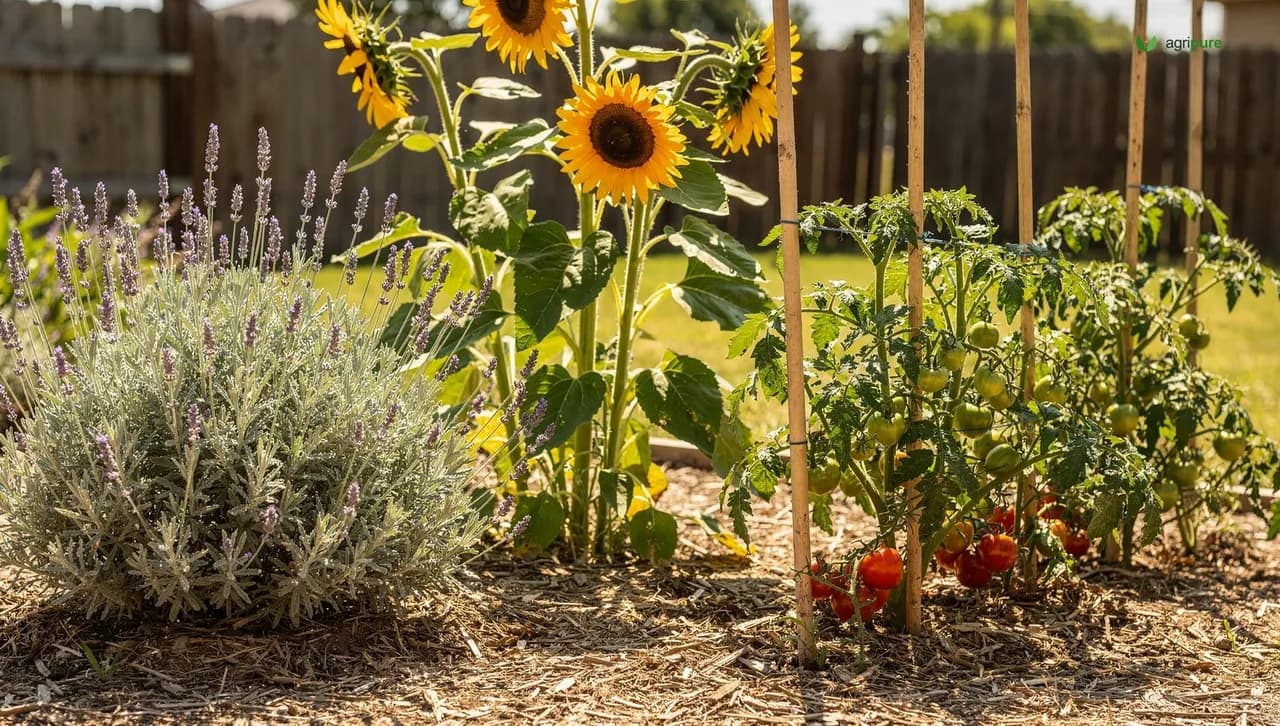
Perennials are the backbone. Lavender is the classic example: Colorado State University Extension notes it grows best in full sun and well-drained, slightly alkaline soil with little organic matter, and hardy English types survive to USDA zones 5 through 7. Coneflower, black-eyed Susan, yarrow, and sedum follow the same rule — sun-baked, lean soil, minimal fuss.
Annuals deliver the fastest color. The common sunflower is the headline act: the Missouri Botanical Garden lists it as full sun, dry-to-medium water, and easily grown in average well-drained soil, topping out anywhere from 3 to 10 feet. Zinnias, marigolds, cosmos, and lantana fill the same role in beds and containers.
Shrubs and edibles that earn their light
Woody shrubs add permanence: rosemary doubles as an evergreen, drought-tough shrub and a kitchen herb, alongside butterfly bush, potentilla, and spirea. For edibles, the heat-lovers dominate — tomatoes need a minimum of 6 hours of direct sun (8 to 10 is better in the north), and peppers, eggplant, okra, squash, and basil all share that appetite for light and warmth.
Matching full-sun plants to your USDA zone
That same warmth behaves very differently in zone 4 Minnesota than in zone 9 Arizona, because summer heat and winter cold reset which species survive in a full-sun bed. Use your USDA hardiness zone to pick the perennials and shrubs that overwinter, then treat annuals and edibles as a one-season choice you replant each spring.
Type | Cool zones (3-5) | Temperate zones (6-7) | Hot zones (8-10) |
|---|---|---|---|
Perennials | Coneflower, yarrow, sedum | Lavender, salvia, daylily | Lantana, agave, gaillardia |
Annuals | Sunflower, calendula, cosmos | Zinnia, marigold, sunflower | Portulaca, vinca, zinnia |
Shrubs | Potentilla, spirea, ninebark | Butterfly bush, rosemary* | Rosemary, oleander, bougainvillea |
Edibles | Tomato, bush bean, kale | Tomato, pepper, squash | Okra, eggplant, sweet potato |
The asterisk on rosemary matters: it is reliably hardy only to about zone 7, so gardeners in zones 5 and 6 grow it in a pot and overwinter it indoors. Across all 4 types, the perennials and shrubs are the rows where your zone decides survival, while annuals and edibles reset every year regardless of cold.
Plant a few of these with care: University of Maryland Extension flags butterfly bush as an invasive species across much of the U.S., and several states now regulate it — choose a seedless cultivar or a native alternative. University of Florida IFAS Extension notes that lantana is invasive across the Southeast and that its unripe berries are toxic if eaten, so plant sterile types and keep them away from children and livestock. And the ASPCA lists every part of oleander as poisonous to people, dogs, cats, and horses — skip it in any yard with pets or kids.
Watering and mulch: keeping full-sun beds from frying
That hot exposure dries soil fast, so in a full-sun bed the watering rule is depth over frequency. The University of Minnesota Extension says a vegetable garden needs about 1 inch of water a week, and that watering early in the day is the better practice because leaves dry before nightfall and less water is lost to midday evaporation. One deep soak that wets the top foot of soil beats five shallow sprinkles that train roots to stay near a baking surface.
Mulch is what holds that inch in place. UMN Extension recommends a 2 to 4 inch layer, which reduces evaporation, blocks the sunlight weed seeds need to germinate, and moderates soil temperature so roots are not cooking. Laying down a thick layer of organic mulch can cut a hot bed’s watering frequency noticeably across a dry July.
Pairing heat and drought tolerance
Group plants by thirst, not just by looks. The University of Georgia Extension notes that sorting plants into water-use zones lets a water-wise design use 50 to 60% less water than a conventional one. In practice that means keeping the thirsty and the drought-tough in separate beds:
- Low-water group: lavender, sedum, yarrow, and rosemary, watered mainly through their first 1 to 2 seasons of establishment.
- Moderate group: coneflower, salvia, and sunflowers, watered only when they show stress, maybe twice a month.
- High-water group: tomatoes, peppers, and squash, on a steady 1 inch a week all summer.
Building beds at a comfortable height keeps this manageable; raised beds drain freely, which is exactly what lean-soil perennials like lavender want.
Avoiding scorch on young plants
That same full sun will fry a plant set out before it is ready, which is the fastest way to kill an otherwise sun-loving species. Seedlings raised indoors or in a greenhouse have thin, tender leaves with no defense against direct light, and moving them straight into 6 hours of sun causes wilting, brown leaf margins, slowed growth, and sometimes death — exactly what Penn State Extension warns about with un-hardened transplants.
The fix is hardening off: expose plants to the outdoors gradually, increasing their sunlight over about 2 weeks before they go in the ground. Start with 2 to 3 hours in dappled shade and add roughly an hour of direct sun each day, letting roots settle into the bed before the first scorching afternoon hits.
Transplant on a cloudy day: setting plants out on an overcast morning, or shading them for 2 to 3 days with row cover, lets roots settle before the first scorching afternoon hits. Keep the soil consistently moist through that first week.

Conclusion
A full-sun bed is the most productive ground you have, as long as you match it honestly. Confirm 6+ hours of direct light, choose perennials and shrubs hardy to your zone with annuals and edibles layered on top, group plants by water need, mulch 2 to 4 inches deep, and harden young plants off over 2 weeks. Do that, and a bed that bakes all afternoon becomes the easiest part of the garden to keep alive.
Frequently asked questions
How many hours of sun is “full sun”?
Full sun means 6 or more hours of direct sunlight per day, and the hours do not need to be continuous. Penn State Extension counts 4 to 6 hours as partial sun and 2 to 4 hours as partial shade, so a bed under 6 hours will underperform true sun-lovers.
What are the best low-maintenance plants for full sun?
Drought-tolerant perennials carry a hot bed with the least work: lavender, coneflower, yarrow, sedum, and rosemary all want lean, well-drained soil and little water once established. Most need only a deep soak through their first season and a single yearly trim.
Do full-sun plants need more water than shade plants?
Usually yes, because direct sun dries soil faster. A vegetable bed needs about 1 inch of water a week, watered deeply and early in the day; many established drought-tolerant perennials need far less once their roots reach down.
Why do my new plants scorch in full sun?
Tender, greenhouse-grown transplants have no defense against direct light, so they wilt and develop brown leaf margins. Harden them off by increasing sun exposure gradually over about 2 weeks before planting, and transplant on a cloudy day.
Can vegetables grow in full sun all day?
Most fruiting vegetables thrive in it: tomatoes, peppers, squash, and okra all want a minimum of 6 hours and do better with 8 or more. In very hot zones 8 to 10, light afternoon shade or row cover can prevent sunscald on fruit.
References
- Penn State Extension — Planting in Sun or Shade
- Colorado State University Extension — Growing Lavender in Colorado
- Penn State Extension — Tomatoes: From Seedlings to Fruit
- Missouri Botanical Garden — Helianthus annuus Plant Finder
- University of Minnesota Extension — Watering the Vegetable Garden
- University of Minnesota Extension — Mulching for Soil and Garden Health
- Penn State Extension — Hardening Transplants
- University of Georgia Extension — Xeriscaping: Creating Water Efficient Landscapes
- University of Maryland Extension — Butterfly Bush (invasive status)
- University of Florida IFAS — Lantana (invasiveness and toxicity)
- ASPCA — Oleander (toxic plant)