Key takeaways
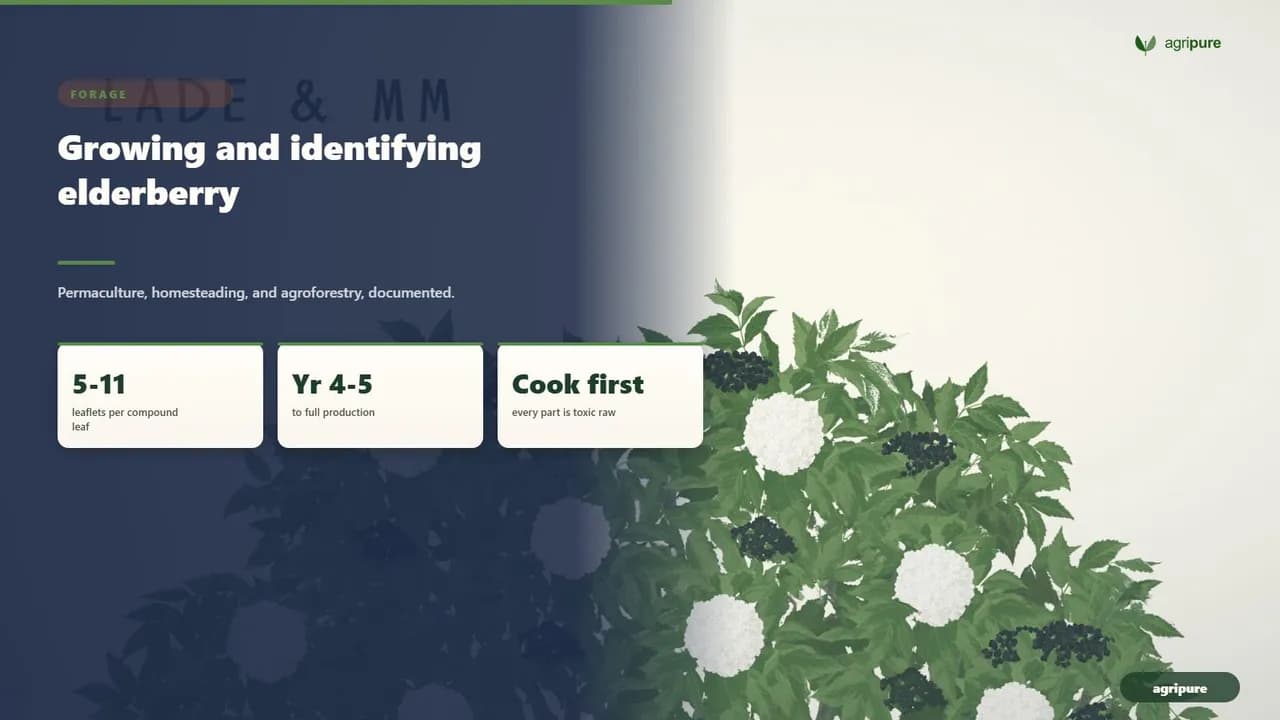
A mature elderberry branch with clusters of dark, ripe berries and green pinnately compound leaves on a woody stem.
Identify elderberry by its pinnately compound leaves, woody stem, and clusters of dark, ripe berries. Careful identification distinguishes it from toxic look-alikes.
- Elderberry is a woody, multi-stemmed shrub to 12 ft with opposite, pinnately compound leaves (5 to 11 leaflets), white flowers in flat-topped clusters called cymes, and soft white pith inside the stems; together, these four traits are diagnostic.
- Never eat any part raw. Leaves, stems, and unripe berries carry the cyanogenic glycoside sambunigrin; cooking the berries destroys the toxin. Stems test highest at 37.43 µg/g, ripe fruit lowest at 0.12 to 6.38 µg/g.
- The deadly look-alike is water hemlock, which has alternate leaves, no woody bark, no berries, and grows in wet ditches. Pokeweed is the other, with a reddish herbaceous stem and drooping berry clusters instead of flat-topped cymes.
- Blue elderberry (Sambucus nigra ssp. cerulea) grows west of the Rockies and wears a waxy blue bloom; American black (ssp. canadensis) grows east of the Rockies with darker, glossier fruit.
- Plant at least two cultivars within 60 ft (elderberry is only partially self-fruitful) at 4 to 7 ft spacing, and expect full production in the fourth to fifth year.
“A roadside cyme of dark berries is either the best free medicine on the continent or a fatal mistake. The difference is four minutes of looking: at the leaves, the stem, the bark, and where the plant is standing.”
A roadside shrub heavy with dark berries is one of the most useful wild and cultivated plants in North America, and one of the easiest to confuse with a plant that can kill you in 15 minutes. Elderberry (Sambucus) gives flowers for cordial, berries for syrup, and a fast-growing perennial that crops in its fourth year. But the same flat-topped clusters that make it worth growing also resemble water hemlock, the most violently toxic plant on the continent. Careful identification is essential.
This guide is identification first, cultivation second. You will learn the 4-part check that separates true elderberry from its dangerous look-alikes, how to tell blue elderberry from American black, and then how to plant named cultivars like Adams and Bob Gordon so they actually fruit. The University of Kentucky describes American elderberry as a large shrub or small tree native from Florida to Quebec and west to the Rocky Mountains, and across all 7 of the zones (USDA 3 to 9) it grows in, one rule holds: no part of this plant is safe to eat raw. What follows is the ID logic, then the safety rule, then the practical business of choosing 2 or more cultivars that crop well in a home garden or a food forest.
How to positively identify elderberry
Identification rests on 4 traits that have to appear together. Any one of them alone proves nothing; all 4 together rule out every dangerous look-alike. Penn State Extension lists them plainly, and they are worth memorizing as a sequence you run every single time before a berry goes in a basket.
The leaves are opposite and pinnately compound, with 5 to 11 toothed leaflets per leaf, each leaflet elliptic and up to 7 inches long. Opposite means the leaves emerge in pairs, directly across from each other on the stem rather than staggered. The flowers form flat-topped clusters called cymes, white, up to 10 inches across, made of tiny five-petalled flowers about 1/4 inch wide, blooming in June and July. The stems hold a soft white pith that hollows out easily when you split a young branch, a trait no toxic look-alike shares. And the plant is woody: a deciduous multi-stemmed shrub to 12 ft with real bark, not a soft green stalk that dies to the ground each year.
Close view of an elderberry branch showing paired opposite compound leaves with toothed leaflets beside a broad flat-topped white flower cyme
The diagnostic pair: opposite compound leaves and a flat-topped white cyme on the same woody stem.
Run the four-part check every time
The order matters because the cheapest checks come first. Look at the leaf arrangement before anything else: opposite pairs of 5 to 11 leaflets, not alternate. Then the flower or fruit cluster: flat-topped cyme, not a drooping spike or an umbrella. Then snap a stem for the white pith and woody bark. Finally, note the habitat: elderberry tolerates damp ground but does not grow as a herb in standing water. If all 4 agree, you have Sambucus. If even one disagrees, stop and identify the plant fully before you touch the fruit. This is the same disciplined habit that underpins all responsible foraging for wild food.
The safety rule: no part is safe raw
Those 4 ID traits get you to the right plant. This next rule keeps you safe once you are sure. Every part of elderberry (leaves, stems, unripe berries, and the seeds inside ripe fruit) contains a cyanogenic glycoside called sambunigrin, a compound that releases cyanide as it breaks down. Penn State Extension is blunt: elderberries must not be consumed raw, and cooking the berries destroys the toxins in the seeds.
Where the toxin sits in the plant
The concentration is not evenly spread, and the pattern is reassuring for anyone who cooks their harvest. A 2021 analysis of American elderberry found the toxin rises through the plant in a clear order (ripe berries lowest, stems highest), with stems averaging 37.43 µg/g and green, unripe berries 25.6 µg/g, while ripe fruit tissues ranged just 0.12 to 6.38 µg/g. The researchers concluded that levels in all tissues were generally low and posed no threat to consumers of fresh and processed products. That is not a license to eat handfuls raw. It is the reason cooking works: you process a low-level toxin out of fruit that already carries little of it, and strip the high-carrying stems out before you do.
The practical protocol is simple, and it comes down to 4 steps:
- Strip the berries from the green stems; the stems carry the most toxin, at 37.43 µg/g.
- Discard every leaf and twig; never eat the foliage at all.
- Cook the fruit before eating or preserving it.
- Use only ripe fruit (0.12 to 6.38 µg/g), never green berries (25.6 µg/g).
Heating during processing reduces the cyanogenic glycosides in the flesh, which is why elderberry syrup, jelly, and cordial are safe while raw berries off the bush (carrying up to 6.38 µg/g) are not.
Telling elderberry from its deadly look-alikes
The cooking rule assumes you have actually got elderberry. Two North American plants get mistaken for it, and one of them is lethal within 15 minutes. This is where the 4-part check earns its keep, because each look-alike fails it in an obvious place once you know where to look.
Water hemlock (Cicuta maculata) is the one that kills. The USDA Agricultural Research Service calls it the most violently toxic plant that grows in North America: its toxin, cicutoxin, is a violent convulsant, and death may occur as early as 15 minutes after a lethal dose. It defeats the elderberry check on three counts. Its leaves are alternate, not opposite, and 2-to-3-times divided, with a tell botanists rely on: the leaf veins end in the notches between the teeth, not at the tips. It is herbaceous, with a hollow purple-streaked stem and no woody bark, and it produces no berries at all. It grows in wet meadows, swamps, and roadside ditches. If a berry plant is standing in water with alternate leaves and no bark, walk away.
Side by side comparison of a woody elderberry shrub with flat-topped berry clusters and a herbaceous water-side plant with alternate divided leaves and no berries
Habit tells them apart at a glance: woody elderberry with bark and berries, versus a herbaceous wetland look-alike with alternate leaves.
Pokeweed (Phytolacca americana) is the more common mix-up and is also toxic in every part. The giveaways are structural: pokeweed is a herbaceous perennial that dies to the ground each year, with a smooth reddish-purple stem, alternate simple leaves rather than compound ones, and berries that hang in drooping elongated clusters on a pink stalk, unlike the flat-topped cyme of elderberry. NC State Extension notes all parts of pokeweed are poisonous to humans and pets, and that it grows 4 to 10 ft high. The berry shape alone settles it: flat-topped means elder, drooping spike means poke.
The table below is the field summary across all 5 traits. Read down the elderberry column first, then check any suspect plant against the 2 on its right.
Trait | Elderberry (Sambucus) | Water hemlock (Cicuta) | Pokeweed (Phytolacca) |
|---|---|---|---|
Stem | Woody, soft white pith | Herbaceous, hollow, purple-streaked | Herbaceous, smooth reddish-purple |
Leaves | Opposite, pinnately compound | Alternate, 2-3x divided | Alternate, simple |
Flower / fruit cluster | Flat-topped cyme | Umbrella-like umbel; no berries | Drooping spike (raceme) |
Habitat | Damp ground, hedgerows | Standing water, ditches, swamps | Disturbed ground, field edges |
Danger | Toxic raw; safe cooked | Fatal in minutes | All parts toxic |
Blue versus American black elderberry
Once a plant passes the look-alike test, the next question is which elderberry it is; for a grower, that decision is mostly about climate. Two species dominate North America, and they split almost exactly along the Rocky Mountains, with blue reaching 15 to 30 ft and black somewhat shorter.
Blue elderberry (Sambucus nigra ssp. cerulea) is the western species, growing west of the Rockies as a shrub or small tree to 15-30 ft, occasionally 50. Its signature is the fruit: dark berries coated in a white, waxy bloom, the glaucous film that makes a ripe cluster look powder-blue. The Missouri Botanical Garden notes the flowers come in large flattened cymes to 8 inches across in June, and UC ANR reports blue elderberry is better suited to hotter, drier regions, tolerating high summer heat and a long dry season. In California’s Sacramento Valley it carries a long harvest window, mid-June to late September.
Which one to plant for your region
American black elderberry (ssp. canadensis) is the eastern species, growing east of the Rockies, with darker, glossier fruit and no blue bloom. UC ANR finds it better suited to cooler, coastal, and higher-elevation regions, and it ripens more uniformly within a shorter window than blue’s mid-June to late-September spread. The flavor splits too: cerulea reads brighter and grassier, canadensis smoother and more caramel. For a grower, the rule of thumb is simple: west and dry favors blue, while east and humid favors black. Almost all of the 3 main fruiting cultivars below are selections of the American black species.
Feature | Blue elderberry (cerulea) | American black (canadensis) |
|---|---|---|
Range | West of the Rocky Mountains | East of the Rocky Mountains |
Fruit look | Dark with a waxy blue bloom | Darker, glossy, no bloom |
Climate fit | Hot, dry summers | Cooler, humid, higher elevation |
Harvest | Long window (mid-June to late Sept.) | Shorter, more uniform ripening |
Flavor | Brighter, grassier | Smoother, more caramel |
Choosing and planting cultivars
That species choice points you at the cultivars. If you want reliable fruit rather than a wild stand, plant named selections of American black elderberry, most of them developed by university breeding programs. 3 are worth a home grower’s attention, all hardy across USDA zones 3 to 9, and the University of Kentucky’s production guide gives the specifics.
Adams (No. 1 and No. 2) is the old standard: vigorous, large-fruited, among the most productive, ripening in August. Bob Gordon, a wild Missouri selection released by the University of Missouri, ripens late July to early August and carries its cymes facing downward, which makes the fruit noticeably less attractive to birds. Wyldewood, found in Oklahoma and released through the same program, ripens in August and tolerates a wide range of soils. All three suit USDA zones 3 to 9, which covers most of the continent.
Cultivar | Zones | Ripens | Standout trait |
|---|---|---|---|
Adams (No. 1 & No. 2) | 3-9 | August | Vigorous, large fruit, among the most productive |
Bob Gordon | 3-9 | Late July-early Aug. | Downward cymes resist birds; fruits on primocanes |
Wyldewood | 3-9 | August | Tolerates a wide range of soils |
The pollination detail is the one most new growers miss. Elderberry is only partially self-fruitful, so a lone bush sets a fraction of the fruit it could. Plant at least two different cultivars to cross-pollinate; Penn State advises keeping them no more than 60 ft apart, since the plant is wind-pollinated. Space the bushes 4 to 7 ft apart in the row, with 10 to 12 ft between rows on the wider Midwest commercial spacing, and remember the roots are extensive but shallow.
A young planted elderberry bush in a garden row with a cluster of ripe dark berries being cut from the shrub by hand shears
A second-year planting: pinch the first flowers, and the bush reaches full production by year four or five.
What to expect, year by year
Patience is part of the crop. In the first 1 to 2 years, Penn State recommends removing the flowers entirely so the plant pours its energy into roots and foliage instead of fruit. The plant rewards that restraint: the University of Kentucky reports elderberry comes into full production in the 4th to 5th year following planting. A bush set out this spring is a foliage plant for 2 seasons, a light cropper in year 3, and a full producer by year 4 or 5, a fast timeline for a perennial that can then crop for decades. It earns its place in a permaculture planting precisely because it gives so much for so little ongoing work once established.
Bringing it together
Elderberry rewards the grower who looks before they pick. The 4-part check (opposite compound leaves, flat-topped white cymes, soft white pith, woody bark) names the plant with confidence and rules out the 2 dangerous look-alikes every time. The safety rule is just as simple: cook the berries, discard the stems and leaves, and never eat any part raw. Get those 2 habits fixed and the rest is gardening.
From there it is a question of matching plant to place (blue elderberry for the dry West, American black for the humid East) and giving 2 cultivars room to cross-pollinate within 60 ft. Plant this spring, pinch the first flowers, and by the 4th year you will be cutting heavy cymes of dark fruit from a shrub that asks almost nothing in return.
Frequently asked questions
Is blue elderberry safe to eat?
Blue elderberry (Sambucus nigra ssp. cerulea) is safe to eat only when cooked. The ripe berries carry low levels (0.12 to 6.38 µg/g) of the cyanogenic glycoside sambunigrin, and the Missouri Botanical Garden notes they are not palatable fresh but quite tasty cooked. Strip the berries from the stems, discard leaves and twigs, and cook before eating or preserving. Never eat the raw fruit, leaves, or stems.
How do I tell elderberry from water hemlock?
Check three things. Elderberry has opposite, compound leaves; water hemlock has alternate leaves divided 2 to 3 times. Elderberry is woody with bark and a soft white pith; water hemlock is herbaceous with a hollow, purple-streaked stem. Elderberry produces flat-topped clusters of berries; water hemlock produces umbrella-shaped flower clusters and no berries. Water hemlock grows in standing water and can be fatal within 15 minutes, so when in doubt, do not pick.
What is the difference between blue and black elderberry?
Blue elderberry grows west of the Rocky Mountains, reaches 15 to 30 ft, and its dark fruit wears a powdery, waxy blue bloom; it tolerates heat and drought. American black elderberry grows east of the Rockies, has darker glossy fruit with no bloom, and prefers cooler, more humid conditions. Blue tastes brighter and grassier; black tastes smoother and more caramel. Most of the named fruiting cultivars are selections of the black species.
Do I need two elderberry plants to get fruit?
Yes, in practice. Elderberry is only partially self-fruitful, so a single bush sets far less fruit than it could. Plant at least two different cultivars within about 60 ft of each other for cross-pollination. Good pairings include Adams with Bob Gordon, or any two of Adams, Bob Gordon, and Wyldewood, since staggered bloom and harvest also spread the picking.
How long until an elderberry bush produces fruit?
An elderberry comes into full production in the fourth to fifth year after planting. For the first year or two, remove the flowers so the plant builds roots and foliage rather than fruit. Expect a light crop in year three and full yields by year four or five, after which a healthy bush can crop heavily for many years.
References
- Elderberry in the Garden and the Kitchen — Penn State Extension
- Cyanogenic Glycoside Analysis in American Elderberry (Molecules 26:1384) — Appenteng et al.
- Sambucus nigra subsp. cerulea — Missouri Botanical Garden Plant Finder
- Blue Elderberry Compared to Black — University of California ANR
- Cicuta maculata (Water Hemlock) — NC State Extension Gardener Plant Toolbox
- Water Hemlock (Cicuta) — USDA Agricultural Research Service
- Phytolacca americana (American Pokeweed) — NC State Extension Gardener Plant Toolbox
- Commercial Production of Elderberry (CCD-CP-6) — University of Kentucky Center for Crop Diversification