Key takeaways
A close-up of a hand harvesting a bunch of bright red radishes with their green leaves still attached from rich, dark soil in a garden bed.
Freshly harvested radishes, pulled gently from the earth after their rapid growth.
- Spring radishes are the fastest crop in the garden, ready in 3 to 5 weeks, about 25 to 35 days from sowing.
- Radishes are a cool-season crop that grows best at 50 to 70°F; above 80°F they bolt and the roots deform.
- Direct-sow ¼ to ½ inch deep and thin to 2 inches, because crowded plants run to leaves and never bulk up a root.
- Heat, crowding, and slow growth are what turn radishes woody, pithy, and sharply hot, not bad luck.
- Sow a fresh pinch every 7 to 10 days for a steady supply, and save large daikon types for a late-summer sowing.
A radish goes from dry seed to crisp root in about a month, which makes it the most forgiving crop a new grower can plant, and the most punishing if you ignore the calendar. Sow a row in cool spring soil and you eat in 25 days. Sow the same seed into 85°F June heat and you get a knot of leaves over a woody, blistering-hot root barely worth pulling.
The difference is almost entirely timing and spacing, not skill. Here is how to grow radishes from seed to harvest across 6 steps: when to direct-sow, how far apart to thin, why roots go pithy or all-tops or bolt, how to keep them coming with succession sowing, and where the big winter daikon types fit. For a quick botanical reference, the radish plant profile covers the species at a glance.
When and where to direct sow radishes
Radishes hate being moved, so they are direct-sown straight into the bed: no seed trays, no transplanting. Sow as soon as the soil can be worked in spring, then again for a fall crop. The window matters more than anything else: UC Integrated Pest Management notes radishes grow best in cool temperatures of 50 to 70°F, and that above 80°F bolting is common and roots are more often deformed. That makes radishes a classic spring-and-fall crop, with a deliberate gap through high summer.
Plant the seed of small spring varieties ¼ to ½ inch deep, with about an inch between seeds in the row. Clemson Cooperative Extension reports the optimum soil temperature for germination is 45 to 85°F, and that seed will not germinate at all once soil climbs above 95°F, one more reason midsummer sowings fail before they start. Loose, stone-free soil lets the root swell evenly, which is the same prep that gives straight carrots.
A simple spring and fall calendar
- Early spring: first sowing 4 to 6 weeks before your last frost, as soon as soil hits 45°F.
- Late summer to fall: resume sowing about 6 weeks before first frost, when nights cool back below 70°F.
- Skip high summer: sustained 80°F-plus heat means bolting and deformed roots, so pause and sow heat-tolerant greens instead.
Soil over season: watch soil temperature, not the date. A cold, late spring or an early heat wave can shift the safe window by 2 weeks in either direction.
A hand-free close-up of radish seeds spaced along a shallow furrow in dark, finely raked garden soil.
Thinning: the step most people skip
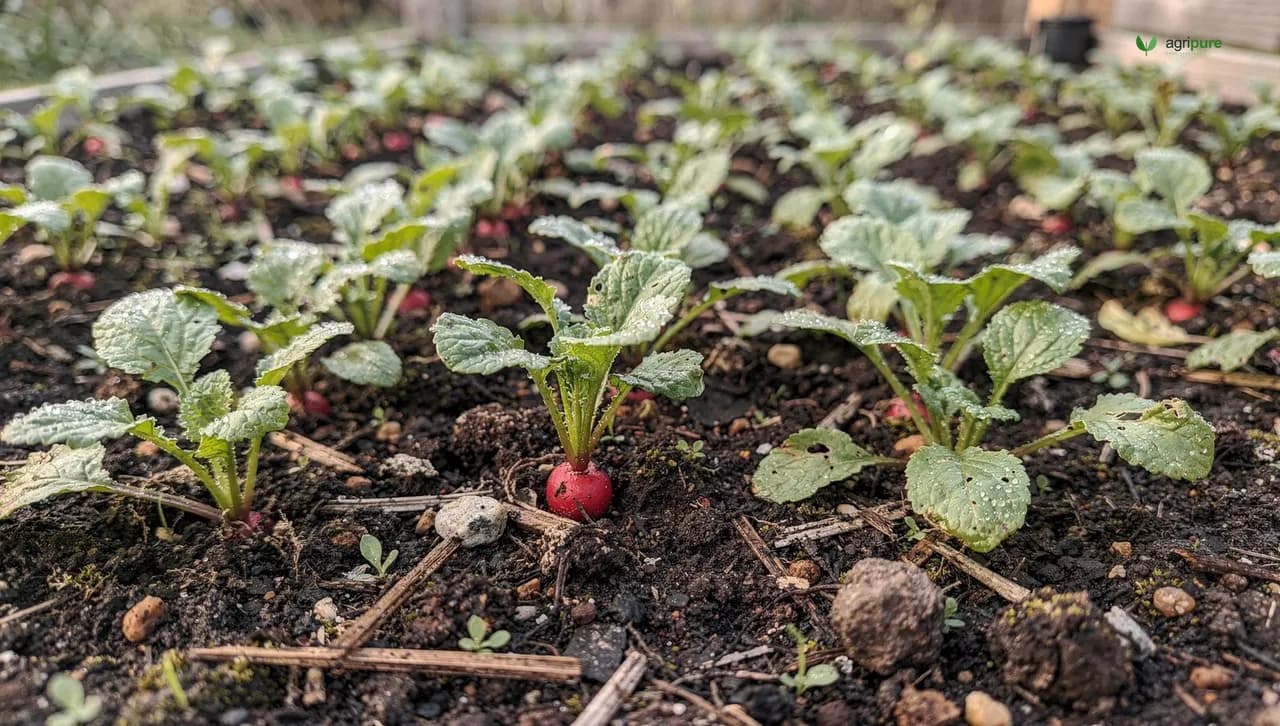
Thinning is the single step that separates a tray of crisp roots from a bed of all-tops. When seedlings crowd, they compete for light and run to leaf, and no root ever forms. University of Minnesota Extension is direct about the fix: allow about 1 inch between seeds in the row, then thin to about 2 inches between plants once seedlings are up. Larger varieties need more: UC IPM puts the range at 4 to 8 inches apart depending on variety.
Do it early, within 7 days of the seedlings showing their first true leaves, and pull the weakest so the survivors get full light. The thinnings are not waste; those tender seedlings are edible microgreens with the same peppery bite. A short-handled tool helps lift crowded clumps without disturbing the keepers; a raised bed at standing height makes the fiddly work far easier on your back.
Sow thin to begin with: radish seed is large and easy to space by hand. Drop one seed per inch and you barely have to thin at all, half the work, twice the roots.
Why radishes go woody, pithy, or all tops
Most radish failures trace to one of 3 things: heat, crowding, or slow growth. A radish wants to swell fast and get pulled young. When anything checks that pace, the root turns fibrous and the flavor turns harsh. University of Minnesota Extension describes roots that develop excessively hot flavor or become woody during the heat of summer, and Clemson notes that high summer temperatures cause radishes to crack, become pithy, and develop a strong flavor.
Pithiness (that dry, spongy, hollow texture) is the classic sign of a root left too long or grown too warm. University of Maryland Extension advises harvesting spring radishes at about 1 inch in diameter, before they crack, become pithy, or turn too hot. Each problem below has a specific, avoidable cause.
- All tops, no root: seedlings too crowded or over-fed with nitrogen, so the plant builds leaf instead of root.
- Woody and sharply hot: growth stalled by heat above 80°F or by dry soil, so fibers and mustard oils concentrate.
- Pithy and hollow: roots left in the ground past their 1-inch prime, or grown through a heat spike.
- Bolted to flower: warm days trigger a seed stalk, after which the root stops bulking and turns inedible.
How radish types compare at a glance
Not all radishes are the quick red spring kind. Fast salad types, the milder French breakfast shape, and the big storage daikons each want a different season and spacing. This table sorts the 5 main groups by speed, size, and when to sow, from 22-day rounds to 70-day daikons.
Type | Days to harvest | Thinning spacing | Best sowing window |
|---|---|---|---|
Round spring (Cherry Belle) | 22-30 days | 2 inches | Early spring, early fall |
French breakfast (oblong) | 25-30 days | 2 inches | Spring, fall |
Easter egg (mixed color) | 28-35 days | 2-3 inches | Spring, fall |
Winter daikon (long white) | 50-70 days | 4-6 inches | Late summer for fall |
Black Spanish (storage) | 55-70 days | 4-6 inches | Mid to late summer |
The pattern is clear: the small spring types mature in under a month and want 2-inch spacing, while the big winter daikons need 50 days or more, 4 to 6 inches of room, and a late-summer start so they finish in cool fall weather.
Succession sowing and the winter daikon types
Because a spring radish is done in 3 to 5 weeks, a single sowing gives you one short glut and then nothing. Succession sowing fixes that. Clemson advises planting every 7 to 10 days through the recommended window for a continuous supply, and University of Maryland Extension suggests a small batch every 5 days. A pinch of seed in a spare foot of row each week keeps crisp roots on the table from early spring until the heat shuts the run down.
The long-season radishes play a different role. Winter daikon and Black Spanish types are sown in late summer to mature over 50 to 70 days in cool fall weather, then stored in the ground or a cool cellar. Their deep roots do double duty: SARE reports that forage and daikon radish taproots can penetrate up to six feet to break up compaction, a process called biodrilling. That makes a late daikon sowing both a crop and a soil treatment, much like a quick-bolting herb such as cilantro earns its place by reseeding.
A weekly succession rhythm
- Week 1: sow a 2-foot row of round spring radishes, thinning to 2 inches once up.
- Weeks 2-6: sow another short row every 7 to 10 days while soil stays under 70°F.
- Late summer: switch to daikon and storage types, giving them 4 to 6 inches and 50-plus days to finish.
Interplant the slow crops: radishes mature so fast you can sow them between rows of slower vegetables and pull the whole crop before the neighbors need the space.
Watering, harvest, and keeping the flavor mild
Even, steady moisture is what keeps a radish mild and crisp over its 3 to 5 week run. A root that dries out and then gets soaked splits, and one grown in dry soil turns sharply hot. Aim for consistent moisture so the plant never checks its growth, the same principle that keeps lettuce from turning bitter. Go easy on nitrogen: too much feeds leaf at the expense of root, the all-tops failure again.
Harvest on time and harvest young. Pull spring radishes at about 1 inch across, within a few days of reaching size, because every extra day in warm soil pushes them toward pithy and hot. A radish that has formed a flower stalk has bolted and the root is finished, so pull and compost it. Healthy soil with steady moisture underwrites all of this, and it pays off across every crop in the garden, not just radishes.
A small cluster of freshly pulled red round radishes with green leafy tops resting on dark soil beside a garden bed.
Conclusion
Radishes reward two simple habits more than any other crop: sow into cool soil and thin without flinching. Get those right and you pull crisp, mild roots in 25 to 35 days, then keep them coming by sowing a fresh pinch every 7 to 10 days. Save the long daikons for a late-summer start, water steadily, and harvest at 1 inch, and the woody, pithy, all-tops failures simply stop happening.
Frequently asked questions
How long do radishes take to grow?
Spring radishes are one of the fastest garden crops, ready to harvest about 3 to 5 weeks after sowing, or roughly 25 to 35 days. Larger winter daikon types take longer, around 50 to 70 days, and are sown in late summer for a fall harvest.
Why do my radishes grow all leaves and no root?
All tops and no bulb almost always means the seedlings were too crowded or the soil had too much nitrogen. Thin radishes to about 2 inches apart early, go easy on high-nitrogen feed, and the plants will put energy into the root instead of leaves.
Why are my radishes woody, pithy, or too hot?
Heat and slow growth are the cause. Above 80°F or in dry soil, roots concentrate fibers and mustard oils, turning woody and sharply hot, and roots left past their 1-inch prime go pithy. Sow in cool 50 to 70°F weather and harvest young.
How do I keep a steady supply of radishes?
Use succession sowing. Plant a short row every 7 to 10 days through spring and again in fall, rather than one big sowing. Because each crop matures in under a month, a small weekly pinch of seed keeps crisp roots coming continuously.
When should I plant daikon radishes?
Sow daikon and other winter radishes in late summer so they mature in cool fall weather over about 50 to 70 days. Their deep taproots, which can reach down several feet, also break up compacted soil while the crop grows.
References
- University of Minnesota Extension — Growing radishes in home gardens
- UC Statewide IPM Program — Cultural Tips for Growing Radish
- Clemson Cooperative Extension — Carrot, Beet, Radish & Parsnip
- University of Maryland Extension — Growing Radishes in a Home Garden
- SARE — Brassicas and Mustards (Managing Cover Crops Profitably)