pioneer
Grey Mangrove
timar
Avicennia marina
Also known as Timar (Pakistan).
- sindh coast
International hardiness
- USDA 10-12
- RHS H1c
- AU: Tropical, Subtropical, Warm temperate
Where it grows — regional guide
| Zones / rating | Regional notes |
|---|---|
USDA 10-12 | No region-specific data yet |
| Zones / rating | Regional notes |
|---|---|
H1c (5 to 10C) | No region-specific data yet |
| Zones / rating | Regional notes |
|---|---|
Tropical, Subtropical, Warm temperate | Native to coastal estuaries and intertidal mudflats across tropical and subtropical zones; it stabilises shorelines and provides fish nurseries. |
| Zones / rating | Regional notes |
|---|---|
USDA 10-12 (USDA scale) Canada uses its own zone system; Canadian zones run roughly one lower than USDA. | No region-specific data yet |
| Zones / rating | Regional notes |
|---|---|
Sindh coast | Pakistan:The dominant native mangrove of the Indus delta, planted on intertidal saline mud for shoreline defense and camel browse. |
Grows alongside
Species that appear with Grey Mangrove in 1 of our published guides — a starting list for a guild, not a planting plan.
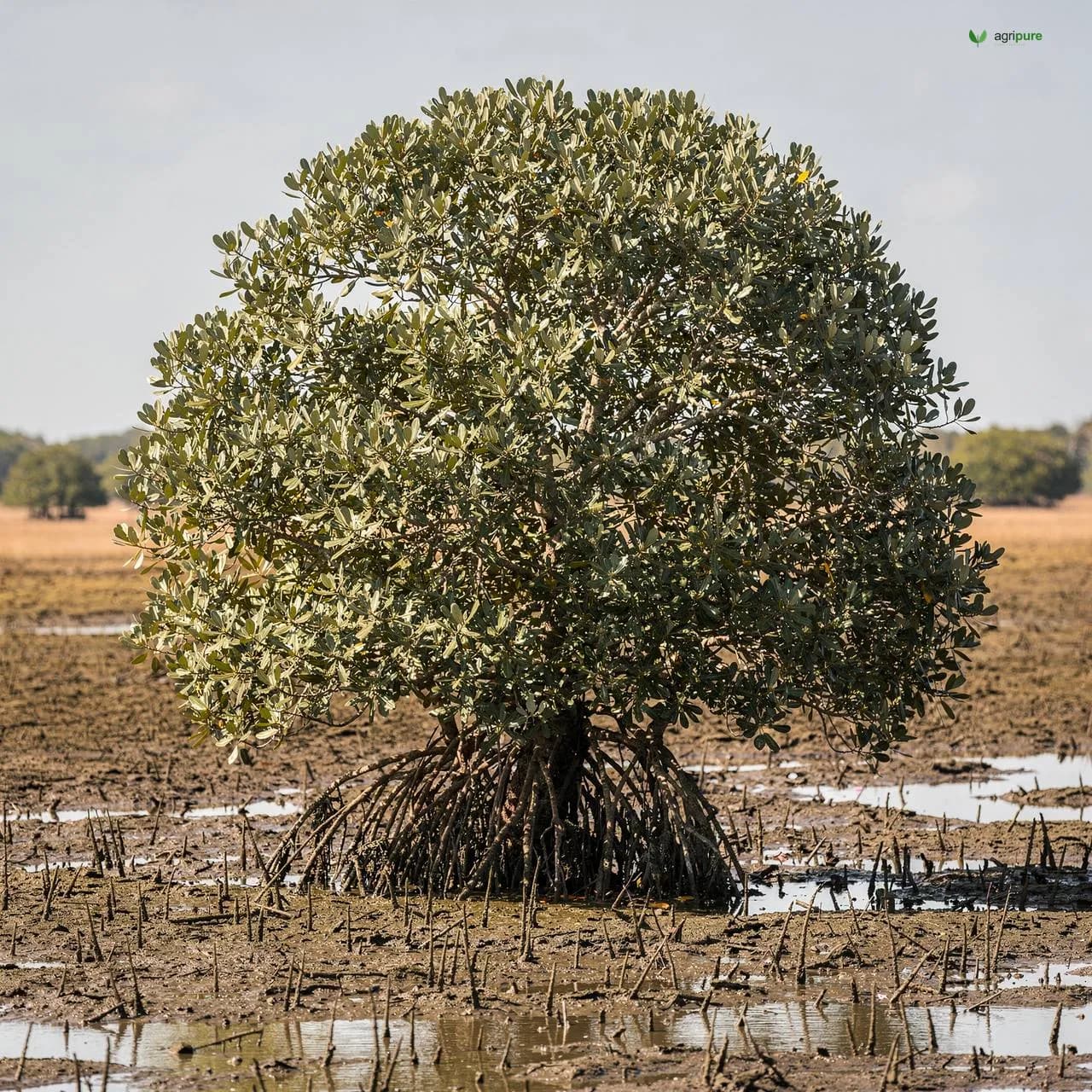
Grey mangrove (Avicennia marina, timar) is the dominant mangrove of the Indus delta, making up roughly 90% of Pakistan’s mangrove forest. It is the pioneer that colonises bare tidal mud, sending up forests of pencil-like breathing roots, the pneumatophores, that ring each tree. Those root stands shelter shrimp and fish nurseries and feed camels along the coast. On a coastal planting it is the first species in: the salt-hardy pioneer that gets a stand going on open saline flats where nothing else can start.
Where it thrives
Grey mangrove is highly salt-tolerant and suited to the delta’s saline soils, which is why the Indus delta is characterised by near-monospecific stands of this one species. It accounts for about 90% of the mangroves in Pakistan, dominating the tidal forest where high salinity rules out competitors. Its pneumatophores, vertical aerial roots that rise above the waterlogged mud to take in oxygen, are the adaptation that lets it hold this ground. Like all mangroves it belongs only to the saline tidal zone of the coast, not to any inland site.
Role in the system
Timar is the textbook pioneer. It is the species that colonises bare, saline tidal mud first, establishing where the salt and waterlogging defeat everything else and opening the way for denser-rooting mangroves such as red mangrove to follow. Standing, it breaks wave and wind energy along the shore, accretes sediment, and holds the coast. The tangle of pneumatophores does double duty as habitat: fish, crustaceans, and invertebrates breed among them and fish fry shelter in the root stands, which is what links these forests to the coastal shrimp and fish catch. On a restoration site it is the species you start with and build on.
Uses
Along the Indus delta the foliage of grey mangrove is a recognised camel fodder, and grazing herds depend on it where little else grows. The wood is used for fuel, and the standing forest works as a living windbreak and coastal shelter belt, protecting the shore and the communities behind it. The larger return, though, is the nursery function: by sheltering shrimp and fish young, these mangroves underpin a coastal fishery worth far more than the fuel or fodder cut from them.
Cautions
The Indus-delta mangroves have been heavily degraded, and grey mangrove stands are under pressure from reduced freshwater flow, cutting, and overgrazing. The honest framing is restoration: replant on tidal saline mud where the species belongs, control grazing on young stands so camels do not browse them out, and treat fuel and fodder cutting as something to keep within what the forest can carry. Planted and protected, it is the foundation the whole delta forest is built on.
Sources
- Wikipedia contributors. “Indus River Delta – Arabian Sea mangroves.”
- Wikipedia contributors. “Avicennia marina — pneumatophores and ecology.”
- Environment Protection Pakistan. “Mangroves of Pakistan — Types, Importance, and Degradation.”
Sourcing notes
Grey mangrove is the mainstay of Indus-delta replanting and is raised from propagules collected in local stands. Plant only on tidal saline mud, and keep grazing camels off young stands until they are established, since overbrowsing is a main cause of loss.