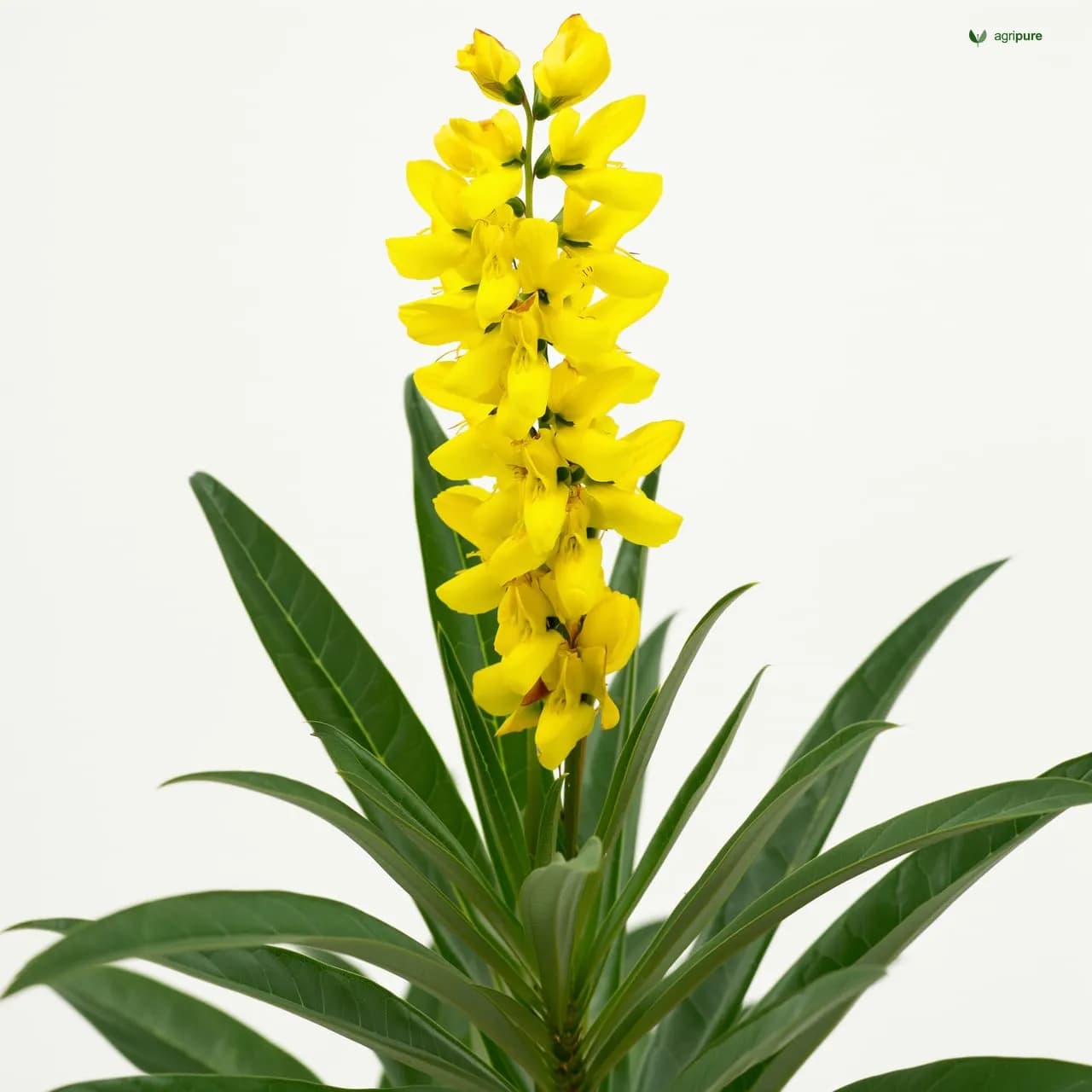
pioneer
Showy Crotalaria
jhumka
Crotalaria spectabilis
Also known as Jhumka (Pakistan).
- punjab plains
- sindh coast
International hardiness
- USDA 9-11
- RHS H1c
- AU: Tropical, Subtropical
Where it grows — regional guide
| Zones / rating | Regional notes |
|---|---|
USDA 9-11 | Grown as a summer nematode-suppressing cover in USDA zones 9 to 11; disk under before seed set to prevent toxic livestock contamination. |
| Zones / rating | Regional notes |
|---|---|
H1c (5 to 10C) | No region-specific data yet |
| Zones / rating | Regional notes |
|---|---|
Tropical, Subtropical | Grown in tropical areas as a green manure; incorporate before flowering and keep well clear of pastures due to fatal livestock toxins. |
| Zones / rating | Regional notes |
|---|---|
USDA 9-11 (USDA scale) Canada uses its own zone system; Canadian zones run roughly one lower than USDA. | No region-specific data yet |
| Zones / rating | Regional notes |
|---|---|
Punjab plains, Sindh coast | Pakistan:Planted as a kharif green manure to break nematode cycles; chop at early bloom, keeping all parts away from horses and livestock. India:Used as a rotation cover to reduce root-knot nematodes; incorporate before seed set, and keep livestock away from poisonous foliage. |
Showy crotalaria (Crotalaria spectabilis), known in parts of Pakistan as jhumka for its lantern-shaped pods, is a fast, upright legume bush that is grown as a green-manure and nematode-trap crop, not as fodder. POWO records the species as native to the Indian subcontinent and east to Taiwan, in the seasonally dry tropical biome.1 For a Pakistani grower laying out a new system on the Punjab plains or the Sindh coast, it earns its place as a pioneer cover that fixes nitrogen and breaks root-knot nematode cycles between vegetable seasons.2
Where it thrives
The plant runs across the warm lowland zones of South and Southeast Asia and naturalises easily in disturbed ground. POWO lists it as an annual to short-lived perennial subshrub of seasonally dry tropics.1 It wants long, hot days and free-draining soils, copes with sandy and lateritic ground, and runs hard on poor land where most pulses sulk. Frost ends it. In Pakistan the obvious slots are kharif fallows on the Punjab plains and Sindh, where it can fill the gap between a winter wheat crop and the next vegetable cycle.
Role in the system
Crotalaria spectabilis sits in the shrub stratum as a pioneer: an erect, single-season bush a metre to a metre and a half tall, used to prepare ground for the productive species that follow. Its real job in a guild is twofold. It fixes atmospheric nitrogen through rhizobial nodules and adds biomass that feeds the next crop; and it acts as a non-host trap for root-knot nematodes (Meloidogyne spp.), the soil pest that wrecks tomato, brinjal and okra rotations.2 Treat it as a rotation tool slotted between vegetable beds, not as a permanent neighbour to grazing animals. The leaves and seed are toxic to horses and most livestock through pyrrolizidine alkaloids,3 so keep it well clear of fodder lines.
Growing it
Direct-seed at the start of the monsoon into a rough seedbed; seed is large enough to drill or broadcast at roughly 20 to 30 kg per hectare for a dense, weed-smothering stand. Inoculate with cowpea-group rhizobia on fresh ground. No supplementary nitrogen is needed. Allow the stand sixty to ninety days to bulk up to flowering, then chop and incorporate at early bloom while the tissue is still green and breaks down fast.2 Do not let it go to seed in a field you plan to rotate to grain legumes, because the hard seed persists in soil and the pod-and-seed contamination is exactly what makes the plant a livestock hazard.3
What you get
The product is soil, not feed. A well-grown crop returns substantial green biomass, contributes to nitrogen fixation, and slashes Meloidogyne populations in the bed for the following season’s tomato or cucurbit.2 Cleaned, hand-stripped seed can be saved for the next rotation.
Sourcing notes
Source seed from a vegetable-research outfit or a known cover-crop supplier rather than a fodder seller, and label the bag so no one mistakes it for sunn hemp. Pair it with okra, brinjal or tomato in rotation, never as a companion in a grazed paddock. Mow before seed-set if grazing animals share a fence.
Sources
- Royal Botanic Gardens, Kew (2024). “Crotalaria spectabilis Roth.” Plants of the World Online.
- Gill, H.K., Grabau, Z.J. and McSorley, R. (2023). “Cover Crops for Managing Root-Knot Nematodes (ENY063/IN892).” University of Florida IFAS Extension.
- Bandarra, P.M. et al. (2022). “Hematological and Serum Biochemical Changes and Their Prognostic Value in Horses Spontaneously Poisoned by Crotalaria spectabilis.” Frontiers in Veterinary Science.