secondary
Carrot
gajar
Daucus carota
Also known as Gajar (Pakistan).
- punjab plains
- pothohar
- kpk hills
International hardiness
- USDA 3-11
- RHS H6
- AU: Cool temperate, Warm temperate, Mediterranean, Subtropical
Where it grows — regional guide
| Zones / rating | Regional notes |
|---|---|
USDA 3-11 | Grown widely as a cool-season taproot; wild forms are regulated as weeds and risk fatal confusion with poison hemlock. |
| Zones / rating | Regional notes |
|---|---|
H6 (-20 to -15C) | Hardy under RHS H6 across allotments; wild plants can cross with crops and carry a dangerous lookalike risk with poison hemlock. |
| Zones / rating | Regional notes |
|---|---|
Cool temperate, Warm temperate, Mediterranean, Subtropical | Grown during the cooler months as a direct-sown root crop; wild forms can cross with crops and foragers must distinguish them from toxic poison hemlock. |
| Zones / rating | Regional notes |
|---|---|
USDA 3-11 (USDA scale) Canada uses its own zone system; Canadian zones run roughly one lower than USDA. | Hardy cool-season taproot sown in spring; wild forms can cross with crops and carry severe confusion risks with poison hemlock. |
| Zones / rating | Regional notes |
|---|---|
Punjab plains, Pothohar, KPK hills | Pakistan:Grown across the plains as a winter rabi root crop; wild relatives can cross with seed crops and resemble toxic hemlock. India:Cultivated in cool winter months across plains and hill terraces; wild umbel forms can cross with crops and present a severe toxic hemlock hazard. |
Grows alongside
Species that appear with Carrot in 53 of our published guides — a starting list for a guild, not a planting plan.
Carrot (Daucus carota) is a biennial herb in the carrot family (Apiaceae), and the wild form known as wild carrot or Queen Anne’s lace is the direct ancestor of the cultivated root vegetable. Wild and garden carrots are the same species, differing only at the subspecies and cultivar level. The species is native to the temperate Old World, especially Europe and Asia, and is thought to have originated as a cultivated root around Afghanistan before spreading westward. For a homesteader, this dual identity is the practical hook: a familiar kitchen root in the bed and a forageable, pollinator-friendly wild relative along field edges — provided you can tell it from its dangerous look-alike.
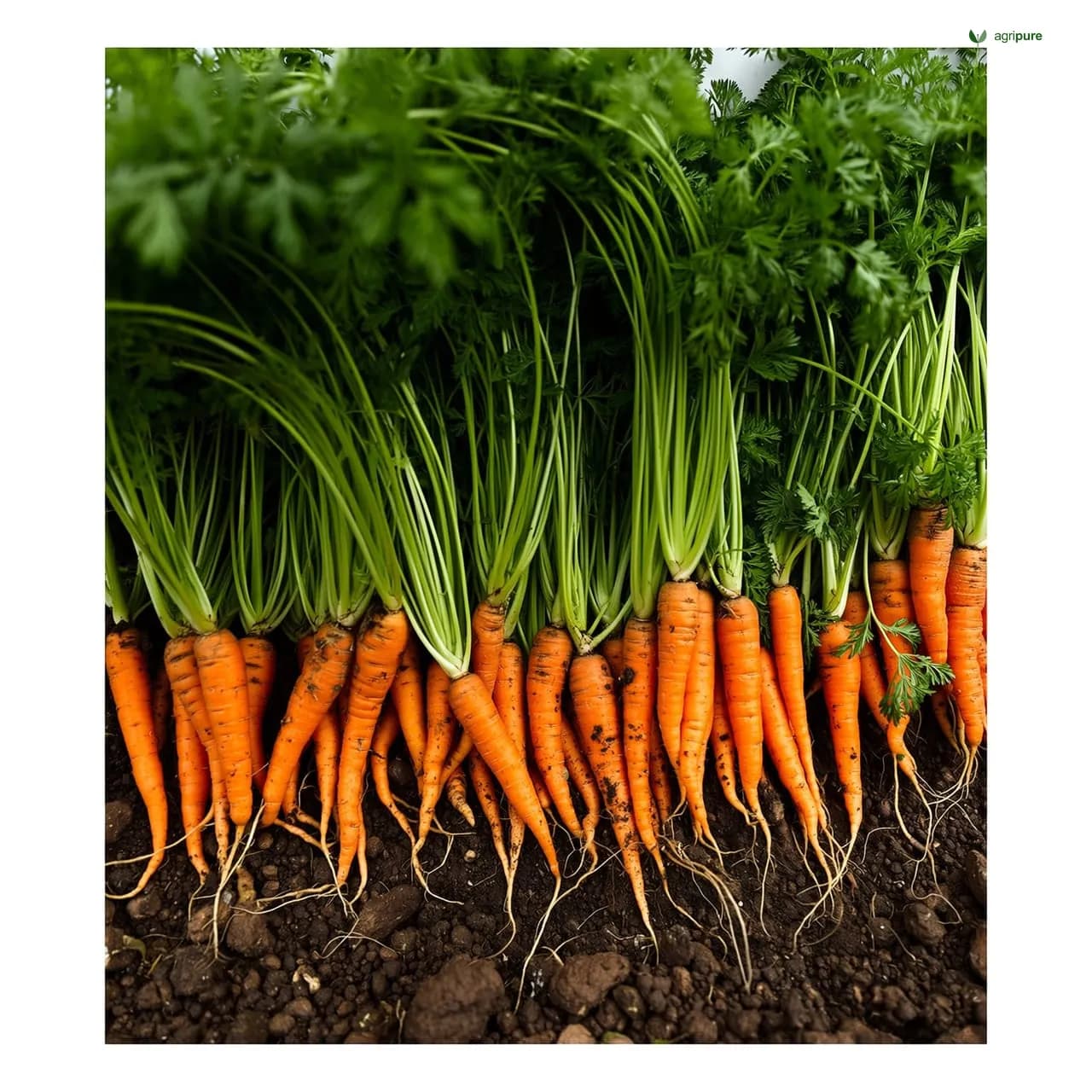
In its first year, carrot forms a low rosette of finely divided, fern-like leaves that are 2-pinnate with narrow segments and often smell of carrot when crushed. In its second year it sends up an erect, noticeably hairy flowering stem typically 30 to 120 cm (1 to 4 ft) tall. The tiny white flowers sit in a compound, umbrella-shaped umbel, flat-topped in bloom and curling inward into a cupped “bird’s nest” as it seeds; many umbels carry a single dark red or purple floret at the center, though not always. The dry, ribbed seeds bear bristly hairs that aid dispersal. The root is a taproot: thin, off-white, and often woody in wild plants, but bred up into the enlarged, usually orange (sometimes purple or yellow) root in cultivated forms.
Growing carrot
Carrot is propagated almost entirely by seed. Because it forms a taproot and resents transplanting, it is direct-sown where it is to grow. It is a cool-season crop in temperate climates, naturalized so widely that it occurs in every U.S. state and across fields, pastures, meadows, roadsides, and waste ground. The wild type ranges from low elevations up to about 1,500 m and is absent only from the hottest desert basins, which gives a sense of how broad its tolerance is.
For soil and site, the plant favors well-drained to dry ground, often sandy or gravelly, and is most common in open, sunny habitats, though it tolerates partial shade. A loose, free-draining, stone-free bed suits the taproot best. One caution for seed savers: wild carrot easily crosses with cultivated carrot, so letting plants flower for seed near naturalized wild stands lets the two interbreed, with offspring reverting toward the tough, woody wild root. To save true seed, keep flowering plants isolated. The sources here do not give consistent figures for sowing dates, spacing, or days to maturity, so those are left out rather than stated with false precision.
Harvest and uses
In cultivated carrot the swollen taproot is the harvest, lifted in the first year before the plant bolts and the root turns woody. Wild carrot’s root is technically edible but typically thin, pale, and fibrous, especially in older plants, so it is far less rewarding. Beyond the root, the species earns its keep ecologically: the broad, flat umbels of white flowers are an open nectar source, and the plant is a well-known component of meadow, pasture, and roadside flora across its naturalized range. For field naturalists, the umbels (flat in bloom, cupping into a bird’s-nest as they dry) are the signature feature.
How to identify it, and the poison hemlock caution
The most important safety point for foraging wild carrot: it is commonly confused with poison hemlock (Conium maculatum), a deadly plant in the same family, and multiple extension services warn to use extra caution. The most reliable cue is the stem — wild carrot stems are hairy, while poison hemlock stems are hairless and often blotched with purple. Use the full combination of features rather than any single trait:
- Stems: erect, 30 to 120 cm tall, and noticeably hairy on wild carrot.
- Leaves: finely divided, 2-pinnate and fern-like with narrow segments, often smelling of carrot when crushed.
- Flowers: small white flowers in a flat-topped compound umbel, often with a single dark red or purple floret in the center, curling into a “bird’s nest” as it seeds.
- Root: a pale, slender taproot that smells of carrot.
Treat any hairless, purple-blotched, umbel-bearing plant as suspect and do not handle or eat it. When in doubt, leave it: the consequences of confusing wild carrot with poison hemlock are severe.
Safety and cautions
The chief hazard with Daucus carota is not the garden carrot but foraging the wild form. Because wild carrot closely resembles poison hemlock — a toxic, potentially fatal species — extension and weed-ID sources stress extra caution, with the hairy versus hairless stem the key check. Wild carrot is also listed as a noxious or regulated weed in some jurisdictions for its ability to spread and cross with cultivated carrot, so check local status before encouraging it. This profile makes no medical claims; correct identification is simply a genuine safety matter for anyone foraging the wild type.
Sources
- Daucus carota — Wikipedia
- Wild carrot (Daucus carota) — UC Integrated Pest Management, University of California
- Queen Anne’s Lace (Daucus carota) — University of Wisconsin Horticulture Extension
- Wild carrot — Minnesota Department of Agriculture
- Wild Carrot — Wild Food UK
- Wild Carrot — Cornell University Weed Identification