secondary
Common Myrtle
murud
Myrtus communis
- balochistan highlands
- kpk hills
International hardiness
- USDA 8-11
- RHS H4
- AU: Mediterranean, Warm temperate, Subtropical
Where it grows — regional guide
| Zones / rating | Regional notes |
|---|---|
USDA 8-11 | Dense evergreen shrub for USDA zones 8 to 11 with aromatic foliage; concentrated myrtle essential oil is toxic and must never be taken internally. |
| Zones / rating | Regional notes |
|---|---|
H4 (-10 to -5C) | RHS rating H4: evergreen Mediterranean shrub for sunny, sheltered south-facing walls; undiluted essential oil is toxic and unsafe for internal consumption. |
| Zones / rating | Regional notes |
|---|---|
Mediterranean, Warm temperate, Subtropical | Grown in mediterranean and warm temperate gardens as a resilient aromatic hedge; avoid internal use of concentrated oil as it is toxic. |
| Zones / rating | Regional notes |
|---|---|
USDA 8-11 (USDA scale) Canada uses its own zone system; Canadian zones run roughly one lower than USDA. | No region-specific data yet |
| Zones / rating | Regional notes |
|---|---|
Balochistan highlands, KPK hills | Pakistan:Cultivated in KPK and Balochistan gardens for aromatic leaves and berries; pure essential oil carries toxicity and must not be ingested. |
Common myrtle (Myrtus communis) is a small, aromatic, evergreen shrub in the myrtle family (Myrtaceae), native to the Mediterranean region. Every part of it (foliage, flowers, and even the wood) is strongly scented, and its leaves and dark berries have a long history as a culinary flavoring as well as ornamental and wildlife value. For a homesteader working warm, dry ground, its appeal is that it is a tough, year-round evergreen that takes sun and lean, free-draining soil, clips well into an aromatic hedge, and earns its keep as both a kitchen herb and a long-lived structural shrub.
How to identify common myrtle
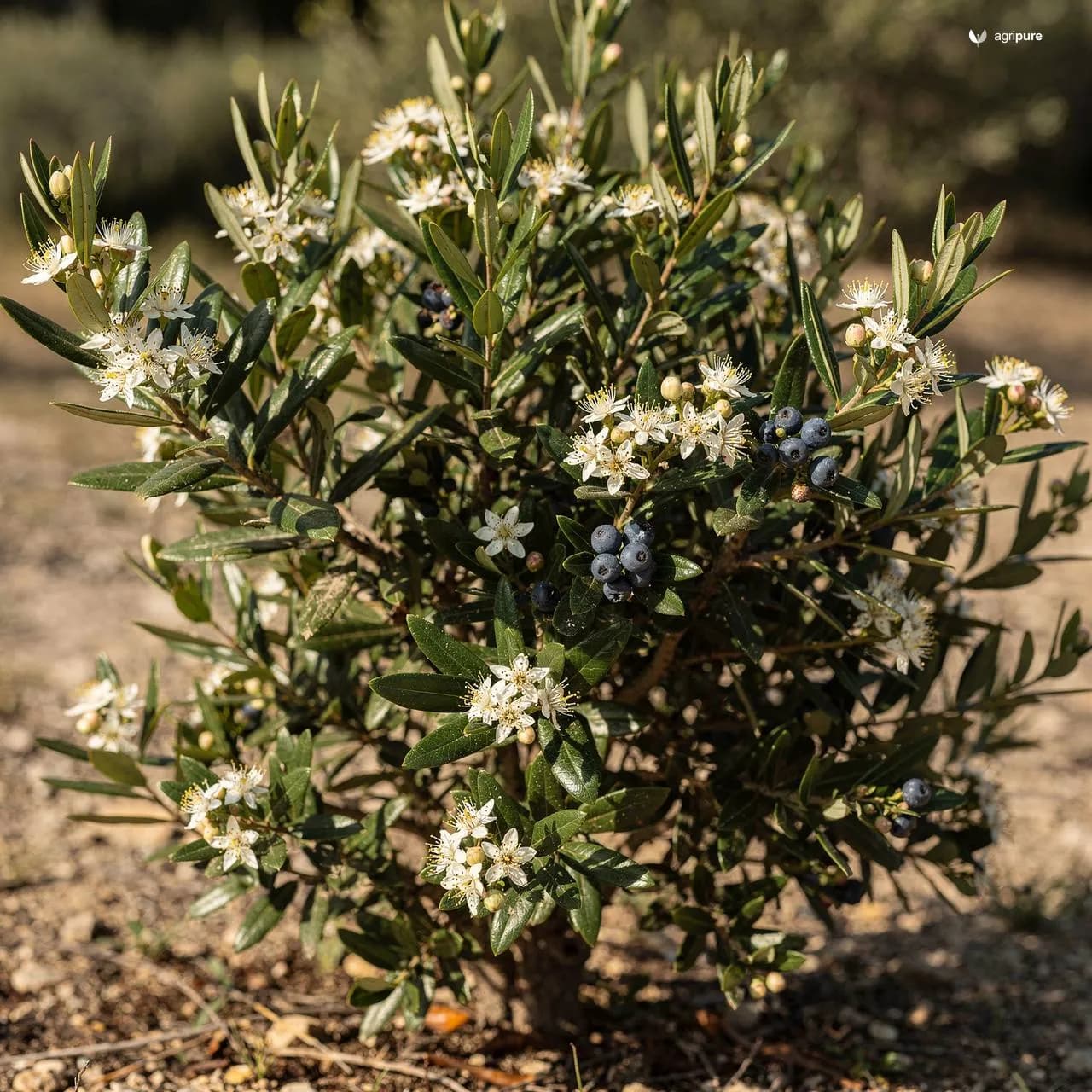
Myrtle is a broadleaf evergreen shrub or small tree. It is most often seen at around 5 to 6 ft (1.5 to 1.8 m) tall, but with age it can grow to 8 to 12 ft (2.4 to 3.6 m), and occasionally up to 15 to 20 ft (4.5 to 6 m). The leaves are opposite (sometimes whorled), ovate to lanceolate, and up to about 2 in (5 cm) long. They are glossy dark green above and paler beneath, dotted with translucent oil glands, and release a strong fragrance when bruised — the classic Myrtaceae cue. In late spring to summer (roughly May to July in temperate climates) it carries white, fragrant flowers about ¾ in (around 2 cm) across, each conspicuous for its many showy yellow-tipped stamens. The flowers are followed by blue-black berries, which are edible but, when raw, are at best moderately tasteful.
Growing common myrtle
Myrtle is a warm-climate plant. The Missouri Botanical Garden lists it as hardy in USDA zones 8 to 10, and NC State gives a tighter range of 8a to 9b. Practical growing experience in the UK puts its cold limit at about −10 °C (14 °F) in a well-drained, sheltered spot, but it is far more vulnerable in cold, wet winters than in cold dry ones. In short, it suits a Mediterranean to mild coastal pattern — dry summers, cool but not severe winters, and sharp drainage.
- Propagation: Grow it from seed or from cuttings. Nursery practice is to take softwood cuttings in early summer and semi-hardwood cuttings in early autumn from non-flowering shoots, then grow the young plants on in pots for about two seasons before planting out, which gives a stronger, better-established plant.
- Soil: It prefers moderately fertile, well-drained soil and will adapt to loamy, clay, or sandy ground provided drainage is adequate; NC State suggests a loamy compost. Sharp drainage is the single most important factor, because the plant is prone to root rot and is especially sensitive to cold, wet conditions.
- Sun: It grows best in full sun to part shade. For warmth and winter protection, a south- or west-facing wall is ideal — it adds heat, sheds some winter rain, and shelters the shrub from cold winds.
- Water: Once established, myrtle has some drought tolerance. In the ground the rule is to give it less rather than more, particularly through winter, to avoid root problems. In containers, water it well in summer but let it dry out more in winter, watching carefully for over-watering.
- Spacing and form: Mature spread is typically 5 to 6 ft (1.5 to 1.8 m), reaching 8 to 12 ft (2.4 to 3.6 m) over time, so for a hedge or screen, space plants on the order of 4 to 6 ft (1.2 to 1.8 m) apart to match its eventual width.
Establishment is steady rather than fast — the two-year potting-on period for cuttings points to a plant that takes its time settling in but rewards patience with long life and low maintenance. Precise figures for years-to-first-flowering and exact hedge spacing are not documented in these sources, so they are left out here rather than stated with false precision.
Harvest and uses
The harvest is the aromatic foliage and the ripe blue-black berries, both of which are used for culinary flavoring; the whole plant’s strong fragrance is what makes it valuable in the kitchen and the garden alike. Beyond food, myrtle is grown as an ornamental for its glossy evergreen foliage and showy white summer flowers, and it carries wildlife value. Because it is evergreen, takes clipping, and holds a dense form, it works well as an aromatic hedge or structural shrub that keeps cover year-round while deciduous neighbours stand bare. No specific yield figures are given in the sources, so none are quoted here.
Safety and cautions
Myrtle’s leaves and berries are generally regarded as edible and aromatic, and raw berries are described as only moderately tasteful rather than dangerous. However, the sources are clear that myrtle essential oil and concentrated extracts have documented toxicity and must be used with caution. There is a meaningful difference between using a few whole leaves or berries as a flavoring and using the concentrated essential oil: the oil should be treated with respect and not casually ingested. This profile describes traditional and culinary use only and makes no medical claims; anyone considering the oil or concentrated preparations, and anyone who is pregnant, breastfeeding, or taking medication, should seek qualified guidance first.
Sources
- Myrtus communis — NC State Extension Plant Toolbox
- Myrtus communis — Missouri Botanical Garden Plant Finder
- All About Herbs: Myrtle (Myrtus) — Jekka’s
- Myrtus communis — Wikipedia
Sourcing notes
Propagate from seed or semi-ripe cuttings; wild myrtle in Lower Dir and Malakand is the nearest local seed source. It is slow to establish but long-lived, and it clips into a dense aromatic hedge if you want a boundary as well as a crop.