secondary
Pomegranate — Bedana (seedless)
anaar bedana (انار بیدانہ)
Punica granatum cv. Bedana
- balochistan highlands
- punjab plains
International hardiness
- USDA 7-11
- RHS H4
- AU: Warm temperate, Mediterranean, Arid / semi-arid, Subtropical
Where it grows — regional guide
| Zones / rating | Regional notes |
|---|---|
USDA 7-11 | Suited to USDA zones 8 to 11 in hot, dry summers; demands full sun to ripen soft-seeded arils, but beware sharp branch spines. |
| Zones / rating | Regional notes |
|---|---|
H4 (-10 to -5C) | No region-specific data yet |
| Zones / rating | Regional notes |
|---|---|
Warm temperate, Mediterranean, Arid / semi-arid, Subtropical | Grown in semi-arid and Mediterranean climates with hot summers; bears sweet arils, but wear gloves against sharp branch spines. |
| Zones / rating | Regional notes |
|---|---|
USDA 7-11 (USDA scale) Canada uses its own zone system; Canadian zones run roughly one lower than USDA. | No region-specific data yet |
| Zones / rating | Regional notes |
|---|---|
Balochistan highlands, Punjab plains | Pakistan:A soft-seeded pomegranate of Balochistan and the Punjab plains; produces large sweet fruit, but beware sharp branch spines. India:Prized in northern orchards for its soft, chewable seeds and sweet arils; demands full sun, but watch for sharp branch spines. |
The pomegranate (Punica granatum) is a deciduous shrub or small tree grown for its hard-rinded, jewel-filled fruit; “Bedana” is the name used in South Asia for soft-seeded, near-seedless selections of this same species, prized because the arils can be eaten whole without crunching on hard pips. The species is native to a broad belt running from southern Europe and the Mediterranean region through the Middle East to northern India and the southern Himalayas, and it has been cultivated and naturalized for so long around the Mediterranean Basin and other warm, semi-arid zones that its exact wild origin is blurred. For a homesteader, the practical appeal is its toughness: a long-lived, drought-adapted fruiter that thrives in hot, dry summers where many tree crops sulk, and a soft-seeded Bedana type simply makes the harvest pleasanter to eat fresh.
There is very little cultivar-level, English-language research specifically on the Bedana selection — almost all reliable botany and agronomy is reported for the species as a whole. Because “Bedana” is simply a fruit selection of ordinary Punica granatum, its plant structure and growing needs match the species, so this profile describes sourced species-level horticulture and avoids inventing cultivar-specific numbers.
Identifying the pomegranate
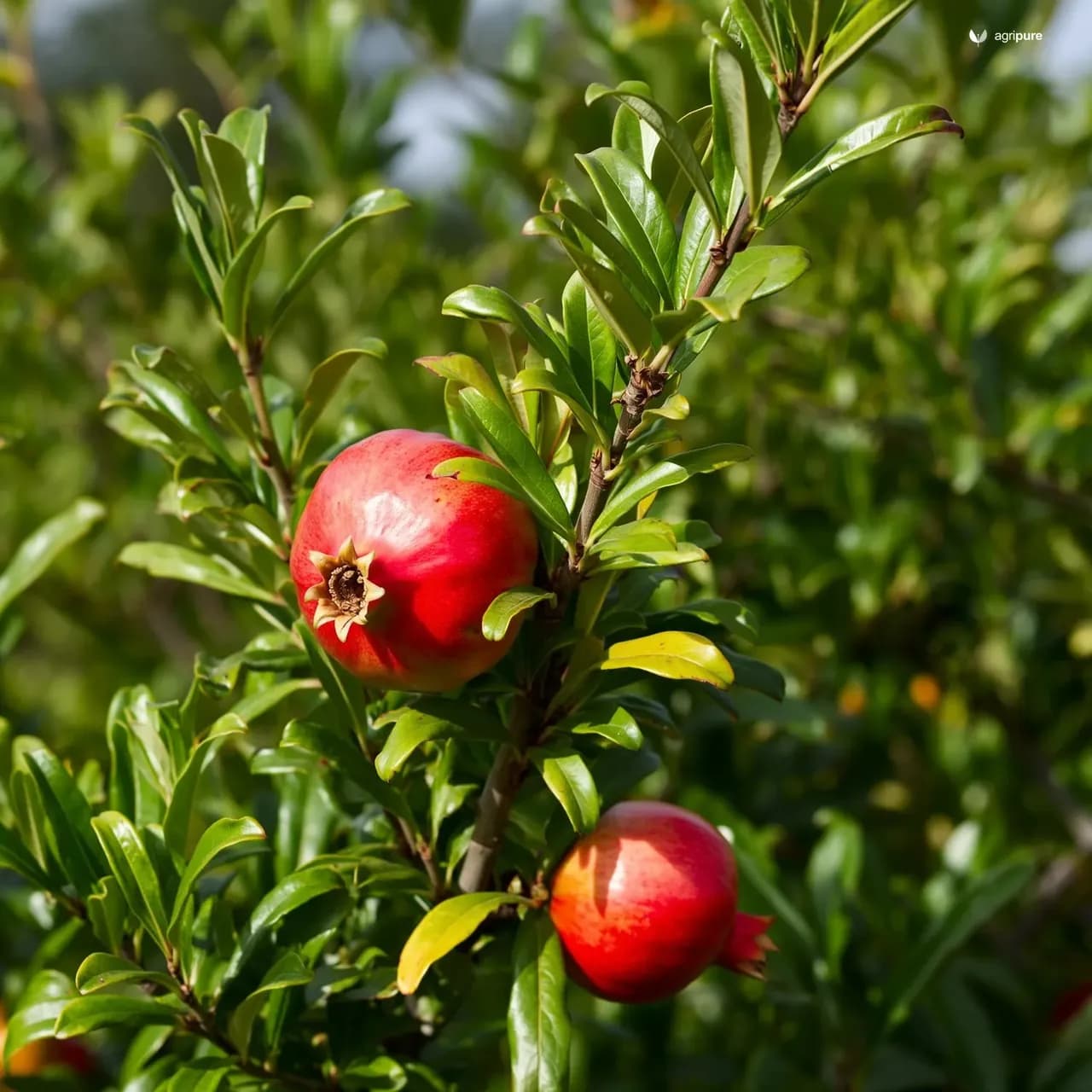
Pomegranate grows as a deciduous shrub or small tree, usually about 1.8 to 6 m (6 to 20 ft) tall with a roughly equal spread, and is often multi-stemmed. The crown is dense and rounded to oval with somewhat tangled branches, and the branches frequently bear sharp points or spines. The leaves are borne opposite or in whorls (sometimes appearing alternate on vigorous shoots), oblong to oval-lanceolate, roughly 2.5 to 7 cm long and 0.8 to 2.5 cm wide, with entire margins and a glossy dark-green surface. Plants are deciduous in most climates but can be nearly evergreen in warm tropical areas.
The flowers are the most distinctive field cue: showy, trumpet-shaped blooms at the branch tips, borne singly or in small clusters, typically orange-red (ornamental forms range through red, orange, pink, yellow, or variegated), with petals of a distinctly crumpled, wrinkled texture and a span of about 2.5 cm or more. The fruit is a globose (spherical) berry topped by a persistent, crown-like calyx: the spiky “tail” is the remains of the flower. Fruit diameter runs roughly 2 to 12 cm, commonly about 5 to 10 cm in cultivated forms, with a tough, leathery rind that ripens yellowish-red to red and browns with age. Inside, membranous compartments are packed with fleshy, juicy arils, each enclosing a seed, and the aril is the edible part.
Growing pomegranate
Pomegranate fruits best where summers are long, hot, and dry (ideally around 32 °C/90 °F or higher) with cool but not severely cold winters. It is generally treated as hardy in roughly **USDA zones 8 to 11** for garden culture, and under European criteria it is rated hardy to about zone 8b (around −9.4 to −6.7 °C). In cooler climates, such as much of north-west Europe, it is usually grown as a tub or container plant and overwintered under protection. There is no evidence that a Bedana selection differs markedly in cold hardiness from typical fruiting pomegranates, so the species range is the safe assumption.
Pomegranate is propagated by seed, hardwood cuttings, and layering in horticultural practice. For a soft-seeded selection like Bedana this matters: named cultivars do not come true from seed, so to keep the soft-seed trait you must propagate vegetatively (from cuttings or grafting) off a known mother plant rather than sowing seed, which would scramble the type. Figures for plant spacing, sowing dates, and exact time to maturity are not consistently documented in the botanical sources used here, so they are left out rather than stated with false precision. In practice, treat it like other dryland fruiting shrubs: give it full sun, free-draining ground, and a hot site, and avoid heavy, soggy soils.
Harvest and uses
The harvest is the fruit, and the edible reward is the aril — the fleshy, juicy sac around each seed that fills the fruit’s membranous chambers. The point of a Bedana selection is that those arils are soft-seeded or near-seedless, easy to eat fresh by the spoonful rather than spitting out hard pips. The tough, leathery rind is not eaten, and the persistent crown-like calyx marks a fully formed fruit. Beyond fresh eating, pomegranate arils and their juice are the basis of the species’ wide culinary and cultural use across its native Mediterranean-to-Himalayan range, where it has been cultivated for millennia.
The sources here give no verified yield figures, harvest timing, or storage data specific to the Bedana selection, so this profile states none — rather than repeat invented numbers, treat productivity as you would any established pomegranate: a mature, well-sited plant rewards a hot dry summer with a concentrated crop, harvested when the rind has fully coloured.
Sources
- Punica granatum — Oregon State University, Landscape Plants
- Punica granatum — Missouri Botanical Garden Plant Finder
- Punica granatum — Van den Berk Nurseries
- Pomegranate — Wikipedia
- Punica granatum L. — Global Biodiversity Information Facility (GBIF)