secondary
Pomegranate — Kandhari
anaar — Kandhari (انار قندہاری)
Punica granatum cv. Kandhari
- balochistan highlands
- punjab plains
- pothohar
International hardiness
- USDA 7-11
- RHS H4
- AU: Warm temperate, Mediterranean, Arid / semi-arid, Subtropical
Where it grows — regional guide
| Zones / rating | Regional notes |
|---|---|
USDA 7-11 | No region-specific data yet |
| Zones / rating | Regional notes |
|---|---|
H4 (-10 to -5C) | No region-specific data yet |
| Zones / rating | Regional notes |
|---|---|
Warm temperate, Mediterranean, Arid / semi-arid, Subtropical | No region-specific data yet |
| Zones / rating | Regional notes |
|---|---|
USDA 7-11 (USDA scale) Canada uses its own zone system; Canadian zones run roughly one lower than USDA. | No region-specific data yet |
| Zones / rating | Regional notes |
|---|---|
Balochistan highlands, Punjab plains, Pothohar | Pakistan:A thick-skinned pomegranate of the Balochistan highlands and Pothohar; it yields large fruit with deep-red arils and firm seeds when grown in hot, dry summers. India:Grown in India for its large, thick-skinned fruit with deep-red arils that store and travel well; it prefers full sun and hot, dry summers. |
Kandhari pomegranate (Punica granatum cv. Kandhari) is a named cultivar of the common pomegranate, selected for large, thick-skinned red fruit whose deep-red arils run sweet to sweet-tart around a notably firm, hard seed. The species itself is native to Central Asia and was grown in antiquity across Persia (modern Iran), Babylon, Egypt, and India before being carried around the Mediterranean and, in the 16th century, to the Americas. For a homesteader, the appeal is that this is a tough, long-lived fruiting shrub adapted to hot, dry summers and cool winters: it earns its keep on warm, sunny ground where many softer fruits sulk, and it yields a single generous autumn-to-winter crop of fruit that stores and travels well.
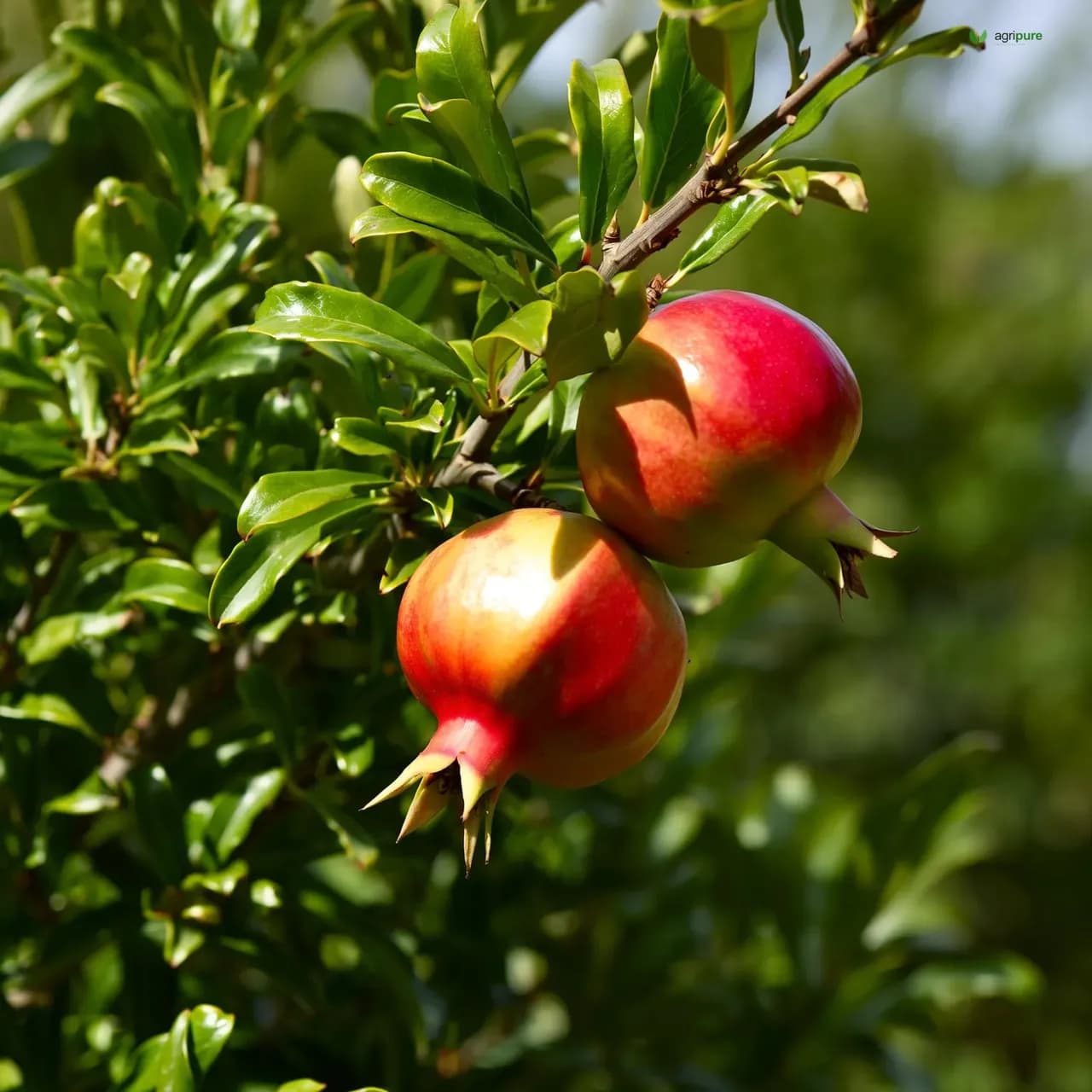
Like all pomegranates, Kandhari grows as a deciduous shrub or small tree, roughly 1.5 to 5 m (5 to 16 ft) tall, usually dense and bushy with slender, somewhat thorny branches. The leaves are opposite to sub-opposite, glossy, narrow, and about 1 to 7 cm long, and the flowers are bright red to orange-red with a tubular, leathery calyx and crinkled petals. What sets the Kandhari selection apart is the fruit: large, with thick red skin and juicy, deep-red arils, eaten fresh and prized for that intense colour. Because it is a clonal selection of P. granatum, its overall size, growth habit, and basic botany follow the species; only the fruit characters are cultivar-defining.
Growing Kandhari pomegranate
To keep the cultivar true, propagate Kandhari vegetatively rather than from seed. Seed-grown pomegranates do not come true to type, so seedlings will not reliably reproduce the Kandhari fruit. The standard method is hardwood cuttings about 15 to 20 cm long, pencil-thickness or larger, taken in winter and set with two to four nodes above the soil; cuttings are commonly grown on in nursery rows for one to two years before being planted out. Layering also works but is more labour-intensive. For a homestead planting, the simplest route is cuttings or established nursery plants clearly labelled as the Kandhari cultivar.
Pomegranate is adaptable on soil, growing in textures from pure sand to heavy clay, but it produces best on deep loams. The trade-offs are worth knowing: yields are low on sands, fruit colour is poor on clays, and growth is poor on strongly alkaline soils. Aim for well-drained ground that is not heavy or persistently wet, with a soil pH around 5.5 to 7.0.1 The plant favours hot, dry summers and cool winters, and once established it tolerates some drought, but the best fruit quality comes from a Mediterranean-type climate of cool winters and hot, dry summers rather than humid conditions. Give it full sun. Extension and horticultural references generally place the species in roughly USDA zones 7 to 10; this is a species-level guide, not a Kandhari-specific rating, and in colder zones the plant needs frost protection.
Harvest and uses
Kandhari is a fresh-fruit cultivar. The fruit is large and thick-skinned, with juicy, deep-red arils that are sweet to slightly tangy, each surrounding a firm, hard seed that is characteristic of the type. In the South-Asian plant trade, Kandhari pomegranate fruit is typically in season from roughly September to February, giving a long late-season window of ripe fruit. The arils are eaten out of hand and pressed for juice; the thick red skin that helps protect the fruit also makes this kind of pomegranate handle and store comparatively well, which is part of why the type holds its market value.
How to identify it
Use this combination of features to recognise a pomegranate, and the Kandhari fruit characters to distinguish the cultivar:234
- Habit: Deciduous shrub or small tree, about 1.5 to 5 m tall, dense and bushy, with slender, somewhat thorny branches.
- Leaves: Opposite to sub-opposite, glossy, narrow, roughly 1 to 7 cm long.
- Flowers: Bright red to orange-red, with a tubular, leathery calyx and crinkled petals.
- Fruit (Kandhari): Large, with thick red skin and juicy, deep-red arils that are sweet to sweet-tart; the seed within each aril is distinctly firm and hard.
Sources
- Pomegranate Growing in the Florida Home Landscape (MG056) – University of Florida IFAS Extension
- Pomegranate (Punica granatum) – Wikipedia
- Kandhari Pomegranate (Punica granatum) – Plant.pk
- Pomegranate Kandhari (Anar) Plant – SeedBeej