climax
Pomegranate — Wonderful
anaar — Wonderful (انار وَنڈرفُل)
Punica granatum cv. Wonderful
- balochistan highlands
- punjab plains
International hardiness
- USDA 7-11
- RHS H4
- AU: Warm temperate, Mediterranean, Arid / semi-arid, Subtropical
Where it grows — regional guide
| Zones / rating | Regional notes |
|---|---|
USDA 7-11 | The standard commercial pomegranate grown across USDA zones 7 to 11 in full sun; it is self-fruitful and needs long hot summers and good drainage to ripen large fruit. |
| Zones / rating | Regional notes |
|---|---|
H4 (-10 to -5C) | No region-specific data yet |
| Zones / rating | Regional notes |
|---|---|
Warm temperate, Mediterranean, Arid / semi-arid, Subtropical | Suited to subtropical, Mediterranean, warm-temperate and arid regions with hot dry summers; self-fertile and drought-adapted once established, it requires free-draining soil. |
| Zones / rating | Regional notes |
|---|---|
USDA 7-11 (USDA scale) Canada uses its own zone system; Canadian zones run roughly one lower than USDA. | No region-specific data yet |
| Zones / rating | Regional notes |
|---|---|
Balochistan highlands, Punjab plains | Pakistan:Grown in sunny, well-drained orchards across Punjab and Balochistan; it shrugs off high summer heat and dry spells, setting large sweet-tart fruit without a partner. |
The ‘Wonderful’ pomegranate (Punica granatum cv. ‘Wonderful’) is a vigorous, self-fertile cultivar best known as the standard commercial grocery-store pomegranate, producing large, red, sweet-tart fruit in hot-summer climates. The species Punica granatum is native from southern Europe to northern India and has long been naturalized around the Mediterranean and across warm regions worldwide. For the homesteader, ‘Wonderful’ earns its place because it crops without a pollination partner, shrugs off heat and a long dry summer, and yields fruit that is equally at home eaten fresh or pressed for juice; the well-known “POM Wonderful” juice is made from exactly this variety.
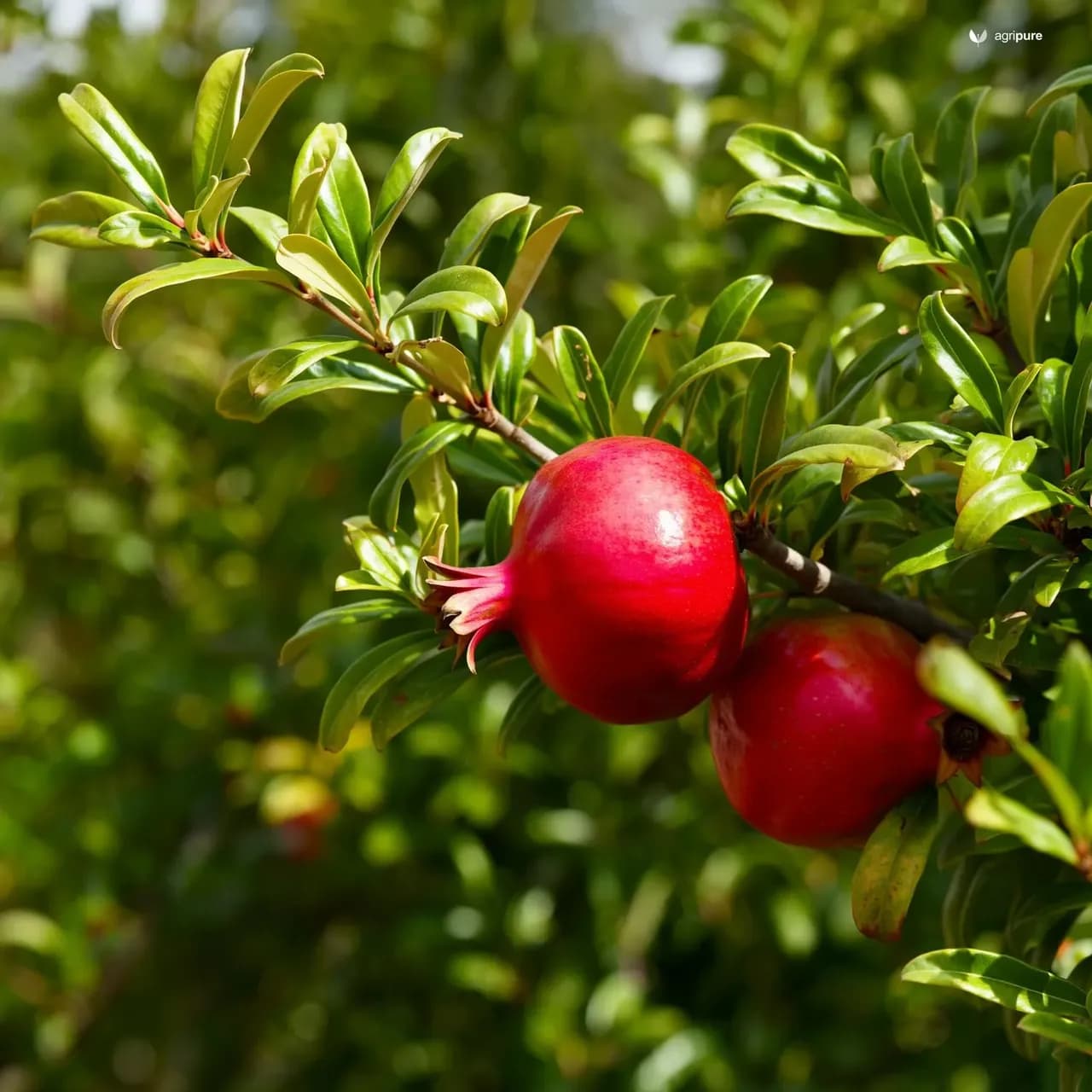
It grows as a deciduous shrub or small tree, often multi-stemmed, with a dense, bushy to mounded form that can be trained either as a shrub or as a small tree. Mature size is commonly cited at 6 to 20 feet tall and 4 to 15 feet wide, though with regular pruning many growers keep it in the 6 to 10 foot range. The leaves are glossy and dark green; in mild climates the plant may stay evergreen, but in cooler areas it behaves as a typical deciduous pomegranate. Branches may carry thorns. In summer it bears showy, trumpet-shaped to tubular orange-red blooms, often from roughly July to September depending on climate, with flowers nodding at the branch tips. The fruit is a large, red to red-blushed oblate globe, frequently 5 to 6 inches across (softball-sized), packed inside with crimson, sweet-tart arils. It is prized specifically for its exceptionally large fruit and strong, tangy flavor.
Growing the ‘Wonderful’ pomegranate
‘Wonderful’ is suited to warm, hot-summer climates. Sources broadly place it in USDA zones 8 to 10 for reliable fruiting, with some nurseries listing it as hardy into zone 7 in protected sites or grown in containers; reported cold hardiness ranges from roughly 10 to 15 degrees Fahrenheit. The plant fruits best where summers are long, hot, and dry, with daytime highs above 90 degrees Fahrenheit and cooler winters. Pomegranates ripen well in the U.S. South and California; in cooler regions such as the Pacific Northwest the plant will grow but often lacks enough summer heat to ripen fruit fully unless it is container-grown and protected. ‘Wonderful’ has a relatively low chill requirement, typically about 150 to 200 chill hours.
A practical run-down of its growing needs:
- Propagation: Clonal pomegranate cultivars like ‘Wonderful’ are propagated vegetatively to stay true to type, and named trees are grown and sold by nurseries rather than raised from seed.
- Pollination: ‘Wonderful’ is self-fruitful, so a single plant will set fruit without a pollinizer; planting a second pomegranate nearby can still increase yields.
- Soil: It does best in organically rich, fertile, well-drained loam with dry to medium moisture, but it tolerates a wide range of soils and is described as growing in almost “any soil” as long as it is well drained. It is not particular about soil pH. Critically, it does not tolerate standing water or waterlogged ground.
- Sun: Full sun is essential for good growth and fruiting; this is the one point every source agrees on.
Precise spacing and time-to-first-crop figures are not consistently given in these sources, so they are left out rather than stated with false precision. In practice, give a ‘Wonderful’ tree a hot, sunny, free-draining spot, keep it off heavy wet ground, and prune as needed to hold it to a manageable shrub or small tree.
Harvest and uses
The reward is a crop of large, deep-red fruit with crimson, juicy arils that carry the cultivar’s signature sweet-tart flavor. The arils are eaten fresh out of hand or scattered over food, and the fruit’s most famous outlet is juice: ‘Wonderful’ is the variety behind commercial pomegranate juice production. Beyond the kitchen, the plant doubles as an ornamental, with its showy orange-red summer flowers and dense form making it useful as a specimen shrub or small tree in a warm-climate planting. Because it is heat- and drought-adapted once established and asks little beyond sun and drainage, it fits well into a low-input corner of a hot, dry homestead.
How to identify it
Use this combination of features to recognize a ‘Wonderful’ pomegranate:1234
- Habit: Deciduous, often multi-stemmed shrub or small tree with a dense, bushy to mounded form, commonly 6 to 10 feet tall under pruning and larger if left unchecked.
- Leaves: Glossy, dark green, oval leaves, sometimes persisting as evergreen in mild climates.
- Stems: Branches that may bear thorns.
- Flowers: Showy, trumpet-shaped to tubular orange-red blooms in summer, nodding at the branch tips.
- Fruit: Large, red to red-blushed oblate fruit, often 5 to 6 inches across, filled with crimson, sweet-tart arils.
Sources
- Pomegranate ‘Wonderful’ – Texas Master Gardeners (Henderson County)
- Wonderful Pomegranate Tree – Ison’s Nursery
- Wonderful Pomegranate – Arbor Day Foundation
- Wonderful Pomegranate – One Green World
- Wonderful Pomegranate Tree – Four Winds Growers