secondary
Wild Pomegranate
daru
Punica granatum var. daru
Also known as Daru (Pakistan).
- pothohar
- kpk hills
- balochistan highlands
International hardiness
- USDA 7-11
- RHS H4
- AU: Warm temperate, Mediterranean, Arid / semi-arid, Subtropical
Where it grows — regional guide
| Zones / rating | Regional notes |
|---|---|
USDA 7-11 | No region-specific data yet |
| Zones / rating | Regional notes |
|---|---|
H4 (-10 to -5C) | No region-specific data yet |
| Zones / rating | Regional notes |
|---|---|
Warm temperate, Mediterranean, Arid / semi-arid, Subtropical | No region-specific data yet |
| Zones / rating | Regional notes |
|---|---|
USDA 7-11 (USDA scale) Canada uses its own zone system; Canadian zones run roughly one lower than USDA. | No region-specific data yet |
| Zones / rating | Regional notes |
|---|---|
Pothohar, KPK hills, Balochistan highlands | Pakistan:A deciduous shrub of the Pothohar and KPK hills; its sour wild fruit is harvested and dried to produce a tangy spice on dry, rocky slopes. India:The wild Himalayan ancestor of the cultivated pomegranate, native to rocky hillsides in Jammu and Uttarakhand; its sour fruit is harvested and dried to produce a tangy spice. |
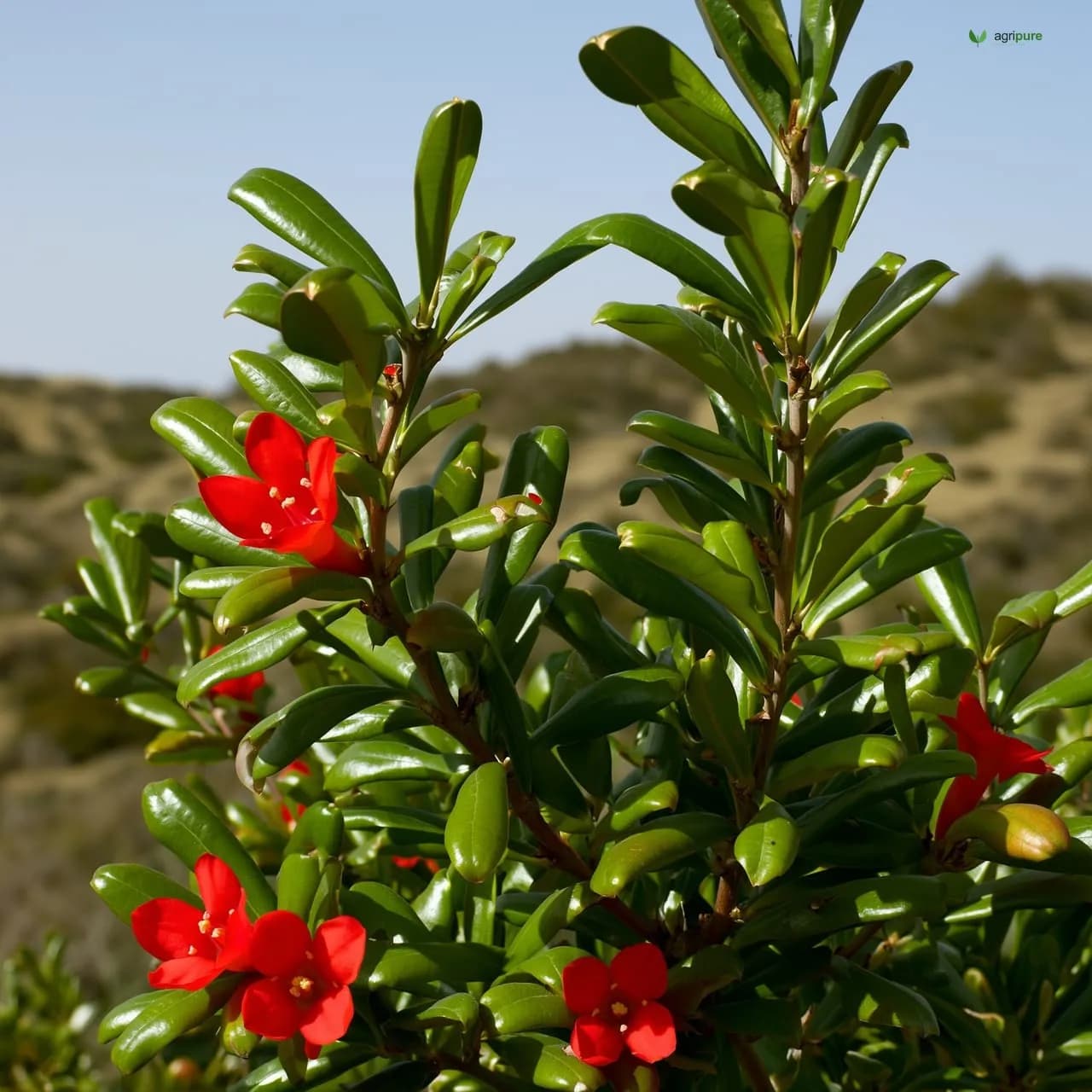
Wild pomegranate (Punica granatum var. daru) is the sour, wild Himalayan form of the familiar cultivated pomegranate, grown not for fresh dessert fruit but for its tart dried seed arils. Known locally as darim in Uttarakhand, daru in Himachal Pradesh, and dhurni in Jammu and Kashmir, it grows spontaneously as a multi-stemmed deciduous shrub on dry, rocky hillsides of the western and central Himalaya. Genomic work on pomegranate domestication treats this Himalayan daru stock, which grows across north India and Nepal, as the wild ancestor of the cultivated species. For a homesteader, the appeal is a hardy fruiting shrub that earns its place on poor, stony ground where pampered orchard cultivars struggle, turning a sour harvest into a useful spice.
Like the species as a whole, daru belongs to the family Lythraceae (subfamily Punicoideae) and grows as a deciduous shrub or small tree, typically around 1.5 to 5 m tall, with multiple stems and grayish-brown bark. The fruit is the classic pomegranate: a roughly spherical berry, about 5 to 12 cm across, sheathed in a tough, leathery rind and divided inside into compartments packed with juicy arils surrounding the seeds. What sets daru apart is flavor rather than form: its fruit is noticeably more acidic and sour than typical cultivated pomegranates, which is exactly why it is favored as raw material for the dried-seed spice. Detailed pomological descriptors specific to the daru variety (exact fruit size, rind color, aril count) are not well documented in reliable sources, so they are omitted rather than stated with false precision.
Growing wild pomegranate
This is a plant of dry, open, sunny hillsides. The wild daru form grows spontaneously on rocky slopes in the sub-tropical mid-hills of the western Himalaya, regions that see cool to cold winters and warm summers. Treat it accordingly: give it a position in full sun on free-draining ground, and favor stony, well-drained soils over rich, wet, or heavy ones. As a deciduous shrub it drops its leaves and rests over winter, which is part of how it copes with the cold-winter Himalayan belt where it occurs naturally.
The species as a whole is best understood as a subtropical to warm-temperate fruit shrub, suited to mild to moderately cold winters and warm, dry summers. Variety-specific climate trials and USDA hardiness-zone figures for daru were not located in the sources used here, so no zone numbers are assigned; what can be said is that daru is adapted to the cool-winter mid-elevation hills of its native range rather than hot lowland plains. Likewise, precise spacing, sowing dates, and time-to-maturity figures for this wild form are not consistently documented in the reliable sources, so they are intentionally omitted; in practice it behaves like other dryland pomegranate stock, settling in on lean, well-drained, sunny slopes.
Harvest and uses
The headline product is the seed. The sour fruit of daru is harvested chiefly to make anardana, the dried sour arils used as a tangy souring spice, and the wild Himalayan daru stock is specifically regarded as a high-quality source for it. Because the fruit is too acidic to be a pleasant fresh dessert, its value lies in this processed, dried form rather than in eating out of hand. The plant has been the subject of Himalayan wild-product and food-supplement programs precisely because it is a useful, harvestable wild resource growing on hillsides that might otherwise go unused. Beyond the spice, a daru shrub contributes the structure and habitat value of a hardy woody plant in a dryland planting.
Origin and distribution
Pomegranate as a species likely originated in the region spanning Iran, southwest Pakistan, and parts of Afghanistan, and has been distributed and naturalized for so long that it now spans Central and Western Asia, the Mediterranean, and into the Himalaya. Studies of its domestication describe a broad wild gene pool that includes wild pomegranate in Transcaucasia and Central Asia running eastward from Iran. The daru wild type sits at the eastern edge of that picture: a wild or naturalized Himalayan form distributed across Jammu and Kashmir, Himachal Pradesh, Uttarakhand, and Nepal, and treated in genomic work as the wild stock from which cultivated pomegranates descend. The practical takeaway for a grower is to source genuine daru stock from this hill lineage rather than sweet orchard cultivars bred for fresh fruit.
Safety and cautions
The reliable sources here describe daru mainly in ecological, botanical, and food-use terms and do not document specific toxicity warnings for the fruit or its dried arils, which are used as food and a culinary spice. No medicinal claims are made for it in this profile, and no dosages are given. As with any wild-harvested plant, identify the shrub correctly before eating any part of it, use only the ripe arils as the food product, and introduce any new wild food cautiously and in small amounts. If you intend to use it for anything beyond food and spice, seek qualified guidance rather than relying on tradition alone.
Sources
- Pomegranate domestication and the wild daru stock — PMC (National Library of Medicine)
- Wild Pomegranate (Darim): food supplement for wild products — National Mission on Himalayan Studies (Uttarakhand)
- Punica granatum — GBIF (Global Biodiversity Information Facility)
- Pomegranate — Wikipedia
- Pomegranate (Punica granatum) — U.S. Fish & Wildlife Service
- Origin, History and Domestication of Pomegranate — Semantic Scholar
- Surprising pomegranate facts — Royal Botanic Gardens, Kew