climax
Mountain Sageretia
grangar
Sageretia thea
Also known as Grangar (Pakistan), Chinese Sweet Plum (United States).
- pothohar
- kpk hills
- balochistan highlands
International hardiness
- USDA 9-11
- RHS H2
- AU: Subtropical, Warm temperate, Tropical
Where it grows — regional guide
| Zones / rating | Regional notes |
|---|---|
USDA 9-11 | Grown as an indoor or patio container bonsai across the country and naturalized in Texas; popular for tiny dark drupes, though fruit edibility is unverified. |
| Zones / rating | Regional notes |
|---|---|
H2 (1 to 5C) | No region-specific data yet |
| Zones / rating | Regional notes |
|---|---|
Subtropical, Warm temperate, Tropical | No region-specific data yet |
| Zones / rating | Regional notes |
|---|---|
USDA 9-11 (USDA scale) Canada uses its own zone system; Canadian zones run roughly one lower than USDA. | No region-specific data yet |
| Zones / rating | Regional notes |
|---|---|
Pothohar, KPK hills, Balochistan highlands | Pakistan:A spiny, drought-tolerant native scrub shrub of the Salt Range and Pothohar slopes; bears small dark drupes, but edibility is unverified for casual consumption. India:Native across dry stony hillsides of northern India; a hardy, spiny evergreen shrub of scrub forests, though its small fruits lack verified food safety standards. |
Mountain sageretia (Sageretia thea) is a spiny shrub, or small tree, in the buckthorn family (Rhamnaceae). It is native to Asia, with a broad range across South, East, and parts of western Asia: floristic records report it from Afghanistan, China, India, Iran, Japan, Korea, Nepal, Pakistan, Thailand, and Vietnam, and note that it has also been introduced in Texas. For a homesteader, its real-world track record is mostly as a tough, small-leaved subject for containers and bonsai rather than as a documented field crop, so the honest framing here is an ornamental and curiosity plant first, with edible and medicinal interest that the available sources do not yet pin down.
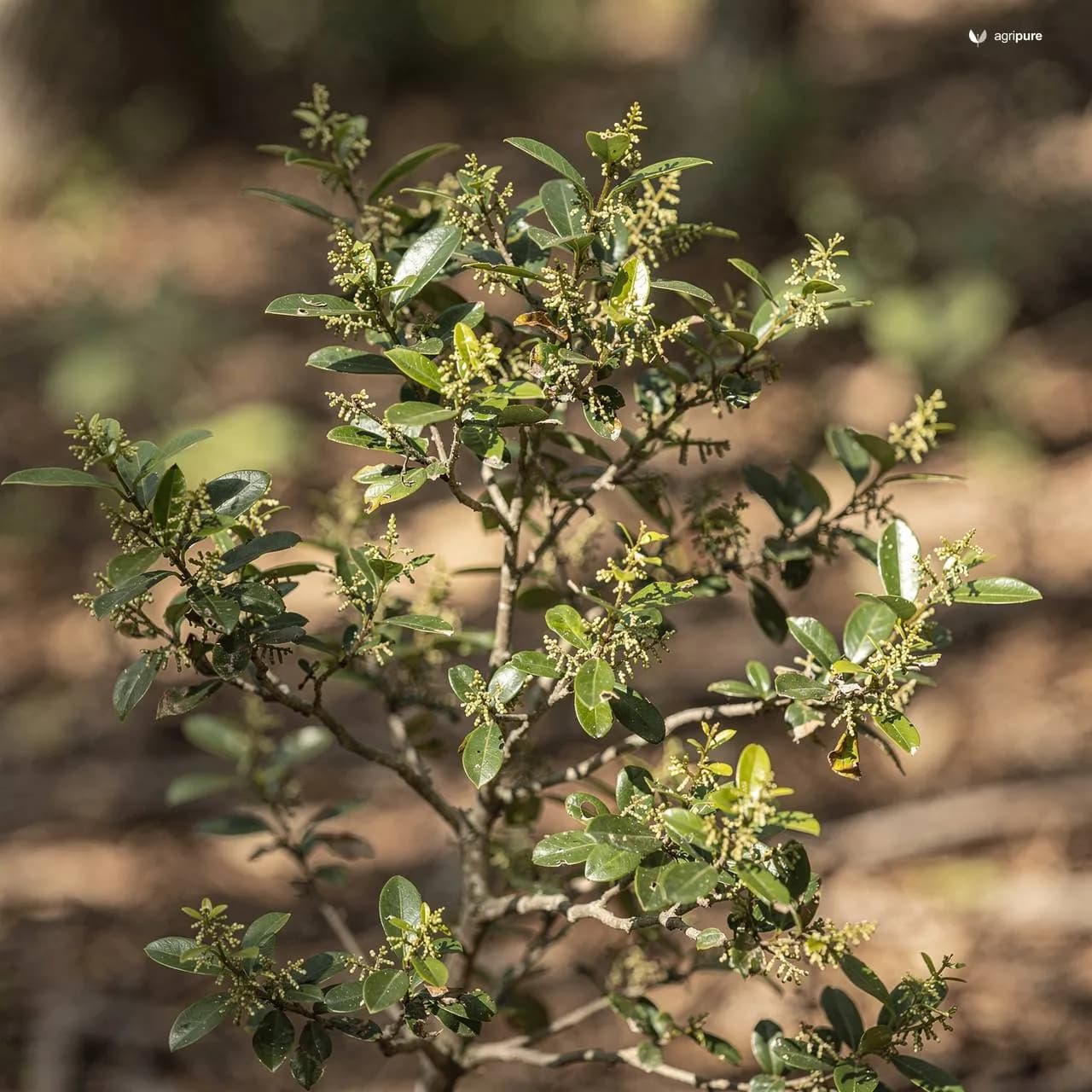
The plant is a loosely to compactly branched shrub or vine, with branches that are usually erect but sometimes sprawl or clamber. Its leaves are persistent (it holds them through much of the year), opposite to subopposite, and oblong to elliptic or ovate, roughly 1 to 4.5 cm long. It carries small white flowers in terminal and axillary clusters, which are followed by black to purple-black drupes about 4 to 5 mm long, each containing three stones. That combination of persistent small leaves, fine twiggy branching, and tiny dark plum-shaped fruit is what makes it a long-standing favourite for training as a miniature tree.
Growing mountain sageretia
An important caveat up front: the reliable growing guidance in the available sources is for bonsai and container culture, not for in-ground field production. Treat the cultural notes below as container-care guidance rather than as a tested planting protocol.
- Propagation: It is grown from cuttings. Bonsai sources report propagation by both softwood and hardwood cuttings, and another advises taking semi-hardwood cuttings in late spring or early summer.
- Light: Give it bright light. One bonsai source recommends semi-shade outdoors during warm summers, with protection from intense sun when kept indoors; another simply calls for bright, indirect light.
- Water: Keep the rootball moist but not waterlogged, and do not allow it to dry out completely.
- Soil: Use a well-draining mix that still retains some moisture; one source specifies a loamy soil.
- Feeding: Container guides recommend regular feeding through the growing season, but these are bonsai-specific cultural recommendations, not field-trial results.
Several details a grower would normally want are simply not documented in reliable form for this species, so they are left out rather than guessed: there is no verified in-ground spacing, and no trustworthy figure for time to maturity or a commercial harvest interval in the available sources. The available records also do not support a confident USDA hardiness zone. The Flora of North America treatment places the species in a warm-temperate to subtropical context but does not assign a hardiness zone, so no zone claim is made here.
Harvest and uses
The plant does bear small drupes, and bonsai growers may wait for it to flower and fruit, but the available sources provide no quantitative yield data and no horticultural harvest standard for S. thea. Both a phylogeny study and a chloroplast-genome paper identify it as a fruit and medicinal species, yet neither gives harvest yields.
On culinary use, a bonsai reference describes the plant as producing tiny purple, plum-shaped fruits, and another source calls them small, sweet fruits. However, the available sources do not provide a rigorous edibility assessment or any food-use preparation guidance, so the fruit is best treated as an interesting feature rather than a verified food.
On medicinal interest, a peer-reviewed chloroplast-genome paper explicitly calls S. thea an important fruit and medicinal species within Rhamnaceae. That establishes a recognised tradition of medicinal use, but the available sources stop short of giving validated preparations, indications, or doses, and no agroforestry or material (wood, fibre) use is documented in them either, so none is claimed here.
How to identify it
Look for this combination of features:1
- Habit: A spiny shrub, small tree, or scrambling vine; loosely to compactly branched, with branches usually erect but sometimes sprawling or clambering.
- Leaves: Persistent (largely evergreen), opposite to subopposite, oblong to elliptic or ovate, about 1 to 4.5 cm long.
- Flowers: Small and white, borne in terminal and axillary clusters.
- Fruit: A dark, black to purple-black drupe about 4 to 5 mm across, plum-shaped, containing three stones.
Safety and cautions
This profile takes a conservative line because the available research does not establish safety for either food or medicine.
- No reliable source in the available results states that Sageretia thea is toxic to humans or pets, and none identifies a specific poisonous part. The absence of a toxicity record is not the same as a guarantee of safety.
- Because the available sources do not establish edibility or medicinal safety, the fruit and any medicinal use should be regarded as insufficiently verified for casual eating or self-treatment.
- No reliable source in the available results documents drug interactions, pregnancy or lactation precautions, or other medicinal-use contraindications for this species, so none can be responsibly asserted here. Anyone considering medicinal use should seek qualified guidance and positively confirm the plant’s identity first.
Sources
- Sageretia thea — Flora of North America (eFloras)
- Sageretia (Chinese sweet plum) bonsai care — Bonsai Empire
- Sageretia thea — Useful Tropical Plants
- Chinese sweet plum bonsai (Sageretia theezans) — Bonsai Direct
- Phylogeny and classification of Sageretia (Rhamnaceae) — PhytoKeys
- Complete chloroplast genome of Sageretia thea, a fruit and medicinal species — PMC (National Library of Medicine)
Sourcing notes
Propagate from seed or cuttings off wild plants in the Salt Range, Margalla, or Pothohar scrub, where it is locally common and tolerates shallow, stony soils.