secondary
Desert Teak
rohira
Tecomella undulata
Also known as Rohira (Pakistan), Rohida (India).
- sindh coast
- balochistan highlands
- punjab plains
International hardiness
- USDA 9-11
- RHS H2
- AU: Arid / semi-arid, Subtropical
Where it grows — regional guide
| Zones / rating | Regional notes |
|---|---|
USDA 9-11 | No region-specific data yet |
| Zones / rating | Regional notes |
|---|---|
H2 (1 to 5C) | No region-specific data yet |
| Zones / rating | Regional notes |
|---|---|
Arid / semi-arid, Subtropical | No region-specific data yet |
| Zones / rating | Regional notes |
|---|---|
USDA 9-11 (USDA scale) Canada uses its own zone system; Canadian zones run roughly one lower than USDA. | No region-specific data yet |
| Zones / rating | Regional notes |
|---|---|
Sindh coast, Balochistan highlands, Punjab plains | Pakistan:A drought-hardy timber and shelter tree native to the Thar desert tracts of Sindh, Punjab, and Balochistan; avoid internal medicinal use of bark due to abortifacient risks. India:A prized arid-zone timber tree native to Rajasthan and northwestern drylands; valued for desert shelter, but bark preparations carry dangerous abortifacient effects. |
Grows alongside
Species that appear with Desert Teak in 2 of our published guides — a starting list for a guild, not a planting plan.
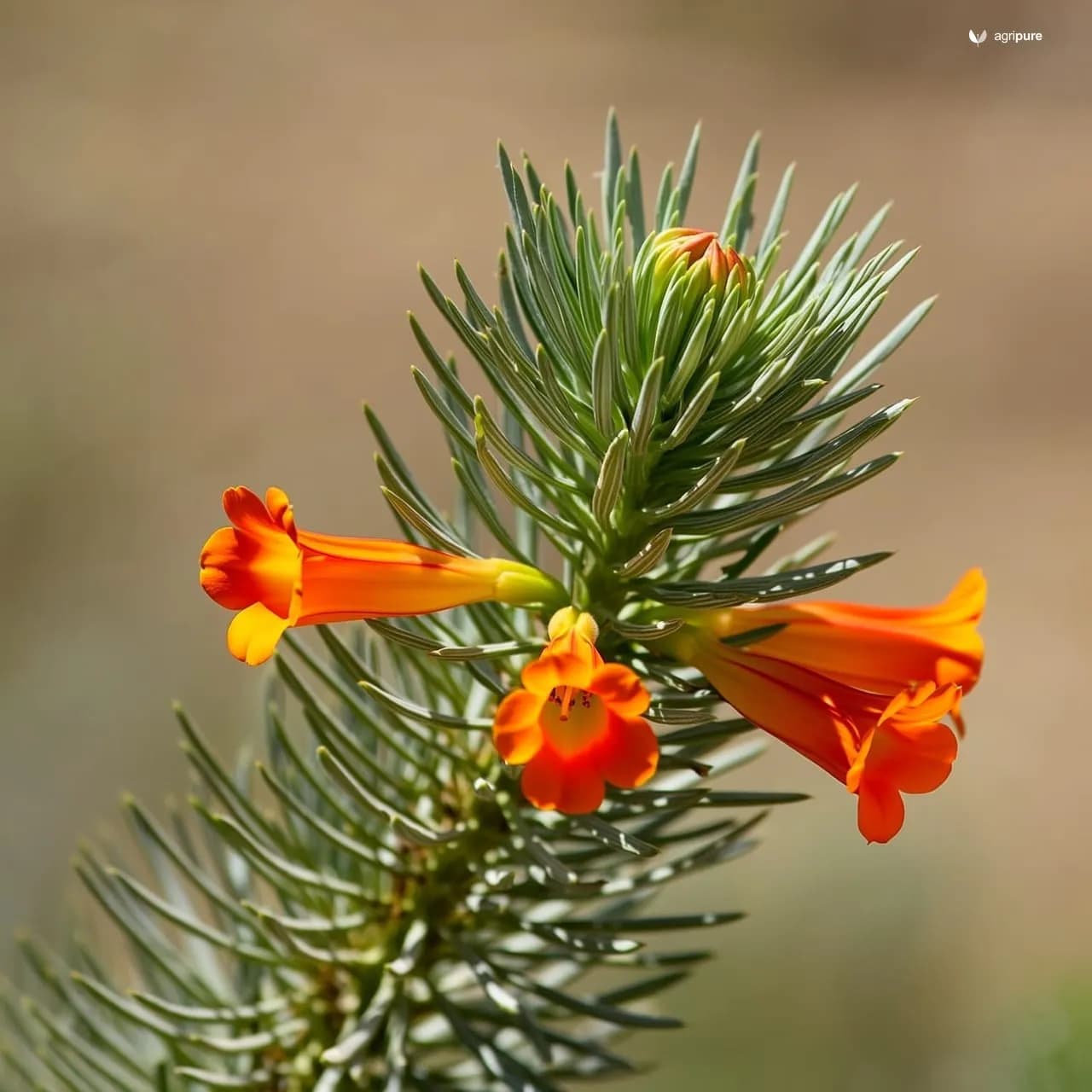
Desert teak (Tecomella undulata) is a slow-growing arid-zone tree in the trumpet-vine family (Bignoniaceae), native to the Thar Desert and adjacent dry country of southwest Asia. It is also known as Marwar teak, honey tree, and rohida or roheda, and it is the state flower of Rajasthan, India. For a homesteader working hot, sandy, low-rainfall ground, its appeal is simple: it is one of the few timber-quality trees that will hold a site, bind loose soil, and put on a showy spring flush of flowers where most trees fail. It is grown for wood, fodder, soil stabilization, and traditional medicine — not for food.
It is a deciduous to nearly evergreen large shrub or small tree, typically 2.5 to 10 m tall and occasionally reaching 15 m, often with a curved trunk (circumference roughly 52 to 80 cm) and drooping branches. The leaves are narrow and lance-shaped with distinctive wavy (undulate) margins — the feature behind the species name undulata — and run about 5 to 12 cm long. In spring it carries showy tubular flowers in shades of yellow, orange, or red, followed by long, thin, slightly curved capsules up to about 20 cm long that split to release winged seeds.
Growing desert teak
Desert teak is a plant for hot, very dry sites with light, free-draining soil; it will not reward a wet or shaded position. Match its needs and it is exceptionally tough.
- Climate: It is characteristic of arid and semi-arid warm zones and thrives on low rainfall, roughly 150 to 500 mm of annual precipitation. It is extremely hardy and tolerant of high temperatures, drought, frost, and even fire, withstanding winter lows around 0 to -2 °C and summer highs of 48 to 50 °C. It is found up to about 1,300 m elevation in arid habitats.
- USDA hardiness (inferred): Primary sources give a temperature minimum of about 0 to -2 °C but no USDA number; by US standards that corresponds roughly to **USDA zones 9b to 10a**. This is an inference from temperature equivalence, not an explicit listing.
- Soil: It prefers well-drained loamy to sandy loam soils at about pH 6.5 to 8.0, and performs very well on stabilized sand dunes. Its strong lateral root system binds sandy soils, which is part of why it is valued for dune fixation.
- Sun: Give it full sun. It occurs in open desert landscapes and is used as a windbreak; no reliable sources describe it as shade-tolerant.
- Water and drainage: It is adapted to drought and arid environments, and there is no evidence it tolerates waterlogging — its success on dunes and sandy loams points to a strong need for excellent drainage.
- Propagation: The usual method is from seed, which sources describe as easy to germinate; the long capsules carry winged seeds that are wind-dispersed.
Specific sowing temperatures, seed pre-treatments, plant spacing, and time-to-maturity figures are not consistently documented in the general botanical sources here, so they are intentionally left out rather than stated with false precision. In practice, treat desert teak as the slow, structural backbone of a dryland planting: sow into a warm, well-drained bed, keep it lean and dry, and avoid heavy or wet ground.
Harvest and uses
Desert teak is best understood as a long-term timber and utility tree rather than a quick crop. Reliable sources document extensive timber and medicinal uses, important ecological functions, and value as livestock fodder, but no human food use. It grows on flat or undulating land, gentle slopes, ravines, and stabilized dunes, where the lateral roots anchor shifting sand, and its spring flowers — the reason for the name “honey tree” — offer nectar in an otherwise sparse landscape. The wood is the primary product, and the species has long been used in traditional medicine.
One caveat belongs front and center: desert teak is slow-growing and heavily harvested, and its conservation is a recurring theme in the literature. The honest homestead position is to grow your own rather than draw on wild-cut wood — plant it for shelter, dune stabilization, fodder, and eventual timber on land you control.
Safety and cautions
Desert teak is not a food plant, and the sources flag specific reasons to keep it out of the kitchen and the medicine cabinet without professional guidance:
- Available literature reports abortifacient use of the bark and notes potent bioactive constituents, so the plant should be treated as potentially unsafe internally without professional supervision.
- It has a long history of traditional medicinal use, but traditional use is not the same as a proven, safe treatment; this profile makes no medical claim and gives no dosage.
- As a general principle with any plant carrying reported abortifacient activity, those who are pregnant or trying to conceive, and anyone considering internal use, should seek qualified medical advice first.
Grown for shelter, soil-binding, fodder, and timber, desert teak suits harsh, dry homesteads.
Sources
- Ethnomedicinal, phytochemical, pharmacological, and conservation studies of the desert teak (Tecomella undulata) — Frontiers in Pharmacology (PMC, National Library of Medicine)
- Tecomella undulata — Useful Tropical Plants Database
- Roheda (Tecomella undulata) — Flowers of India
- Tecomella undulata datasheet — CABI Compendium
- Tecomella undulata — iNaturalist