secondary
Thyme
satar
Thymus vulgaris
Also known as Common Thyme (United States, UK & Ireland), Satar (Pakistan).
- kpk hills
- balochistan highlands
- pothohar
International hardiness
- USDA 5-9
- RHS H5
- AU: Mediterranean, Warm temperate, Cool temperate
Where it grows — regional guide
| Zones / rating | Regional notes |
|---|---|
USDA 5-9 | An evergreen perennial subshrub hardy in USDA zones 5 to 9; culinary use is safe, but avoid concentrated medicinal extracts during pregnancy or if on medication. |
| Zones / rating | Regional notes |
|---|---|
H5 (-15 to -10C) | Hardy to RHS H5, it requires full sun and gritty drainage; culinary leaves are safe, but avoid concentrated oils in pregnancy or if taking medication. |
| Zones / rating | Regional notes |
|---|---|
Mediterranean, Warm temperate, Cool temperate | Cultivated across temperate zones in gritty garden beds; enjoy fresh leaves, but avoid concentrated oil preparations while pregnant or taking medication. |
| Zones / rating | Regional notes |
|---|---|
USDA 5-9 (USDA scale) Canada uses its own zone system; Canadian zones run roughly one lower than USDA. | Grown as a perennial in mild zones or a pot herb; culinary leaf use is safe, but avoid concentrated extracts if pregnant or on prescription medication. |
| Zones / rating | Regional notes |
|---|---|
KPK hills, Balochistan highlands, Pothohar | Pakistan:An aromatic evergreen subshrub suited to sunny slopes; culinary use is safe, but avoid high-dose medicinal oil preparations in pregnancy or if on medication. |
Grows alongside
Species that appear with Thyme in 90 of our published guides — a starting list for a guild, not a planting plan.
Common thyme (Thymus vulgaris) is a small, woody, evergreen subshrub in the mint family (Lamiaceae), grown around the world as a culinary herb. It is native to southern and southwestern Europe and the wider Mediterranean region — listed specifically as native to the Balearics, France, Italy, and Spain — and has since been carried into Europe, North Africa, North America, and beyond as a kitchen and garden plant. For a homesteader, its appeal is that it is a tough, low, drought-tolerant mat that earns its keep in exactly the dry, sunny, free-draining corners where thirstier herbs sulk.
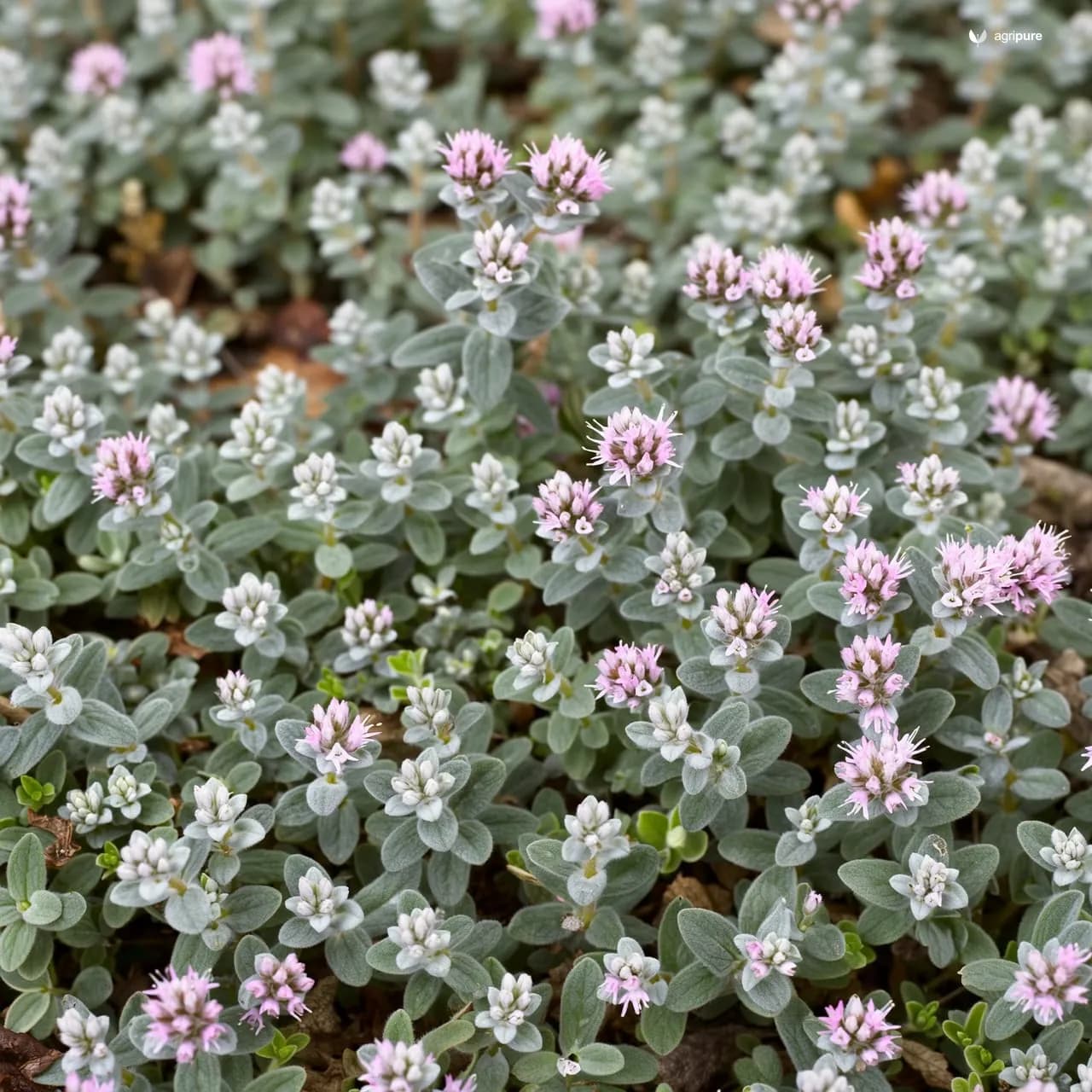
Thyme grows as a bushy, woody-based mound, typically about 6 to 12 in (15 to 30 cm) tall and 6 to 16 in (15 to 40 cm) wide, built from numerous slender, somewhat woody stems. Its leaves are small, linear to elliptic and pointed, only about ¼ to ½ in (6 to 12 mm) long, gray-green to green, finely hairy, and very aromatic; their margins often roll or curl slightly, an adaptation that reduces water loss in dry Mediterranean conditions. From late spring into early summer it carries tiny tubular flowers in whorls near the stem tips, described variously as lilac, pale lavender, white, or purple-and-white.
Growing thyme
Thyme is best started by vegetative means. Extension sources recommend stem cuttings, layering, or division as the primary propagation methods, with transplanting or dividing done in early spring. (Seed propagation is common in practice, but the cited horticultural references focus on these vegetative methods, so no seed-specific guidance is claimed here.)
Site it in full sun, where it performs and flavors best; it will tolerate partial shade, but vigor and aroma suffer there. Give it dry, sandy or rocky, well-drained soil — it even thrives on dry, chalky ground — and a neutral to alkaline pH. On moisture it is emphatic: it grows in average, dry-to-medium conditions, dislikes wet soils, and will rot if the ground stays damp. Once established it is both frost- and drought-tolerant, so the watering rule is simply to keep it well drained and never waterlogged.
Because mature plants form mounds roughly 6 to 12 in tall and 6 to 16 in wide, spacing on about 12 to 16 in centers allows each plant its full spread — note that this figure is inferred from mature width, as the cited sources give no explicit spacing rule. The cited references also do not give a precise days-to-maturity figure; in practice, expect to begin harvesting from vegetatively propagated plants during the first growing season once they have built up ample leafy stems.
Thyme needs a little discipline to stay productive. Trim it when it gets leggy, cutting back in early spring and again in summer to curb woody growth and push fresh shoots. Even so, plants tend to grow overly woody and loose after several years, at which point they are best replaced.
Harvest and uses
The leafy stems are the harvest, and timing matters: for established plants, the cited sources recommend cutting just before flowering, when the essential-oil content of the leaves is at its highest. That is the window when thyme is most intensely aromatic for the kitchen, whether the trimmings are used fresh or dried for storage. As a culinary herb it is the plant’s defining use, valued across temperate, relatively dry climates worldwide.
Beyond the kitchen, thyme earns a place in the homestead system as a low, long-lived, evergreen groundcover. Its drought tolerance and preference for lean, well-drained ground let it hold sunny slopes and dry edges where little else thrives, and its early-summer flowers add nectar to the garden at the stem tips. Reliable companions are the other dry-loving Mediterranean herbs that share its full-sun, sharp-drainage preferences.
How to identify it
Thyme is recognizable by a consistent combination of features:1234
- Habit: Bushy, woody-based, evergreen perennial subshrub forming a low mound about 6 to 12 in tall and 6 to 16 in wide.
- Stems: Numerous slender, somewhat woody stems.
- Leaves: Small (¼ to ½ in), linear to elliptic, pointed, gray-green, finely hairy and strongly aromatic, with margins that often roll slightly.
- Flowers: Tiny tubular blooms in whorls near the stem tips, lilac to white or pale lavender, appearing late spring to early summer.
Safety and cautions
Common thyme is first and foremost a culinary herb, used in ordinary kitchen amounts. The cited botanical and horticultural sources describe it as a food herb and do not document toxicity at culinary use, so this profile makes no medicinal claims for it and offers no dosages. As with any aromatic herb used in concentrated forms such as extracts or essential oils, those are a different matter from the leaf in cooking; anyone who is pregnant or breastfeeding, or who takes prescription medication, should seek qualified advice before using concentrated preparations rather than treating them as interchangeable with the kitchen herb.
Sources
- Thymus vulgaris — Go Botany, Native Plant Trust
- Thymus vulgaris (Common Thyme) — NC State Extension
- Thymus vulgaris — Missouri Botanical Garden Plant Finder
- The Uncommon Thyme — Mother Earth Living
- Thyme — McCormick Science Institute