secondary
Jacquemont’s Grape
guch
Vitis jacquemontii
Also known as Guch (Pakistan).
- kpk hills
- pothohar
International hardiness
- USDA 8-10
- RHS H4
- AU: Cool temperate, Warm temperate
Where it grows — regional guide
| Zones / rating | Regional notes |
|---|---|
USDA 8-10 | No region-specific data yet |
| Zones / rating | Regional notes |
|---|---|
H4 (-10 to -5C) | No region-specific data yet |
| Zones / rating | Regional notes |
|---|---|
Cool temperate, Warm temperate | No region-specific data yet |
| Zones / rating | Regional notes |
|---|---|
USDA 8-10 (USDA scale) Canada uses its own zone system; Canadian zones run roughly one lower than USDA. | No region-specific data yet |
| Zones / rating | Regional notes |
|---|---|
KPK hills, Pothohar | Pakistan:A wild climbing grapevine of the KPK hills and Pothohar; confirm identification before eating to avoid toxic look-alikes, and avoid unguided medicinal use since lab research offers no safe dose. India:A wild grapevine of the western Himalaya; confirm identification before eating to avoid toxic look-alikes, and note that lab research on its compounds offers no safe medicinal dose. |
Jacquemont’s grape (Vitis jacquemontii R. Parker) is a wild, climbing grapevine in the grape family (Vitaceae), native to the arid and semi-arid mountain regions of the western Himalaya — chiefly Pakistan and adjoining parts of northern India. One of the lesser-known wild relatives of the cultivated grape, its berries have long been gathered locally in place of table grapes. For a homesteader interested in tough, drought-hardy fruiting vines, it is worth knowing as a genuinely wild species adapted to dry, cold-wintered upland ground.
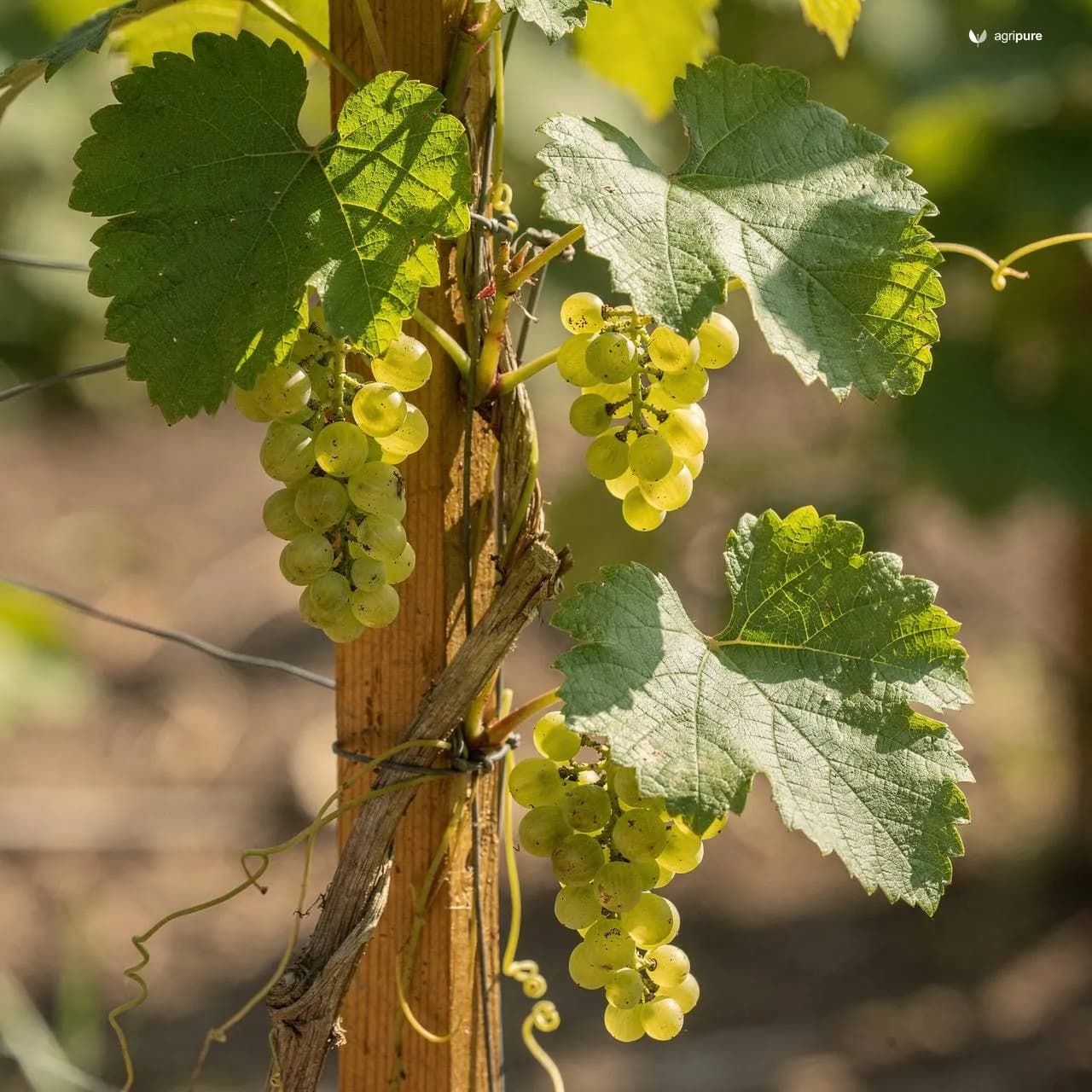
Like other members of the genus Vitis, it is a woody climber (liana) that hauls itself over trees and shrubs by tendrils, with alternate, simple, often-lobed and variable leaves that make wild grapes hard to tell apart by foliage alone. The species-specific floral detail comes from the Flora of Pakistan: flowers sit in woolly-hairy (floccose) clusters on peduncles about 5 to 6 cm long, and are minute (roughly 2 mm) and greenish, on glabrous pedicels about 3 mm long that thicken as the fruit forms. They are described as “bisexual functionally female,” apparently perfect flowers that behave as female, a condition seen in several wild grapes.
Growing Jacquemont’s grape
This is a wild mountain species, and published homestead-scale agronomy is scarce: modern study has focused on laboratory propagation and plant chemistry, not field cultivation, so spacing, sowing dates, and time-to-maturity figures are not documented in the reliable sources and are omitted here rather than invented.
- Propagation: The species has been successfully multiplied by micropropagation. A published study developed an in-vitro regeneration system using nodal explants on Murashige and Skoog-type culture media under controlled conditions to induce shoots and roots, confirming the plant responds well to clonal propagation. Like most grapes, it lends itself to vegetative propagation from nodal (cutting) material rather than seed alone.
- Climate: Naturally a plant of mountainous, often dry habitats, recorded across arid regions of Pakistan, with research material collected from Baluchistan and other dry, mountainous areas. This points to a species adapted to semi-arid to arid, seasonally cold, upland climates, tolerant of both winter cold and summer heat at elevation.
- Sun and support: As a tendril-climbing liana of the genus Vitis, it needs something to climb and the sun-exposed position grapes generally favour, scrambling over established trees and shrubs at the woodland edge.
- Hardiness: No source assigns a specific USDA zone, so none is given; its high-elevation, continental origin implies real winter and summer tolerance, but a numbered zone would be guesswork.
Harvest and uses
The berries are the traditional product, gathered and eaten across the native range in place of cultivated grapes. The floristic and pharmacological sources do not record berry size, colour, cluster weight, or yield, so those figures are left out rather than stated falsely. Treat it as a wild-harvest vine: pick the bunches when ripe, and, since vines train into the canopy of whatever they climb, give it an accessible support for a manageable pick.
Beyond food, V. jacquemontii matters as a wild grape germplasm resource, a hardy relative of the cultivated grape valued for the genetic diversity drought- and cold-adapted mountain species hold. Laboratory propagation has also been used to generate material for research into its compounds.
How to identify it
Identifying any wild Vitis by leaf alone is difficult because the foliage is so variable, so use the whole plant:14
- Habit: A woody climbing vine (liana) ascending over trees and shrubs by tendrils.
- Leaves: Alternate, simple, often lobed and notably polymorphic, typical of the grape genus rather than a single fixed form.
- Flowers: Minute (about 2 mm), greenish and functionally female, in woolly-hairy clusters on peduncles roughly 5 to 6 cm long.
- Fruit: Grape-like berries used locally in place of cultivated grapes.
Safety and cautions
The berries are documented as a traditional wild food eaten in place of cultivated grapes, so the fruit has an established record of human use in its native range. Two cautions apply. First, wild grapes are easy to confuse with unrelated climbers that can be toxic, and Vitis identification is tricky given the variable leaves — be confident of the plant before eating wild-gathered fruit. Second, recent scientific attention concerns the plant’s bioactive compounds and is laboratory research, not evidence of medicinal benefit or a safe dose; this profile makes no health claim and offers no dosage.
Sources
- Vitis jacquemontii — Flora of Pakistan (eFloras)
- Micropropagation of Vitis jacquemontii — Pakistan Journal of Botany
- Pharmacological study of Vitis jacquemontii — Heliyon (ScienceDirect)
- Vitis jacquemontii — Earthpedia Plant Encyclopedia
- Wild grape germplasm including Vitis jacquemontii — VITIS-VEA (Julius Kühn-Institut)
Sourcing notes
Source as hardwood cuttings or rooted layers from a known fruiting wild vine in the KPK or Pothohar hills, since it is not a nursery crop; pick a vine whose fruit you have tasted.