secondary
Small-Leaved Wild Grape
jangli-angur
Vitis parvifolia
Also known as Jangli Angur (Pakistan).
- kpk hills
- pothohar
International hardiness
- USDA 7-9
- RHS H4
- AU: Cool temperate, Warm temperate
Where it grows — regional guide
| Zones / rating | Regional notes |
|---|---|
USDA 7-9 | No region-specific data yet |
| Zones / rating | Regional notes |
|---|---|
H4 (-10 to -5C) | No region-specific data yet |
| Zones / rating | Regional notes |
|---|---|
Cool temperate, Warm temperate | No region-specific data yet |
| Zones / rating | Regional notes |
|---|---|
USDA 7-9 (USDA scale) Canada uses its own zone system; Canadian zones run roughly one lower than USDA. | No region-specific data yet |
| Zones / rating | Regional notes |
|---|---|
KPK hills, Pothohar | Pakistan:A native sub-Himalayan trailing wild grapevine of the KPK hills and Pothohar; produces small black edible berries gathered locally and scrambles through forest canopies. India:A native wild climber of the western and central Himalayan foothills; grown or wild-harvested for small, tart edible black grapes and used as a hardy rootstock vine. |
Grows alongside
Species that appear with Small-Leaved Wild Grape in 4 of our published guides — a starting list for a guild, not a planting plan.
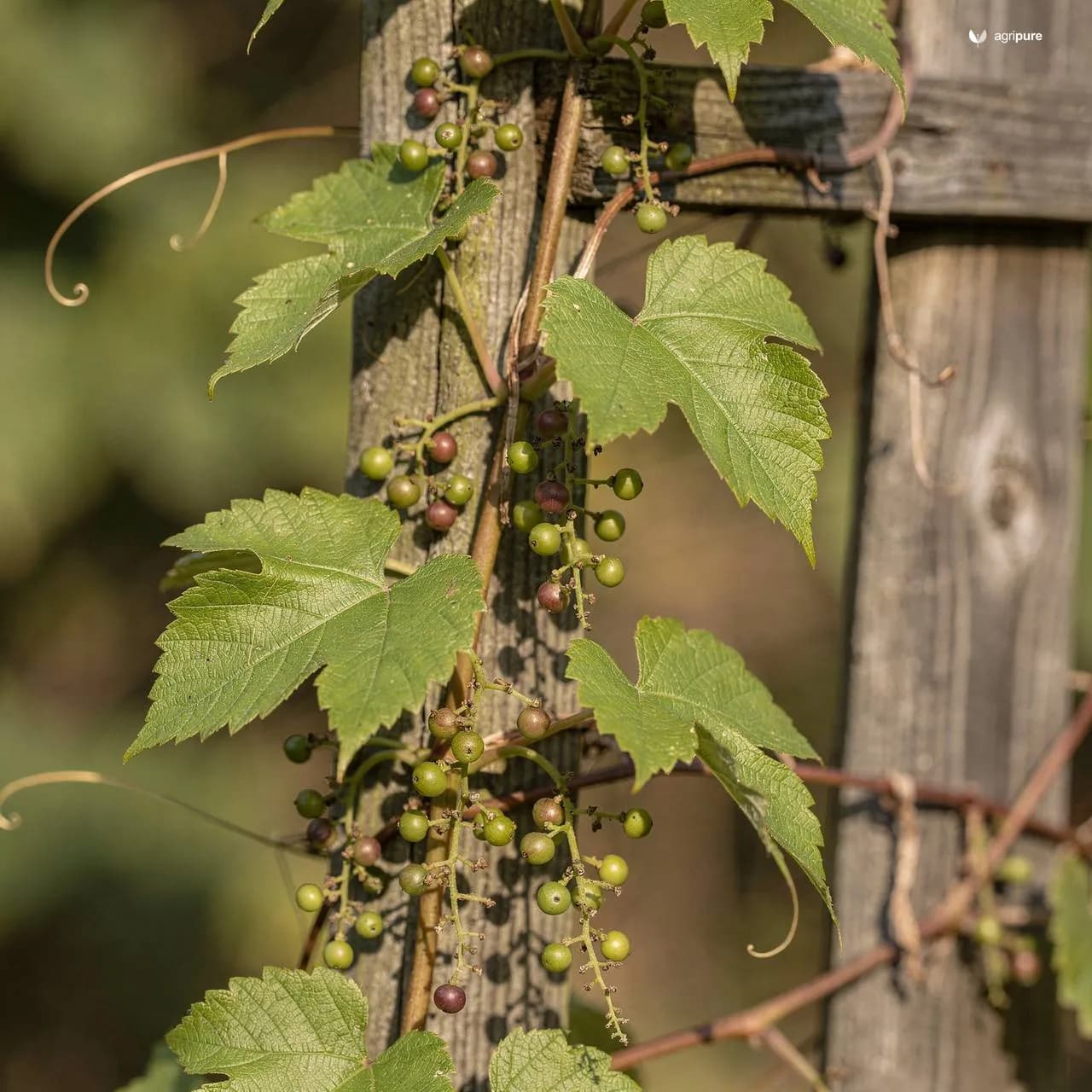
Small-leaved wild grape (Vitis parvifolia, jangli-angur) is the native wild grape of mature sub-Himalayan forest, a trailing climber with smooth, woody old stems and dark bark that peels in strips. It carries small black berries that are gathered and eaten, and its vines are used as climbing fodder, in the the KPK hills and the the Pothohar plateau. On a syntropic site it sits as a climax-stage liana: a long-lived vine that rides up established trees in a closed-canopy forest rather than a quick pioneer.
Where it thrives
The Flora of Pakistan describes it as a trailing climber with simple, glabrous tendrils and membranous, often lobed leaves, bearing black globose berries 5 to 7 mm across. Its range takes in India, Pakistan, the north-west Himalaya, Kashmir, China, and beyond, placing it through the moister hill forests of the KPK belt and the higher Pothohar. Wild grape germplasm of this kind occurs naturally in the humid and sub-humid mountain and sub-mountain country of northern Pakistan, climbing through standing forest rather than colonising open ground.
Role in the system
Use it as a climax liana that climbs the canopy without occupying ground space. It runs up the trunks and through the crowns of established trees, taking its light high in the system while leaving the forest floor and the lower layers free for other plants — the defining trick of a useful vine, which is to add a productive layer in the air rather than competing for the ground. As a long-lived vine of mature forest it is a planting for the settled, closed-canopy stage of a guild, not the early years, and it needs a strong host tree already standing before it has anything to climb. Its fruit feeds people and wildlife, and its leafy growth doubles as browse, so it adds yield and forage in the upper layers where there is otherwise little to harvest. Place it against a sturdy tree you are happy to see carry a vine, and let it find its own way up.
What you get
The return is fruit and fodder. The small black grapes, 5 to 7 mm across, are sour but edible, gathered as a wild food and a source of seed. The vine’s foliage is used as climbing fodder for stock, cut from the lower growth that comes within reach. As a wild relative of the cultivated grape it also carries value beyond the harvest: northern Pakistan’s wild Vitis germplasm is studied as drought-hardy rootstock material for grafting cultivated vines, a reminder that these hill grapes hold useful genetics for a warming, drying climate. For a maturing hill forest, it is a low-effort way to put an edible, browseable vine into the canopy and keep a piece of local grape diversity alive on the farm.
Sources
- Flora of Pakistan. “Vitis parvifolia Roxb.” eFloras.org (description, black berries, trailing climber, distribution).
- Khan, N., et al. (2018). “Wild Vitis germplasm of the mountainous regions of Pakistan.” (natural occurrence in humid hill country; rootstock value).
Sourcing notes
Easiest from hardwood cuttings or by layering a low cane, the way wild grapes are usually struck; lift propagation material from a known fruiting vine, as wild stands vary in fruit quality.