pioneer
Ber
Ziziphus mauritiana
Also known as Chinee Apple (Australia), Indian Jujube (India).
- punjab plains
- balochistan highlands
- sindh coast
International hardiness
- USDA 9-11
- RHS H2
- AU: Tropical, Subtropical, Arid / semi-arid
Where it grows — regional guide
| Zones / rating | Regional notes |
|---|---|
USDA 9-11 | No region-specific data yet |
| Zones / rating | Regional notes |
|---|---|
H2 (1 to 5C) | No region-specific data yet |
| Zones / rating | Regional notes |
|---|---|
Tropical, Subtropical, Arid / semi-arid | Classed as a serious invasive weed across northern areas; check local restrictions, handle spiny branches with gloves, and avoid unguided medicinal use in pregnancy. |
| Zones / rating | Regional notes |
|---|---|
USDA 9-11 (USDA scale) Canada uses its own zone system; Canadian zones run roughly one lower than USDA. | No region-specific data yet |
| Zones / rating | Regional notes |
|---|---|
Punjab plains, Balochistan highlands, Sindh coast | Pakistan:A drought-hardy fruit tree native to the Punjab plains, Balochistan, and Sindh; handle thorny branches carefully, and avoid unguided medicinal use in pregnancy. India:A widely cultivated dryland fruit tree across arid plains; handle sharp thorns with care, and avoid unguided medicinal use in pregnancy. |
Grows alongside
Species that appear with Ber in 8 of our published guides — a starting list for a guild, not a planting plan.
Ber (Ziziphus mauritiana), also known as Indian jujube, Indian plum, Chinee apple, or dunks, is a spiny fruit tree in the buckthorn family (Rhamnaceae). Grown across the warm, dry tropics for fruit, leaf fodder, fuelwood, and traditional medicine, it is considered native to South Asia and parts of Southeast Asia and southern China, with some sources also including Central and West Africa. For a homesteader in a hot, low-rainfall climate its appeal is straightforward: a drought-hardy tree that crops where thirstier orchard fruit fails, turning a baked, marginal corner into a useful multipurpose tree rather than wasted ground.
How to identify ber
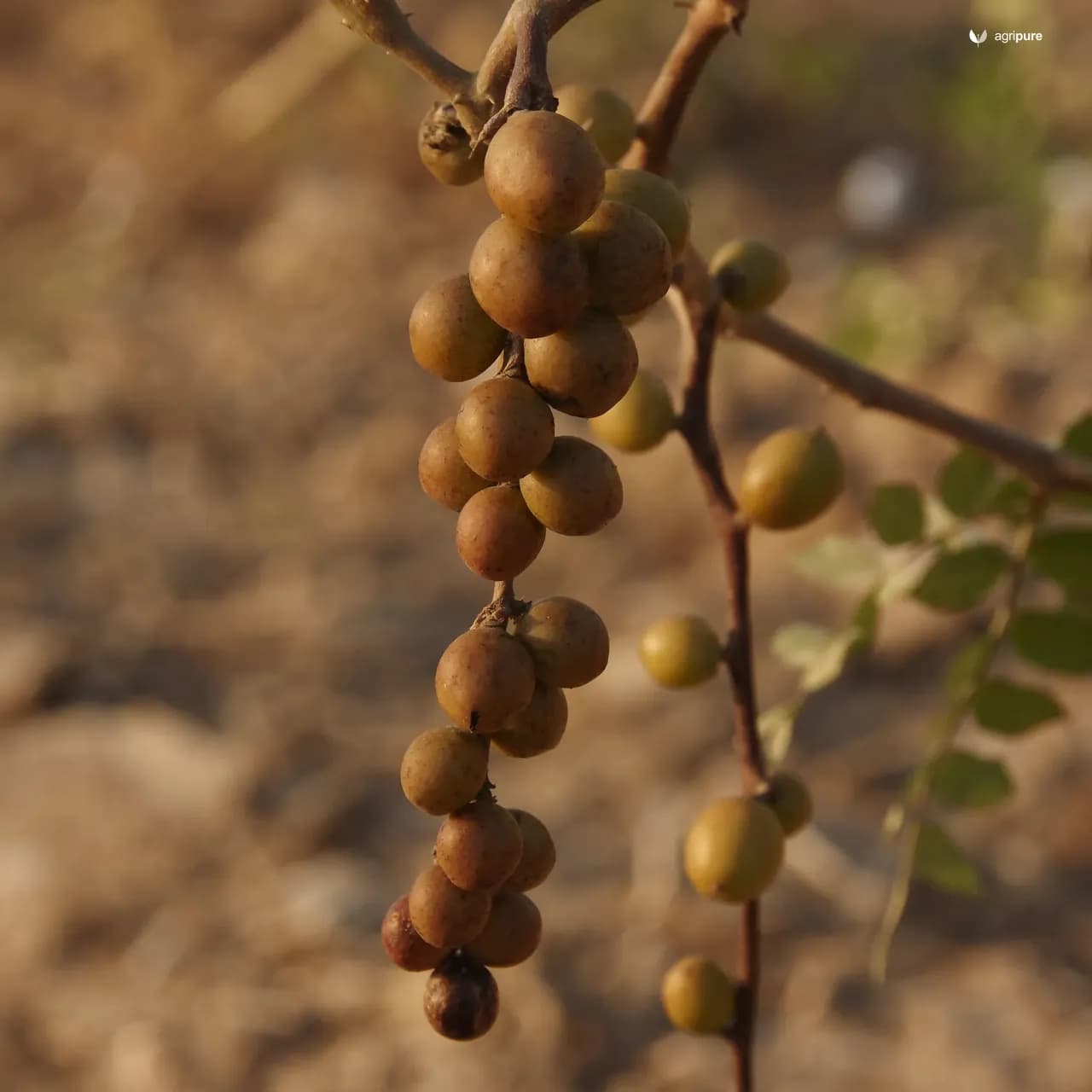
Ber is a spiny evergreen shrub or small tree, typically up to about 15 m tall with a spreading crown and a trunk up to roughly 40 cm across. Its branches form distinctive zigzag twigs, with a leaf and a thorn at each angle; the thorns are modified stipules, usually solitary and straight, about 5 to 7 mm long. The bark is grey to dull black, often irregularly fissured. Leaves are alternate, ovoid to oval, roughly 2.5 to 6 cm long, glossy green above and nearly white or softly hairy beneath — a reliable field cue. The small, greenish-white flowers cluster in the leaf axils, are inconspicuous, and are noted as having an unpleasant odour. The fruit is a fleshy drupe, oval to round and about 2.5 to 6 cm long depending on cultivar; green when unripe, it ripens yellow to pale orange (reddish-brown in some cultivars) over a hard, woody stone holding one or two seeds.
Growing ber
Getting the climate right matters most. The World Agroforestry (ICRAF) species profile records ber growing from sea level up to about 1,500 m and under annual rainfall from 120 to 2,200 mm — but it is most widespread where rainfall is only 300 to 500 mm, the semi-arid band where many other fruit trees fail. It is a frost-sensitive, tropical-to-subtropical species restricted mainly to the drier tropics. Primary references assign no USDA hardiness zone; horticultural sources broadly treat it as suited to warm, frost-free to very-light-frost climates (roughly USDA zones 9 to 11), but that is an inference from the climate data, not a botanical figure. This is not a hardy temperate fruit tree.
Ber can be raised from seed, but rootstock and named fruiting cultivars are handled differently:
- From seed: The seed sits in a tough, woody stone, and germination is improved by cracking or scarifying that endocarp, sometimes with soaking. Seed-grown plants are widely used as rootstocks.
- Grafting or budding (preferred for good fruit): Named, good-quality cultivars are usually budded or grafted onto seedling rootstocks rather than grown from seed, because seedlings do not reliably reproduce the parent’s fruit quality.
Figures for plant spacing, sowing dates, and exact time to first bearing are not consistently documented in the sources here, so they are left out rather than stated with false precision. The supported takeaway: site ber in full, hot sun on free-draining ground in a frost-free climate, and lean on its drought tolerance rather than heavy watering.
Harvest and uses
The ripe drupes are the main harvest, eaten across the tree’s range and valued because it crops reliably in arid and semi-arid conditions. Beyond the fruit, ber is a multipurpose agroforestry tree: the leaves serve as livestock fodder, the wood as fuelwood, and various parts feature in traditional medicine. Stacking fruit, browse, and fuel from one hardy tree is what makes it valuable on land that would otherwise sit idle, and its dense, thorny habit also suits a living barrier or windbreak.
Common problems and pests
The most commonly noted foliar problem is fungal leaf spot, widespread in many areas, showing as yellow mottling above with blackening beneath. Just as important is what ber does to a landscape: outside its native range it is documented as an invasive weed in the drier tropics, naturalising aggressively in warm parts of the Americas and Australasia. Check whether it is listed as invasive or restricted in your area before planting; its toughness, thorns, and bird-spread seed are assets in a managed planting but liabilities if it escapes.
Safety and cautions
The fruit of ber is a recognised edible, and toxicity reports for the plant are described as minimal. Medicinal and supplement-style use, however, carries the standard cautions for any herbal preparation. A few points:
- Ber has a long history of traditional medicinal use, but that is not a proven treatment; this profile makes no claim that any part of the plant treats, cures, or prevents any condition.
- Eating the ripe fruit is well established, but concentrated extracts or supplement-type preparations should be approached conservatively, and this page gives no dosages.
- As with any medicinal plant preparation, those pregnant or breastfeeding and anyone on prescription medication should seek qualified medical advice before use.
Sources
- Ziziphus mauritiana invasive species profile – Florida Natural Areas Inventory
- Ziziphus mauritiana – PROSEA (Plant Resources of South-East Asia)
- Ziziphus mauritiana Agroforestree Database species profile – World Agroforestry (ICRAF)
- Ziziphus mauritiana – Wikipedia
- Ziziphus mauritiana (Chinee apple) – University of Florida IFAS Extension
- Ziziphus mauritiana, a potential fruit tree for livelihoods in arid regions – International Society for Horticultural Science