pioneer
Wild Jujube
jhar beri
Ziziphus nummularia
Also known as Jhar Beri (Pakistan), Jharberi (India).
- punjab plains
- sindh coast
- balochistan highlands
International hardiness
- USDA 8-11
- RHS H3
- AU: Arid / semi-arid, Subtropical
Where it grows — regional guide
| Zones / rating | Regional notes |
|---|---|
USDA 8-11 | No region-specific data yet |
| Zones / rating | Regional notes |
|---|---|
H3 (-5 to 1C) | No region-specific data yet |
| Zones / rating | Regional notes |
|---|---|
Arid / semi-arid, Subtropical | No region-specific data yet |
| Zones / rating | Regional notes |
|---|---|
USDA 8-11 (USDA scale) Canada uses its own zone system; Canadian zones run roughly one lower than USDA. | No region-specific data yet |
| Zones / rating | Regional notes |
|---|---|
Punjab plains, Sindh coast, Balochistan highlands | Pakistan:A drought-hardy shrub of the Punjab plains, Sindh, and Balochistan; sharp paired spines require thick gloves, and avoid unguided medicinal use in pregnancy. India:A thorny dryland shrub of arid northwestern tracts; handle sharp stipular thorns carefully, and avoid unguided medicinal use in pregnancy. |
Wild jujube (Ziziphus nummularia) is a drought-tolerant, thorny fruit shrub in the buckthorn family (Rhamnaceae), grown across the hot drylands of South Asia and neighbouring regions for its small edible fruit, dry-season fodder, and value in erosion control. It is native to India, Pakistan, Afghanistan, Iran, Lebanon, and Zimbabwe, and is especially characteristic of the Thar Desert that straddles western India and southeastern Pakistan. For a homesteader, the appeal is that it earns its keep on the worst ground a property has: it fruits, feeds livestock, and holds shifting soil in place on hot, sandy sites where thirstier plants simply fail.
Identifying wild jujube
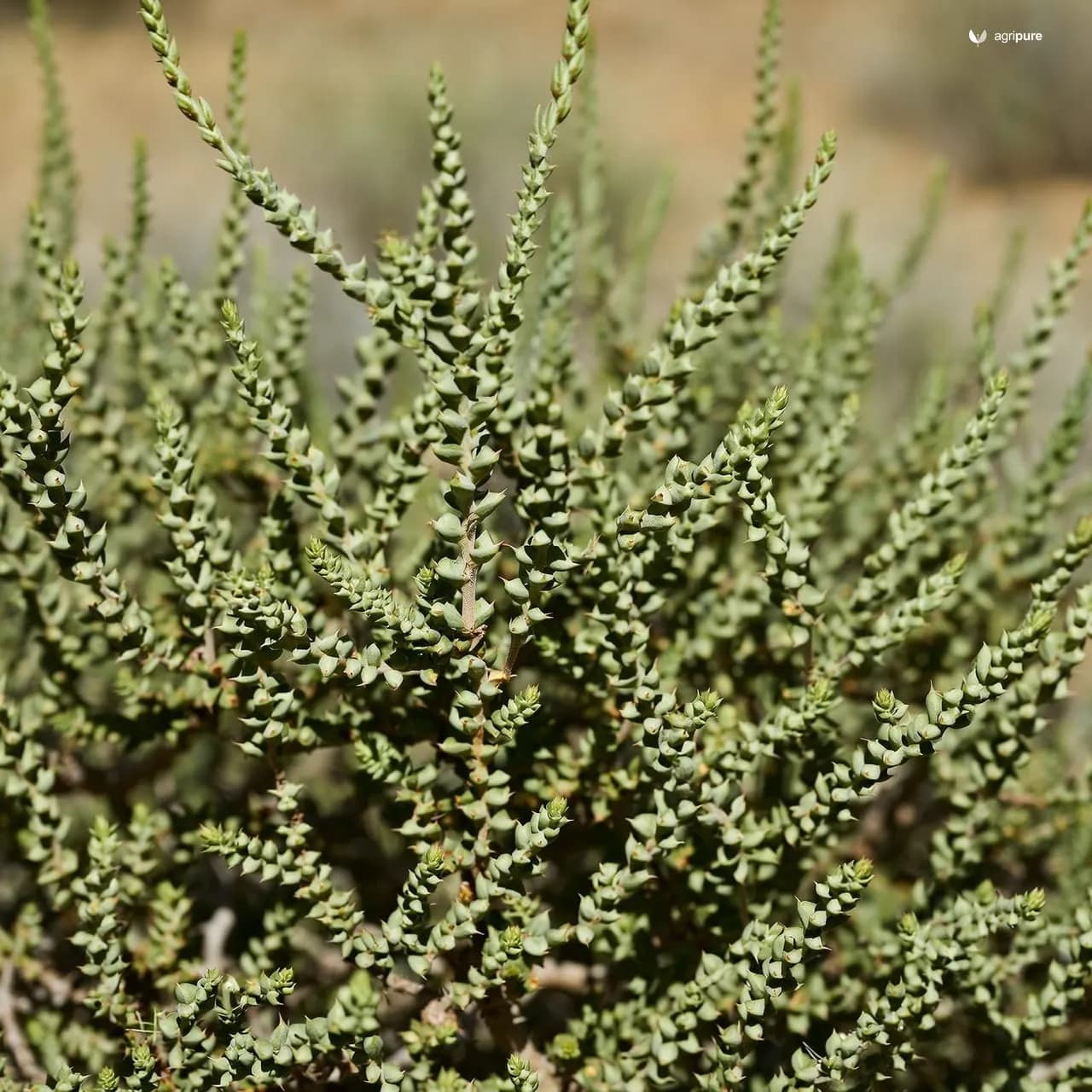
Wild jujube is a much-branched, thorny shrub that forms dense thickets and can reach roughly 6 to 8 m tall, though it is often kept far smaller by browsing and cutting. Its branches spread widely and carry the genus’s signature armament: paired stipular spines at the leaf bases, which may be curved or straight. The leaves are small and ovate to almost round (orbicular), resembling those of the cultivated jujube (Z. jujuba) but smaller and more nearly circular; they are simple and entire, with the three prominent veins typical of Ziziphus. The flowers are small and inconspicuous, greenish-yellow, and borne in clusters in the leaf axils. Below ground, the plant develops deep, widely spreading lateral roots that reach down into the substrate and underpin its survival in dry, sandy soil.
The fruit is a small drupe, no more than about 1 cm across, ripening from golden-yellow through red to a dark brown or blackish colour and enclosing a hard stone that usually holds two seeds. Agronomic work describes the ripe pulp as mucilaginous and notably rich in vitamin C, with ascorbic acid measured at up to roughly 183 mg per 100 g of fresh fruit.
Growing wild jujube
Wild jujube is very much a dryland species, and its native haunts tell you how to site it. It occurs naturally on hills, plains, ravines, cultivated fields, and sand dunes, a spread that shows real tolerance of poor, sandy, eroded, and low-fertility soils. Those same open, exposed habitats point to a clear preference for full sun; no reliable source describes it as shade-tolerant, so treat it as a sun plant. It is documented as growing mainly in arid and dry areas and possesses strong drought and heat tolerance, with its deep lateral roots tapping moisture well below the surface. That dry-adapted habit means it is suited to lean, free-draining ground rather than rich, wet soil.
For propagation, the plant lends itself to two routes. It naturally sends up many suckers from the root system, and these root suckers are used to establish hedges and windbreaks. Its fruit also contains a woody stone with usually two seeds, so seed propagation is possible and is used to raise plants in research collections, though detailed seed-treatment protocols are not given in the sources here. Because homestead-scale agronomy for this species is thin, reliable figures for sowing dates, plant spacing, and time to maturity are not documented and so are not stated. In practice, manage it as you would other thorny dryland shrubs: establish it on warm, well-drained ground, keep it on the dry side, and let its drought tolerance do the work.
Harvest and uses
The small drupes are the edible harvest, picked once they colour up to red or dark brown and the mucilaginous pulp is ripe; they are a true desert fruit, modest in size but with a useful vitamin C content. Beyond the fruit, the shrub’s main agricultural value is as fodder and as a tool for land repair. Its thorny, suckering growth makes it well suited to forming hedges and windbreaks, and it is used specifically for erosion control and for stabilising sand dunes, where its deep roots bind loose, shifting ground. On a homestead working marginal land, that combination of small fruit, browse, living barrier, and soil-holding pioneer is its real return; reliable yield tables for this species are not available in the cited literature.
Traditional medicinal use and cautions
Wild jujube also carries a documented record of use in traditional medicine, and its phytochemistry and pharmacology have been the subject of scientific review. That work catalogues the plant’s chemical constituents and reported biological activities, but a record of traditional use and laboratory study is not the same as a proven treatment, and this profile makes no claim that wild jujube treats or cures any condition. No dosages are given here, because none should be inferred from this material. As a general principle with any medicinal plant, anyone considering it for that purpose, and especially those who are pregnant, breastfeeding, or taking prescription medication, should seek qualified medical advice first. The fruit is the part eaten as food; the medicinal applications belong to informed, traditional practice rather than casual self-treatment.
Sources
- Ziziphus nummularia — Wikipedia
- Biodiversity Evaluation among Wild Jujube (Ziziphus nummularia) — Researchers Links (Pakistan Journal of Zoology)
- Ziziphus nummularia — Global Biodiversity Information Facility (GBIF)
- Ziziphus species — University of Florida IFAS Extension
- Ziziphus nummularia: phytochemical and pharmacological review — PMC (National Library of Medicine)