If you garden or farm on a saline soil, a coastal dune, or a salt-affected irrigation scheme, the usual nursery advice falls apart. Salt does two things at once: it draws water out of roots (osmotic stress) and it poisons plant tissue with sodium and chloride (ion toxicity). A tree that shrugs off frost may collapse the first time the water table turns brackish. The trick to a planting that survives is matching species to two limits at the same time, the salinity your soil carries and the cold your winters deliver.
This guide extends our work on reclaiming salt-affected land in Sindh into an international, zone-keyed reference. It pairs proven salt-tolerant pioneers with their hardiness bands, so a grower in cold inland Central Asia, the hot Arabian coast, the Mediterranean, or the south of England can each find a species that fits.
First, know your salinity, not just your zone

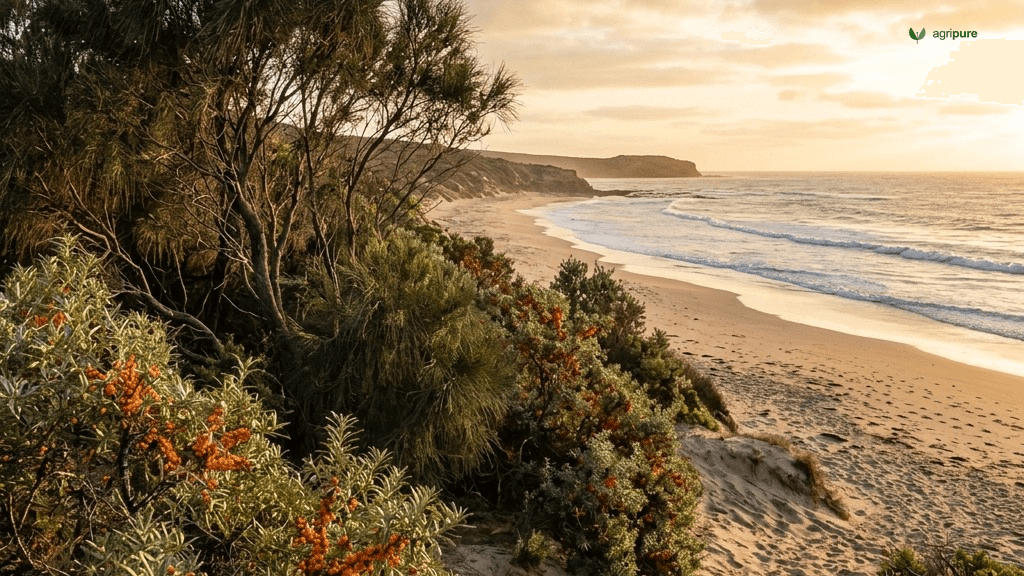
Coastal Tamarisk establishing deep root structures on saline dunes to halt wind erosion.
Soil salinity is measured as the electrical conductivity of a saturated paste extract (ECe), in deciSiemens per metre (dS/m). The widely used USDA-NRCS bands are a useful first sort before you choose any plant:
- Non-saline: ECe below 2 dS/m. Most crops are unaffected.
- Very slightly to slightly saline: 2 to 8 dS/m. Sensitive crops start to lose yield near the bottom of this range, and only moderately tolerant crops hold up near the top.
- Moderately saline: 8 to 16 dS/m. Yields are restricted to salt-tolerant crops.
- Strongly saline: 16 dS/m and above. Only a handful of very salt-tolerant species and true halophytes perform.
The practical point is that “salt tolerant” is a spectrum. A facultative halophyte such as the toothbrush tree germinates at around 15 dS/m, while athel tamarisk grows on flats carrying many times the salt of seawater. Test your ground first; a cheap EC meter on a saturated soil sample tells you far more about what will live than any plant label.
How hardiness zones translate across countries
Three systems dominate the literature, and international readers need to move between them:
- USDA zones (1 to 13) are based on average annual minimum temperature and are used across the Americas and widely cited worldwide.
- UK RHS ratings (H1a to H7) describe cold hardiness for British and Irish conditions; H7 is the hardiest, H1c the most tender.
- Australian zones are often described by climate type (arid, mediterranean, subtropical, tropical, warm and cool temperate) rather than a single cold number, because heat and aridity limit growth as much as frost.
For each species below we give the USDA band as the anchor, with the RHS rating and Australian climate fit noted so you can place it locally.
The zone-by-zone shortlist
The table groups dependable salt-tolerant woody plants by the coldest USDA zone they reliably handle. Choose by your zone first, then narrow by how salty and how wet your particular site is.
Species | USDA | RHS | Best site | Main roles |
|---|---|---|---|---|
Russian olive (Elaeagnus angustifolia) | 2–7 | H7 | Cold inland, saline-alkaline | Nitrogen fixing, windbreak, food |
Fourwing saltbush (Atriplex canescens) | 4–9 | H6 | Dry saline rangeland | Fodder, windbreak, reclamation |
Euphrates poplar (Populus euphratica) | 5–9 | H6 | Cold saline riverine/inland | Timber, fuel, windbreak |
Athel tamarisk (Tamarix aphylla) | 8–11 | H4 | Hot saline flats, dunes | Windbreak, fuel, shade |
Toothbrush tree (Salvadora persica) | 9–12 | H1c | Hot arid to coastal saline | Food, medicinal, windbreak |
Grey mangrove (Avicennia marina) | 10–12 | H1c | Tidal, brackish to hypersaline | Coast protection, fuel, fodder |
Cold inland and temperate sites (USDA 2 to 7)
The hardest combination to plant for is cold winters plus salt, because few of the famous coastal halophytes survive deep frost. Two species carry the load here.
Russian olive (Elaeagnus angustifolia) is the cold-end workhorse, rated to USDA 2 and RHS H7. It fixes nitrogen through actinorhizal root associations, tolerates saline and alkaline soils, and doubles as a windbreak with edible fruit, which makes it valuable on degraded cold-climate land. One caution: it is invasive across parts of the western United States and along riparian corridors, so check local status and prefer it where it is already naturalised or sanctioned, not in intact riverine habitat.
Euphrates poplar (Populus euphratica) is the standout tree for cold, saline, continental interiors, the kind of climate with scorching summers and freezing winters found across Central Asia and western China. Hardy to USDA 5 (RHS H6), it is the main species used to afforest saline desert soils. It tolerates roughly 2 percent soil salinity and can survive far higher, sequestering sodium and chloride in its roots to protect the leaves. Where you need an actual timber and fuelwood tree on cold saline ground, this is the first candidate.
Dry saline rangeland (USDA 4 to 9)
Fourwing saltbush (Atriplex canescens) bridges cold and heat, thriving from USDA 4 to 9 (RHS H6) and across arid, mediterranean and temperate Australian climates. It is genuinely tolerant of saline and strongly alkaline soils (pH up to about 9), and moderate salinity can even improve its growth. With a root system reaching well over 6 metres deep, it is a mainstay of mine-spoil reclamation and erosion control on marginal land, while its foliage provides year-round browse for livestock. As a support shrub it shelters slower climax species while soils recover.
Hot arid and coastal sites (USDA 8 to 12)
Athel tamarisk (Tamarix aphylla) is the classic hot-climate salt pioneer, hardy USDA 8 to 11 (RHS H4). It tolerates extraordinary salt loads, growing on flats with several thousand parts per million of soluble salt and tolerating up to roughly 15,000 ppm, and it excretes excess salt through tiny scale leaves. For decades it has served as a windbreak and shade tree across the dry American west, North Africa and inland Australia. Note that several Tamarix species are aggressively invasive in North American riparian zones; athel is the better-behaved member, but site it deliberately and away from natural watercourses.
Toothbrush tree (Salvadora persica), the source of the traditional miswak chewing stick, is a facultative halophyte for USDA 9 to 12 (RHS H1c). Its adaptability is remarkable, from non-saline desert to highly saline, waterlogged and marshy ground, germinating at around 15 dS/m. It yields edible fruit, traditional medicine and useful windbreak cover, and is being studied for phytoremediation of salt-affected, metal-contaminated soils, making it a multi-purpose anchor for hot coastal and inland saline systems.
Grey mangrove (Avicennia marina) is the choice for the wettest, saltiest extreme, the tidal margin itself. Hardy only to USDA 10 (RHS H1c), it is the pioneer of mangroves, growing optimally in seawater-strength conditions and tolerating hypersalinity well beyond it through specialised salt-secreting leaves and aerial breathing roots. For coastal protection, shoreline stabilisation, carbon storage and brackish-zone fodder and fuel, no terrestrial tree competes in the intertidal band.
A practical reclamation sequence
On strongly salt-affected land, plant in succession rather than expecting one species to do everything:
- Improve drainage and leach where you can. Salts are removed from the root zone by leaching with good-quality water; without drainage, salts simply return. Establish this before or alongside planting.
- Establish pioneers first. Saltbush, athel, Euphrates poplar or mangrove (by zone) break the wind, shade the surface, drop salt-laden litter and begin lowering the water table.
- Add support species. Nitrogen fixers such as Russian olive in the cold, or salt-tolerant legumes and grasses, rebuild fertility under the pioneer canopy.
- Introduce productive and climax species only once EC in the upper soil has fallen into the tolerance range of your target crops.
This staged approach mirrors natural succession and is far more reliable than planting valuable fruit or timber trees directly into raw saline ground.
Frequently asked questions
What is the most salt-tolerant tree I can plant?
Among woody plants, grey mangrove tolerates the highest salinity, thriving in full-strength seawater and beyond, but only in tidal, frost-free zones (USDA 10 plus). On dry land, athel tamarisk and the toothbrush tree handle extreme salt; for cold saline inland sites, Euphrates poplar is the top performer.
Can salt-tolerant trees actually lower soil salinity?
Indirectly, yes. They do not remove salt by magic, but by stabilising soil, shading the surface to cut evaporative salt accumulation, improving structure and helping draw down shallow water tables, they make leaching and recovery possible. Pair planting with genuine drainage and leaching for lasting results.
How do I convert my hardiness zone between systems?
Use USDA as the anchor: each species above lists its USDA band, RHS rating and Australian climate fit. Roughly, RHS H7 corresponds to the coldest USDA zones (around 2 to 5) and H1c to the most tender (USDA 10 plus). Always cross-check with your own recorded winter minimums, since microclimate and coastal moderation shift the real-world result.
Sources
- USDA Forest Service, Fire Effects Information System — species reviews for Atriplex canescens and Tamarix aphylla: research.fs.usda.gov/feis/species-reviews/atrcan
- USDA-NRCS, Electrical Conductivity (EC) Soil Health guide (salinity classification bands): [nrcs.usda.gov](https://www.nrcs.usda.gov/sites/default/files/2022-11/Electrical%20Conductivity%20(EC)%20-%20Soil%20Health%20Guide_0.pdf)
- Liu et al., Transcriptome analysis of Populus euphratica under salt treatment, PMC: pmc.ncbi.nlm.nih.gov/articles/PMC8998595
- Rahman et al., Physiological and metabolic implications of salt tolerance in the halophyte Salvadora persica, PMC: ncbi.nlm.nih.gov/pmc/articles/PMC4801874
- Frontiers in Sustainable Food Systems, Avicennia marina‘s survival in hypersaline arid zones (2025): frontiersin.org