Key takeaways

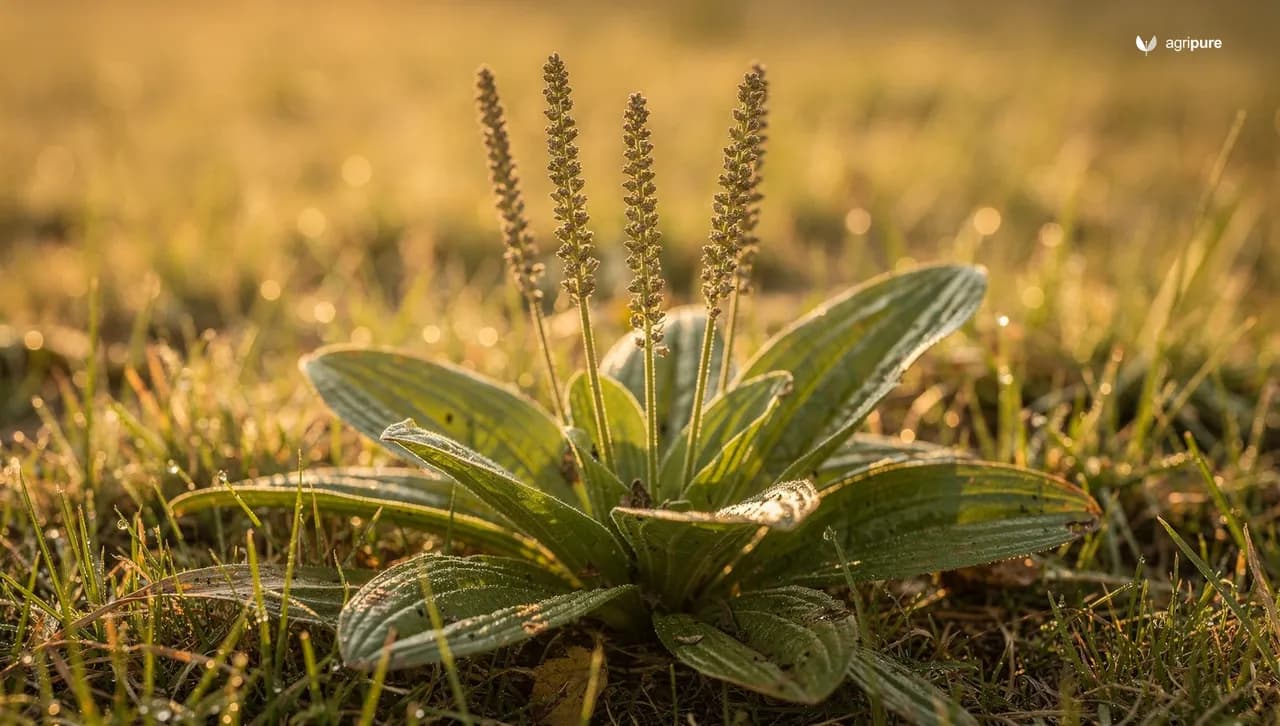
Broadleaf (Plantago major) and narrowleaf (Plantago lanceolata) plantain weeds growing side-by-side, showing their distinct leaf shapes for easy identification in your garden.
- The plantain weed in your lawn is Plantago, a genus of about 200 species. It has nothing to do with the banana plantain (Musa).
- Broadleaf plantain (Plantago major) has oval leaves 2 to 7 inches long with parallel veins; narrowleaf (P. lanceolata) has lance-shaped leaves 3 to 12 inches long.
- Both are perennials of lawns and compacted ground, and a single plant can shed up to 20,000 seeds from its leafless spike.
- The tender young leaves are edible raw or cooked; older leaves get stringy and are better cooked.
- The traditional leaf poultice for bites and scrapes has real bioactive compounds behind it, but human clinical evidence is still thin.
Most people meet plantain weed as the flat green rosette that shrugs off the mower in a worn patch of lawn. It throws up a thin stalk topped with a narrow seed spike, and within a season one plant can scatter up to 20,000 seeds. Learn to read it on sight and it stops being a nuisance and becomes one of the most useful wild greens within 10 feet of your back door.
This guide is about positive identification first. There are 2 common species (broadleaf and narrowleaf plantain), and a name collision with the banana plantain that confuses half the people who search for it. Here is how to tell the 2 weeds apart across 5 traits, where they grow, what is genuinely edible, and an honest read on the old poultice remedy.
Positive ID: parallel veins and a seed spike
Two features settle a plantain identification before you look at anything else: 3 to 7 parallel leaf veins and a leafless seed spike. University of Minnesota Extension describes the leaves as broad and oval, narrowing sharply at the base, with veins that grow from the base parallel to the leaf tip. That parallel venation, running the length of the blade rather than branching like a net, is the single most reliable field mark on both species.
The second giveaway is the flower. Plantains push up a slender, leafless stalk carrying a dense spike of tiny green-to-white flowers, up to 400 on a single head. The whole plant sits low, roughly 6 to 12 inches tall, in a flat basal rosette that survives being walked on and mowed. If you see parallel-veined leaves in a ground-hugging rosette under a thin seed spike, you have plantain.
Three checks before you call it
Run these 3 checks and you will be right nearly every time, because the combination rules out lookalikes that share any single trait.
- Veins: 3 to 7 prominent veins running parallel down the leaf, meeting at a grooved leaf stem, not a branching net.
- Spike: a bare stalk with a cylindrical or cone-shaped seed head, no leaves on the flowering stem.
- Habit: a flat rosette growing from a single crown, common in compacted soil, lawns, and path edges.
Foraging rule: identify to species with at least 2 independent features before eating any wild plant. Plantain’s parallel veins plus a leafless seed spike are an easy, low-risk combination, but never harvest from sprayed lawns or roadside verges.

Broadleaf versus narrowleaf plantain
Those rosettes come in two species you will actually meet, easy to separate once you know the leaf shape and the spike. UC Statewide IPM Program gives the cleanest numbers. Broadleaf plantain (Plantago major) has smooth oval blades 2 to 7 inches long and flowering stalks to about 15 inches. Narrowleaf or buckhorn plantain (P. lanceolata) has a taproot and longer, lance-shaped leaves 3 to 12 inches long, with stalks reaching 18 inches and a short, bullet-shaped flower head ringed with pale stamens.
Both are perennials, so a mid-summer mow only delays them. The seed head also differs: NC State Extension notes that in narrowleaf plantain the flowers and seeds cluster toward the very top of the stem, while broadleaf carries seed much further down a longer spike. Once you have keyed out 2 or 3 plants, the difference reads at a glance across a lawn.
What sets each apart
The table below puts the 2 species side by side on the 5 traits that matter for a quick call in the field.
Trait | Broadleaf (P. major) | Narrowleaf (P. lanceolata) |
|---|---|---|
Leaf shape | Broad oval, 2-7 in | Narrow lance, 3-12 in |
Veins | Parallel, prominent | Parallel, ribbed |
Flower stalk | To 15 in, long spike | To 18 in, short head |
Root | Fibrous, shallow | Taproot |
Preferred site | Moist, compacted soil | Drier, disturbed ground |
For the kitchen the distinction barely matters: both are edible and taste similar. For weed control it matters more, because the narrowleaf taproot snaps and resprouts, much like the one on a dandelion, while broadleaf lifts more cleanly after rain.
It is not the banana plantain
That lawn rosette has a name problem that trips up nearly everyone. The plantain in your lawn is Plantago, a genus of about 200 species of small herbs, and it is completely unrelated to the starchy cooking banana, which sits in the genus Musa, family Musaceae. They share an English name and nothing else: different family, different continent of origin, different plant entirely.
The weed got the name first. Plantago comes from the Latin for the sole of a foot, a nod to the flat, ground-pressed rosette. So when a foraging note says plantain is one of the most useful backyard greens, it means the 2 inch lawn rosette, not the foot-long fruit you fry. Clear that up once and the rest of the plant makes sense.
Name check: lawn plantain = Plantago (a low broadleaf weed); cooking plantain = Musa (a banana relative). If a recipe calls for frying it in oil, it is not the one growing in your grass.

Eating young plantain leaves
That same easy plant makes one of the gentler wild greens to start foraging with, partly because positive ID is so straightforward. NC State Extension confirms the leaves of narrowleaf plantain can be eaten raw or cooked, and the same holds for broadleaf. The catch is texture: the leaves toughen within about 4 to 6 weeks of emerging, so the window for raw eating is narrow.
Harvest the youngest inner leaves, ideally under 3 inches, before the plant sends up a seed spike. At that stage they are mild and tender in a salad. Older leaves develop the stringy parallel ribs you can feel on your tongue, and they are far better wilted into soups, blanched for 2 to 3 minutes, or chopped into a stir-fry where the heat softens the fibre.
- Raw: only the smallest spring leaves, torn into salads; strip out the tough central rib first.
- Cooked: blanch or sauté older leaves for 2 to 3 minutes, the way you would treat slightly tough wild greens in a food forest.
- Seeds: the ripe spikes carry tiny seeds related to the psyllium husk sold as fibre, the same genus as blond psyllium.
Because plantain pulls nutrients from wherever it grows, harvest only from ground you trust. Avoid any lawn treated with herbicide in the past 12 months, stay at least 30 feet back from busy roadsides, and rinse leaves well, the same caution you would apply to greens from your own living garden soil.
The poultice tradition and the honest evidence
That same lawn plant carries plantain’s oldest reputation, as a wound and bite remedy going back more than 2,000 years. The traditional use is a leaf poultice: crushed or chewed fresh leaves pressed onto insect bites, stings, scrapes, and minor sores. That folk practice is genuinely ancient and geographically widespread, and it is not pure superstition: the leaves carry real bioactive compounds.
A 2023 peer-reviewed review in Pharmaceuticals describes Plantago major as a herb long valued in traditional medicine, rich in phenols, flavonoids, and saponins with documented anti-inflammatory and antimicrobial activity in laboratory work. In one animal study, a P. major extract healed burn wounds at least as well as standard silver sulfadiazine cream.
Honest evidence note: most plantain studies are lab or animal work, with only a handful of small human trials. Treat a fresh-leaf poultice as reasonable first aid for a minor sting, not a substitute for medical care on anything deep, infected, or slow to heal.
The sensible read is plain: a chewed plantain leaf on a mosquito bite is a low-risk, time-tested comfort, and there is plausible chemistry behind why it soothes within minutes. Human clinical evidence remains limited, though, resting on a handful of small trials rather than large studies, so keep expectations modest and seek proper care for any wound that is deep, infected, or still raw after 2 to 3 days.
Conclusion
This plantain weed rewards a second look in any lawn. Confirm the 3 to 7 parallel veins and a leafless seed spike, sort broadleaf from narrowleaf by leaf width, and remember it is Plantago and not the banana. From there it is a free, gentle wild green for the youngest leaves and a 2,000-year-old poultice for a bite, used with clear eyes about how thin the human evidence still is.
Frequently asked questions
Is the plantain weed the same as a banana plantain?
No. The lawn weed is Plantago, a genus of about 200 small herbs, while the cooking or banana plantain is in the genus Musa. They share only an English name and are unrelated plants from different families.
How do I identify broadleaf versus narrowleaf plantain?
Broadleaf plantain (Plantago major) has oval leaves 2 to 7 inches long; narrowleaf (P. lanceolata) has lance-shaped leaves 3 to 12 inches long with a taproot. Both show parallel veins and a leafless seed spike, which together confirm the genus.
Can you eat plantain weed?
Yes. The tender young leaves can be eaten raw in salads, and older, tougher leaves are better blanched or cooked for 2 to 3 minutes. Only harvest from ground that has not been sprayed with herbicide.
Does a plantain leaf poultice actually work on bites?
The leaves contain phenols, flavonoids, and saponins with anti-inflammatory and antimicrobial activity in lab studies, and in one animal study a P. major extract healed burn wounds at least as well as a standard burn cream, so a fresh-leaf poultice is reasonable for minor stings. Human clinical evidence rests on only a handful of small trials, so seek care for serious wounds.
Where does plantain weed grow?
Both species are perennials of lawns, gardens, pastures, and path edges, and a single plant can scatter up to 20,000 seeds. Broadleaf plantain favors moist, compacted soil, while narrowleaf plantain grows best in drier, disturbed ground.
References
- UC Statewide IPM Program — Plantains
- University of Minnesota Extension — Plantain
- NC State Extension Gardener Plant Toolbox — Plantago lanceolata
- Pharmaceuticals (2023) — Biomedical Properties of Plantago major Extracts
- USDA NRCS PLANTS Database — Plantago major
- Plantago — Botanical Overview and Name Distinction