Key takeaways

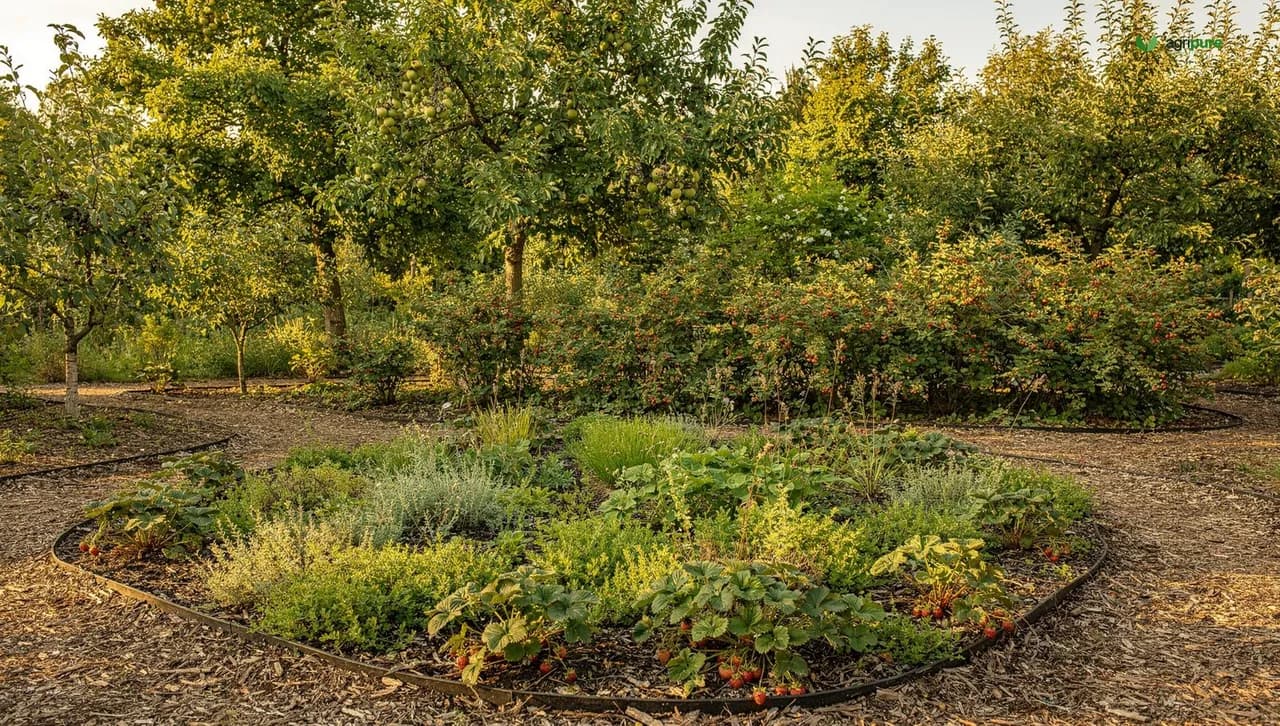
An established food forest demonstrates the seven layers of an edible ecosystem, providing a continuous harvest of fruits, nuts, berries, and herbs from a small plot of land.
- A food forest is a designed edible ecosystem that mimics a young woodland in structure and function.
- Robert Hart’s classic model uses 7 layers: canopy, sub-canopy, shrub, herbaceous, ground cover, root, and vine.
- Layers stack production vertically, so 1 acre can yield fruit, nuts, berries, herbs, and tubers at once.
- Most temperate food forests take 5 to 7 years to feel productive and 10-plus years to mature.
- You can start one on a quarter acre, or even a back corner — Robert Hart’s original plot was 0.12 acres.
A food forest is a garden that, after a few years, stops looking like a garden. The rows blur, the trees close ranks, and the work shifts from planting and weeding to picking and pruning. Defined by the UMN Extension as a food production system that uses perennial plants combined with annuals in a multi-story cropping design, it is the orchard cousin of agroforestry and the design ideal that permaculture design keeps coming back to. The classic temperate model has 7 layers — and you can plant a meaningful one in a back yard.
What a food forest actually is
Strip the romance out of it and a food forest is a deliberate stack of edible perennials, from a few canopy trees down to root crops, planted so each layer feeds the next. UMN Extension calls it three to seven layers in a multi-story design. Its plain three-layer example is apple and cherry overhead, hazelnut and Juneberry in the middle, and asparagus and rhubarb at ground level. The principle is the same at any scale: vertical stacking turns one patch of ground into several yields.
Annual vegetable garden | Food forest |
|---|---|
Replanted every spring | Mostly perennial — planted once, harvested for years |
1 yield layer (the ground) | 3 to 7 yield layers stacked vertically |
High inputs: tilling, fertiliser, water | Self-mulching once mature; light pruning |
Predictable annual harvest | Staggered harvest from spring buds to autumn nuts |
The seven layers, explained
Those yields come from a model worked out by Robert Hart, an English smallholder who in the 1980s adapted tropical home-garden principles to a temperate climate at Wenlock Edge in Shropshire. Hart’s plot was just 0.12 acres. The forest gardening literature lists his seven strata in order: canopy, sub-canopy, shrub, herbaceous, ground cover, vine, and the root zone.

Layer | What grows there | Temperate examples |
|---|---|---|
1. Canopy | Tall fruit and nut trees | Standard apple, chestnut, pecan (site black walnut, Juglans nigra, separately with juglone-tolerant pawpaw or mulberry, as walnut juglone is toxic to apples and pears) |
2. Sub-canopy | Smaller fruit trees | Pawpaw, dwarf cherry, semi-dwarf apple |
3. Shrub | Berry and nut bushes | Hazelnut, blueberry, elderberry, currant |
4. Herbaceous | Herbs and perennial vegetables | Comfrey, lovage, sorrel, asparagus |
5. Ground cover | Low spreaders, often nitrogen-fixing | Strawberry, white clover, creeping thyme |
6. Root | Tubers and bulbs below ground | Jerusalem artichoke, horseradish, garlic |
7. Vine | Vertical climbers on trees and trellises | Hardy kiwi, grape, hops |
Why it outperforms a row of vegetables
Those seven layers are doing more than packing in yield. NC State Cooperative Extension describes food forests as systems designed to replicate ecosystems and growing patterns found in nature. The Springer journal Agroforestry Systems frames forest gardens as systems that mimic the multi-layered vegetation structure of natural forests, predominantly using edible perennials. The practical payoff is that a mature food forest needs less water, less weeding, and less replanting than the same area in annual rows — because the system is doing what woodlands already do for free.

Starter species by USDA hardiness zone
Those layers only work with species that survive your winters. The species below are workhorse choices used in USDA zones 5 through 9: NC Cooperative Extension lists pawpaw, fig, apple, persimmon, mulberry and pear in the canopy, with goji, elderberry, blueberry, raspberry and bush cherry in the understory, and strawberry, clover, oregano, mint and calendula at ground level. Substitute aggressively for your region: what works in Asheville will not work in Tucson.
Zone (USDA) | Canopy | Shrub | Herbaceous / ground |
|---|---|---|---|
5 | Apple, pear, plum, black walnut | Hazelnut, elderberry, currant | Comfrey, rhubarb, strawberry |
6 | Apple, pawpaw, persimmon, chestnut | Blueberry, hazelnut, gooseberry | Sorrel, asparagus, clover |
7 | Pawpaw, persimmon, mulberry, pecan | Blueberry, goumi, goji (Check state and regional noxious-weed lists before planting Elaeagnus species: autumn olive and Russian olive are regulated invasive shrubs in many jurisdictions.) | Mint, oregano, strawberry |
8 | Fig, persimmon, mulberry, jujube | Blueberry, goji, pomegranate (warm 8) | Lemongrass, oregano, sweet potato |
9 | Citrus, fig, jujube, loquat | Pomegranate, guava (warm 9), elderberry | Sweet potato, perennial onion, thyme |
Pick by what you already eat: a food forest only earns its keep if the family eats the fruit. Start with 2 or 3 species you reach for every week — berries, apples, herbs — and build around them. The encyclopedic species list can wait.
First three years — what to expect
Those species lists set the planting list, but the first season is mostly trees and dirt. By year three the canopy is closing, the shrubs are bearing, and the ground cover has knit. Most temperate food forests take 5 to 7 years to feel productive and 10-plus to mature — slow enough that planning matters and fast enough that you will see it in your kitchen.

How to start small
That timeline is also the case for starting small. The Beacon Food Forest in Seattle — the largest public food forest in the United States — sits on 7 acres of Seattle Public Utilities land, but it began with 1.75 acres planted in September 2012. Robert Hart’s original was 0.12 acres. Pick a sunny corner, plant the canopy first, and let the shrubs and ground cover follow as the trees throw shade. A silvopasture trial or a small syntropic alley uses the same logic at field scale.
The takeaway
Starting small is the point. A food forest is not a wilder vegetable garden — it is a different system entirely, one that trades annual labour for decades of stacked, perennial yield. Start with the canopy, fill in the shrubs and ground covers, and plan for 5 to 7 years before it feels like a forest. Hart did it on 0.12 acres; Beacon did it on 7. The pillar is the same: design the layers, then let the woodland do the work.
Frequently asked questions
What is a food forest in simple terms?
It is a garden of edible perennials designed in vertical layers, from tall fruit and nut trees down to root crops, that mimics how a young woodland grows. Once mature it needs much less weeding, watering, and replanting than annual rows because the system does for itself what a forest already does for free.
What are the seven layers of a food forest?
The classic Robert Hart model lists canopy trees, understory or sub-canopy trees, shrubs, herbaceous plants, ground cover, root crops, and vines. The UMN Extension notes that a working design can use anywhere from three to seven layers depending on space and ambition.
How long does a food forest take to mature?
Most temperate food forests start producing meaningful berry and herb harvests in years 2 to 3, first major tree harvests around year 5 to 7, and reach a mature, low-input state at roughly year 10. The exact timeline depends on starting tree size, climate, and species choice.
How big does a food forest need to be?
It can be very small. Robert Hart’s original forest garden in Shropshire was 0.12 acres, and many backyard food forests work on a quarter to a half acre. The Beacon Food Forest in Seattle, the largest public example in the US, sits on 7 acres but began with 1.75.
Is a food forest the same as permaculture?
No, but it is one of permaculture’s signature designs. Permaculture is a broader design philosophy for cultivated ecosystems; a food forest is a specific multi-layered planting that permaculture practitioners commonly use to deliver perennial yields with low maintenance.
What is the difference between a food forest and an orchard?
An orchard usually grows one or two tree species in mowed rows with grass between them. A food forest stacks multiple species across seven layers — trees, shrubs, herbs, ground covers, roots, and vines — so the same ground produces several different harvests at different times of year.
References
- University of Minnesota Extension. “Planting a community food forest.” extension.umn.edu
- N.C. Cooperative Extension, Wilkes County. “Planting a Food Forest.” wilkes.ces.ncsu.edu
- Wikipedia. “Forest gardening” (Robert Hart’s seven-layer model). en.wikipedia.org
- Wikipedia. “Beacon Food Forest.” en.wikipedia.org
- Lopez et al. (2025). “Food forests and forest gardens: Definition, practical application and role in sustainable development,” Agroforestry Systems (Springer). link.springer.com
- Seeds for Sustainability. “What is a food forest?” seeds-for-sustainability.com