Key takeaways
Newly sprouted cover crops emerge from moist garden soil.
Cover crops protect the soil surface, suppress weeds, and add organic matter as they break down.
- Cover crops do 5 jobs at once: feed soil organic matter, fix or scavenge nitrogen, suppress weeds, stop erosion, and hold moisture — all for the price of a packet of seed.
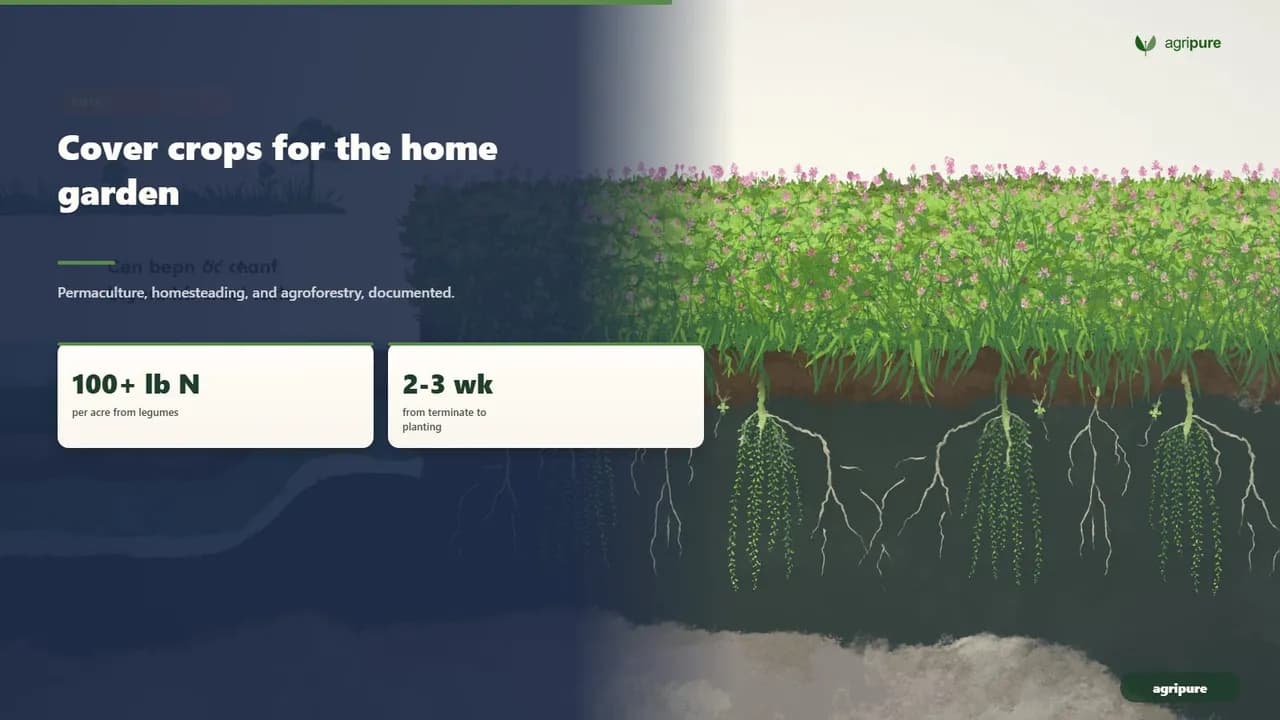
- Legumes (clover, vetch, cowpea, winter peas) fix nitrogen — a strong stand can supply over 100 lb N per acre. Grasses (rye, ryegrass, oats) build biomass and scavenge leftover nitrogen.
- Match the crop to the season: cowpea, buckwheat, and sorghum-sudangrass for summer; cereal rye, ryegrass, crimson clover, and hairy vetch for fall and winter.
- Seed by the 1,000 square feet, not the acre — roughly 2 to 4 lb of cereal rye, 1/2 to 2/3 lb of crimson clover, 1 to 2 lb of cowpea.
- Terminate at flowering for the most benefit, and the home-garden methods need no tractor: let it winterkill, tarp it, chop-and-drop it, or roll-and-crimp it.
- Wait 2 to 3 weeks after terminating before you plant — the residue needs time to start breaking down.
“A bare bed in winter is a bill you pay in spring — in lost nitrogen, eroded topsoil, and a flush of weeds. A cover crop is the cheapest insurance against all three.”
The single most effective thing you can do for garden soil between cash crops costs about $5 and a few minutes of broadcasting seed. A cover crop (such as a stand of rye, clover, cowpea, or buckwheat grown specifically to feed the soil) does the work that bagged fertilizer, weed fabric, and erosion netting do, all at once, and leaves the ground better than it found it. This is the green-manure layer that sits alongside composting and mulch in any plan to build healthy garden soil, except a cover crop composts itself in place with its roots already in the ground.
This guide is practical and species-specific: what cover crops actually do, which 9 to use in which season and at what seeding rate, and how to kill and incorporate one without a tractor. Everything here is sized for a backyard bed rather than a commercial field.
What cover crops actually do
A cover crop earns its keep 5 ways at once, which is why a single sowing can replace several inputs. Clemson’s home-garden extension lists the core benefits plainly: cover crops protect soil from erosion, suppress weeds, hold soil moisture, add organic matter, and recycle nutrients that would otherwise leach away over winter. The organic matter left when the crop decomposes improves soil structure, aeration, and water-holding capacity — the same payoff as a heavy compost dressing, grown in place.
The biggest split is between what a legume does and what a grass does, and the best plantings use both. Legumes (crimson clover, hairy vetch, cowpea, Austrian winter peas) host bacteria that fix atmospheric nitrogen into a plant-available form. SARE notes a strong legume stand can supply over 100 lb of nitrogen per acre to the next crop if grown to flowering. Grasses and non-legumes (cereal rye, ryegrass, oats, buckwheat) are grown mainly for biomass; their fibrous roots scavenge leftover nitrogen so it does not wash away, and they are more likely than legumes to raise soil organic matter. Decomposing cereal rye even has an allelopathic effect that chemically suppresses small broadleaf weed seeds.
Which species, and how much seed
Those two roles, legume and grass, map onto the species you choose. The table below lists 9 reliable cover crops for a home garden sorted by season, with the benefit each one leads on and a seeding rate scaled to 1,000 square feet instead of per-acre figures. A typical raised bed is 32 to 100 square feet, so a single pound of most of these seeds covers several beds.
Cover crop | Type | Season | Seed per 1,000 sq ft | Leads on |
|---|---|---|---|---|
Cereal rye | Grass | Fall / winter | 2-4 lb | Biomass, weed suppression |
Annual ryegrass | Grass | Fall / winter | 1/2-2 lb | Fibrous roots, nitrogen scavenging |
Winter wheat | Grass | Fall / winter | 1.5-4 lb | Biomass, erosion control |
Crimson clover | Legume | Fall / winter | 1/2-2/3 lb | Nitrogen (2-3 lb N/100 sq ft) |
Hairy vetch | Legume | Fall / winter | 1/2-1 lb | Nitrogen (~2 lb N/1,000 sq ft) |
Austrian winter peas | Legume | Fall / winter | 2-3 lb | Nitrogen, edible shoots |
Cowpea | Legume | Summer | 1-2 lb | Nitrogen in heat |
Buckwheat | Broadleaf | Summer | 1.5-2.5 lb | Fast cover, pollinators |
Sorghum-sudangrass | Grass | Summer | 1-2 lb | Huge biomass, weed suppression |
For the best of both worlds, mix a legume with a grass — the grass builds bulk and scavenges nitrogen while the legume fixes it. SARE’s guidance is to drop each species below its solo rate in a mix: sow the clover at about two-thirds of its normal rate and the partner grass at one-third to one-half of its monoculture rate, so the stand does not crowd itself. A classic fall mix is cereal rye with crimson clover and hairy vetch, at roughly 30, 10, and 20 lb per acre.
A seasonal sow chart
That species list only works if you sow each crop in its window. Cover crops divide cleanly into warm-season types that grow on summer heat and cool-season types that establish in fall and overwinter, and the timing is driven by frost and soil temperature.
Summer cover crops
Warm-season crops fill the gap between a spring crop coming out and a fall crop going in. Sorghum-sudangrass needs soil at 65 to 70°F and about 2 months before frost to throw its huge biomass; buckwheat is the sprinter, flowering in just 35 to 40 days and dying at the first light frost, which makes it a fast weed-smothering catch crop; and cowpea is the warm-season legume, sown after all frost danger and fixing nitrogen in heat that would stall clover. A summer mix of cowpea and buckwheat gives you nitrogen and quick cover together.
Fall and winter cover crops
Cool-season crops are the workhorses for the home garden because they fill the long bare months from harvest to spring. Cereal rye is the most reliable, germinating in cold soil and surviving hard winters to produce the most spring biomass of any cover crop. Crimson clover and hairy vetch are the nitrogen-fixing legumes to pair with it, and annual ryegrass and **winter wheat** round out the grass options. Sow these 4 to 6 weeks before your first hard frost so they establish a root system before winter.
Terminating without a tractor
That fall sowing leads to the question that stops most gardeners: how do you kill the cover crop in spring and turn it into food for the soil, without the roller-crimpers and flail mowers a farm would use? Iowa State Extension notes that those farm implements are not practical in a home garden, but 4 backyard-scale methods work just as well on a bed.
Timing matters more than method. Terminate at flowering, when the plant holds the most nitrogen and has not yet set seed; killing earlier leaves nitrogen on the table, and waiting until seed set risks a volunteer weed problem next year. Then wait 2 to 3 weeks before planting your vegetables, so the residue starts breaking down and the brief flush of microbial activity settles.
The four home-garden methods
Each method suits a different crop and a different gardener. Winterkill is the easiest of all: sow a crop like **oats or oilseed radish that dies over a cold winter, and by spring it is a brown mat you can plant straight through — no work, no machinery. **Occultation (tarping) lays an opaque tarp or cardboard over the living crop for 2 to 4 weeks; cut off from light, it dies and decomposes in place, leaving a clean stale seedbed. Chop-and-drop is the hand version of mowing: cut the crop at the base with a sickle, hedge shears, or a string trimmer, and leave the tops lying as a mulch that becomes the year’s organic matter. And roll-and-crimp, scaled down to a weighted board or a small drum, crushes the stems of a grass like rye at flowering so it dies flat in a uniform mulch.
A flowering cover crop chopped down at the base lies as a green mulch over the soil.
Chop-and-drop: the cover crop cut at flowering and left in place as a mulch that feeds the soil it grew in.
Method | Best for | How | Effort |
|---|---|---|---|
Winterkill | Oats, oilseed radish | Let a cold winter kill it; plant through the mat | None |
Occultation (tarp) | Any living crop | Cover with a tarp or cardboard 2-4 weeks | Low |
Chop-and-drop | Clover, vetch, buckwheat | Cut at the base; leave tops as mulch | Medium |
Roll-and-crimp | Cereal rye, wheat | Crush stems flat at flowering (50% anthesis) | Medium |
The nitrogen catch: C:N ratio and timing
One detail separates a cover crop that feeds the next planting from one that briefly starves it, and it comes down to the carbon-to-nitrogen (C:N) ratio of the residue you turn under. A young, leafy, nitrogen-rich cover crop breaks down fast and releases nitrogen to your crop. A mature, woody, high-carbon crop does the opposite: soil organisms pull nitrogen out of the soil to digest all that carbon, locking it up for weeks.
SARE puts a number on it: once a grass like cereal rye has a low percent nitrogen (around 1.5 to 2% N, which happens as stems elongate and flowering begins), little to no nitrogen helps the following crop, because the soil organisms use all of it decomposing the residue. The practical rule follows directly: terminate grasses on the younger side, before they get stemmy, and give any cover crop the full 2 to 3 weeks to break down before planting a hungry crop into that bed. Legumes, which run a lower C:N ratio, are far more forgiving and release their nitrogen sooner.
A garden bed is half covered by a black tarp pinned over a terminated cover crop, while the exposed soil is prepared for planting.
Occultation in progress: a tarp pinned over the cover crop kills it without tilling and leaves a clean, plantable bed.
Putting it together: a first cover-crop year
The whole system is simpler than the detail suggests, and a single year’s rotation shows how the pieces fit. The 5-step sequence below turns one garden bed into a year-round soil-building machine, and none of it asks for more than seed, a rake, and hand tools.
- Late summer: as a summer crop finishes, broadcast a fall mix of cereal rye with crimson clover, rake it in, and water. Sow 4 to 6 weeks before your first hard frost.
- Fall to winter: the rye and clover establish roots and green the bed; they hold the soil and capture nitrogen through the cold months while the bed would otherwise sit bare.
- Early spring: the stand greens up and grows fast as it heads toward flowering — the nitrogen peak.
- At flowering: terminate by chop-and-drop or tarp, leaving the residue on the surface as mulch.
- 2 to 3 weeks later: plant your spring vegetables straight into the enriched bed.
Do that on even one bed and the difference shows by the second season: darker, looser soil, fewer weeds, and a measurable nitrogen credit you did not buy in a bag. Then expand the habit bed by bed, and the garden starts feeding itself.
Frequently asked questions
What are the benefits of cover crops?
Cover crops do 5 things at once: they add organic matter, fix or scavenge nitrogen, suppress weeds, prevent erosion, and hold soil moisture. A strong legume stand can supply over 100 lb of nitrogen per acre to the next crop, and grasses build biomass and capture leftover nitrogen that would otherwise leach away over winter — all for the cost of a packet of seed.
What is the best cover crop for a home garden?
Cereal rye is the most reliable cool-season choice — it germinates in cold soil, overwinters hard, and produces the most spring biomass of any cover crop. Pair it with crimson clover or hairy vetch to add nitrogen, sowing 4 to 6 weeks before frost. For summer, cowpea and buckwheat are easiest. For the least work of all, sow oats or oilseed radish in fall and let winter kill them.
How do you terminate a cover crop without tilling?
Four home-garden methods need no tractor: let a winterkill crop like oats die over a cold winter, tarp the living crop for 2 to 4 weeks (occultation), chop it at the base and leave the tops as mulch (chop-and-drop), or roll and crimp a grass like rye flat at flowering. Terminate at flowering and wait 2 to 3 weeks before planting.
How much cover crop seed do I need per 1,000 square feet?
It varies by species: roughly 2 to 4 lb of cereal rye, 1/2 to 2 lb of annual ryegrass, 1/2 to 2/3 lb of crimson clover, 1/2 to 1 lb of hairy vetch, 1 to 2 lb of cowpea, and 1.5 to 2.5 lb of buckwheat. In a mix, cut each species below its solo rate so the stand does not crowd itself.
How long after a cover crop can you plant vegetables?
Wait 2 to 3 weeks after terminating the cover crop before planting. The residue needs time to begin breaking down, and there is a brief period where decomposing high-carbon material (like mature grass) ties up soil nitrogen. Terminating at flowering, when nitrogen content is highest, shortens that lag.
References
- Cover Crops — Clemson Cooperative Extension Home & Garden Information Center
- Cover Crops (Building Soils for Better Crops, Ch. 10) — SARE
- How to Terminate Cover Crops in the Vegetable Garden — Iowa State University Extension
- Offing Cover Crops for Weed Suppression: The Roller Crimper — University of Maryland Extension
- Summer Cover Crops — NC State Extension
- Crop Rotation with Cover Crops (Managing Cover Crops Profitably) — SARE
- Selecting the Best Cover Crops for Your Farm — SARE