Key takeaways
A close-up, photorealistic image of a young Lamb's Quarters plant with a hand gently pinching a leaf. The plant's distinctive goosefoot-shaped leaves are visible, and a fine, flour-like white mealy coating is clearly visible on the underside of the pinched leaf and slightly dusting the fingertips, demonstrating the key identification feature. The background is softly blurred to show a natural garden setting.
The tell-tale sign of Lamb’s Quarters (Chenopodium album): a fine, flour-like white mealy coating that rubs off on your fingers, especially dense on the leaf undersides. This unique feature is your most reliable identifier, distinguishing it from toxic look-alikes.
- The single most reliable ID feature is the white mealy coating — a flour-like dust on young upper leaves and all leaf undersides that rubs off on your fingers.
- Leaves are goosefoot-shaped, toothed, up to 5 inches long; the plant runs from about 4 inches to 6 feet tall as a summer annual.
- Toxic nightshade seedlings can look similar but lack the mealy coating entirely — that dusting is your safety check.
- Raw leaves hold about 1,112 mg of oxalate per 100 g dry matter; boiling cuts that to roughly 683 mg, so cook it and eat it in moderation.
- Lamb’s quarters concentrates nitrate, so skip plants from fertilized cropland, manure piles, or roadsides.
Walk past any disturbed garden edge in early summer and you will likely brush against lamb’s quarters without naming it. Pinch 1 young leaf and look closely: a fine, pale dust comes off on your skin like talcum powder, densest on the underside. That single trait, more than leaf shape or height, is what tells you that you have found Chenopodium album (wild spinach) and not 1 of its riskier look-alikes.
This plant grows on every continent but Antarctica, shrugs off poor soil, and out-yields most things you deliberately plant. Below is how to make a positive identification, the 2 honest cautions every forager should know, and how to turn a dismissed garden weed into the best free green of the season.
Reading the plant: a positive ID
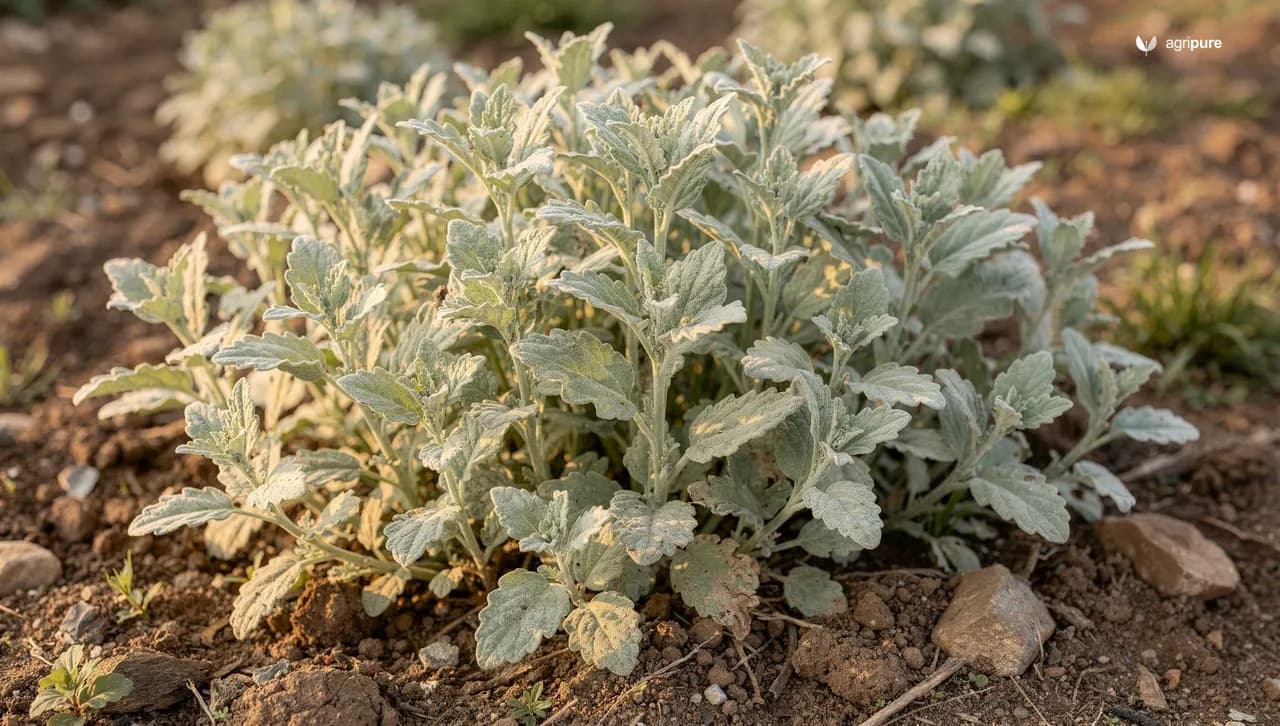
Identification starts with the coating. North Carolina State Extension describes a white mealy coating produced by tiny hairs on the leaves, and the leaves themselves as goose foot-shaped with some teeth along the edge, growing up to 5 inches long. The UMass Weed Herbarium puts the same coating especially below, on leaves that are alternate, triangular, and toothed. Run a young plant through all 4 checks before you pick.
Size alone will not identify it — NC State records the plant anywhere from 4 inches to 6 feet tall depending on conditions, and it is a summer annual that bolts fast in warm weather. Look instead at the diamond-to-triangular leaf outline, the toothed margins, and the way young upper growth often carries a faint pink or purple tint at the leaf base.
The four-point field check
Match all 4 boxes below before a leaf goes in your basket. Any 1 of them failing means you stop and look harder.
- The mealy dust: rub a young leaf; a flour-like white powder should come off, heaviest on the underside.
- Leaf shape: goosefoot or diamond outline, 1 to 5 inches long, with shallow teeth, not smooth ovals.
- Growth habit: upright, single main stem branching with age, often ridged or red-streaked.
- Setting: disturbed, fertile ground (garden edges, old manure, fence lines) where this annual thrives.
The mealy coating is non-negotiable. Per the MOFGA plant profile, that powder repels water and disappears upon cooking — but on the living plant it is the trait that confirms wild spinach over a look-alike. No dust, no harvest.
A close-up of a young lamb's quarters leaf showing the pale white mealy powder coating the surface and gathering thickly on the underside veins.
Telling it apart from toxic nightshade
The look-alike that matters is young nightshade (Solanum species), whose seedlings can sit in the same disturbed soil and reach a similar 4 to 8 inch height before either plant flowers. Get this wrong and you trade a nutritious green for a plant that carries solanine. Here is the reassuring part: the 1 trait that confirms lamb’s quarters is the exact trait nightshade lacks.
Four Season Foraging notes that lamb’s quarters first appears with leaves covered in a whitish mealy coating, becoming alternate and more triangular or diamond-shaped with age. Nightshade seedlings, by contrast, have smooth or slightly hairy egg-shaped leaves with 0 dusting at all, and they later set small round berries that ripen black. If you see clean, glossy leaves with no powder on either of the 2 leaf surfaces, treat the plant as suspect and leave it.
- Lamb’s quarters: mealy white dust, goosefoot leaves up to 5 inches, tiny green flower clusters at the stem, seeds dark and gritty.
- Black nightshade: no dust, egg-shaped glossy leaves, small 5-petalled star-shaped white flowers, round green-to-black berries.
When in doubt, throw it out. A 30-second rub test for the mealy coating costs nothing; misidentifying a nightshade seedling for a salad does not. New foragers should cross-check against the Chenopodium album (bathua) plant profile to train their eye on the goosefoot family.
The 2 honest cautions: oxalate and nitrate
Lamb’s quarters is not a free pass, and pretending otherwise does foragers no favors. It carries 2 real compounds worth respecting. The peer-reviewed journal Foods measured the total oxalate of raw leaves at 1,112.4 mg per 100 g dry matter, which is high enough that people prone to kidney stones should be cautious with large raw servings.
Cooking is the lever that solves most of it. The same study found oxalate fell to 682.8 mg per 100 g after boiling (roughly a 39% drop) and to 883.6 mg after wok-frying. MOFGA notes that this oxalic acid, which can interfere with iron and calcium absorption, breaks down in cooking, and that cooks have long paired such greens with calcium-rich dairy. The second caution is nitrate: this plant concentrates it from rich soil.
Concern | The number | What lowers it | Who should care most |
|---|---|---|---|
Oxalate (raw) | 1,112 mg / 100 g DM | Boiling (down to ~683 mg) | Kidney-stone history |
Oxalate (boiled) | 683 mg / 100 g DM | Discard the boiling water | Daily heavy eaters |
Nitrate | Varies with soil | Avoid fertilized ground | Livestock, infants |
Sourcing | No spray history | Clean wild sites | Every forager |
West Virginia University Extension confirms the plant is fine to eat: seedlings, leaves or tender stems consumed fresh or boiled as a potherb, while warning that in large quantities it may cause nitrate poisoning in livestock and oxalic acid trouble in some animals. The practical rule for the kitchen: pick from clean ground, cook the greens, and keep daily portions modest.
Harvesting and cooking wild spinach
Once you have a confident ID and a clean site, lamb’s quarters is among the easiest wild greens to gather. Harvest the top 4 to 6 inches of tender growth and the youngest leaves; these have the mildest flavor and the lowest fiber. Pinching the growing tips makes the plant branch and re-leaf, so a single patch can give 3 or 4 cuttings across a summer before it bolts to seed.
Treat it exactly as you would spinach, because it cooks down the same way and, per MOFGA, outclasses spinach for protein, calcium, iron, vitamin C, and vitamin A. A heaping colander of leaves wilts down to about 2 cups. A hand weeder and cultivator helps lift whole young plants cleanly when you are thinning a thick stand for the kitchen.
Three ways to put it on the plate
Each of these 3 methods handles the oxalate and the mealy texture a little differently, so pick by the dish.
- Quick boil, 2 to 3 minutes: the biggest oxalate cut; drain and discard the water, then dress with oil, garlic, and lemon.
- Saute or wok: faster and tastier, with a smaller oxalate drop; pair with eggs, paneer, or a splash of cream for the calcium.
- Soups and dal: the classic bathua use — simmered into lentils or potato curry, where 10 minutes of cooking handles the rest.
For preserving a glut, blanch and freeze it in portions exactly as you would put up any harvest in the homesteading kitchen. If you want a cultivated row instead of a foraged stand, the same growing rhythm that gives you a continuous salad supply of lettuce works for sowing wild spinach in succession.
From garden weed to deliberate crop
Most growers meet lamb’s quarters as a weed pulling nitrogen out of a fertile bed, and there the irony lands: the plant you fight all spring is more nutritious than the spinach you sowed. The honest move is to manage it rather than only eradicate it. In a no-dig, permaculture-style bed, you can leave 1 clean corner stand to harvest and pull the rest before each plant sets its tens of thousands of seeds.
That dual role, free food and soil indicator, makes it a natural fit for a wilder planting. A patch of self-seeding wild greens belongs in the understory of a perennial food forest, where it fills the disturbed-ground niche, feeds you in early summer, and dies back before the woody layers need the light. Manage 1 stand, eat from it weekly, and weed the rest.
Let one stand go to seed on purpose. A single mature plant drops tens of thousands of seeds, so 1 deliberate patch reseeds itself every year with zero effort — your easiest crop, free, on repeat.
A skillet of bright green cooked lamb's quarters greens wilted down with garlic, steam rising, on a rustic kitchen counter.
Conclusion
Lamb’s quarters rewards careful eyes more than any other beginner forage. Confirm the white mealy coating, rule out nightshade by that same dust, pick young tops from clean ground, and cook to knock the 1,112 mg raw oxalate down toward 683 mg. Do those 4 things and a plant most people poison off their beds becomes the most nutritious free green of your summer.
Frequently asked questions
How do I positively identify lamb’s quarters?
Look for the white mealy coating that rubs off young leaves and leaf undersides like flour, paired with goosefoot-shaped, toothed leaves up to 5 inches long on an upright summer annual. That powdery dust is the single most reliable feature.
How do I tell lamb’s quarters from toxic nightshade?
Lamb’s quarters carries the mealy white coating and goosefoot leaves up to 5 inches long; nightshade seedlings have smooth or hairy egg-shaped leaves with no dust and later set round black berries. If a leaf has 0 powder, treat the plant as suspect and do not eat it.
Is lamb’s quarters safe to eat given its oxalate?
Yes, in moderation and cooked. Raw leaves hold about 1,112 mg of oxalate per 100 g dry matter, but boiling drops that to roughly 683 mg, so cook it like spinach and keep daily portions modest, especially if you are prone to kidney stones.
Why should I avoid lamb’s quarters from fertilized soil?
The plant concentrates nitrate from rich ground, and large quantities can cause nitrate poisoning in livestock. Harvest from clean wild sites rather than fertilized cropland, manure piles, or sprayed roadsides, and keep well back from busy roads where soil also carries traffic residues.
How do I cook lamb’s quarters?
Treat it as wild spinach: boil the young tops for 2 to 3 minutes and discard the water for the biggest oxalate cut, or saute with garlic and a calcium-rich food like paneer or eggs. It outclasses spinach for calcium, iron, and vitamin A.
References
- NC State Extension Gardener Plant Toolbox — Chenopodium album (Lambsquarters)
- UMass Amherst Weed Herbarium — Chenopodium album
- Foods (2018) — Oxalate Contents of Raw, Boiled and Wok-Fried Fat Hen Leaves
- West Virginia University Extension — Common Lambsquarters
- Maine Organic Farmers and Gardeners Association — Lambsquarters
- Four Season Foraging — Identifying Lamb’s Quarters