Key takeaways
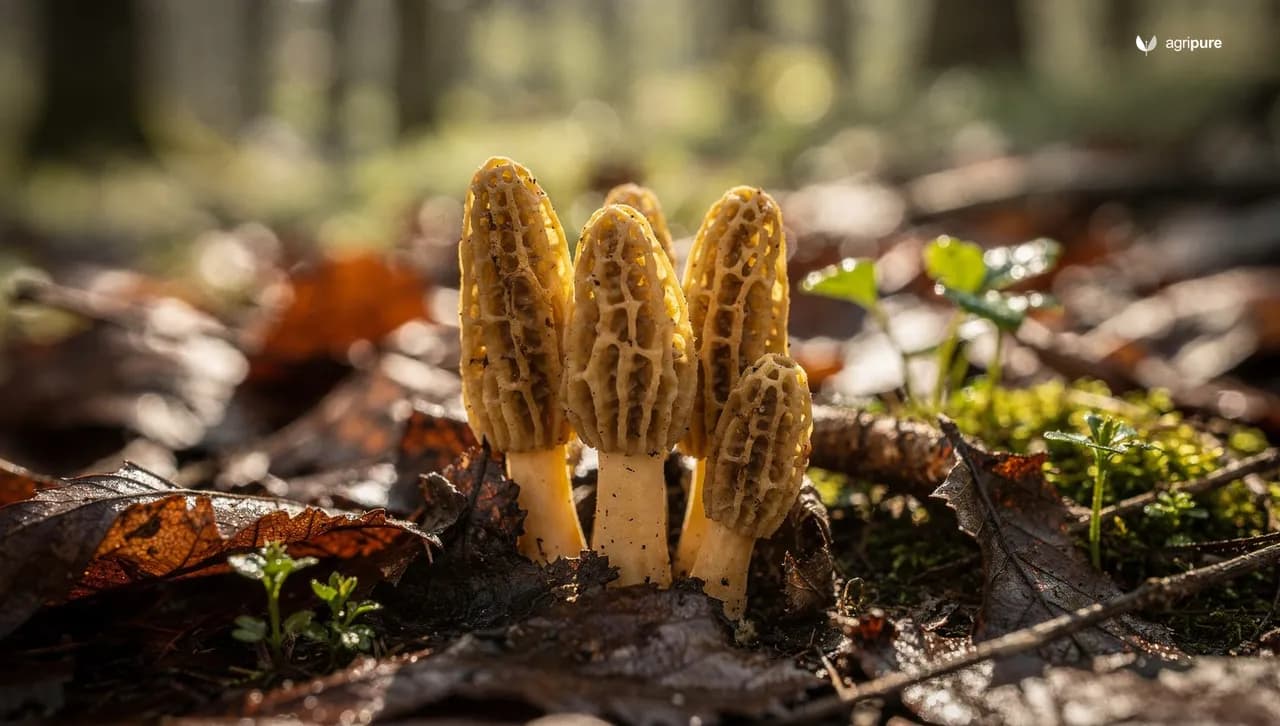
A photorealistic image showing a true morel (Morchella) with its characteristic pitted, honeycomb cap and hollow stem, positioned beside a false morel (Gyromitra) which has a wrinkled, brain-like cap and a visibly denser, chambered interior. Both mushrooms are emerging from dappled leaf litter on a forest floor.
Distinguishing a true morel from its toxic false counterpart is critical for safe foraging. Note the unique pitted cap and hollow interior of the true morel versus the wrinkled cap and dense, chambered interior of the false morel.
- A true morel has a pitted, honeycomb cap whose base is fused directly to the stem, with no skirt hanging free.
- Slice it top to bottom: a true morel is completely hollow, one continuous chamber from cap tip to stem base.
- The dangerous look-alike is a false morel (Gyromitra) — a wrinkled, brain-like cap that is cotton-stuffed or chambered inside, not hollow.
- Gyromitra carries gyromitrin, which the body turns into monomethylhydrazine, a toxin that injures the liver, kidneys, and nervous system.
- Never eat any morel raw; cook it at least 10 minutes in boiling heat, and eat only a small portion the first time.
A true morel reads like a little honeycombed sponge on a stalk, pushing up through leaf litter on a damp spring morning. Get the identification wrong and you can pick its toxic twin instead — so with mushrooms the standard is not 90% sure, it is 100% sure.
The good news is that a genuine morel carries 2 unmistakable tells that a false morel cannot fake: a pitted cap fused to the stem, and a body that is completely hollow when you slice it open. Learn those 2 checks, learn the wrinkled brain-like cap of a Gyromitra, and you can forage with confidence. Here is exactly how to read each feature, season and habitat included, plus the cook-it-through rules that keep a good find from turning into a hospital trip.
The pitted honeycomb cap, fused to the stem
The cap is the first of the 2 features to read, and a true morel’s cap is unlike anything else on the spring forest floor. The Missouri Department of Conservation describes it as a conical head covered with definite pits and ridges, resembling a sponge, pinecone, or honeycomb — irregular hollows pressed into the surface, not folds laid on top of it. That texture is the single most quoted morel feature, and for good reason: a Gyromitra cannot reproduce it.
The second half of the cap test is where the cap meets the stem. On a true morel, the bottom of the head is attached directly to the stem, so the lower edge of the cap is fused down rather than flaring out like a skirt. A cap that hangs free for even 1 inch at the bottom, draped over the stalk like a thimble on a finger, is a warning sign — that is the build of a Verpa or a half-free morel, not a fully attached true morel.
Three quick cap reads
- Pitted, not wrinkled: a true morel has sunken pits and raised ridges like a honeycomb; a false morel has lobes and folds laid over a smooth surface.
- Fused, not skirted: the cap base joins the stem with no gap; a cap that hangs loose is a different mushroom entirely.
- Roughly symmetrical: a true cap is conical or egg-shaped; a brain-like, saddle-shaped, or lopsided cap belongs to a Gyromitra.
One feature is never enough. The honeycomb cap alone does not confirm a morel — you still owe it the hollow-stem slice below before a single specimen goes in the basket.
Close-up of a yellow morel mushroom cap showing the deep honeycomb pits and ridges with the cap base fused to a pale stem.
Slice it lengthwise: the hollow test
If the cap gets you 80% of the way to an identification, the knife gets you the last 20%. Michigan State University Extension tells hunters to slice every mushroom lengthwise before cooking to verify it is a morel — and the same cut, made in the field, is your strongest single safety check. On a true morel the cap is attached to the hollow stem at its base, and that hollow runs the entire length.
Lay a confirmed morel on a board and draw the blade from cap tip to stem bottom. The Missouri Department of Conservation is blunt about what you should see: the stems of true morels are completely hollow. There is one continuous open chamber, top to bottom — no pith, no cotton, no stacked compartments. Anything packed with fibrous wisps, stuffed like cotton wool, or divided into chambers is not a true morel, full stop. The slice also lets you check for slugs or beetles hiding in the stem before the mushroom reaches the pan.
What the cut should and should not show
- True morel: 1 clean, empty cavity from the very tip of the cap down through the base of the stem.
- False morel (Gyromitra): a cotton-stuffed or chambered interior with cottony fibers or wispy partitions filling the space.
- Verpa look-alike: a stem loosely stuffed with cottony pith and a cap that is only attached at the very top, the top 10% or so.
Slice all of them, every time. Even on a patch you have picked for 10 years, cut each mushroom lengthwise. It costs 5 seconds and is the one habit that catches a false morel hiding in a basket of real ones.
The false morel, and why it is dangerous
The look-alike that lands people in the hospital is the false morel, a Gyromitra. Its cap is wrinkled, lobed, and brain-like or saddle-shaped rather than pitted, and inside it is stuffed or chambered rather than hollow: the exact opposites of the 2 true-morel tells. According to the StatPearls toxicology reference, Gyromitra esculenta produces gyromitrin, which the body metabolizes into the more potent cytotoxin monomethylhydrazine, the same chemical family used in rocket fuel.
The damage is systemic. That review notes poisoning victims may show a gastrointestinal prodrome followed by acute injury to the liver, kidneys, and central nervous system. A 2020 analysis in a peer-reviewed clinical journal is just as direct that false morels are Gyromitra species, which do not belong to the Morchellaceae family and are highly toxic, gyromitrin-containing species. While Gyromitra made up only about 0.55% of roughly 133,000 logged mushroom-exposure cases, home cooking cannot be trusted to remove the toxin reliably, so the safe rule is simple: treat every false morel as poisonous.
Two mushrooms, side by side
Across the 2 caps and the 2 interiors, the contrasts line up cleanly. A true morel is pitted and hollow; a false morel is wrinkled and stuffed. This table sorts the features hunters actually use in the field, so you can run all 4 checks before anything goes in the bag.
Feature | True morel (Morchella) | False morel (Gyromitra) |
|---|---|---|
Cap surface | Pitted, ridged, honeycomb | Wrinkled, lobed, brain-like |
Cap to stem | Fused at the base | Hangs free, draped over stem |
Inside (sliced) | Completely hollow | Cotton-stuffed or chambered |
Toxin | None (once cooked) | Gyromitrin to monomethylhydrazine |
Verdict | Edible, well cooked | Treat as poisonous |
If even 1 of the 4 rows points to the false-morel column, set the mushroom down. There is no morel worth a coin-flip on your liver, and a self-reliant kitchen is built on caution, not luck.
Where and when to find true morels
Identification gets easier when habitat and timing already point you at the right mushroom. University of Minnesota Extension notes that morels emerge annually in spring when there has been adequate rainfall, which in much of North America means a roughly 8-week window from late March through May. The Missouri Department of Conservation places the main flush in late March and through April, once soil temperatures climb into the 50s Fahrenheit.
Habitat narrows it further. Morels favor the edges of woodland, especially around dying or recently dead trees — elm, ash, apple, and old orchard ground are classic. A south-facing slope warms first and often fruits a week or 2 ahead of shaded north slopes. Reading the land this way is the same skill that underlies a working food forest: match the species to the spot, and the spot does half the work.
- Season: roughly late March to May, after soil reaches the low 50s Fahrenheit and rain has soaked in.
- Trees: dying elm and ash, old apple orchards, and the ground around recently dead hardwoods.
- Ground: well-drained woodland edges and south-facing slopes that warm 1 to 2 weeks earlier.
A note of honesty: a Gyromitra can fruit in the very same woods within the same 2-week window, so habitat raises your odds but never replaces the cap-and-slice checks. Carry a small folding knife and a clean trowel, and confirm all 4 features on every single mushroom on its own merits.
A spring hardwood forest floor with leaf litter and a fallen log, the kind of woodland edge habitat where morel mushrooms fruit.
Cook them right, and start small
A confirmed morel is still not safe to eat straight from the basket. The same NIH-indexed review is explicit that morels are not edible if eaten raw, and that cooking at least 10 minutes in boiling heat or more is what makes them safe — raw or undercooked morels regularly cause gastric upset. Michigan State University Extension keeps the rule plain for every wild mushroom: cook all mushrooms thoroughly.
Treat your own body as the final test, too. Extension guidance is to be careful the first time you eat a new mushroom — eat only a small amount and wait several hours for any reaction before making a meal of it. Skip alcohol with that first tasting, since some species react badly with it, and set 2 or 3 specimens aside uncooked in the fridge so a clinician can identify them if anything goes wrong.
The kitchen checklist
- Clean and halve: slice lengthwise again to confirm the hollow interior and rinse out any grit or insects.
- Cook 10 minutes plus: saute or simmer until fully cooked through; never serve raw or barely warmed.
- Start small: eat a modest portion the first time, with no alcohol, and wait several hours.
These 3 steps scale into broader preserving and putting-up work, where the same care with identification and at least 10 minutes of heat keeps the whole pantry safe.
Conclusion
Identifying a morel comes down to 2 features no false morel can fake and 1 cut that settles every doubt: a pitted honeycomb cap fused to the stem, and a body that is completely hollow when you slice it lengthwise. Read those, rule out the wrinkled, cotton-stuffed Gyromitra, cook your find at least 10 minutes, and start with a small portion. Done that way, the spring morel hunt stays one of foraging’s surest pleasures rather than its most dangerous gambles.
Frequently asked questions
What is the easiest way to identify a true morel?
Check 2 features together: a pitted, honeycomb cap whose base is fused to the stem, and a completely hollow interior when you slice it lengthwise. A true morel is one continuous open chamber from cap tip to stem base, with no cottony or chambered stuffing.
How do I tell a morel from a false morel?
A true morel has a pitted, sponge-like cap and a hollow inside; a false morel (Gyromitra) has a wrinkled, brain-like or saddle-shaped cap and an interior that is cotton-stuffed or chambered. Run all 4 field checks: if even 1 of them or the hollow-stem slice points the wrong way, do not eat it.
Are false morels poisonous?
Yes. False morels are Gyromitra species that contain gyromitrin, which the body converts to monomethylhydrazine and can injure 3 organ systems: the liver, kidneys, and central nervous system. Treat every false morel as poisonous, even though some traditions still eat them.
Can you eat morel mushrooms raw?
No. Even true morels are not edible raw and regularly cause gastric upset; cook them at least 10 minutes in boiling heat or thoroughly in a pan. Eat only a small amount the first time, skip alcohol with that tasting, and wait several hours to check for any reaction.
When and where do morels grow?
Morels fruit in spring, roughly late March through May, after rain and once soil warms into the low 50s Fahrenheit. Look at woodland edges and around dying or dead elm, ash, and old apple trees, favoring south-facing slopes that warm 1 to 2 weeks earlier.
References
- Missouri Department of Conservation — Morels (Field Guide)
- Warning on False or True Morels and Hydrazinic Toxins — Journal of Clinical Medicine (NIH PMC)
- Gyromitra Mushroom Toxicity — StatPearls (NCBI Bookshelf)
- Michigan State University Extension — Advice for morel hunters
- Michigan State University Extension — Michigan wild mushroom safety
- University of Minnesota Extension — Harvesting morel mushrooms