Key takeaways

Urban homesteading turns small city spaces, like a balcony with container vegetables and vertical planters, into places to grow food and build self-reliance.
- Urban homesteading is growing food, preserving it, and cutting what you buy, all on a city lot or balcony.
- Intensive methods can produce serious volume: one famous 1/10-acre lot grows 6,000 pounds of food a year.
- Containers and vertical planters let you garden with as little as 20 square feet.
- Where hens are banned, 6 quail fit a balcony and still give eggs.
- Check your local ordinance before you buy a single chick.
Homesteading does not require a farm. Urban homesteading takes the same goal, producing more of what you use, and fits it onto a city lot, a balcony, or a shared community plot. It pairs an old skill set with tight space: grow food, preserve it, and lean on the grocery store a little less each month. If you are weighing what homesteading is against a downtown address, the answer is that 200 square feet is enough to begin.
What urban homesteading means
At its simplest, urban homesteading is self-reliance scaled to the city: growing some of your own food, cooking from scratch, preserving the surplus, and closing waste loops with compost. It is the same direction a 40 acre homestead faces, just worked in square feet instead of acres, and it leans harder on 3 things, vertical space, containers, and clever storage.
Where you live | Realistic urban homesteading moves |
|---|---|
Apartment or balcony | Container herbs and greens, sprouting, fermenting, 6 quail |
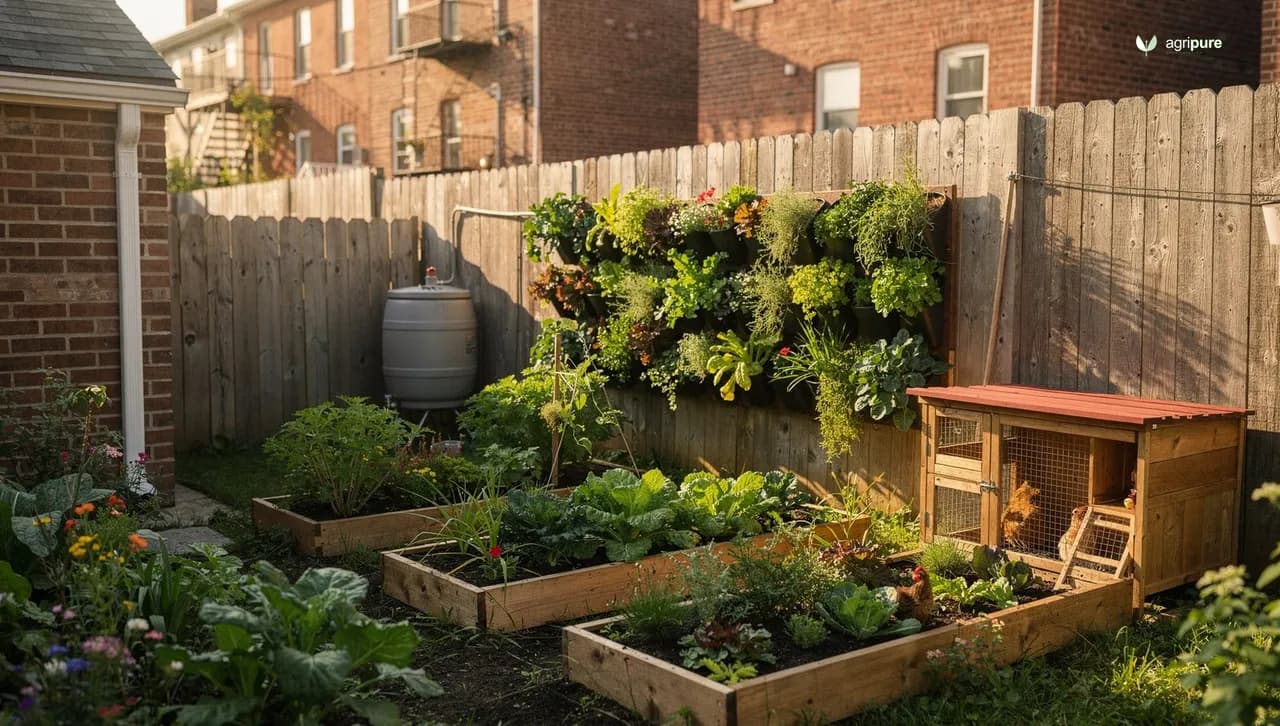
House with a small yard | Raised beds, a dwarf fruit tree, 4 to 6 hens, a rain barrel |
Community garden plot | A full vegetable patch shared with neighbors |
Grow more than you think in a small space
That small footprint goes further than most people expect. The best-known proof is the Dervaes family lot in Pasadena, which grows roughly 6,000 pounds of food a year on 1/10 of an acre. You will not match that in year 1, but it shows the ceiling is high when you garden intensively and grow up, not just out.


Start with 20 to 40 square feet of containers and vertical planters, pick high-value crops like greens, herbs, and a dwarf fruit tree such as a patio fig, and match each to your light. The plant profiles flag dwarf and container-friendly varieties, and if your space grows, our guide to homesteading on an acre picks up where a balcony leaves off.
Small livestock that fit a city lot
Those crops pair well with small stock, even downtown. Where zoning allows hens, 4 to 6 birds cover a household’s eggs on less than 1/10 of an acre. Where it does not, quail are the city workaround: 6 hens fit a balcony hutch, eat little, and start laying at just 6 to 8 weeks.

Close the loop without a backyard
Those animals and plants make waste you can recycle in almost no space, the same closed-loop thinking behind permaculture design. A worm bin fits under a sink and turns scraps into compost in about 3 months, while a bokashi bucket ferments all food waste, meat included, with no smell. Catch roof runoff in a 50 gallon barrel and you have closed the 2 biggest loops, food and water.

The windowsill rule: if a system needs more room than you have, shrink it, do not skip it. A single worm bin, 1 rain barrel, and 4 pots of herbs already cut your waste and your grocery list. Add the next piece only when the last one runs itself.
Check the rules before you start
That enthusiasm needs 1 reality check first: city rules. Many municipalities cap backyard flocks at 4 to 6 hens, ban roosters outright, and set coop setbacks from property lines. Read your local ordinance and any HOA bylaws before you spend a dollar, because moving an illegal coop later costs far more than checking now.
Hens | Quail |
|---|---|
Often capped at 4 to 6, roosters usually banned | Rarely regulated, quiet, no rooster needed |
Lay 1 egg most days at peak | Lay smaller eggs, 5 to 6 a week each |
The takeaway
Those rules just take some checking. Urban homesteading proves that self-reliance is a set of skills, not acreage: 20 square feet of containers, 6 quail, and 1 worm bin already cut into what you buy at the store. Start with 1 crop and 1 loop, and let next season add the next.
Frequently asked questions
What is urban homesteading, exactly?
It is practicing homesteading skills, growing food, preserving it, composting, and sometimes keeping small animals, in a city or suburb rather than on rural land. The goal is the same self-reliance; only the scale changes, from acres to square feet and containers.
How much can you really grow in a city?
More than most expect. The Dervaes family lot in Pasadena grows about 6,000 pounds of food a year on a tenth of an acre. A beginner with 20 to 40 square feet of containers can still supply most of a household’s herbs and salad greens.
Can I keep chickens in the city?
Often yes, but check first. Many cities allow 4 to 6 hens while banning roosters and setting coop setbacks. Where hens are not allowed, quail are a quiet, legal alternative that lay well in a small balcony hutch.
How do I compost without a yard?
Use a worm bin or a bokashi bucket. A worm bin fits under a sink and turns scraps into compost in about 3 months; bokashi ferments all food waste, including meat, in a sealed bucket with no odor. Both work in an apartment.
Where do I start with urban homesteading?
Pick one crop and one loop. Grow herbs or greens in containers, then add a worm bin or a rain barrel. Once that runs itself, layer on the next skill, preserving, quail, or a dwarf fruit tree.
References
- Wikipedia. “Urban homesteading.” en.wikipedia.org
- Attainable Sustainable. “Urban Homesteading Skills.” attainable-sustainable.net
- The Prairie Homestead. “How to Be a Suburban or Urban Homesteader.” theprairiehomestead.com
- Penn State Extension. “Management Requirements for Laying Flocks.” extension.psu.edu
- USDA Agricultural Research Service. “Plant Hardiness Zone Map.” planthardiness.ars.usda.gov