Key takeaways
A compact home biogas digester with connecting pipes and a gas storage bag in a vegetable garden.
Harnessing the power of organic waste, a small anaerobic digester efficiently converts food scraps and manure into biogas for cooking, while also producing nutrient-rich digestate for the garden.
- A home digester runs on warmth as much as on manure. The bacteria that make biogas work best at mesophilic temperatures around 35 C (95 F), and one North Carolina homestead found their system kept functioning down to 75 F but only hit its stride near 95 F, which is why cold North American winters, not feedstock, are the main barrier.
- Biogas is mostly methane and carbon dioxide, and that mix is modest fuel. Methane runs 45% to 75% by volume (commonly 55% to 65% on a farm digester), the rest mostly CO2, giving a lower heating value of 16 to 28 MJ/m3, roughly half to two-thirds the energy of pipeline natural gas at 36 MJ/m3.
- The output is a few hours of cooking, not whole-home electricity. At Living Web Farms, 2 lbs of food scraps a day yields about 20 cu ft of gas, and one cubic meter (35 cu ft) holds about 6 kWh, enough to keep a single cookstove burner going for 4 to 7 hours. A whole-farm electrical system needs the manure of 200 cows, not a backyard bucket.
- Anaerobic digestion is four microbial stages, and temperature governs all of them. Hydrolysis, acidogenesis, acetogenesis, and methanogenesis run in sequence; mesophilic digestion takes 15 to 30 days, and gas output tracks temperature so tightly that one cold-climate study found a cubic relationship between the two.
- Digestate is a secondary payoff. The slurry that leaves the digester is a nutrient-rich fertilizer, and anaerobic digestion destroys more than 90% of disease-causing bacteria in manure, so even a digester that barely heats your kettle still upgrades your waste into something worth spreading.
Why a home digester runs on warmth, not just manure
Start with the fact that decides whether a backyard biogas digester is worth building at all: it is a living system, and the microbes that make the gas are fussy about temperature. The peer-reviewed literature indicates there are two practical temperature regimes for anaerobic digestion: mesophilic at about 35 C and thermophilic at about 55 C, and a small home unit almost always runs mesophilic. A study of small rural household digesters in Northern Vietnam put it plainly: temperature is the most important factor affecting biogas production, with a cubic relationship between gas output and temperature as it climbs from 10 C to 30 C. Doubling the warmth in that range significantly increases gas production.
That single piece of biology is why most honest writing about home biogas leads with the climate, not the hardware. A digester in the tropics fed on pig manure can cook three meals a day for a family. The same drum in a Minnesota winter, sitting at 5 C, makes almost nothing. The manure has not changed. The bacteria have simply gone dormant. Before choosing between fixed domes, floating drums, or IBC totes, the initial question for a temperate-climate homesteader is how to keep the digester warm rather than what shell to build.
The honest verdict up front. A small biogas digester is useful homestead infrastructure that turns manure and food scraps into cooking gas and fertilizer, though it cannot run an entire house. Both things are true, and a cold winter sharpens the gap. Everything below is about setting expectations to the biology.
What biogas is, and why the methane percentage matters
Biogas is a mixture of methane and carbon dioxide with a few trace gases, made when bacteria break down organic matter in the absence of oxygen. The two constituents of biogas are methane (CH4) and carbon dioxide (CO2): methane is the flammable portion, while CO2 is inert. According to the U.S. EPA, biogas is composed of methane at a relatively high percentage of 50% to 75%, plus CO2, hydrogen sulfide, water vapor, and trace gases. The International Energy Agency gives a similar band: methane typically 45% to 75% by volume, with most of the remainder CO2. On a working farm digester the number usually lands in the 55% to 65% range.
That percentage determines the fuel value. Because only the methane burns, a higher methane fraction means a hotter, more useful gas. Biogas has a lower heating value of 16 to 28 MJ/m3, against about 36 MJ/m3 for the biomethane or natural gas in a utility pipeline. Penn State’s research digester, running at roughly 60% methane, produces gas worth about 600 Btu per cubic foot, or 22 MJ/m3. In plain kitchen terms, raw biogas carries a little more than half the punch of the natural gas in a city line, so you burn more of it to cook the same meal.
Biogas versus biomethane
There is a cleaner, denser cousin worth knowing about, because the term biogas upgrading points straight at it. Upgrading is the process of stripping the CO2 and contaminants out of raw biogas to leave near-pure methane — biomethane, also called renewable natural gas. The IEA notes biomethane has a heating value of around 36 MJ/m3 and is indistinguishable from natural gas, so it can be injected into existing pipelines or burned in a standard appliance with no changes. That is what large landfill and dairy projects do with landfill biogas and farm gas: scrub it up to pipeline grade and sell it. For a home digester, upgrading is almost never worth the capital — you burn the raw gas locally and accept the lower energy density.
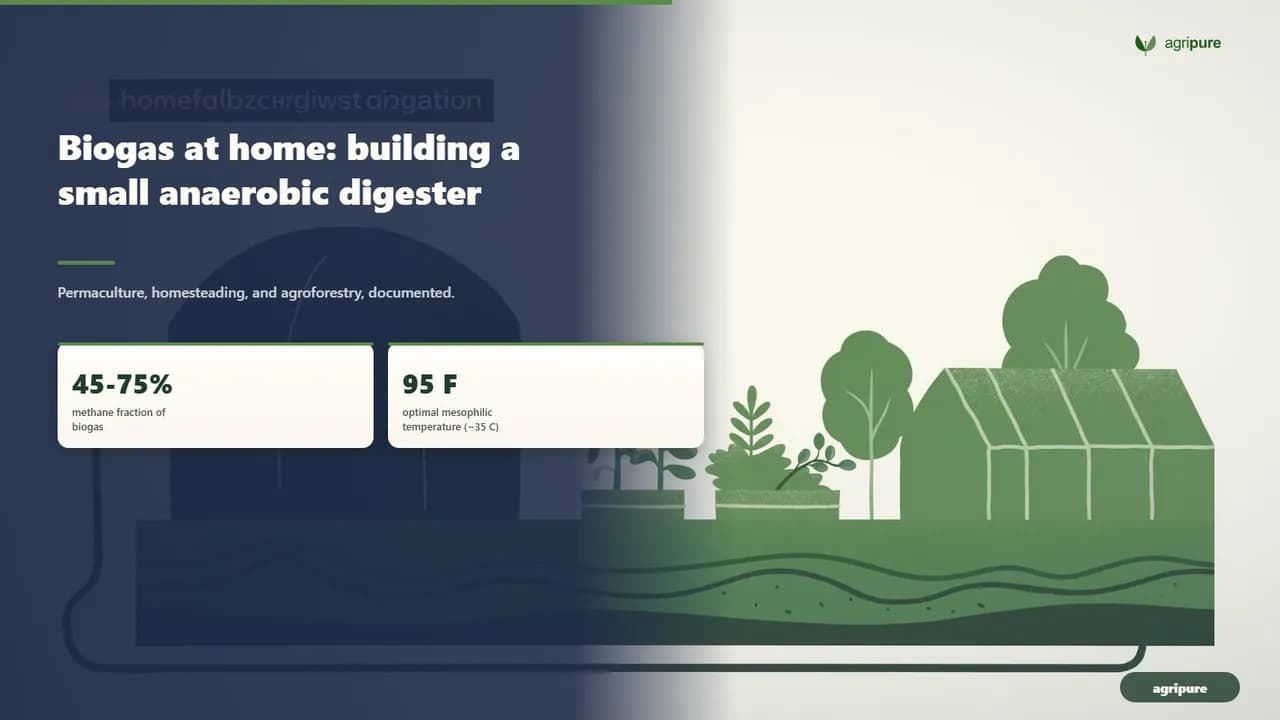
Three numbers that frame a home digester: the methane fraction, the energy in a cubic meter, and the temperature the microbes want.
How anaerobic digestion works, in four stages
Anaerobic digestion is less one reaction than a relay race run by 4 different microbial teams, each handing off to the next. The process takes place through four successive stages (hydrolysis, acidogenesis, acetogenesis, and methanogenesis), and a home digester is a warm, sealed, oxygen-free container held near 35 C that gives those teams a place to work. Understanding the relay helps you keep it running, because the last team is the slowest and the most temperature-sensitive.
The four microbial steps
- Hydrolysis. The 1st bacteria break down complex organic polymers (the carbohydrates, fats, and proteins in manure and food scraps) into simpler sugars, fatty acids, and amino acids the next team can use.
- Acidogenesis. Acid-forming bacteria ferment those simple molecules into organic acids, plus carbon dioxide, hydrogen, and ammonia.
- Acetogenesis. Acetogens convert the products of the previous stage largely into acetic acid, along with more carbon dioxide and hydrogen.
- Methanogenesis. The methane-making archaea take those intermediates and produce the methane and CO2 that make up biogas. This is the slow step: methanogens are the microbes that are most sensitive to cold.
The four-stage microbial relay that turns manure and scraps into biogas, ending with the slow, cold-sensitive methane step.
Why retention time and temperature go together
Because the relay takes time, you cannot rush a digester. Mesophilic digestion is generally accomplished within 15 to 30 days of retention — the feedstock has to sit in the warm tank long enough for all four teams to finish. Run the tank too cold and methanogenesis stalls, the relay backs up, and gas production collapses even though the first stages keep going. That is the mechanism behind the cold-climate numbers later in this guide, and it is why a home digester is sized around days of warm residence time, not just the volume of waste you can throw at it. Feed it faster than it can digest, or let it chill, and you get acid sludge instead of gas.
What a small home or farm digester actually looks like
Strip away the industrial photos and a home anaerobic digester is a simple thing: an airtight tank, an inlet for slurry, an outlet for spent digestate, and a gas line off the top. The 4 designs below cover almost everything a homesteader will encounter, and the right one depends on budget, climate, and how handy you are.
The four common designs
- Fixed-dome (Chinese) digester. A masonry or concrete dome built partly underground, with no moving parts. Gas collects under the dome and pushes slurry up into a displacement chamber. Durable and cheap to run, but a buried concrete build, and hard to insulate or heat in a cold climate.
- Floating-drum (Indian) digester. A tank with a steel or fiberglass drum that floats on the slurry and rises as gas accumulates, giving steady gas pressure and an at-a-glance fuel gauge. More moving metal to corrode, but forgiving to operate.
- Tube or balloon (tubular plug-flow) digester. A long polyethylene bag, partly buried and inclined, widespread on small farms in Latin America. It is the cheapest and most DIY-friendly design (a roll of tubing, two pipe fittings, and a gas bag), but the thin plastic is fragile and hard to keep warm through a hard freeze without an enclosure.
- Prefab IBC-tote or kit digester. The modern North American backyard route: a 275-gallon intermediate bulk container, or a sealed commercial kit, plumbed with an inlet, an overflow, and a gas collector. Easy to site inside a greenhouse, easy to insulate, and the basis for most successful temperate-climate home builds.
A long black polyethylene tube biodigester partly buried in a trench on a small homestead, slightly inclined, with a clear gas bag inflating above it and a feed inlet at the higher end.
A low-cost tubular (balloon) digester: cheap and DIY-friendly, but fragile and hard to keep warm in a freeze without an enclosure.
How the designs compare for a home build
Design | Build cost & effort | Cold-climate suitability |
|---|---|---|
Fixed-dome (Chinese) | High — buried masonry or concrete | Stable once buried, but hard to add heat |
Floating-drum (Indian) | Moderate — tank plus a steel drum | Forgiving to run; drum corrodes over time |
Tube / balloon | Low — polyethylene tubing and fittings | Poor unless inside a heated enclosure |
Prefab IBC tote / kit | Low to moderate — a 275-gallon tote | Best home option — easy to insulate and heat |
Feed-to-water ratio sets the recipe
Whichever shell you choose, the digester is fed a slurry, not dry waste, and the dilution matters. The mix differs by design: a fixed-dome unit is typically fed a manure-to-water ratio of about 1:1, while a thin tubular digester runs closer to 1:3, three times the water. The FAO’s field manual for tube digesters gives a concrete recipe: about 5 kg of fresh manure (1 kg of solids) per meter of digester, with roughly 15 litres of water added so the solids content sits near 5%. Too thick and the slurry will not flow or mix; too thin and you wash microbes out before they finish the relay. Getting that consistency right is most of the day-to-day skill of running one.
What home biogas can realistically power
Here is where honesty matters most, because the gap between the dream and the data is wide. A small home digester makes cooking gas, not whole-home electricity, and even the cooking is modest. The single most useful real-world figure comes from Living Web Farms, a homestead in Mills River, North Carolina, that has run a home-scale digester for years: a moderate daily feeding of 2 lbs of food scraps yields about 20 cu ft of gas under ideal conditions. One cubic meter of that gas (about 35 cu ft) holds roughly 21,000 Btu, the equivalent of 6 kWh of heat, enough to keep a single cookstove burner going for 4 to 7 hours.
Read that carefully. Two pounds of scraps a day yields roughly half a cubic meter of gas, or a couple of hours on one burner. That is a real, useful thing: it is free cooking fuel from waste you already have. It is not a power plant. Turning biogas into household electricity means burning it in a generator, and the engine and conversion losses are steep, so the electrical yield from a backyard unit is close to negligible. The FAO’s tube-digester data shows what a productive small system looks like at scale (a mean of 1,235 litres of gas per day, with about 200 litres per person enough to cook three meals), but that is a warm-climate digester fed daily by the manure of several pigs.
When biogas scales to real power
The phrase biogas power generation is real, but it belongs to a different scale. Penn State’s dairy digester produces a net 40 cubic feet (1.2 m3) of biogas per cow per day, converting 20% to 30% of the manure’s volatile solids to gas. To generate meaningful electricity, you need a herd: a common rule of thumb for an economical farm digester is the manure from at least 200 dairy cows or the equivalent in swine or poultry. At that scale, the gas runs an engine-generator and the math works. A biogas generator sized to a backyard simply cannot gather enough volatile solids to matter.
A realistic menu for a home unit
So set expectations at the right level. A well-run home biogas plant in a warm season can reasonably do 3 things:
- Run a single cooking burner for 2 to 4 hours a day on kitchen and garden scraps.
- Supplement, not replace, your propane or gas for cooking.
- Produce a steady stream of liquid fertilizer as its more dependable output.
It will not heat your house, charge your batteries, or run your well pump. The most honest way to value a home digester is as a waste-to-fertilizer machine that happens to throw off some cooking gas — which reframes the whole project around something it reliably delivers, even in a Zone 5 winter.
The temperature problem: why cold winters are the real barrier
Everything above assumes the digester is warm. In most of North America, for much of the year, it is not — and this is the single hardest fact about home biogas in a temperate climate. Methanogens slow as the tank cools and effectively stop near freezing, so a digester that cooks well in July goes quiet in January. The Northern Vietnam study quantified the seasonal collapse cleanly: biogas yield held around 381.9 litres per kg of volatile solids from August to October, then dropped to 254.2 litres by January as the weather turned — a fall of roughly a third, in a climate far milder than a Wisconsin winter.
A cold-climate study’s seasonal numbers: gas yield falls roughly a third from late summer to the coldest month as the digester cools.
How people keep a digester warm
The fix is to protect the digester from heat loss using multiple measures. Living Web Farms in North Carolina is an instructive case: their digester lives inside a small greenhouse for direct solar gain year-round, is lined with extruded polystyrene insulation on the endwalls and subfloor, and is carried through cold nights by a 300-watt internal tank heater. Their numbers frame the target: the system keeps functioning down to about 75 F but reaches higher mesophilic output closer to 95 F. The practical toolkit looks like this:
- A greenhouse or solar enclosure. Free daytime heat, and the most cost-effective single move in a cold climate.
- Heavy insulation. Rigid foam board or even bubble-wrap under black plastic around the tank to hold the warmth you gather.
- A modest electric or hydronic heater. Roughly 300 watts, or warm water circulated through a coil, to carry the tank through nights and cold snaps, sometimes fed by the digester’s own gas.
- Burying the tank below frost line. Soil is a stable heat reservoir; a partly buried digester swings less than one sitting in the open air.
A 275-gallon IBC-tote anaerobic digester wrapped in rigid foam insulation inside a small backyard greenhouse, a gas bag overhead, snow visible through the panels.
The temperate-climate answer: an insulated IBC-tote digester inside a greenhouse, heated through the cold nights so the microbes stay near 35 C.
The honest cold-climate verdict
In a cold North American winter, a home digester needs almost as much energy management as it produces. Running one through a Zone 5 winter inside a heated greenhouse is possible, but the heat and infrastructure required mean the gas is rarely free in net energy terms once cold weather sets in. In summer the same unit is genuinely productive. For most temperate-climate homesteads, biogas is best understood as a three-season system that idles or goes dormant in deep winter, unless you are willing to build and heat seriously around it. If a single energy lever has to pay for itself first, our guide to where home biogas ranks among home energy upgrades puts it in honest order against solar, heat pumps, and the cheaper wins.
Digestate: the fertilizer that is the real payoff
The gas gets the attention, but the slurry that leaves the digester may be the better product. Anaerobic digestion yields two outputs: biogas and digestate, the residual liquid and solid material left after the microbes finish. That digestate is a nutrient-rich fertilizer: the EPA notes its liquid and solid fractions can be used as fertilizer, compost, animal bedding, or soil amendment, on-farm or sold. The FAO notes that once manure has passed through a biodigester it becomes an effective organic fertilizer, because digestion conserves nitrogen while breaking the material down into a form plants take up readily.
Cleaner waste, not just fertilizer
Digestion also cleans the waste. The EPA reports that anaerobic digesters destroy more than 90% of the disease-causing bacteria that would otherwise pose a risk in raw manure, and digesting manure significantly cuts its odor. For a homesteader, that combination is the quiet argument for building one even where the gas is marginal: you take raw manure and food scraps (a storage and sanitation problem) and turn them into a low-odor, low-pathogen liquid fertilizer, with cooking gas as the bonus. If a digester is more than you want to manage, the same feedstock and a good hot composting routine for the same scraps gets you to a similar fertilizer by a simpler path, just without the gas.
Dark liquid digestate draining from the outlet pipe of a home anaerobic digester into a bucket, beside a vegetable garden bed on a homestead, ready to be diluted and applied as fertilizer.
Digestate (the nutrient-rich slurry that leaves the digester) is often the more dependable product than the gas.
Safety: methane is explosive, and the gas is toxic
A digester makes a flammable, partly poisonous gas, so safety is not optional. Methane is explosive in air at concentrations between 5% and 15%, and the Cooperative Extension safety guidance is explicit that, because of that hazard, no open flames should ever be used near a digester and the area needs adequate ventilation. Concentrated biogas in a sealed bag is above the explosive range and will not ignite, but a leak that mixes gas into room air passes straight through the dangerous band. Treat the gas line, fittings, and storage the way you would a propane system, and keep ignition sources away from the digester itself.
The other hazard is the gas you do not burn. Biogas carries hydrogen sulfide, a highly toxic gas heavier than air that smells of rotten eggs even at 0.01 to 0.3 ppm and, at dangerous concentrations, destroys the sense of smell and causes respiratory paralysis. Asphyxiation is a real risk in any enclosed space where manure or slurry is stored, because the gas can displace the air above the liquid. These 4 practical rules are short and non-negotiable:
- Ventilate. Never work on or around an enclosed digester or manure pit without airflow; with methane at 50% to 75% of the gas, biogas can quietly displace breathable air.
- No flames or sparks. Keep open flames, smoking, and non-rated electrical gear away from the digester and gas storage.
- Respect the smell and its loss. Rotten eggs indicates H2S; if the smell suddenly vanishes in an enclosed space, that is a danger sign, not a safe one.
- Plumb deliberately. Use gas-rated hose and fittings, check for leaks with soapy water, and store only modest volumes near the house.
The honest verdict on home-scale biogas in a temperate climate
So, is a home biogas digester worth building if you live somewhere with a real winter? The grounded answer: yes as a three-season waste-to-fertilizer system that throws off some cooking gas, and no as a serious source of household energy. The biology sets the ceiling: methane-making microbes require roughly 35 C, gas output rises and falls with temperature on a cube-like curve, and a cubic meter of biogas holds about 6 kWh, good for a few hours on one burner. Feed a backyard unit 2 lbs of scraps a day and you get a couple of burner-hours; to generate real electricity you need the manure of 200 cows, not a bucket.
Where it earns its place is in the things it reliably does: it turns manure and food waste into a low-odor, low-pathogen liquid fertilizer, destroys more than 90% of the pathogens in raw manure, and gives you free cooking gas in the warm months. Build it inside a greenhouse, insulate it well, accept that deep winter is its off-season unless you heat it hard, and value the digestate as much as the flame. Treated that way, and run with respect for a gas that is both explosive and toxic, a small digester is an honest, useful piece of homestead infrastructure. Just size your expectations to the biology, and you will not be disappointed. For homesteaders mapping full off-grid independence, our guide to building an off-grid energy plan puts biogas in its place alongside the systems that carry more of the load.
Frequently asked questions
What is biogas made of?
Biogas is mostly methane and carbon dioxide. The two main constituents of biogas are methane (CH4), which is the flammable part, and carbon dioxide (CO2), which is inert. Methane usually makes up 45% to 75% by volume (commonly 55% to 65% on a farm digester), with the rest mostly CO2 plus traces of hydrogen sulfide and water vapor. That gives biogas a lower heating value of 16 to 28 MJ/m3, roughly half to two-thirds the energy of natural gas.
Can a home biogas digester power my house?
No. A small home digester makes cooking gas, not whole-home electricity. As a real-world benchmark, 2 lbs of food scraps a day yields about 20 cu ft of biogas, and one cubic meter holds about 6 kWh, enough for 4 to 7 hours on a single cookstove burner. Generating meaningful electricity needs the manure of around 200 dairy cows, which is why backyard biogas is best valued as free cooking fuel plus fertilizer.
How does anaerobic digestion work?
Anaerobic digestion is a four-stage microbial process that runs without oxygen: hydrolysis breaks down complex organics, acidogenesis ferments them into acids, acetogenesis produces mainly acetic acid, and methanogenesis converts those intermediates into methane and CO2. In a mesophilic home digester at about 35 C, the feedstock needs 15 to 30 days of warm residence time for all four stages to finish.
Why do home biogas digesters struggle in cold climates?
Because the methane-making microbes slow dramatically as the tank cools and nearly stop near freezing. Temperature is the main factor in biogas production; one study found gas output and temperature follow a cube-like relationship between 10 C and 30 C, with yield falling about a third from late summer into winter. In North America, people keep digesters going with a greenhouse enclosure, heavy insulation, and a small heater, but deep winter is usually a digester’s off-season.
What can I feed a home digester, and what should I avoid?
Feed it manure (livestock manure is the classic feedstock) and food scraps: vegetables, fruit, kitchen and dairy waste, fats, and meat scraps are all usable in a sealed home digester. Feed it as a slurry, with a manure-to-water ratio near 1:1 for a fixed-dome unit or 1:3 for a thin tubular one. Avoid loading it faster than it can digest, and avoid disinfectants, large amounts of woody or fibrous material, and anything antibacterial that would harm the microbes.
Is the digestate from a biogas digester good fertilizer?
Yes, it is often the more dependable payoff than the gas. Digestate, the slurry left after digestion, is a nutrient-rich organic fertilizer that conserves nitrogen and is readily taken up by plants. Anaerobic digestion also destroys more than 90% of the disease-causing bacteria in raw manure and sharply cuts odor, so a digester turns a sanitation problem into a low-odor, low-pathogen soil amendment.
References
- International Energy Agency. Outlook for Biogas and Biomethane: An Introduction to Biogas and Biomethane.
- U.S. Energy Information Administration. Biomass explained: Landfill gas and biogas.
- U.S. EPA AgSTAR. How Does Anaerobic Digestion Work?
- U.S. EPA AgSTAR. The Benefits of Anaerobic Digestion.
- U.S. EPA. Types of Anaerobic Digesters.
- Meegoda, J.N., Li, B., Patel, K. & Wang, L.B. A Review of the Processes, Parameters, and Optimization of Anaerobic Digestion. Int. J. Environ. Res. Public Health 15(10), 2018.
- FAO. World Animal Review 88: Low-cost polyethylene tube biodigesters on small-scale farms.
- Penn State Extension. Biogas from Manure.
- Living Web Farms. Home-Scale Biogas Production.
- Factors Affecting Process Temperature and Biogas Production in Small-scale Rural Biogas Digesters in Winter in Northern Vietnam. 2014.
- eXtension Farm Energy. Anaerobic Digesters and Biogas Safety.
- Mbir Bryant, S. & Osei-Marfo, M. Innovative Designs in Household Biogas Digester in Built Neighbourhoods. IntechOpen, 2021.