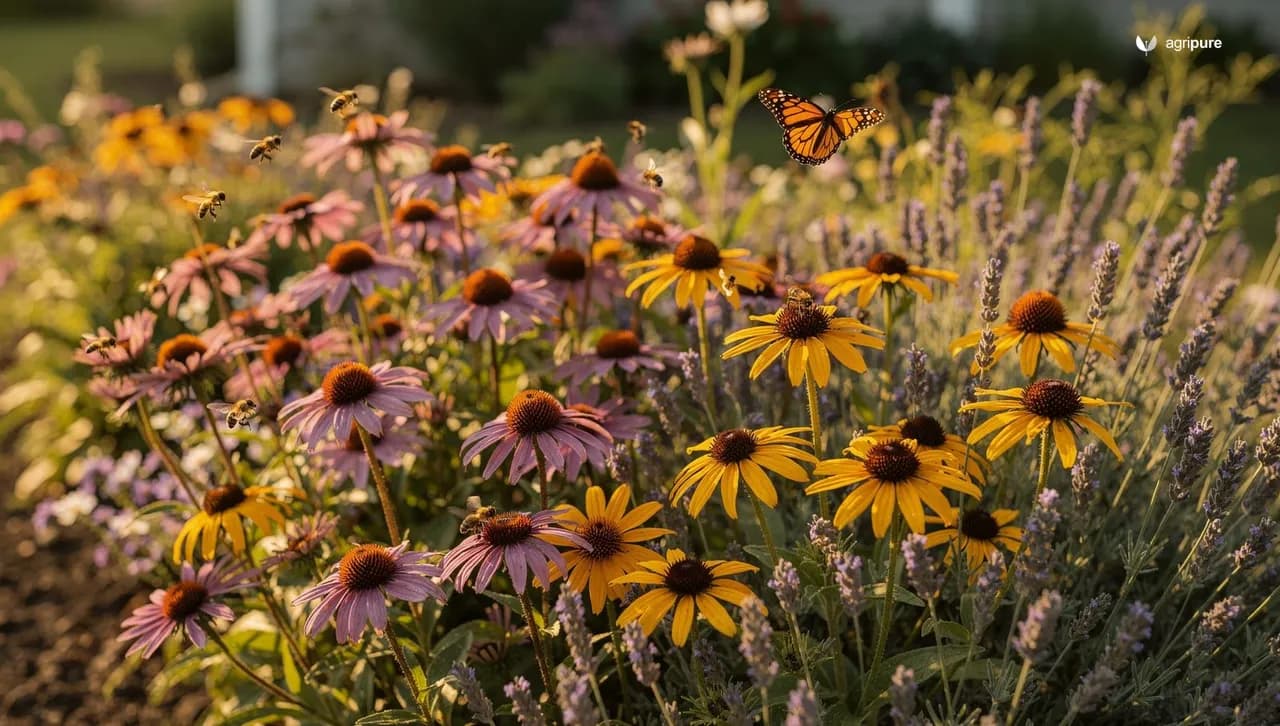
Key takeaways

A well-planned garden feeds bees, butterflies, and hummingbirds throughout their active seasons.
- Aim for overlapping bloom across early, mid, and late season so something is always flowering from spring through frost.
- Buy at least 3 of each plant and group them; pollinators find larger drifts of one color far more easily than scattered singles.
- Native plants are the safer bet for native bees; in one trial, 9 of 11 cultivars supported a different, often narrower bee community than their wild parents.
- Host plants differ from nectar plants: monarch caterpillars eat only milkweed, so a nectar-only border raises no monarchs.
- If you must spray, use neem at dusk on plants that are not in bloom, when bees have stopped foraging.
A border that is loud with bees in June can go silent by August if every plant in it blooms at once. The fix is a calendar rather than a single magic flower: roughly 3 to 4 plants flowering in each of the early, mid, and late windows, so a pollinator that emerges in March and one that emerges in July both find food.
Here is how to choose plants for pollinators the way an ecologist would, in 5 moves — organized by bloom season for continuous forage, native-first, with host plants set apart from nectar plants, and 1 honest caveat about pesticides that most plant lists skip entirely.
Bloom in three waves, not one
The single most common mistake is planting only summer flowers. Pollinators are active across roughly 7 to 8 months in much of North America, and Penn State Extension is direct about the remedy: have a variety of plants in bloom throughout the season, because overlapping bloom times ensure there is always something providing nutrition. Split your buying list into 3 windows and fill each one before you add a fourth zinnia to the summer pile.
Early-season bloomers carry the queen bumblebees and mason bees that wake in March and April, when little else is open. Mid-season is the easy part — 80% of catalog flowers land in the June-to-August window. Late-season blooms in September and October fuel migrating monarchs and the bumblebee queens fattening up before winter, and they are the 1 wave most gardens forget.
What to plant in each window
- Early (March-May): crocus, willow, wild lilac, golden currant, and woodland phlox — the first 6 weeks of forage.
- Mid (June-August): bee balm, coneflower, mountain mint, and sunflower, which alone can carry dozens of bee species at peak.
- Late (Sept-Oct): goldenrod, native asters, and Joe-Pye weed, the trio that closes out the year.
Plant in clumps, not singles: Penn State Extension recommends buying at least 3 or more of one kind and planting them together, because pollinators home in on larger blocks of color rather than a lone plant lost in a mixed bed.

Why native-first beats a tray of cultivars
Walk into any garden center and the pollinator shelf is mostly cultivars — named selections bred for bigger blooms, compact size, or a flashier color. They look like the wild plant, but the breeding can quietly change the nectar, pollen, and flower shape that bees actually use. Oregon State University researchers ran a 4-year trial comparing 5 Pacific Northwest natives against 11 of their cultivars, measuring both visits and floral traits.
The result is worth memorizing before you shop. 9 of the 11 cultivars supported bee communities that differed from the wild plants they came from, and many supported a narrower range of bee types. Plants that stayed closest to the wild phenotype kept the richest bee visitors. Native-first does not mean native-only — a few well-behaved exotics like culinary garden sage are bee magnets — but the backbone of the garden should be local species.
Read the tag: a name in single quotes after the species (for example, a coneflower sold as a trademarked color selection) signals a cultivar. When 2 plants sit side by side, choose the straight species for the most reliable forage.
Host plants and nectar plants are not the same job
Every pollinator garden needs both 2 roles, and confusing them is why some butterfly gardens never raise a single butterfly. Nectar plants feed adults the sugar that powers flight; almost any daisy-shaped or tubular flower does this. Host plants feed the larvae, and they are far pickier — many caterpillars eat the leaves of only 1 plant family.
The monarch is the textbook case. Oregon State University Extension is blunt: monarch butterflies lay their eggs on milkweed, and their caterpillars exclusively eat milkweed. There are over 70 species of milkweed native to the United States, so there is a regionally native one for almost every garden. Plant a border of nothing but nectar flowers and adult monarchs will visit, but they cannot complete their life cycle without an Asclepias to lay eggs on.
Pollinator group | Nectar plants they favor | Host plant for the young |
|---|---|---|
Monarch butterfly | Milkweed, goldenrod, aster | Milkweed only (70+ US species) |
Swallowtail butterfly | Coneflower, bee balm, zinnia | Parsley, dill, fennel, spicebush |
Bumblebees | Bee balm, sage, lupine, clover | Nest in ground/cavities, not on plants |
Hummingbirds | Cardinal flower, salvia, trumpet vine | Insects on native plants (feed young) |
Hummingbirds add a third design rule: they are pulled in by red and orange tubular flowers that most insects skip, so 2 or 3 cardinal flowers or salvias widen the garden’s reach. Even hummingbirds rely on the insect life a native border supports, since they feed their chicks tiny spiders and gnats for the first 3 weeks of life, not nectar.
The pesticide caveat every plant list skips
You can plant the perfect 3-window bloom calendar and still run an empty garden if you spray it at the wrong time. A hazard hides in even gardener-favorite treatments, which hit bees when they are applied onto open flowers full of foragers. One rule protects the most pollinators and costs nothing: do not treat plants while they are in bloom, and time any spray for when bees have gone home.
Ohio State University Extension sets the window precisely: honey bees are generally inactive from one hour after sunset until 2 hours before sunrise. Michigan State University Extension extends the same logic to softer products, advising that on pollinator-attractive plants you spray at dawn or dusk when pollinators are not present — and that removing the flowers before treating cuts the risk further.
How to use neem and IPM without harming bees
- Try non-spray steps first. A strong jet of water, hand-removal, and tolerating minor damage solve most pest problems with zero risk to the 4,000-plus native bee species in North America.
- Spot-treat, never blanket-spray. Target the affected leaf, not the whole border, so foraging bees on nearby blooms stay clear of the droplets.
- Time neem for dusk. Apply neem oil in the evening once flowers have closed and bees have stopped working, giving the residue overnight to dry before the morning shift returns.
The 1-bloom test: if a plant has a single open flower with a bee on it, the spray bottle goes back on the shelf until dusk. A pollinator garden’s first pest-control tool is patience, not chemistry.
Build the habitat, not just the flower bed
Flowers are the menu, but pollinators also need somewhere to nest and a season free of disturbance. About 70% of native bees nest in the ground, so a patch of bare, undug soil matters as much as the blooms above it. The same low-intervention habits that grow good soil also grow good pollinator numbers.
Three structural choices do 90% of the work. No-dig beds leave ground-nesting bees and overwintering larvae undisturbed beneath the surface. A light layer of mulch that leaves some open soil keeps weeds down without sealing off every nesting site. And leaving the stems and seed heads standing through winter shelters eggs and pupae for 5 to 6 months until spring, then feeds finches in the lean months.
- Leave the leaves: a thin layer of fall leaves shelters queen bumblebees and moth pupae through the cold.
- Skip the fall cleanup: cut perennial stems in late spring, not autumn, so cavity-nesting bees survive winter inside them.
- Add water: a shallow dish with stones gives bees and butterflies a safe place to drink within 3 feet of the blooms.
Conclusion
A garden that feeds pollinators is mostly a matter of sequence and restraint: 3 waves of bloom instead of 1, native species as the backbone, a host plant beside every nectar plant, and the spray bottle left alone until dusk. Group your plants in 3s, add a regionally native milkweed for the monarchs, and skip the fall cleanup, and the garden will hum from the first crocus to the last aster.
Frequently asked questions
What are the best plants for pollinators?
The best pollinator gardens combine native species across 3 bloom windows: early bloomers like willow and woodland phlox, mid-season coneflower, bee balm, and mountain mint, and late-season goldenrod and asters. Add a regionally native milkweed as a host plant for monarchs.
What is the difference between a host plant and a nectar plant?
Nectar plants feed adult pollinators the sugar that powers flight, and most daisy-shaped or tubular flowers qualify. Host plants feed the larvae, and they are specific — monarch caterpillars eat only milkweed, so a garden needs both kinds.
Are native plants really better for pollinators than cultivars?
Usually, yes. In a 4-year Oregon State University trial, 9 of 11 cultivars supported bee communities that differed from their wild parents, and many drew a narrower range of bees. Straight native species are the more reliable choice.
How do I attract bees, butterflies, and hummingbirds to the same garden?
Layer the menu: grouped native nectar flowers for bees, milkweed and parsley-family plants as butterfly hosts, and red tubular flowers like cardinal flower or salvia for hummingbirds. Plant in clumps of at least 3 so each group is easy to find.
Will pesticides hurt the pollinators in my garden?
They can, especially when sprayed on open blooms. Avoid treating plants while they flower, and if you must use neem or another product, apply it at dusk when bees have stopped foraging, roughly one hour after sunset.
References
- Penn State Extension — Planting Pollinator-Friendly Gardens
- Oregon State University Extension — How Can I Support the Endangered Monarch Butterfly?
- Pohl et al., Frontiers in Ecology and Evolution (2018) — Monarch Utilization of Nine Milkweed Species
- Oregon State University Extension — Native Plants Attract More Pollinators Than Cultivars
- Ohio State University Extension — Protecting Pollinators While Using Pesticides
- Michigan State University Extension — Controlling Pests While Protecting Pollinators