Key takeaways
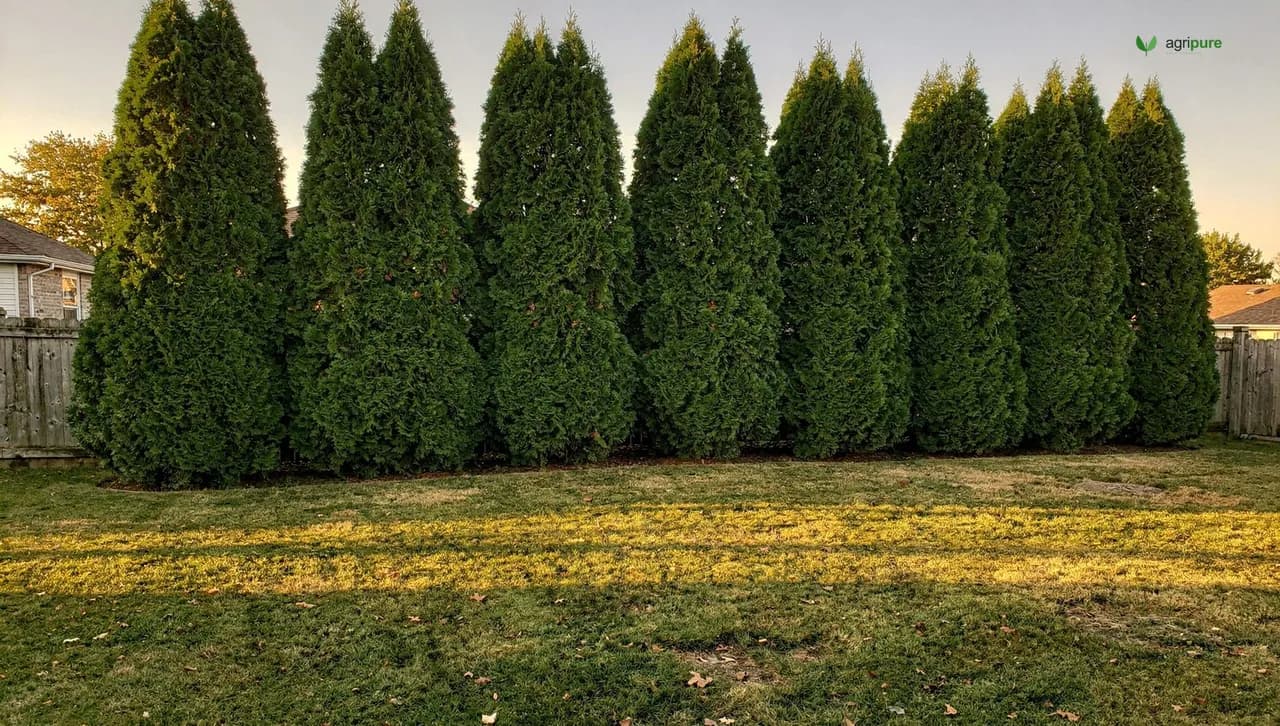
A dense privacy screen of Green Giant arborvitae trees planted along a property boundary in evening light.
Choosing fast-growing privacy trees involves understanding the tradeoffs between rapid growth and long-term durability. A well-planned screen can offer year-round seclusion, but careful selection prevents future issues with weaker wood and shorter lifespans.
- The quickest screen trees add 3 to 4 feet a year, but that speed usually comes with weaker wood and a shorter life.
- Green Giant arborvitae matches Leyland cypress for speed without its canker problems, maturing near 40 to 60 feet.
- Spacing is math, not guesswork: divide your run by the tree’s mature width, and plant at roughly 60% of that for a solid wall.
- Evergreens screen year round; deciduous trees grow faster but drop the wall every winter.
- Skip the fast invasives — Callery (Bradford) pear is brittle, short-lived, and banned in a growing list of states.
A bare property line is the most common reason people plant trees in a hurry, and the nursery tag that says “3 to 4 feet per year” is hard to walk past. Plant the wrong fast grower, though, and in 15 years you are cutting down a 60-foot tree that splits in the first ice storm.
Speed has a price. The trees that throw up a screen in 3 seasons tend to carry weaker wood, shallower roots, and shorter lifespans than trees that take their time. Here is what extension research shows about growth rates, mature size, spacing math, and the fast growers worth avoiding, helping ensure the screen planted this spring stands for decades.
What you trade for 3 to 4 feet a year
Growth rate and durability pull in opposite directions. Leyland cypress, the classic fast screen, grows 3 to 4 feet per year when young according to Clemson Cooperative Extension, and reaches 60 to 70 feet tall and 12 to 20 feet wide, with heights of 70 to 100 feet not uncommon. That speed explains why it is widely planted on property lines, but also why many of those plantings fail.
The University of Minnesota is blunt about the other end of the spectrum: silver maple “is weak wooded and is prone to storm damage and decay,” yet it is still sold as a quick 50 to 80 foot shade and screen tree. That pattern holds across most rapid growers: low wood density buys vertical feet but costs you in the first wind event.
Speed versus the long game
Before you buy on growth rate alone, weigh 3 things the price tag never mentions.
- Wood strength: trees adding more than 3 feet a year often have brittle wood that breaks under ice and wind load.
- Lifespan: the fastest screens frequently fade or fail in 15 to 25 years, while a moderate grower holds the line for 50-plus.
- Disease load: Clemson notes Leyland cypress’s most serious problem is a canker that causes branch dieback to the trunk and can kill the tree outright.
Rule of thumb: if a tree adds more than 3 feet a year, expect more pruning, frequent storm cleanup, and a replacement plan within 2 decades.
A close view of dense columnar evergreen foliage on a privacy screen tree with afternoon light filtering through the green needles.
The fast screen trees worth planting
A handful of fast growers earn their place because they pair speed with reasonable wood and disease resistance. Green Giant arborvitae (Thuja ‘Green Giant’) is the standout: NC State Extension records it growing 3 to 4 feet per year in good conditions and maturing at 40 to 60 feet tall and 12 to 18 feet wide, matching Leyland growth rates without the canker history. On a tighter conifer like Himalayan pencil juniper, you trade a foot of annual growth for a denser, longer-lived column.
Clemson’s alternatives list points the same direction, naming 3 screen trees that sidestep Leyland’s problems: Green Giant arborvitae, Arizona cypress, and Japanese cedar. For a fast evergreen, a deodar cedar fills a large lot in under 10 years and can live for generations.
Evergreen versus deciduous
The screen you want depends on what you are blocking and when. Evergreens hold their foliage all 12 months, so they block sightlines and wind in January as well as July. Deciduous trees like hybrid poplar grow faster (often 5 feet a year) but lose 100% of their leaf cover for roughly 5 months, leaving the view open all winter.
- Choose evergreen for 12 months of privacy, a windbreak, or to mute a road you see in every season.
- Choose deciduous only where you want summer screening plus winter sun, such as shading a south wall.
- Mix both on long runs: evergreens for the permanent wall, a few fast deciduous trees for quick early cover while the conifers catch up over 5 years.
Spacing math for a solid wall
Most failed screens come from 1 mistake: planting too close for instant cover. Clemson warns that “the desire for instant screening often leads to trees being planted too closely, which results in overcrowding at maturity,” bringing poor air circulation, more disease, and bare lower branches. The fix requires simple arithmetic: 1 measurement and 1 multiplication.
Start with the tree’s mature width, then plant at about 60% of that spacing so crowns knit into a wall without strangling each other. NC State lists Leyland cypress screen spacing at 4 to 8 feet; for a 12-to-18-foot-wide Green Giant, 5 to 8 feet on center is the working range. Run the numbers for your line before you dig.
Tree | Growth/yr | Mature H x W (ft) | Screen spacing | Note |
|---|---|---|---|---|
Leyland cypress | 3-4 ft | 60-70 x 12-20 | 4-8 ft | Prone to canker |
Green Giant arborvitae | 3-4 ft | 40-60 x 12-18 | 5-8 ft | Best all-round screen |
Arizona cypress | 2-3 ft | 40-50 x 15-25 | 8-10 ft | Best for dry sites |
Deodar cedar | 2-3 ft | 40-70 x 20-40 | 15-20 ft | Long-lived specimen |
Hybrid poplar (deciduous) | 5+ ft | 40-50 x 25-30 | 8-12 ft | Fast but short-lived |
Read the table as a tradeoff curve: the top 2 rows give you the quickest wall, the middle 2 give you decades of life for a foot less growth a year, and the bottom row buys raw speed at the cost of longevity.
Match the tree to your zone and site
A screen that thrives in zone 7 can die outright in zone 4, so regional fit matters as much as growth rate. Green Giant arborvitae performs across roughly USDA zones 5 to 8, while Arizona cypress is the better pick for hot, dry sites that scorch other conifers. Clemson recommends Arizona cypress specifically “for dry sites in full sun” and Japanese cedar for partly shaded spots.
Site preparation is essential. Loosen a planting zone at least 3 times the width of the root ball, and feed the whole run instead of individual holes so roots spread outward instead of circling. Building living soil along the line before you plant pays off more than any fertilizer spike does later. On exposed, windy ground, a staggered double row reads as a fuller wall and shelters the inner trees, using the same design found in farm windbreaks.
Cold, heat, and wind
Select trees based on your most extreme season rather than the average, such as the 1 week of ice or 100-degree heat that tests plant survival.
- Cold zones (3 to 5): lean on arborvitae and spruce, which shrug off ice better than Leyland cypress, which struggles below zone 6.
- Hot, dry zones (7 to 9): Arizona cypress and deodar cedar tolerate drought once their roots reach 18 to 24 inches deep.
- High-wind sites: avoid the most brittle fast growers and space wider so each tree roots firmly before the canopy catches the wind.
A young evergreen privacy tree freshly planted in dark loosened soil along a backyard line with a ring of straw mulch around its base.
Chip your prunings: a fast screen sheds a lot of trimmings each year. Running them through a chipper turns the cleanup into 3 to 4 inches of free mulch for the same row.
The fast growers to avoid
Some quick screen trees cost more than they are worth, and 2 categories stand out. The first is the weak-wooded shade trees sold for speed: silver maple, which Minnesota flags as weak wooded and prone to storm damage, drops limbs in nearly every serious wind and rots from the center as it ages past 40 feet.
The second is invasive species. NC State Extension notes that Callery (Bradford) pear has “weak branching structure and brittle wood” that cause frequent breakage and post-storm debris, on top of being highly invasive. It is now banned for sale in at least 3 states, and extension services recommend planting native trees instead.
- Avoid Callery / Bradford pear: brittle, short-lived, invasive, and outlawed in several states.
- Avoid silver maple and Siberian elm: fast but weak wooded, with a high storm-damage rate.
- Limit hybrid poplar: useful as a 10-year placeholder, but plan to replace it before it fails near 20.
Conclusion
Choosing a privacy screen requires balancing growth rate against tree durability. Trees that add 3 to 4 feet a year can give you cover by year 3, but the quickest growers (Leyland cypress, hybrid poplar, silver maple, and Bradford pear) often develop weak wood, disease, or a lifespan of only 15 to 25 years. Pick a Green Giant arborvitae or a regional conifer, run the spacing math at 60% of mature width, and you trade one foot of annual growth for a screen that is still standing in 30 years.
Frequently asked questions
What is the fastest growing privacy tree?
Among reliable evergreens, Green Giant arborvitae and Leyland cypress both grow 3 to 4 feet per year. Hybrid poplar grows even faster at 5-plus feet, but it is deciduous and short-lived, so it works only as a temporary screen.
How far apart should I plant privacy trees?
Plant at roughly 60% of the tree’s mature width. For Leyland cypress that means 4 to 8 feet on center, and for Green Giant arborvitae about 5 to 8 feet, which closes into a wall without overcrowding.
Are fast growing trees weak?
Often, yes. The fastest growers tend to have lower wood density, so trees like silver maple and Bradford pear break more in storms and live 30 to 50 years less than moderate growers such as cedar or spruce.
Should I plant evergreen or deciduous privacy trees?
Choose evergreen for year-round screening, since they hold foliage all 12 months. Pick deciduous only where you want summer cover plus winter sun, because they drop their leaves for roughly 5 months each year.
Which privacy trees should I avoid?
Avoid Callery (Bradford) pear, which is invasive and brittle and now banned for sale in at least 3 states, plus weak-wooded shade trees like silver maple and Siberian elm that drop limbs in most serious wind events.
References
- Clemson Cooperative Extension — Leyland Cypress
- NC State Extension — Leyland Cypress
- NC Extension Gardener Plant Toolbox — Thuja ‘Green Giant’
- Clemson Cooperative Extension — Leyland Cypress Alternatives
- NC State Extension — Callery Pear and Its Invasive Offspring
- University of Minnesota UFOR — Silver Maple (Acer saccharinum)