Key takeaways

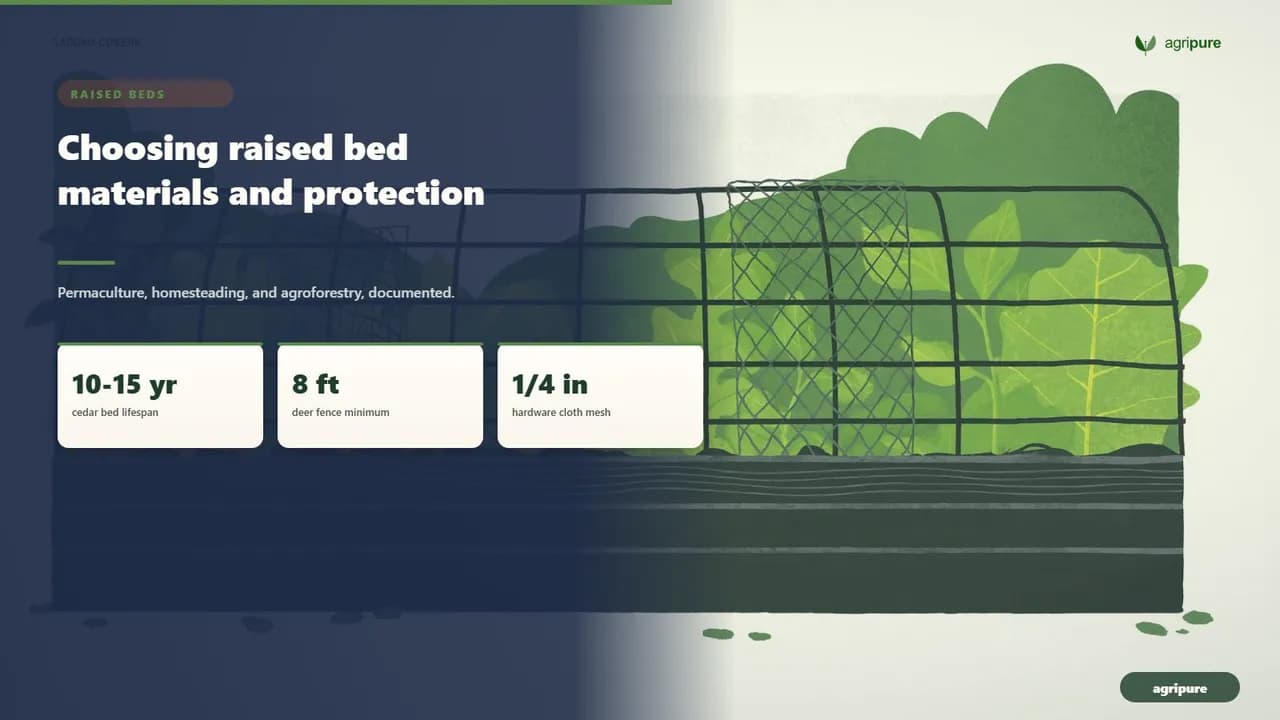
Beyond the aesthetic, the right raised bed material and thoughtful protection are key to a lasting, productive garden. This image features raised beds crafted from durable cedar, modern coated steel, and robust composite, each representing different lifespans and care requirements, complemented by strategic pest barriers.
- Cedar lasts about 10 to 15 years, coated steel 25 to 30, and HDPE recycled plastic is often guaranteed for life at a 50-year life expectancy.
- HDPE does not leach chemicals into soil; some composite decking can, so buy boards labeled safe for garden use.
- A real supply list is short: the frame, hardware cloth for the base, a soil blend, and hoops plus netting if you need protection.
- Line the base with 1/4-in. hardware cloth to stop everything from rats to voles; 1/2-in. mesh blocks gophers but lets the smallest rodents through.
- Cooperative Extension puts the deer-fence minimum at 8 ft of woven wire; 7 ft is the practical floor, and no fence is perfect.
- A 4 ft square herb bed holds six culinary herbs at honest spacing: basil, thyme, rosemary, and sage at 12 in., parsley at 6 in.
The bed itself is the easy part. What decides whether a raised bed is still standing (and still feeding you) in 15 years is the material you frame it with and whether you bothered to keep the deer and the gophers out. This guide compares cedar, composite, and metal on the three things that actually matter: lifespan, cost, and whether anything leaches into your soil. Then it covers the short, honest supply list, how to enclose a bed against deer and tunneling pests, and a compact herb layout you can copy. For the metal side specifically, our piece on metal raised beds in depth goes further on heat and coatings; this one sits next to the broader raised-bed gardening guide and assumes you will fill the frame with a real soil blend.
Cedar, composite, or metal
That material choice comes down to lifespan per dollar and food-safety, and the three common options land in different places on both. Cedar is the traditional pick because its natural oils resist rot, but it is a wood and wood eventually loses. Eartheasy’s estimate is a clean anchor: cedar garden beds “can last between 10 to 15 years, depending on the quality of the wood, environmental conditions, and the level of maintenance.” The biggest killer is standing moisture at the base, where soil contact and splashback keep the lowest 1 to 2 in. of board wet.
Recycled plastic and metal both outlast cedar by a wide margin. Eartheasy notes that beds “made of HDPE recycled plastic are commonly guaranteed for life,” with manufacturers “often cite a minimum life expectancy of 50 years.” Coated steel sits between the two, lasting roughly 25 to 30 years depending on the coating. So on durability alone the order is plastic, then steel, then cedar, but the upfront price runs the other way, with cedar usually the cheapest to buy and recycled plastic the most expensive board for board.
The food-safety question
Material choice carries one real safety question: whether chemicals leach into the soil, rather than rumors about metal heating roots. Here HDPE is the reassuring case: because it “is a stable material it does not leach any chemicals, toxic or otherwise, into the soil,” per Eartheasy. Composite is the one case where care is warranted, since “some composite decking may contain chemicals that could leach toxins or hormone disruptors into the soil.” The fix is simple: choose composite “products that are labeled as safe for use in gardens” rather than generic deck board. Cedar is inert and fine; the wood to avoid is pre-2004 pressure-treated lumber, whose chromated-copper-arsenate preservative was never meant to sit against food crops.
Material | Typical lifespan | Upfront cost | Food-safety note |
|---|---|---|---|
Cedar | 10-15 years | Low-moderate | Inert; rots from the base up |
Composite board | 20+ years | Highest | Buy garden-labeled; some leach |
HDPE recycled plastic | ~50 years | High | Stable; does not leach |
Galvanized / coated steel | 25-30 years | Moderate | Food-safe at garden pH |
Read the table as a budget decision, not a quality ranking. A cedar kit is the right call if you want the lowest entry cost and do not mind rebuilding in 10 to 15 years; HDPE or coated steel wins if you would rather buy once for 25 to 50 years. None of these is unsafe at the pH 6 to 7 most gardens sit at; the leaching caveat applies only to unlabeled composite and salvaged treated wood.
The supplies you actually need
That material decision made, the supplies follow, and most “raised bed supply lists” pad the cart. Stripped down, you need four things plus an optional fifth for protection, and skipping the padding can cut 30% off the bill. The frame is the obvious one: a cedar kit, a coated-steel kit, or composite boards and 4 corner brackets. Everything else is about what goes under and inside it.
The one supply people skip and regret is the base barrier. A sheet of hardware cloth stapled across the bottom before you fill the bed is the single best insurance against losing a season to tunneling rodents. After that it is soil — and the right answer is a blend, not pure compost, which slumps and starves for structure within a year. Fill it the way our soil guide describes for a real soil blend of roughly 50% topsoil, 30% compost, and 20% aeration.
- The frame: cedar, composite, or steel kit sized to an arm’s reach across.
- Hardware cloth: 1/4 in. galvanized, cut larger than the base.
- A soil blend: roughly topsoil, compost, and aeration, not straight compost.
- Staples or screws: to fix the cloth up the interior walls.
- Hoops and netting: optional, only if pests or deer are a problem.
For the structural pieces (4 corner brackets, 3 to 5 hoops, and the hardware cloth itself), a single trip covers it. A raised-bed hardware kit bundles the brackets and fasteners so you are not sorting loose screws at the register.
Deer-proofing and enclosing a bed
Those supplies cover the bed; deer cover the rest, because an open raised bed in browse country is a salad bar, and the fix is height, more than most people expect. Cooperative Extension is blunt about the target: Cornell’s guidance states that “the recommended minimum height for a boundary deer fence of wire is 8 feet.” The reason is simple jumping ability (it is why the recommended barrier is 8 ft rather than 4 or 5), and shorter barriers only reduce damage instead of stopping it.

That said, 7 ft is the practical floor for a backyard. Critterfence puts it directly: “a deer proof garden fence should be at least 7 feet in height,” because “deer will jump over common garden fences.” For a small plot under light pressure there is some give: “for very small areas like a 25 x 25 garden area, 6 foot high fences can be adequate in some areas with light deer pressure.” The honest caveat, from the Cornell Small Farms program, is that “no fence perfectly excludes deer, and all fences require inspection and some amount of maintenance.”
Cost and the enclosed-bed option
Fencing cost depends entirely on the type. The Cornell Small Farms figures are useful: traditional woven-wire installation runs “typically $2.50 to almost $4 or more per running foot,” while lighter plastic mesh and high-tensile designs come in near “$0.59” and “$0.51” per running foot respectively. For a single bed, you rarely need a full perimeter fence; a per-bed enclosure of PVC or metal hoops with netting over the top is cheaper and easier to lift for harvest.
The two-zone enclosure: wrap the lower 18 to 24 in. of the bed in 1/4-in. hardware cloth to stop rabbits and groundhogs at ground level, then run hoops up to 6 or 7 ft with deer netting over the top for the browsers. The cloth handles the climbers and gnawers; the netting handles the jumpers.
Stopping pests from below
Deer come over the top; gophers, voles, and moles come from underneath, and the only reliable answer is a barrier laid before the soil goes in. Mesh size is the whole game. Frame It All’s guidance is clear: “a 1/4-inch, galvanized steel hardware cloth is the perfect all-in-one defense against rats, gophers, mice, and voles simultaneously,” whereas “the 1/2-inch mesh is a solid choice for blocking larger burrowing animals, though it won’t stop smaller rodents like mice or voles.”
Mesh size | Stops | Lets through | Best for |
|---|---|---|---|
1/4 in. | Rats, gophers, mice, voles | Almost nothing | All-in-one base barrier |
1/2 in. | Gophers, moles, rabbits | Mice, voles | Drainage-first, larger pests only |
1 in. poultry netting | Rabbits above ground | Most rodents | Side wrap, not a base |
Installation is what makes it permanent. Cut the cloth “a few inches larger than the bottom of your bed on all sides,” then “fold these extra inches up against the interior walls of the bed” and staple them every 6 in. so there are no gaps at the corners. Do it once, at build time, and you never dig the bed out to retrofit it. The same hardware cloth does double duty wrapped around the lower 18 in. of the sides against rabbits and groundhogs, which is why buying a slightly oversized roll is the right move.
A compact herb bed you can copy
This protection done, the most rewarding bed to build is a small herb bed: most herbs are perennial or cut-and-come-again, they want sharper drainage than vegetables, and a 4 ft square within reach holds 6 culinary herbs. Spacing is where beginners crowd themselves out. Gardening Know How’s per-herb figures keep it honest: basil, thyme, rosemary, sage, and dill at “12 inches” apart, parsley at “6 inches,” oregano at “9 inches,” and the sprawlers (cilantro and mint) at “18 inches.”

A workable plan for a 4 ft by 4 ft bed: put the woody perennials (rosemary and sage) along the north edge so they do not shade the rest, give mint its own corner or a sunken pot because it runs, and keep basil and parsley near the front where you will cut them most. That single bed covers a kitchen’s worth of cooking herbs at spacing that leaves each plant room to bush out rather than bolt.
- North edge: rosemary and sage, 12 in. apart, tallest so they cast no shade.
- Middle: thyme and oregano, 9 to 12 in., low and spreading.
- Front: basil at 12 in. and parsley at 6 in., the cut-most often.
- Contained corner: mint at 18 in. in its own pot sunk into the bed.
The takeaway
That herb bed and every other one starts with the same two decisions. Pick the material for how long you want to buy once: cedar for the cheapest entry and a 10-to-15-year life, coated steel for 25 to 30 years, or HDPE plastic for a 50-year bed that never leaches. Keep the supply list to the frame, a base sheet of 1/4-in. hardware cloth, a real soil blend, and hoops only if you need them. Then protect from both directions (cloth low against gophers and rabbits, netting at 7 to 8 ft against deer), and the bed will keep producing long after the first season’s novelty wears off.
Frequently asked questions
Is a cedar raised garden bed kit worth it over composite or metal?
Cedar is usually the cheapest kit to buy and lasts about 10 to 15 years, which suits gardeners who do not mind rebuilding within a decade. Composite and HDPE plastic cost more upfront but last 20 to 50 years, and coated steel lasts 25 to 30. If you want to buy once, metal or plastic wins; if you want the lowest entry cost and like the look of wood, cedar is the right call.
Are composite raised garden beds safe for growing food?
Most are, but it depends on the product. HDPE recycled plastic is stable and does not leach chemicals into the soil. Some composite decking, however, can contain chemicals that may leach into soil, so choose boards specifically labeled as safe for garden or food use rather than generic deck material. Cedar is inert and safe; the wood to avoid is older pressure-treated lumber.
How tall does a fence need to be for a deer-proof raised garden bed?
Cooperative Extension lists 8 feet of woven wire as the recommended minimum for a true exclusion fence, because deer easily clear shorter barriers. Seven feet is the practical floor for a backyard, and a small plot under light deer pressure can sometimes get by with 6 feet. No fence is perfect, so for a single bed a hoop-and-netting enclosure is often more practical than a full perimeter fence.
What mesh size hardware cloth should I use under a raised bed?
Use 1/4-inch galvanized hardware cloth as an all-in-one base barrier; it stops rats, gophers, mice, and voles. Half-inch mesh blocks larger burrowers like gophers and moles but lets the smallest rodents through, so it is only a good choice when drainage matters more than total exclusion. Cut the cloth larger than the bed and fold it up the interior walls before adding soil.
What supplies do I actually need to build a raised garden bed?
Four things plus an optional fifth: the frame kit, a sheet of 1/4-inch hardware cloth for the base, a soil blend of topsoil, compost, and an aeration component, and staples or screws to fix the cloth up the walls. Add hoops and netting only if you need to keep pests or deer out. Skip the padded supply lists; pure compost as a fill is a common and costly mistake.
How many herbs fit in a small raised herb bed?
A 4-foot square bed comfortably holds six culinary herbs at proper spacing. Place rosemary and sage 12 inches apart along the north edge, thyme and oregano at 9 to 12 inches in the middle, basil at 12 inches and parsley at 6 inches near the front, and keep mint in its own sunken pot since it spreads aggressively. That covers a kitchen’s worth of cooking herbs.
References
- Cornell Cooperative Extension of Tompkins County. “Gardening With Deer Q&A.” ccetompkins.org
- Cornell Small Farms Program. “Low-Cost Fence Designs to Limit Deer Impacts in Woodlands and Sugarbushes.” smallfarms.cornell.edu
- Eartheasy. “Cedar vs. Recycled Plastic vs. Composite Raised Garden Beds.” eartheasy.com
- Critterfence. “How to Deer Proof Your Garden.” critterfence.com
- Frame It All. “Hardware Cloth for Raised Beds: A Complete Guide.” frameitall.com
- Gardening Know How. “Spacing For Herb Gardens: Learn How Far Apart To Plant Herbs.” gardeningknowhow.com