Key takeaways

Discover the long-lasting appeal and safety of metal raised garden beds. Contrary to common myths, modern galvanized steel provides a durable, food-safe environment for growing a bounty of vegetables, often outliving other materials by decades.
- Metal does heat in the sun, but damp soil cools it; the bed’s core stays close to ground temperature, so roots are not cooked.
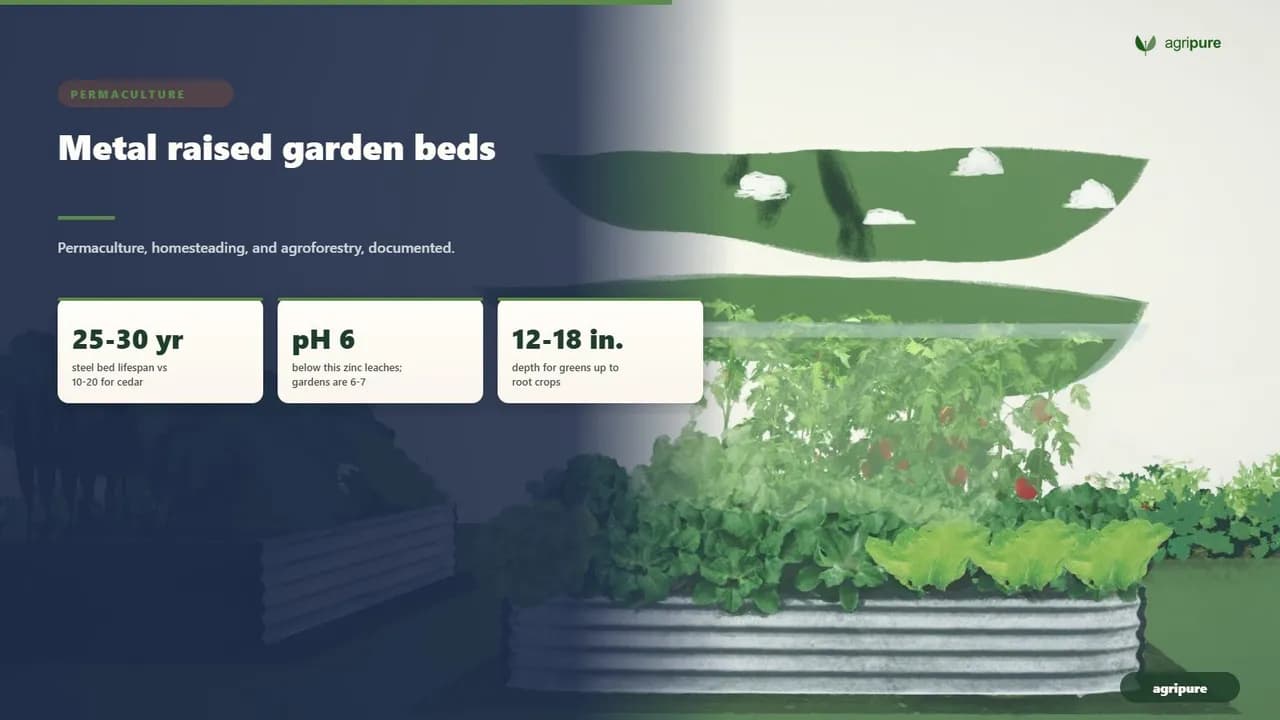
- Galvanized coatings only release meaningful zinc below about pH 6; most garden soils sit at pH 6 to 7, so leaching stays negligible.
- Zinc is a plant micronutrient, not a contaminant at these levels — the worry is backwards for modern, food-safe galvanized steel.
- Steel beds last roughly 25 to 30 years; cedar lasts 10 to 20 and untreated pine about 5, so metal wins on lifespan per dollar.
- Aluzinc / zinc-aluminum-magnesium coatings outlast plain galvanized steel several times over and resist rust far longer.
- Go at least 12 in. deep for most crops and 18 in. or more for carrots, potatoes, and other deep roots.
Two questions stop most people before they buy a corrugated metal raised bed: does the metal cook the roots in July, and does the galvanized coating poison the vegetables? Both fears collapse under the evidence, and once they do the real decision is the boring, useful one — lifespan, shape, and depth. This guide walks the heat and food-safety science with sources, compares metal against cedar on lifespan and cost, and covers assembly, liners, and the depths that root crops actually need. It sits alongside our broader raised-bed gardening guide and our walk through cedar, composite, and protection options; here we go deep on metal specifically.
Does metal cook the roots?
The heat fear is intuitive and mostly wrong. Bare metal does get hot in the sun, but a bed full of damp soil behaves like a heat sink, not an oven. Epic Gardening answers it directly: metal heating roots is “not at all” a problem, because “damp soil is a miraculous cooling agent for the hot metal.” The water in the soil absorbs and spreads the heat the wall picks up.
The numbers back the intuition. Frame It All reports that “the soil in the center of the bed stays about the same temperature as the ground,” and that “the core of the bed, where the most important root activity happens, stays much cooler and more stable.” Only a thin band of soil right against the sunny wall warms noticeably, and most roots are not there.
The hot-edge fix: if you garden in a scorching climate like the desert Southwest, plant 3 to 4 in. in from the south and west walls, mulch the surface, and keep the bed evenly watered. The damp-soil cooling effect only works if the soil is actually damp.
Is the galvanized coating food-safe?
That heat question settled, the bigger fear is zinc, and the honest answer is nuanced but reassuring. Galvanized steel is coated in zinc, and zinc only leaves that coating in meaningful amounts when the soil is acidic. A university Extension answer states it plainly: “galvanized metal is coated with zinc, which can leach into soil under acidic conditions (pH < 6),” but “most garden soils are pH 6 to 7, limiting zinc release.”

Epic Gardening sharpens the threshold: “only acidity at 5 pH or below can cause this slow and gradual corrosion,” which is more acidic than nearly any vegetable garden. And the thing leaching is not a poison: zinc is a plant micronutrient. Both plants and people “need a small quantity of zinc to survive,” so “the microscopic amounts they may absorb from your beds won’t harm any food you’re growing.”
There is one real caveat worth stating, and it is about age, not modern beds. The same Extension answer notes that “older galvanized metal — 60-plus years — may have traces of lead or cadmium from historical manufacturing.” A brand-new food-safe galvanized or Aluzinc bed uses modern zinc coatings without those impurities; a salvaged 1950s roofing panel is the only case where caution is warranted. For an acidic soil, keep an eye on pH in the soil you fill it with.
If you garden acidic on purpose (blueberries at pH 4.5 to 5.5, for instance), keep those crops in a wood or fabric bed and reserve the galvanized beds for the pH 6 to 7 vegetables. That sidesteps the one condition under which zinc release climbs.
Metal vs cedar: lifespan and cost
With the fears retired, the comparison that matters is lifespan per dollar, and here metal pulls clearly ahead. Gardenary’s figures are a clean anchor: “steel raised beds last about 25 to 30 years,” while cedar and similar rot-resistant woods “can be expected to last anywhere from 10 to 20 years,” and cheap pine “only about 5 years, maybe 10 under the best conditions.”
Material | Typical lifespan | Relative upfront cost | Notes |
|---|---|---|---|
Untreated pine / fir | ~5 years | Lowest | Rots fast at the wet base |
Cedar / redwood | 10-20 years | High | Natural oils resist rot |
Galvanized steel | 25-30 years | Moderate | Coating quality drives lifespan |
Aluzinc / Zn-Al-Mg steel | 20-30+ years | Moderate-high | Several times the rust resistance |
Coating is the variable that decides where a metal bed lands. Frame It All notes the best beds use “a zinc-aluminum-magnesium alloy” that creates “a more stable and resilient barrier against rust than traditional zinc coatings alone.” These Aluzinc or Galvalume coatings can outlast plain galvanized steel several times over, which is why a quality metal bed often outlives 2 cedar beds bought back to back.
Cost tells the same story over time. A cedar bed may cost less per year than pine but still needs replacing in 15 years; a coated steel bed amortized over 25 to 30 years is usually the cheapest durable option per season. Timberlane Gardens puts the caveat well: “coating quality matters more than the fact that it is metal,” so buy on the coating spec, not the silver look.
Assembly, liners, and the brand kits
That lifespan only pays off if the bed goes together right, and most metal beds today ship as flat-pack corrugated panel kits — the Birdies-style modular beds that bolt into ovals, rectangles, and rounds. Assembly is genuinely quick: a typical kit is 30 to 60 minutes with the included bolts and a single wrench or drill, and the corrugation gives the thin steel its rigidity once it curves.
Two assembly choices affect longevity. First, edge safety: better kits roll or fold the top rim so there is no exposed cut edge; if yours has raw edges, a few feet of split tubing or edge trim makes the bed safe to lean on. Second, liners: a breathable fabric liner or a food-safe poly liner on the walls slows soil-to-metal contact and can add years to a bed’s life, though it is optional on a neutral pH 6 to 7 soil where leaching is already negligible.
- Prep the ground level and weed-free; lay cardboard to smother grass if needed.
- Bolt the panels per the kit, keeping the rolled rim up and bolt heads consistent.
- Line if you like — fabric for drainage, poly on the walls for an acidic soil, never sealing the base.
- Fill with a real soil blend, not pure compost, so it holds structure and moisture.
Shapes and depths for root crops
The advantage of the modular kits is that shape and depth are choices, and root crops care about both. Depth is the one that bites: leafy greens and most annuals are happy in 8 to 12 in., but carrots, parsnips, and potatoes want real room below them.
Match the bed height to the deepest crop you plan to grow. A 12-in. bed covers lettuce, bush beans, peppers, and herbs; a 17 to 18 in. bed, a common tall-kit height, handles carrots and potatoes without hitting the native soil below. Many corrugated kits also come in extra-tall 29 to 32 in. versions that double as a no-bend gardening height, which spares the knees as much as the carrots.
Crop group | Minimum depth | Bed height to buy |
|---|---|---|
Leafy greens, herbs | 6-8 in. | 12 in. |
Tomatoes, peppers, beans | 10-12 in. | 12-17 in. |
Carrots, beets, parsnips | 12-18 in. | 17-18 in. |
Potatoes | 16-18 in.+ | 18 in. or taller |
Shape follows the site. A narrow 3 to 4 ft width lets you reach the middle from either side without stepping in; ovals and rectangles suit row crops, while round kits anchor an herb spiral or a single fruit bush. Whatever the footprint, keep it to an arm’s reach across, and let depth, not the brochure photo, be set by what grows below the surface.
The takeaway
A metal raised bed is a better buy than its reputation suggests. The heat fear is answered by physics (damp soil keeps the root zone near ground temperature) and the zinc fear by chemistry: leaching only matters below pH 6, most gardens sit at pH 6 to 7, and zinc is a micronutrient anyway. What is left is a genuinely good deal: 25 to 30 years from coated steel against 10 to 20 from cedar, modular shapes, and a quick bolt-together build. Buy on coating quality, go at least 12 in. deep (18 in. for roots), line it only if your soil runs acidic, and the bed will outlast several wooden ones in the same spot.
Frequently asked questions
Do metal raised garden beds get too hot and cook plant roots?
No, not in practice. Bare metal heats in the sun, but the damp soil inside acts as a cooling agent and heat sink. Frame It All notes the soil in the center of the bed stays about the same temperature as the surrounding ground, and only a thin band against the sunny wall warms noticeably. In very hot climates, plant a few inches in from the south wall, mulch, and keep the bed watered.
Are galvanized metal raised beds safe for growing vegetables?
Yes, for modern food-safe galvanized or Aluzinc beds. Zinc only leaches from the coating in meaningful amounts when soil is acidic, below about pH 6, and most garden soils sit at pH 6 to 7. Zinc is also a plant micronutrient, so the trace amounts absorbed are not harmful. The only real caution is salvaged metal over 60 years old, which may carry lead or cadmium impurities.
How long do metal raised beds last compared to cedar?
Steel raised beds typically last about 25 to 30 years, while cedar and similar rot-resistant woods last 10 to 20 years and untreated pine only about 5. Coating quality is the deciding factor for metal: Aluzinc or zinc-aluminum-magnesium coatings resist rust several times longer than plain galvanized steel, so a quality metal bed often outlives two cedar beds bought back to back.
Do I need to line a metal raised garden bed?
It is optional on neutral soil. A breathable fabric liner aids drainage, and a food-safe poly liner on the walls slows soil-to-metal contact, which helps if your soil is acidic. Since zinc leaching is already negligible at pH 6 to 7, a liner is more about extending bed life and protecting raw edges than about safety. Never seal the base, or the bed will not drain.
How deep should a metal raised bed be for vegetables?
Go at least 12 inches for most crops, which covers greens, tomatoes, peppers, beans, and herbs. For carrots, beets, and parsnips, choose a 17 to 18 inch bed so roots do not hit the native soil; potatoes want 18 inches or more. Many corrugated kits also come in extra-tall 29 to 32 inch heights that double as a comfortable no-bend gardening height.
What are corrugated metal bed kits like to assemble?
Most are flat-pack panel kits, the Birdies-style modular beds, and assembly runs about 30 to 60 minutes with the included bolts and a wrench or drill. The corrugation stiffens the thin steel once it curves. Look for a rolled or folded top rim so there is no exposed cut edge, and prepare level, weed-free ground before you bolt the ring together and fill it.
References
- Ask Extension (Cooperative Extension). “Galvanized metal raised beds — toxins leaching.” ask.extension.org
- Epic Gardening. “Are Galvanized Steel Garden Beds Safe?” epicgardening.com
- Frame It All. “Galvanized Steel Bed Safety: Fact vs. Fiction.” frameitall.com
- Gardenary. “How Long Can Raised Beds Really Be Expected to Last?” gardenary.com
- Timberlane Gardens. “How Long Do Cedar Raised Garden Beds Last vs Metal.” timberlanegardens.com
- Gardenary. “Is It Safe to Garden in Steel Raised Beds?” gardenary.com