“Turkeys reward the grower who pays attention in week one, because a poult that piles in a cold corner or drinks from a dirty font on day two will cost you a bird you cannot get back.”
A pair of broad-breasted toms will reach 30 pounds of dressed weight in roughly 18 weeks. A pen of heritage Narragansetts will hit the table at 26 weeks and taste markedly different from anything sold in a supermarket. Either path is achievable on a quarter-acre homestead, and the timeline from ordering poults to pulling a bird from the oven is well within a single growing season. Turkeys require different management habits than chickens.
This guide covers the full arc: choosing between heritage and commercial birds, setting up a brooder that does not kill your first batch, housing and feed through the grow-out phase, the critical biosecurity rule of separating turkeys from chickens, and the realistic economics of a small flock. By the end you will know whether turkey production fits your land and your calendar, and how to get a flock through its first 18 to 28 weeks without the costly mistakes that trip up most first-timers.
Key takeaways

The first days are critical for turkey poults. Providing a warm, clean brooder environment ensures healthy growth before they move to pasture.
- Broad-breasted birds reach market weight in 14–18 weeks; heritage breeds take 26–28 weeks and produce a richer, more complex flavour at higher cost per pound.
- Poults need a warmer, longer brooding period than chicks (95°F on day one, dropping 5°F per week for six weeks), and they are far more prone to piling and drowning in waterers.
- Never raise turkeys on ground previously used by chickens within three years: blackhead disease (histomoniasis) can kill 80–100% of a turkey flock while leaving chickens as asymptomatic carriers.
- Feed protein drops through four stages (28% starter, 26% grower, 22% developer, and 16–19% finisher), and switching too early slows growth measurably.
- A small flock of 10–20 birds is a realistic entry point; toms consume roughly 90 lb of feed each to market weight.
Why turkeys — and how they differ from chickens
The straightforward case for turkeys is the meat. A single broad-breasted White tom dressed at 25–30 lb feeds a large family for days, and heritage-breed birds deliver a depth of flavour that is structurally impossible in a commercial bird raised to market in 16 weeks. Beyond the table, turkeys are voracious foragers. Turned onto brushy pasture they work through grasshoppers, beetles, and ticks that chickens miss, which is useful if you run other livestock and want a second cleanup flock.
The differences from backyard chickens start in the first hour of life. Poults are famously fragile. They will starve rather than find feed on their own, drown in one inch of water, and pile fatally in a corner if the brooder cools by 10°F. Once past six weeks they become sturdy, curious, and active when given space. They also grow fast enough that housing designed for week three is wrong for week eight, so planning the whole grow-out space before the poults arrive pays off.
Chickens and turkeys share ground poorly. Separating the two species is the primary biosecurity rule of turkey production, explained in detail below. If you already run a chicken flock, separating the species and their pasture is non-negotiable.
Heritage vs. broad-breasted: choosing your bird

Heritage breeds (left) have a longer, leaner frame; Broad-Breasted Whites (right) grow a much larger breast in half the time.
The choice between commercial and heritage birds is really a choice of timeline, feed cost, and what you want on the plate. Penn State Extension puts it plainly: broad-breasted hens reach 20 lb live weight in 14 weeks and toms reach 38 lb by 18 weeks, while heritage breeds require 26 to 28 weeks to hit market weight and dress out smaller. That extra 10 weeks of feeding affects economics significantly; toms consume roughly 90 lb of feed each to finish.
Trait | Broad-Breasted White/Bronze | Heritage breeds |
|---|---|---|
Weeks to market | 14–18 weeks | 26–28 weeks |
Tom live weight | 35–42 lb | 18–23 lb |
White-to-dark meat ratio | ~70:30 | ~50:50 |
Natural mating | No (artificial insemination) | Yes |
Foraging ability | Limited | Excellent |
Disease hardiness | Moderate | Higher on range |
Feed efficiency | Better | Lower |
Heritage breeds (Narragansett, Bourbon Red, Black, Standard Bronze, and the smaller Beltsville Small White documented by the USDA National Agricultural Library) were nearly extinct by the 1990s. The Livestock Conservancy listed them as critically endangered in 1997. Small-flock growers have done more to bring them back than commercial operations. If breed conservation matters to you alongside the harvest, heritage birds make the most sense. If you want a single annual flock timed to Thanksgiving, Broad-Breasted Whites are the easier calculation: predictable weight, shorter timeline, lower feed cost per pound of meat.
Common heritage breeds and their strengths: Narragansett for calm temperament and good mothering; Bourbon Red for rich flavour and manageable size (hens 12–14 lb dressed); Standard Bronze for the biggest heritage frame; Royal Palm for the home grower who wants a smaller finished weight.
Setting up the brooder
A bad brooder kills poults in the first 48 hours. A good one is simple: warm, dry, draft-free, with feed and water the poults cannot miss.
Start temperature at 95°F measured at floor level under the heat source; a 250-watt infrared heat lamp works for small batches. Drop 5°F per week until you reach 70°F, then hold there until the birds no longer need supplemental heat, typically by six weeks. Cornell Small Farms notes that turkeys need five to six weeks in the brooder (roughly twice the time of chicks) and warns that even nighttime temperatures above 60°F are required before outdoor transition at four weeks.
Bedding is kiln-dried wood planer shavings or peat moss. UNH Extension is specific: no sawdust (poults eat it and impact their crop), no newspaper (causes splay legs on the slippery surface), no hay or wood chips (both mold quickly under a damp flock). Lay 3 to 5 inches. Plan to rake and replace bedding every two to three days, as wet litter is the primary breeding ground for the respiratory and intestinal pathogens that kill young turkeys.
The three first-day rules: dip each beak in water the moment poults arrive so they drink before they explore; scatter feed across paper towels or shallow trays so they find it without searching; check the brooder at two-hour intervals for the first 48 hours for piling, when a cold draft or a startled flock can crush birds in a corner. If you see piling, raise the temperature two to three degrees and check for drafts.
Waterers matter. Poults drown in one inch of open water. Use chick-size founts or shallow waterers with marbles in the trough for the first two weeks. Ammonia from wet litter damages turkey lungs at concentrations too low for the human nose to detect, per Cornell Small Farms. Ventilate the brooder well from week one, even if it means using a small secondary fan on a timer.
Housing and space from brooder to finish

A well-ventilated grow-out shelter with roost bars and dry litter provides the essential conditions through weeks 6 to 18.
Space requirements expand quickly as turkeys grow. Penn State Extension and UNH Extension converge on these benchmarks:
- Brooder (0–6 weeks): 1 sq ft per poult inside the heated guard ring, expanding to 2–3 sq ft as they grow.
- Grow-out barn (weeks 6 to market): 3–5 sq ft per bird on cleanable litter floors inside; UNH Extension recommends 6 sq ft per bird minimum for good litter management.
- Outdoor yard: 20 sq ft per bird once birds are eight weeks old and feathered out.
- Pasture range: A minimum of one acre of production land for a flock of 200–500 birds in commercial pastured systems; at homestead scale, 50–100 birds per acre on rotating paddocks keeps grass alive.
Roost bars are worth building in by week eight. Turkeys roost instinctively and a flock that sleeps on bare litter develops breast blisters and has higher respiratory-disease rates. Set roosts at 18 to 24 inches off the floor, low enough that heavy broad-breasted birds can manage the drop without injuring their hocks. Four to six inches of horizontal bar space per bird is adequate.
Ventilation, along with square footage, is an essential design variable. Air speed of 400 cubic feet per minute across the birds’ heads helps cool a summer flock, per Penn State Extension. Plan the airflow before you build, because retrofitting ventilation into a solid-sided shed is expensive and often inadequate.
Feed: four stages, four protein levels
Turkeys cannot use a standard chicken starter. The protein and amino-acid requirements differ, and chick starter typically lacks the methionine and lysine levels turkey poults need in the first four weeks. Always buy feed labeled for turkeys.
The four-stage protocol that Penn State Extension and UNH Extension agree on:
- Starter, weeks 0–4: 28% protein crumbles. This is the stage where the difference matters most; under-feeding protein in the first month produces birds that never fully catch up. Keep feed available free-choice, 24 hours a day.
- Grower, weeks 4–6: 26% protein crumbles or pellets. A gradual step down that maintains muscle-building while beginning the transition.
- Developer, weeks 6–10: ~22% protein. Often a commercially blended ration or a home mix of developer feed plus whole grains.
- Finisher, week 10 to processing: 16–19% protein. Switch to an unmedicated ration at least three to four weeks before processing to meet withdrawal requirements and avoid off-flavors.
Total feed consumption: UNH Extension puts hens at roughly 60 lb of feed from hatch to processing and toms at ~100 lb. eXtension Poultry’s estimate for toms is closer to 90 lb. Budget $0.40–$0.65 per pound for turkey feed, putting the feed cost per tom at $36–$65 before processing. A local processor typically charges $5–$8 per bird for kill and $0.25–$0.40 per pound for cut-and-wrap.
The blackhead rule: why turkeys and chickens cannot share ground
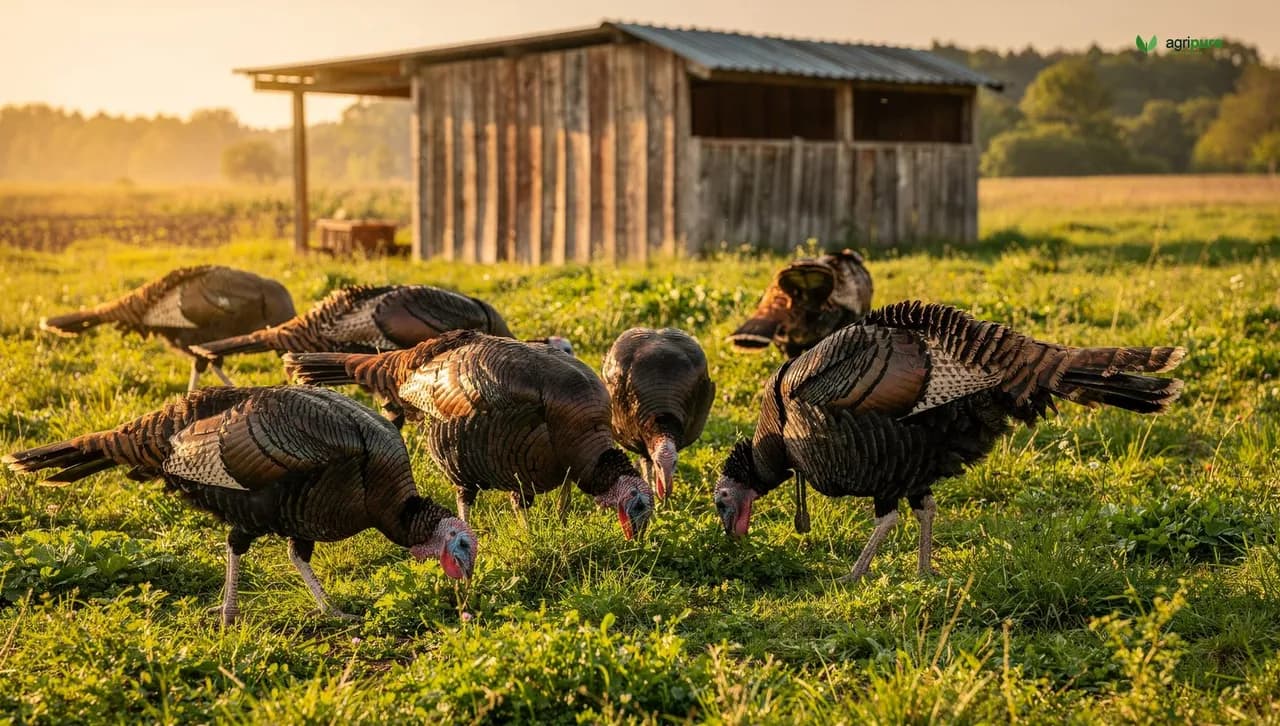
Preventing blackhead disease is the primary management priority when raising turkeys on small acreages.
Blackhead disease (formally histomoniasis) is caused by the protozoan Histomonas meleagridis. In a turkey flock, it kills 80 to 100% of infected birds within days of symptom onset. In a chicken flock, it causes mild illness and full recovery — after which those chickens carry the organism for life as asymptomatic reservoirs.
The transmission route is specific and stubborn. H. meleagridis cannot survive long outside a host on its own, but it can penetrate the eggs of the cecal nematode Heterakis gallinarum and remain infectious inside those eggs for up to 150 weeks in soil and litter, per ATTRA/NCAT. Chickens and most other gallinaceous birds carry H. gallinarum naturally. Every time a chicken defecates on ground that turkeys will later use, it deposits cecal worm eggs that may harbor H. meleagridis, and those eggs survive in the soil for years.
Earthworms compound the problem. Cecal worm eggs are ingested by common earthworms, where H. meleagridis continues to survive. A turkey grubbing through pasture for earthworms in a field that chickens used two years ago is still at risk.
The Merck Veterinary Manual states it plainly: chickens recover from clinical signs but remain carriers, whereas turkeys die. eXtension Poultry’s prevention standard: do not range turkeys on pasture used by chickens within the past three years. ATTRA/NCAT’s research shows cecal worm eggs are viable up to three years in soil and litter, which is the scientific basis for that three-year gap.
The practical rules for a mixed homestead:
- Keep turkey housing and pasture on a completely separate circuit from chicken housing and pasture, with no shared fencing runs or drainage lines.
- If you have both species and limited land, designate permanent turkey ground and do not rotate chickens onto it, ever.
- Do not allow turkey poults to free-range near areas where chicken manure falls — including near the chicken coop even if the chickens are confined.
- There are no approved treatments for blackhead in North America. Prevention is the only lever.
For this reason, egg flocks and turkey flocks must be planned as separate enterprises from the start. Most small-flock growers keep one species rather than managing both on limited property.
Health, predator protection, and getting started

Good fencing (buried six inches and topped with a horizontal overhang) is the first line of predator defense for a turkey grow-out.
Beyond blackhead, the other major health concerns in young turkeys are coccidiosis and respiratory disease. Coccidiosis: use a turkey starter formulated with a species-specific coccidiostat that targets the Eimeria strains affecting turkeys rather than chickens. Respiratory disease: ammonia from wet litter is the most common underlying cause. Manage litter, ventilate aggressively, and buy poults only from National Poultry Improvement Plan (NPIP)-certified hatcheries to reduce the likelihood of introducing Mycoplasma gallisepticum and other egg-borne diseases at the source.
Predators: turkeys are large enough by eight weeks to deter most raptors, but foxes, coyotes, raccoons, and opossums will take birds at any age given the chance. Welded-wire fencing buried six inches below grade and fastened to a top rail discourages digging. Poults in the brooder are vulnerable to rats — seal gaps in the brooder building larger than half an inch.
Getting started checklist:
- Order poults from an NPIP-certified hatchery 8–12 weeks in advance of your target start date; supply tightens in spring.
- Build or acquire the brooder before poults ship, and have it warmed to 95°F for 24 hours before arrival.
- Have turkey starter feed on hand (not chick starter); 10 poults will consume roughly 10–12 lb in the first six weeks.
- Check local zoning: turkeys are regulated separately from chickens in many municipalities, and some jurisdictions prohibit them outright in residential zones.
- Plan your processing option before you order; a local USDA-inspected processor booked in advance avoids the scramble at Thanksgiving when slots fill in August.
A flock of 10 to 20 birds is a reasonable entry point for a first-time grower. It is small enough to manage on a tight land budget, large enough to cover a home processing setup or a processor booking, and it gives you a meaningful data set (feed costs, mortality, finished weight) to size the next season accurately. Many growers start with a spring batch of 10 to 15 broad-breasted Whites, harvest in October, and scale up or pivot to heritage breeds the following year with the first season’s numbers in hand.
The cost and the calendar
Turkey production pencils out differently than egg production. Unlike egg production, turkeys provide meat at the end of the grow-out rather than weekly output. Treat it as home meat production unless you sell directly to restaurants or farmers markets willing to pay $8–$12 per pound for dressed heritage birds.
Rough per-bird economics for a broad-breasted White tom at 16–18 weeks:
- Poult cost: $8–$14 (NPIP-certified, spring delivery)
- Feed to market: ~90 lb at $0.50/lb average = $45
- Processing: $5–$8 kill fee + $0.30/lb cut-and-wrap on a 25-lb dressed bird = $12–$15
- Bedding, waterers, heat lamp electricity: ~$8–$12 per bird across the season
- Total cost per tom: roughly $73–$86 for a 25 lb dressed bird = $2.90–$3.45/lb
That is below the retail price of a fresh heritage or pastured turkey at most farm stands ($6–$12/lb), and well below what a restaurant-quality bird costs wholesale. The calculation for heritage breeds shifts upward due to a longer grow-out, higher feed consumption, and smaller finished weight, but direct-sale demand for their flavor remains strong.
The calendar for a Thanksgiving target: order poults for a mid-June delivery, brood through July, move to grow-out by late July, process in mid- to late November for broad-breasted birds or early November for heritage breeds that started at the same time. Book your processor in May. That single booking detail separates the growers who hit the holiday table from those who are still searching for a slot in September.
If Thanksgiving is not the goal, spring processing for a summer turkey around July 4 works just as well. Start poults in February, brood indoors through March, finish on spring pasture. The pastured poultry model translates directly: rotating paddocks, portable shelters, and daily moves onto fresh grass cut both feed cost and parasite pressure on heritage breeds significantly.
Frequently asked questions
Can I raise turkeys and chickens together?
No, not safely. Chickens carry blackhead disease (histomoniasis) as asymptomatic reservoirs. The causative protozoan, Histomonas meleagridis, survives inside cecal worm eggs in soil for up to three years. Turkey mortality from blackhead is 80–100%. Keep the species on completely separate ground; do not range turkeys on pasture used by chickens within the past three years.
How long does it take to raise a turkey?
Broad-breasted hens reach 14–20 lb live weight in 12–14 weeks; toms reach 35–42 lb in 16–19 weeks. Heritage breeds take 26–28 weeks and produce a smaller, more flavourful bird. The grow-out window of 14–18 weeks makes a spring batch easily achievable for a summer or Thanksgiving harvest.
What do turkey poults eat?
Start with 28% protein turkey crumbles (not chick starter) free-choice for the first four weeks. Step down to 26% grower (weeks 4–6), ~22% developer (weeks 6–10), and 16–19% finisher through processing. Switch to an unmedicated ration at least three to four weeks before slaughter.
How much space do turkeys need?
Brooding poults need 1 sq ft each in the heated ring, expanding to 2–3 sq ft by week five. Finishing birds need 3–6 sq ft indoors and 20 sq ft each in an outdoor yard. Heritage breeds on rotating pasture thrive at 50–100 birds per acre.
Are heritage turkeys worth raising?
For flavor and breed conservation, yes: heritage birds produce a 50:50 white-to-dark meat ratio and can mate naturally. The tradeoffs are a 26–28 week timeline (vs. 14–18 weeks for broad-breasted), higher total feed cost, and a smaller finished weight. Growers who sell direct at premium prices or value self-sufficient breeding stock find heritage breeds a strong fit.
References
- Small-Flock Turkey Production — Penn State Extension
- Histomoniasis in Poultry — Merck Veterinary Manual
- Blackhead in Poultry — eXtension Poultry
- Parasite Management for Natural and Organic Poultry: Blackhead in Turkeys — ATTRA / NCAT
- Heritage or Production Turkeys: Which Is the Best Fit? — Penn State Extension
- Raising Turkeys — University of New Hampshire Extension
- Getting Turkeys Off to a Good Start — Cornell Small Farms Program
- Raising Meat Turkeys in Small or Backyard Flocks — eXtension Poultry