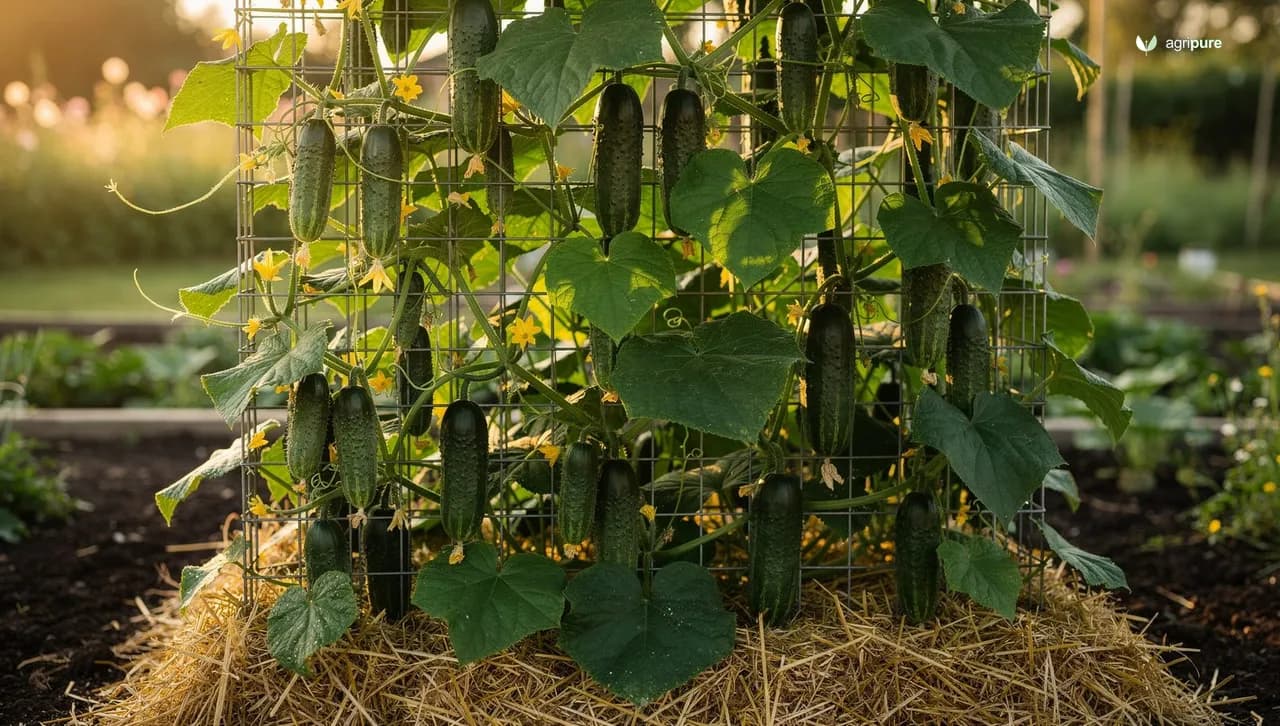
Cucumbers reward warm soil, consistent water, and a trellis built before the vines need it.
Cucumbers are one of the fastest returns in the kitchen garden. Sow seed into warm soil in late spring and you can be harvesting within 50 to 70 days, picking every two to three days through midsummer to keep the vines producing. They belong to the cucurbit family alongside squash and melons, sharing their love of heat, their monoecious flowering habit (separate male and female flowers on the same plant), and their one non-negotiable demand: soil that never drops below 60°F at planting time, ideally 70°F.
The search term “how to grow cucumbers” hides a lot of variation. There are slicing cucumbers and pickling cucumbers, bush types that stay compact enough for a container and vining types whose stems run six feet or more. There are gynoecious hybrids bred to produce mostly female flowers and burpless varieties engineered to eliminate the compound (cucurbitacin) responsible for bitterness and post-meal belching. This guide works through every decision in order, from choosing the right type for your space to harvesting at peak flavor without triggering bitterness.
Internal links will send you deeper where you need them: for the broader context of how cucumbers fit into a vegetable patch, see the guides on raised-bed gardening and companion planting; for starting seeds before the season opens, the seed-starting guide covers all the mechanics.
Key takeaways
Healthy cucumber vines trellised vertically with mature cucumbers ready for harvest in rich soil.
Consistent warmth, ample water, and proper trellising are the secrets to a bountiful cucumber harvest, often ready within 50 to 70 days from sowing.
- Wait until soil reaches at least 60°F (ideally 70°F) before sowing or transplanting; chilling below 50°F causes lasting injury.
- Vining cucumbers on a trellis produce straighter fruit, better airflow, and take up half the ground space of sprawling plants.
- Bush varieties suit containers 12 inches or larger; one plant per pot works well with daily watering.
- Bitterness is caused by cucurbitacin, concentrated at the stem end and under the skin; consistent water and avoiding heat stress keep it out of the flesh.
- Pick every two to three days; a single oversized cucumber left on the vine signals the plant to slow fruit production.
- Cucumber beetles are the primary threat; row covers until flowering, then remove to allow bee pollination.
Choosing your cucumber: slicing, pickling, bush, and vining
Before you buy seeds, two decisions shape everything else: what you want to eat, and how much space you have. Getting both right means you will not be fighting the plant all season.
Slicing vs. pickling. Slicing cucumbers are bred for fresh eating: thinner skin, milder seeds, and longer fruit at 6 to 8 inches. Pickling cucumbers are shorter (harvest at 2 to 4 inches), have bumpier skin, thinner cell walls, and lower water content, which gives pickled slices a better crunch. Both types taste fine fresh, but pickling varieties picked at full slicing size tend to go seedy and tough. If you want to do both, choose a dual-purpose variety like Calypso or a slicing type you pick young for the brine.
Bush vs. vining. Vining cucumbers (Straight Eight, Marketmore 76, Diva, Sweet Slice) produce vigorous stems that easily reach six feet and bear abundantly over a longer season. They need a trellis or at least four to six feet of horizontal ground per plant. Bush types (Salad Bush Hybrid, Spacemaster, Bush Pickle) stay compact at two to three feet, fruit about 10 days earlier (50 days vs. 60), and suit containers, raised beds, and small gardens where sprawl is not an option. The tradeoff is a shorter overall harvest window.
Category | Example varieties | Harvest size | Days to maturity | Best use |
|---|---|---|---|---|
Slicing (vine) | Marketmore 76, Diva, Sweet Slice, Straight Eight | 6–8 in | 58–65 days | Fresh eating; low bitterness |
Slicing (bush) | Salad Bush Hybrid, Fanfare, Spacemaster | 6–7 in | 50–55 days | Containers, small beds |
Pickling (vine) | Calypso, General Lee, County Fair | 2–4 in | 52–58 days | Pickles; gynoecious types set fruit fast |
Pickling (bush) | Bush Pickle, Fancipak M | 2–4 in | 48–52 days | Container pickling |
Specialty | Lemon, White Wonder, Armenian | Varies | 60–70 days | Heirloom novelty, fresh eating |
One more term worth knowing: gynoecious varieties like Calypso and General Lee are bred to produce predominantly female flowers, which means more cucumbers set earlier. Seed packets often include a few seeds of a standard (male-flowering) variety to ensure pollination; plant them in the same row.
Starting from seed vs. transplants, and timing by zone
Cucumber seedlings in biodegradable pots on a windowsill, ready for transplanting outdoors after the last frost date.
Start cucumbers indoors three weeks before your last frost date; use peat or coir pots to avoid disturbing roots at transplant.
Cucumbers are most often direct-sown, but starting indoors three to four weeks before your last frost date lets you get ahead of the season in shorter-summer zones. University of Maryland Extension recommends handling transplants gently to minimize root disturbance; cucurbits are sensitive. Peat, coir, or paper pots that go directly in the ground are worth the extra cost.
Soil temperature is the real planting trigger. Oregon State University Extension is emphatic: do not plant until soil temperature reaches at least 60°F. The preferred range is 70°F at one inch depth. Chilling injury below 50°F causes yellowing, water-soaked patches, and root rot that can follow the plant all season. A $10 soil thermometer pays for itself in one season of avoided replanting.
Approximate last-frost and planting windows by zone:
- USDA Zone 5 (Upper Midwest, New England): last frost mid-May; direct sow late May to early June; transplant third week of May under row cover.
- Zone 6–7 (Mid-Atlantic, Pacific Northwest): last frost late April; direct sow first week of May; transplant late April with cover ready.
- Zone 8–9 (Southeast, Southwest): last frost March; sow April for summer harvest, or August for a fall crop.
- Zone 10 (Deep South, Southern California): two seasons possible: February–March and August–September.
Besides frost protection, row covers placed over seedlings immediately after planting and secured at the edges raise air temperature, accelerate establishment, and keep cucumber beetles off young plants. Remove the covers once flowers open, so bees can get in.
Soil, sun, and spacing
Cucumbers want full sun (a minimum of six hours, though eight is better) and loose, well-drained, moisture-retentive soil. Both University of Minnesota Extension and University of Georgia Extension cite a soil pH of 6.0 to 6.5 as the target range. If you are working from a soil health baseline, that pH lands your cucumbers in the sweet spot for nitrogen and phosphorus availability.
Amend heavy clay or sandy soils before planting by working in four to six inches of finished compost. A pre-plant application of a balanced fertilizer (5-10-10 at 3 lb per 100 sq ft, per UGA Extension) gives seedlings a phosphorus boost for root establishment. Side-dress with a nitrogen fertilizer one week after blossoming begins, then again three weeks later to sustain fruiting.
Spacing depends on training method:
- Hills (no trellis): three to five seeds per hill, hills four to five feet apart; thin to two to three plants per hill after germination.
- Rows with trellis: sow four to five seeds per foot in rows 30 inches apart; thin to one plant every 12 inches when seedlings reach five inches tall.
- Bush varieties in beds: 18 to 24 inches apart in every direction; they spread but do not vine.
Trellising and training for vertical growing
Trellising is the single highest-return investment for cucumber growing. University of Maryland Extension lists the benefits: higher yields, straighter fruit, better air circulation that slows fungal disease, lower soil-contact rot, and easier harvest without bending. A trellis also cuts the ground footprint of vining types from six feet of sprawl to a 12-inch column.
A simple A-frame or flat trellis three to five feet tall, built from wire stock panel or nylon netting stretched between T-posts, handles most vining varieties. Set it up before you sow; driving posts after seedlings emerge risks root damage. Train young vines onto the netting by hand; they attach with tendrils once they find something to grip.
The RHS recommends pinching out the growing tip after six or seven leaves on outdoor ridge cucumbers to encourage lateral branching and more fruiting shoots. On a trellis, this is less critical (the vine will branch naturally), but pinching the main tip once it tops the trellis keeps the plant from becoming an unmanageable wall of foliage.
Cucumber vines with tendrils grip a wire trellis panel as small cucumbers form behind yellow female flowers.
Female flowers carry a tiny immature cucumber at the base; male flowers do not. Bees move pollen between them.
Pollination note. Cucumbers are monoecious: separate male and female flowers grow on the same plant, and bees move pollen between them. Male flowers appear first, sometimes two weeks before female flowers, and may drop without setting fruit. That is normal. Female flowers have a tiny swelling (the immature cucumber) at the base of the petal; male flowers have a plain stem. Once female flowers open, bees do the rest. Do not remove male flowers; the plant needs them. If you have few bees, hand-pollinate with a small paintbrush, moving pollen from a male to a female flower in the morning when both are open.
Watering, feeding, and avoiding bitterness
Consistent moisture is the single biggest factor in cucumber quality, mattering more than variety or fertilizer. Cucumbers are roughly 95% water, and the stress that sends cucurbitacin (the bitter compound) flooding into the fruit is almost always water-related: drought followed by irrigation, extreme heat, or wildly uneven soil moisture. University of Minnesota Extension recommends about one inch of water per week from rain or irrigation, applied at the root zone rather than overhead. Drip irrigation or soaker hoses keep foliage dry, which matters because wet leaves carry fungal disease. On sandy soils, water more frequently in smaller amounts; on clay, water deeply but less often.
Cucurbitacin is normally concentrated in the leaves, stems, and roots. Under stress, it migrates into the fruit, especially toward the stem end and just under the skin. Iowa State University Extension notes that bitterness concentrates at the stem end; peeling and cutting off the stem end removes most of it. Prevention is better: water deeply on a schedule, mulch the root zone to buffer temperature swings, and choose low-cucurbitacin varieties like Diva, Sweet Slice, or Marketmore 76 if bitterness is a recurring problem.
Feeding is a two-stage process. A pre-plant balanced fertilizer builds the soil; then side-dress with nitrogen after the first flowers appear and again three weeks later. Avoid high-nitrogen fertilizers before flowering, as they push leafy growth at the expense of fruit. Work the mulch layer four inches deep around plants to hold moisture, regulate soil temperature, and reduce the splash that spreads bacterial disease.
Pests and diseases to watch for
Two threats account for most cucumber failures: cucumber beetles and bacterial wilt.
Cucumber beetles, striped (Acalymma vittatum) and spotted (Diabrotica undecimpunctata), chew holes in leaves, flowers, and fruit. Worse, they carry bacterial wilt (Erwinia tracheiphila), injecting the pathogen as they feed. Once wilt takes hold in a plant, there is no cure: the bacterium blocks the vascular system and the plant collapses within days. University of Georgia Extension is direct: early and continuous control of cucumber beetles is critical. Row covers from transplant to first flower are the most reliable defence for the home garden. Once covers come off for pollination, yellow sticky traps, kaolin clay sprays, or targeted pyrethrin applications can reduce beetle numbers.
A quick field test for bacterial wilt: cut a wilted stem, touch the two cut surfaces together briefly, then slowly pull them apart. If the cut ends stretch a bacterial thread between them like a thin spider web, wilt is confirmed.
Diseases to monitor:
- Powdery mildew: white powdery coating on older leaves in late summer, common as humidity rises. Improve air circulation (trellis helps), remove badly affected leaves, and apply sulfur-based fungicide if needed.
- Downy mildew: yellow angular patches on the upper leaf surface with gray-purple sporulation below; it spreads fast in cool, wet weather. Resistant varieties and good airflow are the main tools.
- Anthracnose and angular leaf spot: wet-looking spots that turn tan, common in rainy seasons. Avoid overhead watering; rotate cucumbers to a different bed each year.
Cucumber plants are good neighbors for beans, corn, nasturtium, and marigolds, and nasturtium in particular has shown some effect against cucumber beetles in Iowa trials. See the full companion planting guide for the pairing evidence.
Container and small-space growing
A Spacemaster bush cucumber plant in a large terracotta container trained up a bamboo tripod on a balcony.
Bush cucumbers in a 12-inch or larger container with a simple bamboo tripod give a balcony or patio garden a genuine harvest.
Cucumbers are among the most container-friendly large vegetables when you choose the right variety and meet their water demands. The Royal Horticultural Society recommends containers at least 30 cm (12 inches) wide and deep, filled with a peat-free compost mix with good drainage. On a balcony or patio, that means a 5-gallon or larger pot for one bush plant.
Bush varieties (Spacemaster, Salad Bush Hybrid, Bush Pickle) are the standard choice because their compact root systems suit container volumes and their vines do not overwhelm a simple bamboo tripod or short trellis. One plant per container; two per a 15-gallon half-barrel if you want more fruit. Container soil dries faster than ground soil, which means bitterness risk rises: check daily in hot weather and water when the top inch is dry. Feed with a dilute liquid fertilizer (half-strength balanced formula) every two weeks once fruiting begins, since container compost exhausts nutrients faster than garden beds.
For small raised beds, the square-foot gardening method places one vining cucumber per two-square-foot section when the plant is trained up a vertical net at the bed edge, offering a clean way to add cucumbers without shading the rest of the bed.
Harvest, ripening cues, and storage
Cucumber harvest begins 50 to 70 days after sowing, depending on variety and growing temperature, and it demands consistency. Fruit left on the vine too long signals the plant to wind down production: one yellow, seedy cucumber can slow an entire vine’s output for two weeks.
When to pick:
- Slicing varieties: 6 to 8 inches, dark green, firm. If the skin starts to yellow at the blossom end, it is already past peak.
- Pickling varieties: 2 to 4 inches for whole pickles; up to 5 inches for sliced relish.
- Specialty types (Lemon, White Wonder): pick when the color matches the variety name: Lemon at pale yellow, before it turns deep gold.
Use a knife or scissors to cut the stem a quarter inch above the fruit; pulling can damage the vine or uproot a shallow-rooted container plant. Harvest every two to three days at peak season: the window from "almost ready" to "past it" is often 24 to 48 hours in July heat.
Storage. Cucumbers are cold-sensitive. The ideal storage is 50 to 55°F at 95% relative humidity, which is closer to a cellar than a refrigerator. In practice, most home gardeners refrigerate them and use within one week. University of Minnesota Extension gives about one week in the fridge as the realistic window. Wrapping individual cucumbers in a paper towel and then a loose plastic bag reduces the surface moisture that accelerates softening. Do not store cucumbers near ethylene-producing fruit (apples, pears, tomatoes), as the gas yellows them fast. For longer-term preservation, pickling is the traditional and most reliable method.
The takeaway
Growing cucumbers well comes down to three non-negotiable rules: wait for warm soil, keep water consistent, and harvest before the fruit turns yellow. Everything else (trellis type, variety choice, fertilizer timing) is tuning around those three principles. Choose a bush type for a container or small raised bed, a vining type for a trellis with room to run, and a low-cucurbitacin variety if you have had bitterness problems before. Control cucumber beetles from day one with row covers, remove them when flowers open, and let the bees close the loop. A well-managed cucumber vine gives you fruit every two to three days for six to eight weeks, providing one of the highest returns by volume and speed of any vegetable you can grow from seed.
Read the companion planting guide
Frequently asked questions
When should I plant cucumbers?
Plant cucumbers when soil temperature reaches at least 60°F at one inch depth, ideally 70°F. In the upper Midwest and New England (Zone 5), that typically means late May to early June for direct sowing. In Zone 7 and warmer, the first week of May is usually safe. A soil thermometer is the most reliable guide; air temperature alone can be misleading after a cold snap.
Why are my cucumbers bitter?
Bitterness comes from cucurbitacin, a compound the plant produces under stress, most commonly drought followed by irrigation, extreme heat, or overcrowding. It concentrates at the stem end and just under the skin. Peeling and cutting off the stem end removes most of it. To prevent it: water consistently, mulch the root zone to buffer temperature swings, and choose low-cucurbitacin varieties like Diva, Sweet Slice, or Marketmore 76.
How often should I water cucumbers?
Aim for about one inch of water per week from rain or irrigation. In hot weather or on sandy soil, that may mean watering two or three times a week. Apply water at the root zone (drip or soaker hose rather than overhead) to keep foliage dry and reduce fungal disease. Never let the soil dry out completely between watering during fruit set.
Do cucumbers need a trellis?
Vining cucumbers benefit greatly from a trellis: it produces straighter fruit, improves airflow (reducing fungal disease), prevents soil-contact rot, and cuts the ground footprint by more than half. A three- to five-foot trellis of wire mesh or nylon netting stretched between posts works well. Bush varieties do not need trellising, though a short bamboo tripod in a container helps keep fruit off the pot rim.
What is the difference between slicing and pickling cucumbers?
Slicing cucumbers are bred for fresh eating: thinner skin, milder seeds, fruit harvested at 6 to 8 inches. Pickling cucumbers have bumpier skin, thinner cell walls, and lower water content; they are harvested at 2 to 4 inches for whole pickles. Both taste good fresh, but pickling varieties left to full slicing size tend to go seedy. Dual-purpose varieties like Calypso bridge the gap.
References
- Growing cucumbers in home gardens — University of Minnesota Extension
- Growing Cucumbers in the Home Garden (C1034) — University of Georgia Cooperative Extension
- Growing Cucumbers in a Home Garden — University of Maryland Extension
- Growing cucumbers in the home garden — Iowa State University Extension and Outreach
- Wait for soil to warm up to plant cucumbers — Oregon State University Extension Service
- How to grow cucumbers — Royal Horticultural Society