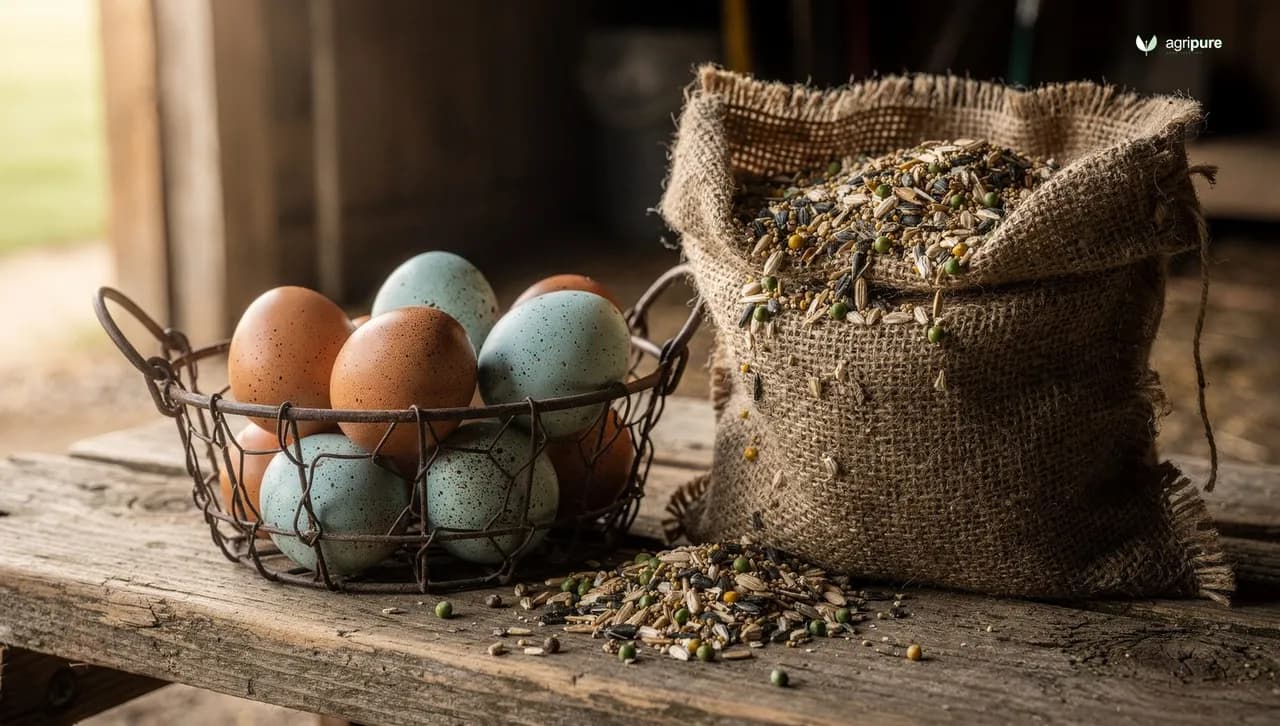
Raising chickens for premium eggs: breed, feed, and yolk realities
‘Premium chicken’ eggs are sold on a vibe – the russet yolk, the matte shell, the farm name on the carton. The vibe is downstream of two boring inputs: breed and feed. Breed sets your ceiling – how many eggs a hen lays a year, how much feed she eats to get there, whether she keeps laying through a Midwestern winter. Feed sets everything you actually taste: yolk color, omega-3 ratio, vitamin density, and the cost per dozen at the bottom of your spreadsheet. This guide stays narrowly on those three: which laying breeds earn their feed, what a soy-free corn-free ration actually does to the egg, and what the cost-per-dozen math really looks like at backyard scale. For pasture rotation, predator protection, and coop design, our raising pastured chickens guide covers that side; for a perennial forage paddock, see our food forest for chickens piece.
Picking the right laying breed
The breed conversation is overrated past the basics, but the basics matter. A laying-bred hen, well-fed, will run roughly 6 eggs a week through her first 2 years and eat about 3 pounds of feed weekly, per University of Minnesota Extension. From there the differences are temperament, cold-hardiness, and how long they keep laying after molt.
| Breed | Eggs / year (typical) | Shell color | Temperament | Cold-hardy? |
|---|---|---|---|---|
| Rhode Island Red | 250 – 300 | Brown | Assertive, foraging | Yes |
| Plymouth Rock (Barred) | 200 – 280 | Brown | Calm, family-friendly | Yes |
| Buff Orpington | 180 – 240 | Brown | Very docile | Yes |
| Wyandotte | 180 – 260 | Brown | Independent | Yes (heavy plumage) |
| Easter Egger / Ameraucana | 200 – 280 | Blue, green | Curious | Yes |
| Leghorn (White) | 280 – 320 | White | Flighty, active | Less – thin combs frostbite |
Feed: where ‘premium’ actually happens
Standard layer pellets are cheap because they are corn and soy, plus a vitamin premix. The ‘premium chicken’ egg is almost always made by changing the feed: shifting away from soy and corn toward whole grains, adding fish-meal or insect protein, and giving the birds enough pasture or forage to harvest their own carotenoids. The yolk follows the feed within days.

| Ration style | Typical ingredients | What it does to the egg | Feed cost (USD/lb, 2026 retail) |
|---|---|---|---|
| Conventional layer pellet | Corn, soybean meal, vitamin premix | Pale yolk, baseline nutrient profile | 0.35 – 0.55 |
| Non-GMO layer | Non-GMO corn + soy, vitamin premix | Same as conventional, marketing tier | 0.55 – 0.85 |
| Soy-free / corn-free whole-grain | Field peas, oats, wheat, sunflower, kelp | Better omega ratio, deeper yolk | 0.85 – 1.40 |
| Pasture + scratch + supplements | Above + pasture forage + grit + oyster shell | Best omega-3, B12, carotenoids | 0.95 – 1.60 + pasture cost |
Yolk color and the nutrition data
The orange yolk readers think of as premium is a carotenoid story. Carotenoids come from green plants, marigold petals, alfalfa, and insects – things the hen scratches up on pasture or that get added to the ration deliberately. A widely-cited 2007 farm-press study tested eggs from 14 pastured flocks against USDA conventional figures and found pastured eggs averaged 2 times more omega-3 fatty acids, 3 times more vitamin E, and 7 times more beta-carotene, with one-third less cholesterol and one-quarter less saturated fat.
| Metric | Conventional cage-free | Pasture (corn-soy) | Pasture (corn-soy-free) | Source |
|---|---|---|---|---|
| Omega-6 : omega-3 ratio | ~50.6 : 1 | ~3x lower (relative) | 5.7 : 1 | Foods 2022 (PMC9658713) |
| Carotenoid content | Baseline | ~2x baseline | ~2x baseline | Foods 2022 |
| Beta-carotene daily value / 2 yolks | ~8% | ~20% | ~20% | Foods 2022 |
| Vitamin E (vs USDA average) | 1x | Up to 3x | Up to 3x | 14-flock pastured-egg test (Long 2007) |
Cost-per-dozen, honestly
The backyard egg economics question deserves a straight answer. At soy-free whole-grain feed prices and realistic lay rates, a backyard dozen costs more than a supermarket dozen, sometimes a lot more. Whether that is worth it is a different question. Use the worksheet below with your local prices.
The feed and brooder gear behind a real premium-egg program
Whole-grain layer feed, kelp meal, oyster shell grit, and the brooder kit that gets a flock from chick to laying.
| Line item | Conventional flock (6 birds) | Premium soy-free flock (6 birds) |
|---|---|---|
| Pullets to point of lay | USD 90 – 150 (chicks + brooder feed) | USD 110 – 200 |
| Layer feed, year 1 (18 lb / bird / yr per Penn State avg, ~165 lb / flock for laying period) | USD 60 – 90 | USD 140 – 230 |
| Bedding, supplements, electricity | USD 50 – 100 | USD 70 – 130 |
| Eggs / year, year 1 (250 / bird average, 1,500 / flock = 125 doz) | 125 dozen | 125 dozen |
| Approx. cost / dozen, year 1 | USD 1.60 – 2.70 | USD 2.50 – 4.50 |
| Cost / dozen, year 2 (no pullet cost) | USD 0.90 – 1.50 | USD 1.70 – 2.90 |
Where breed and feed actually interact
Not every breed makes economic sense on a premium-feed program. A White Leghorn is a feed-conversion machine: she will turn cheap pellets into 300 eggs efficiently, and feeding her soy-free whole grain is throwing dollars at a hen built for a cheaper job. The breeds that earn a premium ration are the ones with deeper foraging instincts and a long laying curve.
| Goal | Best breed choice | Best feed program |
|---|---|---|
| Max eggs per dollar of feed | Leghorn, sex-link hybrids | Conventional layer pellet |
| Best omega-3 + vitamin profile per dozen | Plymouth Rock, Wyandotte, Orpington | Soy-free whole grain + pasture |
| Dual-purpose homestead (eggs + meat) | Buckeye, Sussex, Java | Whole grain + pasture |
| Cold-climate winter lay | Wyandotte, Rhode Island Red, Chantecler | Whole grain, supplemental light, dry coop |
When to stop and read a different article
This piece deliberately stops short of three big topics that deserve their own treatment. Pasture rotation, predator protection, and coop design are where the husbandry decisions get made, and our pastured-chicken guide is where those belong. If a section here started to drift into electric netting, fox latches, or chicken-tractor sizing, this is the cross-reference to pull.
| You are asking about | Where to read |
|---|---|
| Daily and seasonal pasture rotation | raising-pastured-chickens |
| Predator-proof coop and run design | raising-pastured-chickens |
| Mixed silvopasture with chickens under a canopy | livestock-in-the-mature-canopy |
| A perennial paddock that offsets a real share of feed | food-forest-for-chickens |
The takeaway
A premium farm egg is mostly the feed and the pasture, packaged in a breed that can use them. Pick a laying-bred hen with foraging instincts (Plymouth Rock, Wyandotte, Orpington, or an Easter Egger), put her on a soy-free whole-grain ration, and give her real green forage. The yolk gets darker, the omega-6:omega-3 ratio drops from 50:1 toward 6:1, the beta-carotene roughly doubles, and the cost per dozen runs USD 2.50 – 4.50 in year one and drops in year two. None of that is magic – it is just the diet the hen would have eaten on a 1920s farm. For the husbandry side, the pastured-chickens guide is the natural next read; for the forage paddock, the food forest for chickens piece is where the feed-offset math actually lives.
Frequently asked questions
What makes an egg ‘premium’ versus a regular supermarket egg?
Two things, mostly: the hen’s diet and her access to pasture. A widely-cited 14-flock test of pastured eggs (Cheryl Long, 2007) found 2x the omega-3, 3x the vitamin E, and 7x the beta-carotene of USDA conventional figures, with one-third less cholesterol. A 2022 peer-reviewed study (Foods, PMC9658713) found pasture-raised hens on a corn- and soy-free diet hit a 5.7:1 omega-6:omega-3 ratio versus 50.6:1 in conventional eggs. Breed matters at the margins; feed and pasture do most of the work.
How many eggs per week does a backyard chicken lay?
Around six per week from a healthy laying-bred hen, per University of Minnesota Extension, with peak production in the first two years. Expect a 20 – 30% drop in years two and three, plus a seasonal dip during the fall molt and short-daylight winter months. Annualized: a hatchery-quoted ‘300 eggs’ becomes more like 200 – 260 in real backyard conditions.
Is soy-free or corn-free feed actually worth it?
Nutritionally, yes: the 2022 Foods study showed the soy-free corn-free pasture group reached a 5.7:1 omega-6:omega-3 ratio against 50.6:1 in conventional eggs – about a 9-fold improvement. Economically, soy-free whole-grain feed runs USD 0.85 – 1.40 per pound versus USD 0.35 – 0.55 for conventional. The premium math works if you sell the eggs, value the omega profile for your own household, or pair it with substantial pasture forage to offset some of the feed cost.
What is scratch-and-peck style feed?
It is a style of whole-grain, soy-free layer ration – typically peas, oats, wheat, sunflower seed, and kelp, with a vitamin and mineral premix. Several US brands sell this format. It is distinct from ‘scratch grains,’ which are a treat (cracked corn, wheat berries) and not a complete diet. A premium-egg program uses a whole-grain layer ration as the base feed, plus pasture access, plus free-choice oyster shell and grit.
How much does it really cost to produce a dozen backyard eggs?
On a conventional pellet ration with six birds, roughly USD 1.60 – 2.70 per dozen in year one (including the chicks and the brooder), dropping to USD 0.90 – 1.50 in year two. On a premium soy-free whole-grain program: USD 2.50 – 4.50 per dozen in year one, USD 1.70 – 2.90 in year two. Penn State Extension’s small-scale guide tracks 142 pounds of feed per conventional bird and 90 pounds per organic bird across a full laying cycle.
Which laying breeds are best for a cold US climate?
Heavy-bodied, small-combed birds handle winter best: Wyandottes (rose comb), Rhode Island Reds, and Chanteclers (specifically bred in Quebec for cold). Avoid large single-comb breeds like white Leghorns if you do not want frostbitten combs. All cold-hardy breeds still benefit from a dry, draft-free coop and, if you want winter eggs, 12 – 14 hours of supplemental light – per UMN Extension, hens need that daylight floor to keep laying.
References
- University of Minnesota Extension. “Raising chickens for eggs.” extension.umn.edu
- Penn State Extension. “Small-scale egg production (organic and non-organic).” extension.psu.edu
- Long, Cheryl. “Are Real Free-Range Eggs Better?” 14-flock pastured-egg testing report, 2007. motherearthnews.com
- Krawczyk et al. “Fatty Acid and Antioxidant Profile of Eggs from Pasture-Raised Hens Fed a Corn- and Soy-Free Diet.” Foods, 2022 (PMC9658713). pmc.ncbi.nlm.nih.gov
- Cheryl Long. “Raising omega-3-rich chicken and eggs.” Homestead-press feature. motherearthnews.com
