Key takeaways

Agrivoltaics combines solar energy generation with agricultural activities like grazing on the same land. This integration improves land-use efficiency, supports biodiversity, and shapes modern solar farm design.
- Site selection sets the ceiling on a project: slope, shading, soils, and distance to the grid matter more than the panels you pick.
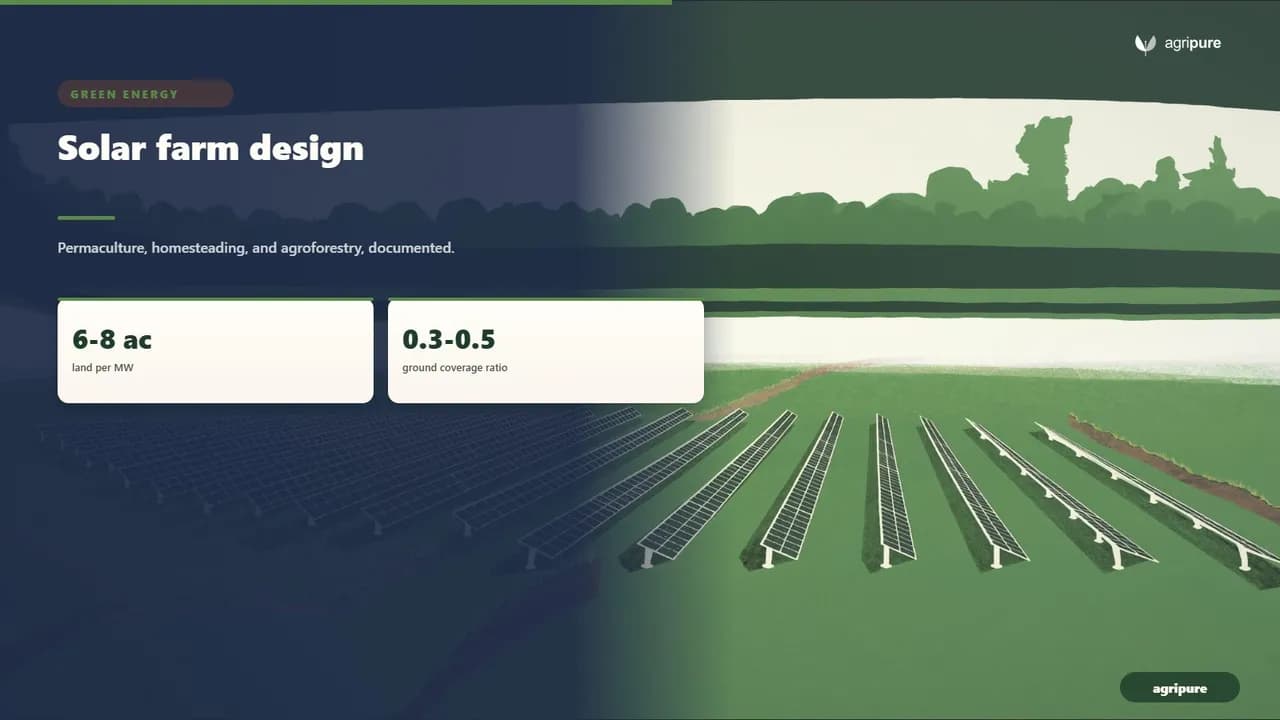
- A utility array needs roughly 6 to 8 acres per MW once you count rows, roads, inverters, and setbacks, well beyond the panel footprint alone.
- Row spacing is a trade between land cost and shading loss, captured by the ground coverage ratio (GCR), typically 0.3 to 0.5 on a fixed-tilt farm.
- Engineers size row spacing so panels stay unshaded during a 9 a.m. to 3 p.m. window on the winter solstice, the worst-case low sun.
- Agrivoltaics (grazing sheep or cropping between rows) is now a mainstream second use of the same acreage, with over 200 U.S. grazing sites.
- The layout itself is drawn in software: PVcase and similar tools for the geometry, PVsyst for the bankable energy yield that secures financing.
“A solar farm is a land-use plan first and an electrical plan second, and the land decides almost everything.”
Start with the land, not the panels
The most expensive mistakes in solar farm design are made before a single module is chosen. A panel is a commodity; a site is not. Two parcels of the same acreage can differ by 20% in lifetime yield and by hundreds of thousands of dollars in grading and interconnection cost, purely because of slope, aspect, and how far the nearest substation sits. This is the opposite of a residential install, where the roof is fixed and the only real decision is how many panels fit. The cell-level physics of solar panels are covered elsewhere; this guide focuses on site design.
The four factors that screen a site
Four factors do most of the work in a first-pass screen. Slope comes first: developers want flat or gently south-facing ground, and most guidance treats roughly 5 degrees as the practical ceiling for a cheap build, though single-axis trackers can be engineered onto grades of 10-15% at added cost. Grid proximity is the second factor: a site that is suitable in every other way is unusable if the interconnection is 10 miles off. Shading is the third: tree lines, towers, and terrain that throw shadows across the array in winter reduce the yield you modeled. And land area is the fourth: a working solar farm is mostly the space between panels, so the 6 to 8 acres needed per MW dwarfs the panel footprint itself.

A buildable site reads like this from the air: parallel rows on gentle ground, an access road, and a grid tie close enough to keep the cable run short.
Grid distance earns a hard number because it kills more projects than any other single factor. Siting guidance keeps solar farms within roughly 5 miles of a utility substation and around 0.2 miles of a three-phase distribution line; beyond that, the cost of conductors and the multi-year queue for interconnection studies usually sink the economics. Interconnection is also where timelines slip by 2 or 3 years, so experienced developers screen the grid before they ever walk the parcel.
How much land a solar farm really needs
Land availability shapes solar farm design because panels occupy far less of a site than people expect. The National Renewable Energy Laboratory’s empirical study of operating U.S. plants put the capacity-weighted-average total land use at about 7.3 acres per MWac, with direct land use (the area disturbed by rows, roads, and equipment) at 5.5 acres/MWac for fixed-tilt systems and 6.3 acres/MWac for one-axis tracking systems under 20 MW. Trackers sweep through the day, so they need wider aisles and therefore more ground per megawatt than a fixed array.
A practical planning figure that folds in roads, inverter pads, fencing, and setbacks is roughly 6 to 8 acres per MW. That gap between the 5.5-acre direct figure and the 8-acre planning figure is the part beginners forget: the access road a delivery truck needs, the buffer to the property line a county ordinance requires, and the inverter stations all consume real area. Plan for the whole parcel, not the panel rectangle.
Why fixed-tilt and trackers use land differently
The land math follows directly from how each system catches the sun. A fixed-tilt array bolts panels at one angle (usually close to the site latitude) and never moves, so its row spacing only has to clear the winter shadow once. A single-axis tracker rotates panels east-to-west across the day to chase the sun, which lifts energy yield by roughly 15-25% but forces wider rows so the moving panels never shade each other. More yield per panel, more land per megawatt: that is the standing trade, and it is why a developer with cheap land often picks trackers and one with expensive land often picks fixed-tilt.
Row spacing and ground coverage ratio
Row spacing comes down to one metric engineers evaluate constantly: the ground coverage ratio, or GCR. GCR is simply the collector length divided by the row pitch, written GCR = L / R. A GCR of 1 means the panels completely cover the ground with no gaps; a GCR of 0 means the rows are infinitely far apart. Real solar farms live in a narrow band: a typical GCR runs from 0.3 to 0.5, meaning panels sit over 30 to 50% of the site and the rest is the aisle.
The tension is money against shading. Pack the rows tight (high GCR) and you fit more megawatts on fewer acres, cutting land cost — but adjacent rows start shading each other in the early morning and late afternoon, and that lost generation compounds every day for 30 years. Spread the rows out (low GCR) and you nearly eliminate inter-row shading, but you buy or lease more land for the same capacity. Every solar farm design is a chosen point on that curve, and the right point depends on whether land or energy is the scarcer resource at that site.

The aisle between rows is sized to the winter sun so the row behind never falls into shadow when it matters.
Sizing the aisle to the winter sun
To turn GCR into an actual aisle width, designers solve for the worst-case shadow. The winter-solstice convention keeps panels unshaded during a 9am-to-3pm window on December 21, when the sun sits lowest and shadows run longest; design for that day and the array stays clear the rest of the year. The geometry follows a standard calculation (row spacing equals the panel’s height difference divided by the tangent of the solar elevation angle), so a worked example with a 10-inch height difference and a 17-degree winter sun angle gives about 33 inches of spacing before any azimuth correction. Scale that panel-to-panel logic up to a multi-acre array and you have the row pitch that fixes the GCR.
Agrivoltaics: farming the same acres twice
For a long time a solar farm meant taking land out of agriculture. Agrivoltaics, the use of one parcel for both solar generation and farming, changes that dynamic, and it is the part of solar farm design most relevant to agricultural landholders. The two uses turn out to help each other: panels shade the crop and animals from the harshest sun, while the plants beneath give off water vapor that cools the panels and can lift their efficiency by a few percent.
Grazing sheep between rows solves a problem every solar farm faces (keeping vegetation down without mowers hitting racking) and turns a maintenance cost into a wool-and-meat revenue stream. U.S. agrivoltaics grew from 27,000 acres in 2020 to 62,000 acres by November 2024, spread across nearly 600 sites; more than 200 of them now combine arrays with livestock grazing. For flock owners, panels raised high enough to walk under provide pasture while generating power.
Cropping between rows is the harder, higher-value version. Leafy greens often hold or even raise their yield under the diffused shade of panels because they bolt more slowly out of the worst heat, and the largest agrivoltaics site in the country (a 10-acre, 4.2-megawatt project on a blueberry farm in Rockport, Maine) was built precisely to test that a perennial fruit crop and a solar array can share ground. The design cost is real: panels must be raised and rows widened to let light, rain, and equipment reach the crop, which lowers GCR and raises the cost per megawatt. Whether that penny pencils out depends on the value of the crop underneath.

Raising the panels and widening the rows turns a solar farm into dual-purpose pasture, replacing maintenance mowing with grazing.
None of this requires utility scale to matter. The same logic that pairs sheep with a hundred-acre array scales down to a homestead, and it aligns with the principles in our guides to sustainable energy solutions and to off-grid and hybrid solar systems; agrivoltaics is simply the land-sharing version of the same idea, applied at acreage scale.
Read the off-grid and hybrid solar guide
The software that lays it out
No serious solar farm is designed by hand. The layout, the shading losses, and the year-one energy estimate all come out of dedicated software, and the tools split by scale and purpose rather than competing head-to-head. Getting the tool choice right matters because the output is what a bank or investor underwrites.
Layout tools versus simulation engines
Three names cover most of the field. PVcase is designed for utility-scale layout; it runs inside AutoCAD or Civil 3D to handle terrain, grading, and row geometry on real topography. PVsyst serves as the simulation engine: it provides the standard energy-yield modeling accepted for project financing. HelioScope is the fast, web-based option built for commercial and smaller ground-mount jobs, and its results have been shown to land within about 1% of PVsyst when the assumptions are aligned. In a typical workflow a designer lays out the geometry in one tool and confirms the bankable yield in PVsyst.
Tool | Best for | Strength | Trade-off |
|---|---|---|---|
PVcase | Utility-scale layout on real terrain | Runs in AutoCAD/Civil 3D; grading, roads, and racking geometry | Needs Autodesk skills; overkill for a small rooftop |
PVsyst | Bankable energy-yield simulation | Detailed, financing-grade loss modeling | Not a layout tool; manual, slower, steeper learning curve |
HelioScope | Commercial and smaller ground-mount design | Fast, web-based, within ~1% of PVsyst | Less granular than PVsyst for the final bankable model |
Aurora | End-to-end design + sales proposals | Remote shading and design in one platform | Oriented to residential and C&I more than large utility farms |
For a landowner exploring whether a parcel could host a project, the takeaway is simpler than the tool list suggests. You do not need to run the software yourself; you need to know that a credible developer will model your specific site (its slope, shading, and grid distance) and provide a yield estimate backed by PVsyst rather than an informal estimate. If a proposal cannot show that, it is not yet a design.
Putting a solar farm design together
Read in sequence, the decisions stack into a coherent design. You screen the site for gentle slope, grid access within about 5 miles, and minimal shading. You size the parcel at 6 to 8 acres per MW, knowing the panels are the small part. You pick the racking (fixed-tilt or trackers) based on whether land or energy is scarcer, then set a GCR in the 0.3 to 0.5 band that balances land cost against shading loss, with the winter-solstice sun fixing the actual row spacing. You decide whether the ground underneath earns a second income through grazing or cropping. And you prove the yield in software before you spend a dollar on steel.
A solar farm rewards careful front-end planning, where siting and layout decisions determine 30 years of operating output. Proper land selection avoids fundamental engineering constraints that cannot be resolved later.
Frequently asked questions
How many acres does a solar farm need per megawatt?
Plan for roughly 6 to 8 acres per MW once you include rows, access roads, inverter pads, fencing, and setbacks. The directly disturbed area is smaller (NREL found about 5.5 acres/MWac for fixed-tilt and 6.3 for one-axis tracking systems under 20 MW), but the buildable parcel always needs to be larger than the panel footprint alone.
What is ground coverage ratio (GCR) in solar design?
GCR is the collector length divided by the row pitch (GCR = L / R), representing the fraction of the site covered by panels. A typical utility solar farm runs a GCR of 0.3 to 0.5. Higher GCR fits more capacity on less land but increases shading between rows; lower GCR reduces shading at the cost of more land.
How is solar panel row spacing calculated?
Row spacing is sized so panels are not shaded during a 9am-to-3pm window on the winter solstice, when the sun is lowest. The geometry is row spacing equals the panel height difference divided by the tangent of the solar elevation angle, then adjusted for the row azimuth. Designing for the winter worst case keeps the array unshaded the rest of the year.
What is agrivoltaics?
Agrivoltaics is using the same land for both solar generation and agriculture, typically grazing livestock or growing crops between and beneath the panel rows. U.S. agrivoltaics roughly doubled to 62,000 acres by late 2024, with over 200 sites combining arrays with livestock grazing. Panels shade the crop or pasture, and the vegetation can cool the panels and lift their efficiency.
What software is used to design solar farms?
Utility-scale layout is usually done in PVcase (an AutoCAD/Civil 3D plugin) for the geometry and terrain, while PVsyst provides the bankable energy-yield simulation that secures financing. HelioScope is a faster web-based tool for commercial and smaller ground-mount projects and agrees with PVsyst to within about 1% when assumptions match.
References
- Solar Farm Land Requirements — Transect
- Land-Use Requirements for Solar Power Plants in the United States (TP-6A20-56290) — National Renewable Energy Laboratory
- Understanding Ground Covering Ratio (GCR) in Solar PV Systems — Detra Solar
- Utility-Scale Solar Investment Guide — Lion Solar
- Determining Module Inter-Row Spacing — Greentech Renewables
- Agrivoltaics: Coming Soon to a Farm Near You? — USDA Northeast Climate Hub
- Lighting the Way for Agrivoltaics — National Renewable Energy Laboratory
- Optimizing Commercial Solar Project Designs: HelioScope and PVsyst — Aurora Solar