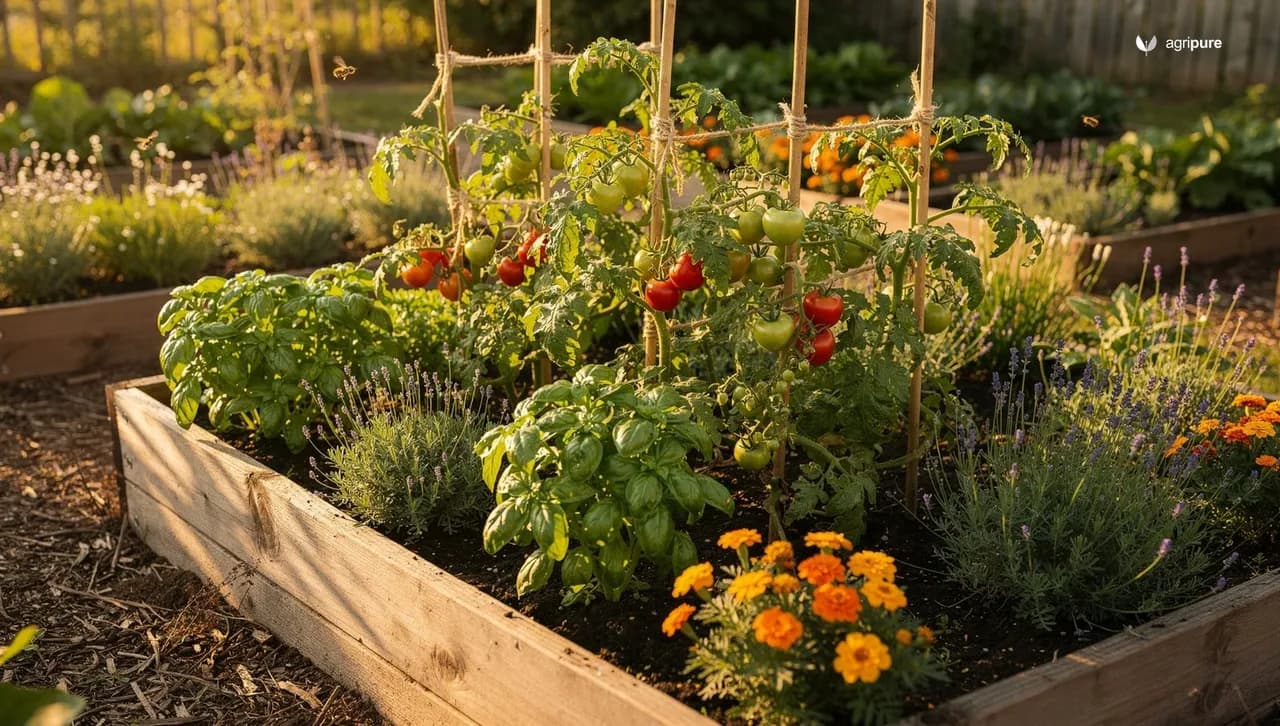
Key takeaways

Basil primes the tomato's defense response, and marigolds suppress root-knot nematodes when grown as a cover crop ahead of planting.
- Basil earns its spot: a 2024 study found basil volatiles prime the tomato defense response, with up to 3 times the reactive-oxygen signaling after wounding.
- Marigolds fight root-knot nematodes through alpha-terthienyl, but only as a dense cover crop planted 2 months ahead — interplanting the same season does little.
- Flowering companions pull in beneficial insects, and trap-crop mixes of 3 or more species beat any single repellent plant.
- Real antagonists are few but real: black walnut (juglone) and fennel both suppress tomatoes chemically.
- Much of the classic companion chart is folklore — aromatic plants do not repel pests by smell beyond about 5 meters.
Plant 1 tomato and the internet hands you a chart with 30-odd pairings: basil here, marigolds there, never near a brassica. Some of that advice traces to a controlled trial; most of it traces to a 1975 gardening book. The gap between the two is where home growers waste a season.
Here is what holds up. Of the dozens of pairings printed on companion charts, only a handful — basil for plant health, marigolds for nematodes, flowering insectary plants for pest predators — survive a research review, and only 2 widely named antagonists, walnut and fennel, do real chemical harm. The rest is worth knowing as folklore, not as a planting rule.
Basil and the science of a good neighbor
Basil is the one tomato pairing with a peer-reviewed mechanism behind it. A 2024 study in Plant Cell Reports found that volatile compounds released from basil prime the tomato wound response, switching on jasmonic-acid and reactive-oxygen signaling before a pest ever bites. Tomato plants grown with basil expressed the Pin2 defense gene faster and harder, and in the same study, tomato leaves exposed to basil essential oil ran reactive-oxygen accumulation up to 3 times higher than unexposed controls.
That is a measured effect on the tomato’s immune system, not a claim that basil’s scent shoos bugs away. It also fits how growers have paired sweet basil with tomatoes for 100-plus years, and it slots neatly beside the spacing and staking covered in our guide on how to grow tomatoes. Keep about 12 to 18 inches between the two so neither shades the other out.
What basil does and does not do
Match the expectation to the evidence. There are 3 claims worth separating before you credit basil with more than it earns.
- Supported: basil volatiles measurably strengthen the tomato’s own defense response in mixed plantings.
- Plausible but small: a modest dip in whitefly and aphid landings, with effect sizes that vary by season and pest.
- Folklore: the popular line that basil “improves tomato flavor” — no controlled taste trial backs it.
Honest note: basil helps the tomato, but it is not a pesticide. Treat it as 1 layer of plant health, not a substitute for scouting your plants every few days.

Marigolds, nematodes, and the timing that everyone gets wrong
Marigolds are the most over-promised tomato companion, and also the one with the strongest hard science — when used correctly. Their roots release alpha-terthienyl, which University of Florida Extension calls one of the most toxic naturally occurring compounds known, and it blocks nematode eggs from hatching. Marigold can suppress 14 genera of plant-parasitic nematodes, hitting root-knot (Meloidogyne) and lesion nematodes hardest.
The catch is timing. To work, marigold has to be grown as a dense cover crop at least 2 months before you set out tomatoes, with plants spaced under 7 inches apart. Dotting a few marigolds between tomatoes the same season does almost nothing for nematodes — Extension is blunt that interplanting marigold for nematode control “does not appear to be effective.” A 2002 Plant Disease trial showed the payoff of doing it right: tomato grown after a marigold rotation yielded roughly 50% more than tomato after fallow ground.
Use marigold as a rotation, not a garnish: sow a solid block of French or African marigold the season before tomatoes go into a nematode-prone bed, then turn it under. The interplanted single marigold is decoration, not protection.
Good and bad neighbors at a glance
Each companion has a job it does well and a limit worth knowing. This table sorts the 7 common tomato pairings by what the research supports and how strong the evidence is, so you can tell the 3 worth planting from the 4 printed out of habit.
Companion | Claimed benefit | Evidence | Verdict |
|---|---|---|---|
Basil | Primes tomato defenses | Peer-reviewed (2024) | Good neighbor |
Marigold (cover crop) | Suppresses nematodes | Strong, if timed right | Good, as rotation |
Flowering herbs (dill, calendula) | Draw beneficial insects | Supported | Good neighbor |
Garlic and onions | Repel pests by smell | Weak at garden scale | Harmless, low payoff |
Brassicas (cabbage, broccoli) | “Antagonist” by lore | Mostly competition, not chemistry | Space them apart |
Fennel | Allelopathic | Inhibits nearby growth | Keep away |
Black walnut | Juglone toxicity | Documented, no cure | Hard no |
Across all 7 rows, only 3 companions carry real research support, 2 do genuine harm, and the rest sit in a harmless middle where they neither help nor hurt much.
The real antagonists: walnut, fennel, and disease overlap
Most “enemy” pairings on companion charts are really just plants competing for the same light and nitrogen. A brassica next to a tomato is not poisoning it; it is a heavy feeder crowding a heavy feeder, which you fix with 24 to 30 inches of spacing. The genuine chemical antagonists are a short list, and 2 of them matter.
Black walnut is the clearest. Its roots and leaves release juglone, and Wisconsin Extension notes that tomato and the other nightshades are particularly sensitive, with a mature tree’s toxic zone reaching 50 to 80 feet from the trunk and no cure once a plant wilts. Fennel is the second: its roots are allelopathic and slow the growth of most vegetables around them, so it belongs in its own corner or a container.
Disease overlap with the potato family
The subtler antagonist is shared disease. Tomato and potato are both nightshades, so planting them side by side lets the 2 main blights — early and late — jump between them and concentrates root-knot nematode pressure on 1 patch of soil. Rotating garlic or another non-host through a bed for at least 2 seasons breaks that cycle far better than any companion can.
- Keep apart: tomato and potato, to limit blight and nematode buildup in 1 spot.
- Isolate: fennel and any black walnut, the only 2 companions that suppress tomatoes chemically.
- Space, do not fear: brassicas and tomatoes can share a garden if they are 24 inches apart and well fed.
What companion planting can and cannot do
The honest verdict is that companion planting works as 1 tool among several, not as a force field. Trap cropping holds up: University of Minnesota Extension reports that mixes of 3 or more species cut pest damage better than any single repellent plant, and flowering companions reliably pull in the beneficial insects that eat aphids. Those are 2 real, measured wins.
What does not hold up is the idea that an aromatic plant repels pests by scent. WSU Extension is direct that field research has not borne this out, and that volatile-emitting plants do not repel or attract insects beyond about 5 meters — pests find hosts mostly by spotting green surfaces, not by smell. So a ring of basil or garlic is not a chemical barrier. Pair companions with the basics in our guide on growing tomatoes, and let crop rotation do the heavy lifting.
Plant for the predators, not the perfume: give over 5 to 10% of bed space to flowers like dill, calendula, and alyssum to feed beneficial insects. That is the companion tactic with the most consistent return.

Conclusion
Tomato companion planting is less a chart to memorize than a 4-item list to act on: pair basil for plant health, rotate a dense marigold cover crop 2 months ahead of nematode-prone beds, and plant 5 to 10% flowers for the beneficial insects. Then keep tomatoes well away from fennel, black walnut, and their potato cousins. That handful of choices does more than the other 30 rows of folklore combined.
Frequently asked questions
Are basil and tomatoes really good companions?
Yes, with the best evidence of any tomato pairing. A 2024 Plant Cell Reports study found basil volatiles prime the tomato’s wound and defense response, raising reactive-oxygen signaling up to 3 times. Plant them 12 to 18 inches apart for plant health, not as a guaranteed pest repellent.
Do marigolds actually protect tomatoes from pests?
Only against nematodes, and only when grown the right way. Marigold roots release alpha-terthienyl, but it works as a dense cover crop planted at least 2 months before tomatoes, not as a few plants tucked in alongside them. Interplanting marigold the same season does little for nematode control.
What should you never plant near tomatoes?
Keep tomatoes away from black walnut, whose juglone is toxic to nightshades up to 50 to 80 feet from the trunk, and from fennel, which is allelopathic. Avoid planting tomatoes beside potatoes too, since both share early and late blight and root-knot nematodes.
Can I plant tomatoes and brassicas together?
Yes, if you space them 24 inches or more apart. The old “antagonist” label is mostly about competition rather than chemistry, since both cabbage and tomato are heavy feeders that draw down the same nitrogen and light. Feed the bed well and they coexist.
Does companion planting really work for tomatoes?
Partly. Trap-crop mixes of 3 or more species and flowering insectary plants have measured benefits, but aromatic plants do not repel pests by smell beyond about 5 meters. Treat companions as 1 tool alongside crop rotation, not as a substitute for it.
References
- University of Florida IFAS Extension — Marigolds (Tagetes spp.) for Nematode Management
- Yoshida et al., Plant Cell Reports (2024) — Companion basil primes the tomato wound response
- University of Minnesota Extension — Companion planting in home gardens
- Wisconsin Horticulture, UW-Madison Extension — Black Walnut Toxicity
- Ploeg, Plant Disease (2002) — Marigold Varieties, Root-knot Nematodes, and Tomato Yields
- Chalker-Scott, WSU Extension (2023) — Gardening with Companion Plants