Key takeaways

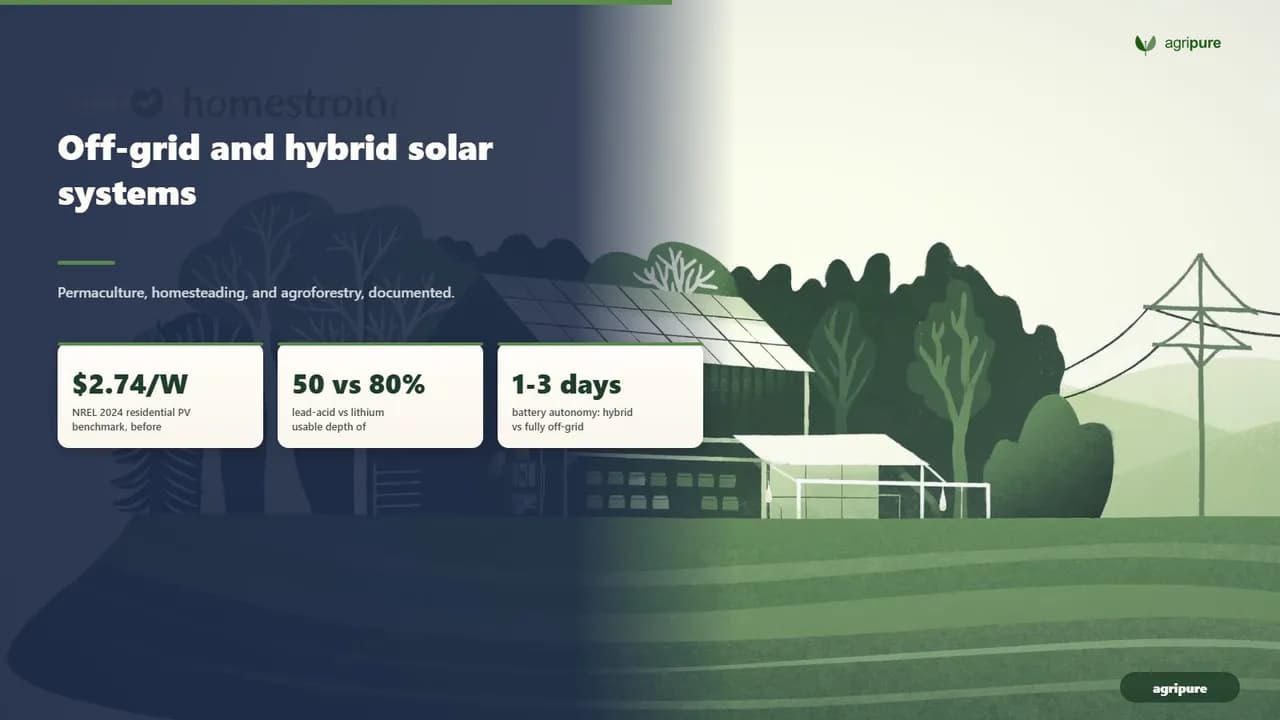
Solar power offers homesteads energy independence, whether in remote areas or tied to the local utility grid. A well-designed system with battery storage provides reliable power under either approach.
- Three architectures: grid-tied (no battery), off-grid (no grid, big battery plus a generator), and hybrid (grid plus battery, best of both).
- A hybrid system keeps the grid as backup, so it can run a smaller battery bank than a fully off-grid home that must survive every cloudy stretch alone.
- Battery sizing is arithmetic: bank kWh = daily load × days of autonomy ÷ depth of discharge; lead-acid gives 50% usable, lithium 80%.
- An off-grid inverter is a standalone island; a hybrid inverter is bidirectional, moving power between panels, battery, and grid.
- NREL benchmarked a residential PV system at $2.74 per watt in early 2024, before batteries — storage and the off-grid generator are extra.
- Pick hybrid when the grid exists but flickers; pick off-grid only when there is no line to connect to.
A homestead at the end of a long gravel road has a choice the suburban rooftop never faces: carry every watt yourself, or lean on a grid that is there but unreliable. That single fork (fully off-grid versus hybrid grid-tie) decides how big the battery bank gets, which inverter you buy, and how the final bill lands. This guide walks the 3 system architectures, the battery-sizing math, the inverter-charger choice, and a worked cost example built on a 10 kWh/day load. It is the architecture layer; if you want the parts list, our breakdown of what is actually in an off-grid solar kit covers the four boxes, and our guide to choosing panels for off-grid living covers the array itself.
Three architectures, one fork in the road
Strip away the brand names and residential solar comes in 3 architectures. SolarReviews defines them cleanly: a grid-tied system is “connected to the utility power grid,” an off-grid system “has no connection to the utility grid at all,” and a hybrid system has “the solar panels attached to batteries and the utility grid.” The fork that matters for a homestead is the 2nd versus the 3rd: off-grid carries the whole load, while hybrid keeps the grid as a quiet backup.
That backup line changes everything downstream. An off-grid home, in the words of the same source, needs “a significant amount of battery storage, and usually another backup power source, like a gas-powered generator.” A hybrid home can lean on the grid during a 5-day cloud instead of a propane tank. The grid is the cheapest battery you will ever own, provided you have a line to it.
System | Grid link | Battery | Backup for a cloudy week | Best when |
|---|---|---|---|---|
Grid-tied | Yes | None | The grid itself | Reliable grid, lowest cost |
Off-grid | None | Large bank | A fuel generator | No utility line at all |
Hybrid | Yes | Smaller bank | The grid | Grid exists but flickers |
Why hybrid usually needs less battery
This is the crux that the kit brochures skip. Because a hybrid system can pull from the grid when the battery runs low, it sizes the bank for a typical evening and a short outage, roughly 1 day of autonomy rather than a multi-day storm. An off-grid bank, by contrast, must cover the longest realistic dark stretch on its own (typically 2 to 3 days), which is why off-grid homes “need a lot of battery storage to power an entire home without help from the grid, and the cost adds up,” as SolarReviews puts it.
Rule of thumb: a hybrid bank sized for 1 evening (roughly 1 day of autonomy) can be a third to a half the size of a fully off-grid bank sized for 3 days — for the same house. The grid absorbs the rare deep cloud.
The catch is honesty about your grid. If outages on your line run a few hours a year, a modest hybrid battery is plenty. If they run days at a time (common at the rural edge), you are effectively designing an off-grid bank that happens to have a grid tie. Size the battery for actual outages rather than salesperson assumptions. A hybrid system is also the natural home for a solar water pump for a well, which can run direct off the array by day and fall back to grid or battery at night.
Sizing the battery bank: the arithmetic
Battery sizing is not mysticism; it is one equation run twice. The usable energy you need is bank kWh = daily load (kWh) × days of autonomy ÷ usable depth of discharge. Depth of discharge (DoD) is the lever that separates the two main chemistries: AltE and Unbound Solar both note that lead-acid batteries are typically discharged only 50%, while lithium runs to roughly 80% of nameplate before you stop.

A worked 10 kWh/day example
Take a homestead burning 10 kWh a day. AltE’s own worked numbers show the chemistry gap directly: at 50% DoD with a 1.2 inefficiency factor, lead-acid needs “10 kWh × 2 × 1.2 = 24 kWh” of nameplate storage; lithium at 80% DoD needs “10 kWh × 1.2 × 1.05 = 12.6 kWh.” The lithium bank is roughly half the nameplate kWh for the same usable energy.
Step | Lead-acid (50% DoD) | Lithium (80% DoD) |
|---|---|---|
Daily load | 10 kWh | 10 kWh |
Sizing factor | × 2.0 × 1.2 | × 1.2 × 1.05 |
Nameplate bank | 24 kWh | 12.6 kWh |
At 48 V (AltE: 24 kWh = 500 Ah) | ~500 Ah | ~260 Ah |
Days of autonomy assumed | 1 (hybrid) | 1 (hybrid) |
To turn kWh into the amp-hours a battery is actually rated in, divide by system voltage: AltE gives the clean conversion “24 kWh = 500 amp hours at 48 volts”. Want 3 days of off-grid autonomy instead of 1? Triple the bank. That is the entire reason hybrid homes spend less on batteries.
Inverters: off-grid island vs hybrid bridge
Once the bank is sized, the inverter decides how power moves. The 2 relevant types map exactly onto the 2 architectures. An off-grid inverter, per Solax, “converts DC electricity from solar panels and batteries into AC electricity to power household appliances in standalone systems that are not connected to the utility grid”; for it the battery bank is “mandatory.” It runs an electrical island.
A hybrid inverter is a bridge instead of an island. The same source describes it as a unit that “manages power flow between your solar panels, battery storage, and the utility grid,” moving energy bidirectionally between all 3. In practice that 1 box replaces the separate charge controller, battery inverter, and grid-tie inverter a piecemeal system would otherwise need.
The inverter-charger shortcut: for most homestead builds, a single hybrid inverter-charger (sized to your peak AC load, with a continuous and a surge rating) is simpler and cheaper than stacking three separate units. Match its continuous watt rating to your largest simultaneous load (such as a well pump, fridge, and kitchen) rather than the nameplate sum of every breaker.
One more spec to demand: a pure sine wave output. Modified-sine inverters can cost 30% less but mistreat well pumps, compressors, and anything with a brushless motor, the exact loads a homestead runs hardest. Size the continuous rating to your largest simultaneous draw, perhaps 3 to 6 kW for a small home, rather than the nameplate sum of every breaker. If you want the underlying physics of how panels feed any of these inverters, our explainer on how solar panels work covers the DC side.
What a real system costs
Sticker shock usually comes from conflating the panels with the whole system. NREL’s benchmark is the cleanest public anchor: its representative 8 kW residential PV system was benchmarked at $2.74 per watt in the first quarter of 2024, and that figure is before any battery storage. Storage, the inverter-charger, and an off-grid generator all stack on top.

NREL also notes that beyond the hardware, the remaining cost lives in soft costs: installation labor, permitting, and customer acquisition. Off-grid builds dodge utility interconnection fees but add the generator, the bigger battery, and often a longer wire run. The table below is an order-of-magnitude frame, not a quote; actual prices swing with region, brand, and whether you do your own labor.
Line item | Hybrid (grid backup) | Fully off-grid |
|---|---|---|
PV array (NREL: ~$2.74/W base) | Same array | Same array |
Battery bank | Smaller (1-day) | Larger (3-day) |
Inverter | Hybrid inverter-charger | Off-grid inverter |
Backup for deep cloud | The grid (free) | Generator + fuel |
Utility interconnection | Yes (fee) | None |
When a hybrid system pays back faster
Cost is only half the decision; payback is the other half. A hybrid system earns its keep 2 ways an off-grid system cannot. First, it can sell surplus back: SolarReviews notes that excess solar “is sent to the grid,” and where net metering exists the utility credits it “to offset future electricity costs.” An off-grid home simply curtails and wastes any energy its full battery cannot hold; on a sunny spring day that can be 20% or more of what the array makes.
Second, hybrid avoids the generator-and-fuel line entirely, leaning on the grid for the 1 or 2 deep-cloud stretches a year that would otherwise drain a battery. SolarReviews observes that hybrid systems “are popular in areas that experience frequent grid failures,” which is precisely the rural-edge homestead profile: power that is present but unreliable. Where the grid is merely intermittent instead of completely absent, the hybrid math almost always wins.
The honest off-grid case: go fully off-grid when there is no utility line to connect to, or when bringing one in costs more than years of generator fuel. Otherwise, a hybrid system keeps the grid as a free third-day battery and pays back faster.
For the wider picture of how a home’s total energy demand shapes any of these choices, our overview of household energy use and sustainable energy solutions sets the loads in context before you size a single panel; most homesteads land between 5 and 20 kWh a day.
The takeaway
The central question is whether there is a grid line worth using. If yes, a hybrid system keeps it as a backup, runs a smaller battery bank, sells surplus where net metering allows, and skips the generator. If no, a fully off-grid system carries every watt, which means a bigger lithium bank sized for 3 days at 80% depth of discharge, a standalone inverter, and a fuel generator for prolonged cloudy periods. Size the battery for the outage you actually get, demand a pure-sine inverter-charger, and treat NREL’s $2.74-per-watt as the floor that storage builds on. The lights stay on either way; the architecture just decides what you pay to keep them there.
Frequently asked questions
What is the difference between an off-grid and a hybrid solar system?
An off-grid system has no utility connection at all, so it relies entirely on solar panels, a large battery bank, and usually a backup generator. A hybrid system stays connected to the grid and adds battery storage, so it can use solar, draw from the battery, or fall back to the grid as needed. The grid acts as a free backup that lets a hybrid system run a smaller battery.
How big a battery bank do I need for an off-grid house?
Size it with bank kWh = daily load × days of autonomy ÷ usable depth of discharge. For a 10 kWh/day home, AltE’s worked numbers give about 24 kWh of lead-acid (at 50% depth of discharge) or 12.6 kWh of lithium (at 80%) per day of autonomy. A fully off-grid home usually targets 2 to 3 days, so multiply accordingly; a hybrid home can size for about one day.
Do I need a special inverter for a hybrid system?
Yes. A hybrid inverter is bidirectional and manages power between the panels, the battery, and the grid in one unit, whereas an off-grid inverter runs a standalone island and treats the battery as mandatory. For most homestead builds a single hybrid inverter-charger, rated for your peak simultaneous load and outputting pure sine wave, is simpler and cheaper than stacking separate units.
How much does an off-grid or hybrid solar system cost?
NREL benchmarked a representative 8 kW residential PV system at $2.74 per watt in early 2024, but that figure is before any battery storage. Storage, the inverter-charger, and (for off-grid systems) a generator all add to it. Hybrid systems save on batteries and skip the generator; off-grid systems skip utility interconnection fees but pay for more storage and fuel.
When is going fully off-grid worth it over a hybrid system?
Go fully off-grid when there is no utility line to connect to, or when extending one costs more than years of generator fuel. If the grid is present but unreliable (with frequent short outages), a hybrid system is usually the better value, because it keeps the grid as a free backup and avoids oversizing both the battery and the generator.
Can a hybrid system sell power back to the grid?
Yes, where net metering is offered. Surplus solar beyond your immediate use and battery charging is exported to the grid, and the utility credits it against future bills. A fully off-grid home cannot do this; any energy its battery cannot hold is curtailed and lost.
References
- SolarReviews. “Grid-Tied, Off-Grid and Hybrid Solar Systems.” solarreviews.com
- AltE Store. “Off Grid Solar System Sizing Calculator.” altestore.com
- Unbound Solar. “Solar Battery Bank Sizing Calculator for Off-Grid.” unboundsolar.com
- SolaX Power. “Off-Grid vs Hybrid Inverter: The Ultimate Comparison & Buying Guide.” solaxpower.com
- U.S. Department of Energy / NREL. “Solar Photovoltaic System Cost Benchmarks.” energy.gov
- NREL. “Fall 2024 Solar Industry Update.” docs.nrel.gov