Key takeaways
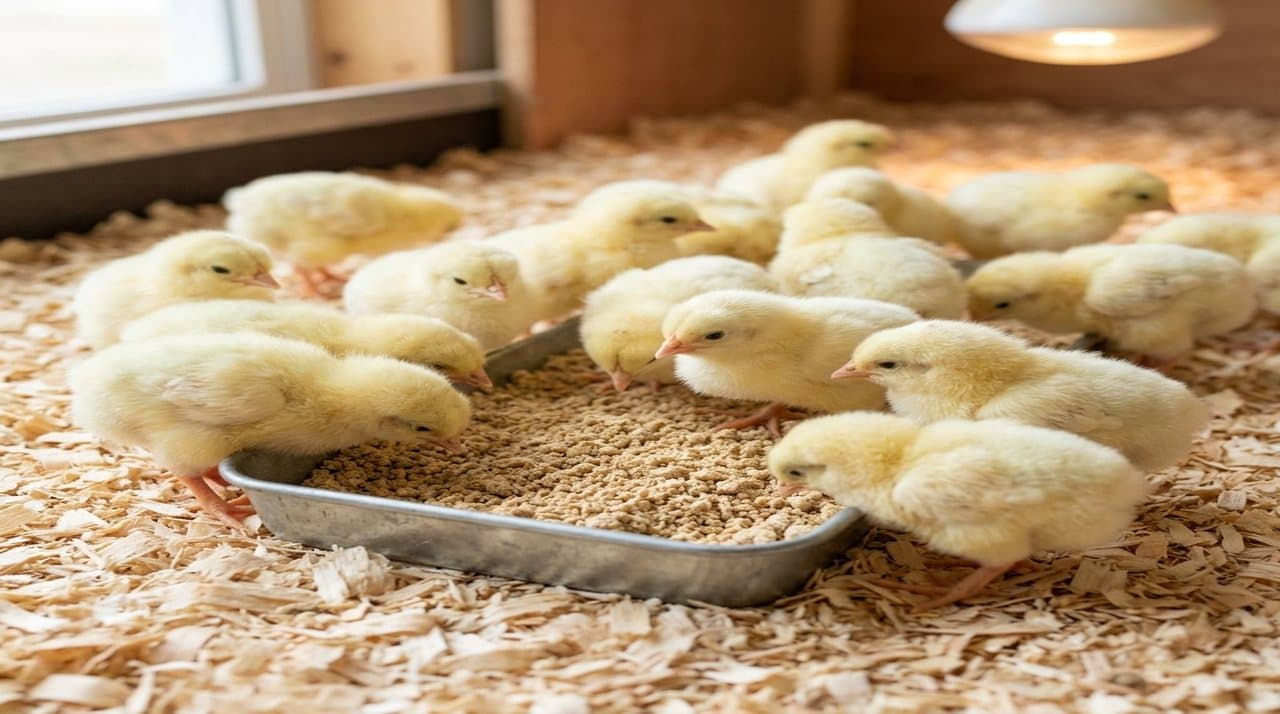
Five yellow baby chicks eat crumble chick starter feed from a shallow round feeder in a brooder.
Day-old chicks forage instinctively from day one, so providing a complete chick starter feed gives them necessary early nutrition.
- Chick starter feed is a complete crumble at roughly 18 to 20% crude protein: the primary feed baby chicks need from day one, without scratch, corn, or table scraps to dilute it.
- Medicated starter contains amprolium, which starves the coccidia parasite of vitamin B1 while chicks build immunity; choose it for brooder-raised chicks and skip it only if your chicks were vaccinated for coccidiosis.
- Feed starter as the whole diet through about week 6 to 8, then move to a grower; most layer breeds switch to a calcium-rich layer feed around week 18 or the first egg.
- Transition feed gradually (the standard is mixing 100% old to 100% new over about 10 days) so the gut is not shocked.
- Chicks on a complete starter do not need grit; they only need it once they eat anything other than the crumble, and even then just a pinch of chick-sized grit.
- Ducklings can eat chick starter but need extra niacin, because a starting chick diet carries about 27 mg niacin/kg and ducklings need closer to 50 mg/kg.
A box of day-old chicks arrives needing exactly one thing on the feed shelf, and the bag art does not make it obvious which one. Get it wrong and you either stunt them on a treat feed or load their kidneys with calcium meant for laying hens. Get it right and the first 8 weeks are close to foolproof. This guide covers what chick starter feed actually is and the protein number that defines it, the medicated-versus-non-medicated question that trips up nearly every first-timer, how long baby chicks stay on starter before grower or layer feed, how to switch feeds without a gut upset, whether chicks need grit, the short list of things you must never feed them, and whether the ducklings or other poultry in the same brooder can eat the same bag. If you are still deciding on birds, start with our guide to starting a small backyard flock; this piece is the brooder feeding manual.
What chick starter feed is
Chick starter is a complete feed: a single ration formulated so that day-old chicks need nothing else added to it for the first 6 to 8 weeks. Sold as chick starter feed, chicken starter feed, or simply starter feed for chicks, it is the same idea under every label. The Merck Veterinary Manual is blunt about why that matters: although foraging behavior might be desired, “birds should receive most of their diet from a balanced, nutritionally complete ration.” For a chick in a brooder, with no pasture and no hen to teach it, the starter crumble is that ration in full. It is usually sold as a fine crumble rather than a pellet because a day-old chick’s beak cannot manage a pellet.
Chick starter crumble in a trough feeder with day-old chicks on wood-shaving bedding.
The number that defines a chick starter feed is crude protein, and it sits higher than any feed the bird will eat later in life. University of Florida IFAS Extension tells new keepers to “feed a good commercial chick starter for the first 6-8 weeks,” one “which should be about 20% crude protein.” Alabama Cooperative Extension sets the floor a touch lower, advising that a chick diet “should contain a minimum of 18 percent protein,” and adds the mineral targets most labels never show you: “0.85 percent to 1.00 percent calcium and at least 0.42 percent available phosphorus for proper bone development.” The working range for chick starter feed is 18 to 20% protein, with modest calcium, unlike layer feed, which carries far more calcium and would harm a chick.
That 18 to 20% protein drives feathering and frame growth during the fastest weeks of a bird’s life. It is also why the cheaper grain products on the shelf are a trap. Alabama Extension is direct: “scratch grains or cracked corn are not a complete feed and do not contain enough protein, vitamins, or minerals to raise a productive chick.” University of Florida echoes it word for word — “do not feed three-grain scratch or ground corn. Chicks need more protein, vitamins, and minerals than these feeds can provide.” When choosing what to feed baby chicks, the answer is simple: chick starter feed, and almost nothing else.
Starter versus grower versus layer
It helps to see chick starter feed in the context of the 3 feeds a chicken eats across its life, because the differences are only two numbers moving in opposite directions. Starter is high protein (18-20%) and low calcium. Grower (sometimes labeled developer) drops the protein slightly and keeps calcium low. Layer feed lowers protein again but adds a large dose of calcium for eggshells. The reason chicks cannot eat layer feed early is that calcium load — a young bird’s kidneys cannot clear it.
Feed | Crude protein | Calcium | Who it is for |
|---|---|---|---|
Chick starter | 18-20% | Low (~1%) | Day-old chicks through the brooder weeks |
Grower / developer | 16-18% | Low (~1%) | Growing pullets after starter, before lay |
Layer | 16-18% | High (~3%+) | Hens from the first egg onward |
Many bags now combine the first 2 as a single “chick starter/grower” crumble you run straight through, which is the simplest path for a backyard flock and the reason the phrases chick starter feed and chick starter chicken feed get used interchangeably on store shelves.
Medicated versus non-medicated starter
This is the choice that confuses nearly every first-time chick raiser, and it comes down to 1 disease. Medicated chick starter contains a single added drug — amprolium — aimed at coccidiosis, a gut infection that is a leading killer of brooder chicks in the first 6 weeks. Non-medicated starter is the identical feed without that drug. The protein, the vitamins, the minerals are the same; the only difference is the amprolium.
Medicated and non-medicated chick starter feeds are commonly sold side by side in farm stores.
To choose well, it helps to know what amprolium does, because the name “medicated” makes people imagine antibiotics and hormones. It is neither. The Merck Veterinary Manual explains that coccidiosis "is caused by protozoa of the phylum Apicomplexa, family Eimeriidae" (the Eimeria parasites) and that "amprolium is an antagonist of thiamine (vitamin B1)," while "rapidly dividing coccidia have a high requirement for thiamine." In plain terms, amprolium mimics the vitamin B1 the parasite needs to multiply; the coccidia take up the decoy, run short of real thiamine, and stall. Michigan State University’s College of Veterinary Medicine puts it the same way: “amprolium is not an antibiotic,” and it “blocks the uptake of thiamine in coccidia which prevents the disease coccidiosis.”
The point of medicated feed is not to sterilise the brooder — it is to hold the parasite at a low level through those first 6 weeks while the chick’s own immune system catches up. Merck notes that “anticoccidials are given in the feed to prevent disease,” and that “the natural development of immunity to coccidiosis may proceed during the use of anticoccidials in the feed.” The feed buys time; the bird earns the immunity.
When to choose each
For most backyard keepers brooding day-old chicks on shavings, medicated starter is the safer default through the first 6 weeks. The brooder is warm and damp (ideal conditions for coccidia), and a single sick chick can seed the whole batch. Michigan State’s standing advice to small flocks is to “always start baby chickens and turkeys with medicated feed for the first six weeks of life,” and Alabama Extension agrees that “medicated diets help prevent intestinal diseases in chickens and are an excellent option to help keep chickens healthy.”
The vaccination exception: there is exactly one situation where you must use non-medicated feed: when chicks were vaccinated against coccidiosis at the hatchery. The vaccine works by exposing chicks to a tiny dose of live coccidia so they build immunity, and amprolium would suppress that exposure and cancel the vaccine. The rule is clean: vaccinated chicks get non-medicated starter, unvaccinated chicks get medicated starter, and you never pay for both at once.
If you object to medicated feed on principle and your chicks are not vaccinated, you can raise them on non-medicated starter, but you trade up the risk and have to keep the brooder scrupulously dry and clean. Amprolium also carries no withdrawal period and does not pass into eggs you will eat months later, which settles a worry many people raise.
How long to feed chick starter
The honest answer is that it depends on the feed and the bird, but the timeline is well bounded. The shortest version: chicks live on starter for roughly the first 6 to 8 weeks. University of Florida’s “first 6-8 weeks” is the conventional starter window, after which birds move to a grower or developer ration that carries slightly less protein.
There is also a longer, simpler path that has become common for backyard layers. Purina Animal Nutrition advises keepers to “continue feeding the same chick starter feed to your chicks from day 1 to week 18,” because “most layer breeds will lay their first egg around week 18.” On that plan a single chick starter/grower crumble runs the whole growing period, and only when the first egg appears do you switch: “choose a layer feed that has at least 16% protein and 3.0% calcium.” Either path is legitimate. What matters is that calcium-heavy layer feed waits until the bird is building eggshells; feeding it earlier risks the kidneys of a pullet that is not yet laying.
So the practical rule of thumb is: run starter (or starter/grower) as the sole feed through the brooder and growing weeks, and make the switch to layer feed at the first egg or about 18 weeks, whichever comes first. Heavy and heritage breeds often lay later and can stay on grower a few extra weeks with no harm. If you are raising the flock for eggs, our guide to raising chickens for eggs walks through that laying transition in detail.
Transitioning feed without a gut upset
Whenever you change feeds (starter to grower, or grower to layer), do it gradually rather than swapping the bag overnight. A chick’s gut microbes are tuned to the current ration, and a cold switch can cause loose droppings and a few off days. The medicated-to-non-medicated change has a published standard you can borrow for any feed transition: Michigan State advises that “after 6 weeks, feed should be gradually changed from 100% medicated to 100% non-medicated over a period of 10 days.” Mix a little more of the new feed into the old each day across roughly a week to ten days, and the birds barely notice. The same gradual mix applies when you graduate growing pullets onto chicken grower feed or finally onto layer.
Do chicks need grit?
Grit is the small, hard stones a bird holds in its gizzard to grind food, since chickens have no teeth. The common worry is that brooder chicks in their first 1 to 2 weeks will not be able to digest their feed without it. For chicks on a complete starter, that worry is unfounded: the crumble is already ground fine enough to digest, so a chick eating nothing but starter feed does not need grit.
Grit becomes necessary when a chick eats anything other than crumble, such as grass, mealworms, or treats. Then it needs grit to grind the fibrous bit. University of Florida notes that “fine grit can be added to the feed in a 1:10 ratio” as a light insurance measure, and the Merck Veterinary Manual’s general rule is to follow “recommendations of the feed manufacturer or the strain’s breeder company with regard to the feeding of extra calcium, grit, or whole grain.” The practical takeaway: if your chicks are strictly on starter, skip grit; once you start offering anything else, put out a small dish of chick-sized grit (parakeet-grade or a commercial chick grit), free choice, and let them self-regulate. Never substitute oyster shell for grit at this age: oyster shell supplies calcium rather than grinding stone, and chicks should not receive excess calcium.
What not to feed baby chicks
A common risk to brooder chicks is offering treats and scraps too early and too freely. Because chick starter is a complete feed, anything else you add dilutes the nutrition it was carefully built to deliver. Purina’s rule for chickens of any age is the 90/10 rule: “offer 90% complete feed to a maximum of 10% treats each day,” and to “provide complete feed for at least 90 percent of the bird’s diet.” For chicks in the first weeks, the simplest discipline is to hold treats near zero and let the starter do its job.
A handful of foods are not merely diluting but genuinely toxic, and these 5 are worth committing to memory before someone hands the kids a bowl of kitchen scraps for the brooder:
- Avocado — Purina warns that “avocado pits and skins are toxic to chickens as they contain a toxin called persin.” Keep avocado away from chicks entirely.
- Raw or dried beans — “undercooked or dried beans can be harmful because they contain a compound known as hemagglutinin,” per Purina. Beans must be fully cooked, and for chicks are best skipped.
- Anything moldy or very salty — “moldy, rotten foods and very salty foods can result in excessively wet feces and may be toxic.” A chick’s small body has little tolerance for salt.
- Rhubarb — it “contains anthraquinones, which can have a laxative effect,” so leave it out.
- Layer feed — not toxic in the acute sense, but its high calcium can damage the kidneys of a bird that is not yet laying. Save it for the first egg.
None of this means a six-week-old chick can never have a treat. It means the bulk (the entirety in the first weeks) should be starter feed, treats stay under that 10% line, and dangerous foods are excluded completely.
Free-choice feeding and how much chicks eat
Brooder chicks should be fed free choice (feed available at all times) rather than on set meals. They are growing flat out and self-regulate well; an empty feeder is a bigger risk than a full one. The amounts are reassuringly small at the start. The Merck Veterinary Manual puts early intake at “approximately 30–60 g (1–2 ounces) of feed per day” for a day-old chick, climbing steadily as the bird grows. A practical way to picture it: a handful per chick per day in the first week, several times that by the time they feather out.
Keeping feed clean in the brooder
Keep the feed clean and dry, because chicks foul and scratch their feeder constantly. A few habits cut waste and spoilage sharply over the 6 to 8 weeks chicks are in the brooder:
- Raise the feeder to roughly the height of the birds’ backs: a trough or hanging tube feeder set this high stops chicks standing in the crumble.
- Refill little and often rather than dumping a week’s worth at once; fresh crumble holds its vitamins better and stays out of the damp.
- Site it away from heat and water so the brooder does not turn into one soggy corner.
- Graduate off the flat dish quickly: a shallow dish is fine for the first day or two, but it becomes fouled within hours.
A note on the diy temptation: search around and you will find a hundred chick feed diy and homemade chick starter recipes built from ground grains and seeds. Treat them with caution. The whole reason a commercial starter hits 18 to 20% protein with balanced vitamins, minerals, and that 0.42% available phosphorus is hard, tested formulation. A kitchen mix of cracked corn and oats lands nowhere near it, which is why both Alabama and Florida Extension warn that scratch and ground corn cannot raise a productive chick. For the brooder weeks, a bagged complete starter is the reliable choice; save the experiments for treats once the birds are grown.
Can ducklings and other poultry eat chick starter?
Mixed orders are common (a few ducklings or keets tucked in with the chicks), so the question comes up fast. Can ducklings eat chick feed? The short answer is yes, with 1 important adjustment. Ducklings can eat chick starter feed, but they need more niacin (vitamin B3) than chicks do, and a plain chick ration can leave them short, which shows up as weak, bowing legs.
Ducklings and chicks sharing a low trough feeder of crumble in a brooder.
Ducklings need more niacin
The numbers bear this out. The Merck Veterinary Manual’s poultry tables put a starting broiler chick at about 23% crude protein with roughly 27 mg niacin/kg of diet, and a starting Pekin duck at about 22% protein. A peer-reviewed review of duck nutrition found that “feeding diets containing 40 mg niacin/kg from hatching until 21 d of age achieved satisfactory performance” in White Pekin ducks, and that recommended diets carry “50 mg/kg niacin for meat-type ducks aged 1-21 days.” That leaves a real gap to close if ducklings eat plain chick starter:
- Supplement niacin — ducklings want roughly 40 to 50 mg/kg against the ~27 mg/kg in a chick starter; brewer’s yeast sprinkled on the feed is the common backyard fix.
- Prefer unmedicated starter for ducklings, since they eat more than chicks and you do not want them over-consuming any medication.
- Use a waterfowl starter if you can find one — a purpose-made duck feed is the cleanest option of all.
Other poultry vary. Turkey poults and game birds need higher protein than chicks (closer to 28%), so chick starter is only a temporary stopgap and a game-bird or turkey starter is necessary. The shared rule across all of them is that a chick starter feed is built for chicks; the further a species sits from a chicken, the more its starter needs to differ.
The takeaway
Chick starter feed is the one decision that makes or breaks the brooder weeks, and it is simpler than the shelf suggests. Buy a complete crumble at 18 to 20% protein and feed it free choice as the entire diet, without scratch, corn, or scraps. Choose medicated starter with amprolium for ordinary brooder chicks, and only switch to non-medicated if your chicks were vaccinated for coccidiosis. Run starter through about week 6 to 8 and on into a grower, then change to a calcium-rich layer feed at the first egg or around 18 weeks, transitioning over about 10 days each time you switch. Skip grit until the chicks eat something other than the crumble, keep the toxic short-list off the menu, and give ducklings extra niacin if they share the bag. Following these feed guidelines covers the nutritional requirements of brooder chicks from hatch to coop transition.
Frequently asked questions
What protein percentage should chick starter feed be?
Chick starter feed should be about 18 to 20% crude protein. University of Florida Extension recommends a starter of about 20% crude protein for the first 6 to 8 weeks, and Alabama Extension sets a minimum of 18%, alongside roughly 1% calcium and at least 0.42% available phosphorus for bone development. That higher protein supports the rapid feathering and frame growth of the first two months, and it is deliberately paired with low calcium, since young birds cannot handle the calcium load of a layer feed.
Do I need medicated chick starter feed?
For most brooder-raised chicks, medicated starter is the safer choice. It contains amprolium, which controls the coccidia parasite while chicks build their own immunity, and small-flock guidance from Michigan State University is to start chicks on medicated feed for the first six weeks. The one exception is chicks vaccinated against coccidiosis at the hatchery; they should get non-medicated feed, because amprolium would cancel the vaccine. Never use both at once.
How long do chicks need starter feed?
Chicks need starter feed for roughly the first 6 to 8 weeks, after which they move to a grower ration. Many backyard keepers simplify this by running a single chick starter/grower crumble from day one all the way to about 18 weeks, then switching to a layer feed when the first egg arrives. Either way, the high-calcium layer feed should wait until the bird is actually laying.
How do I switch my chicks from starter to grower or layer feed?
Switch gradually, never overnight. Mix a growing share of the new feed into the old over about 7 to 10 days; the published standard for the medicated-to-non-medicated change is a 10-day transition from 100% old to 100% new. This gives the gut microbes time to adjust and prevents the loose droppings that a sudden feed change can cause.
Do baby chicks need grit?
Not while they are eating only chick starter feed, because the crumble is already ground fine enough to digest. Chicks need grit only once they eat something other than starter (grass, treats, or scraps) to grind those fibers in the gizzard. At that point offer a small dish of chick-sized grit free choice. Do not confuse grit with oyster shell; oyster shell is calcium and is not appropriate for chicks.
Can ducklings eat chick starter feed?
Yes, but ducklings need more niacin than chicks, so a plain chick starter can leave them short and cause leg problems. A starting chick diet carries about 27 mg niacin/kg, while ducklings need closer to 40 to 50 mg/kg. If you raise ducklings on chick starter, supplement niacin (brewer’s yeast on the feed is the common fix) and prefer an unmedicated starter, since ducklings eat more than chicks. A dedicated duck or waterfowl starter is the cleanest option where available.
References
- Merck Veterinary Manual. “Coccidiosis in Poultry.” merckvetmanual.com
- Merck Veterinary Manual. “Nutritional Requirements of Poultry.” merckvetmanual.com
- Merck Veterinary Manual. “Management of Backyard Poultry.” merckvetmanual.com
- University of Florida IFAS Extension. “AN182: Care of Baby Chicks.” ask.ifas.ufl.edu
- Alabama Cooperative Extension System. “Backyard & Small Poultry Flock Management Series: Brooding Tips for Successful Bird Performance.” aces.edu
- Michigan State University College of Veterinary Medicine. “Preventing Six Common Mistakes in Small Poultry Flocks.” cvm.msu.edu
- Purina Animal Nutrition. “Chick Starter Feed: What to Feed Baby Chicks for a Healthy Life.” purinamills.com
- Purina Animal Nutrition. “What Can Chickens Eat? Chicken Treats to Feed and Avoid.” purinamills.com
- Zeng, Q., et al. “Nutritional requirements of meat-type and egg-type ducks: what do we know?” Journal of Animal Science and Biotechnology. pmc.ncbi.nlm.nih.gov