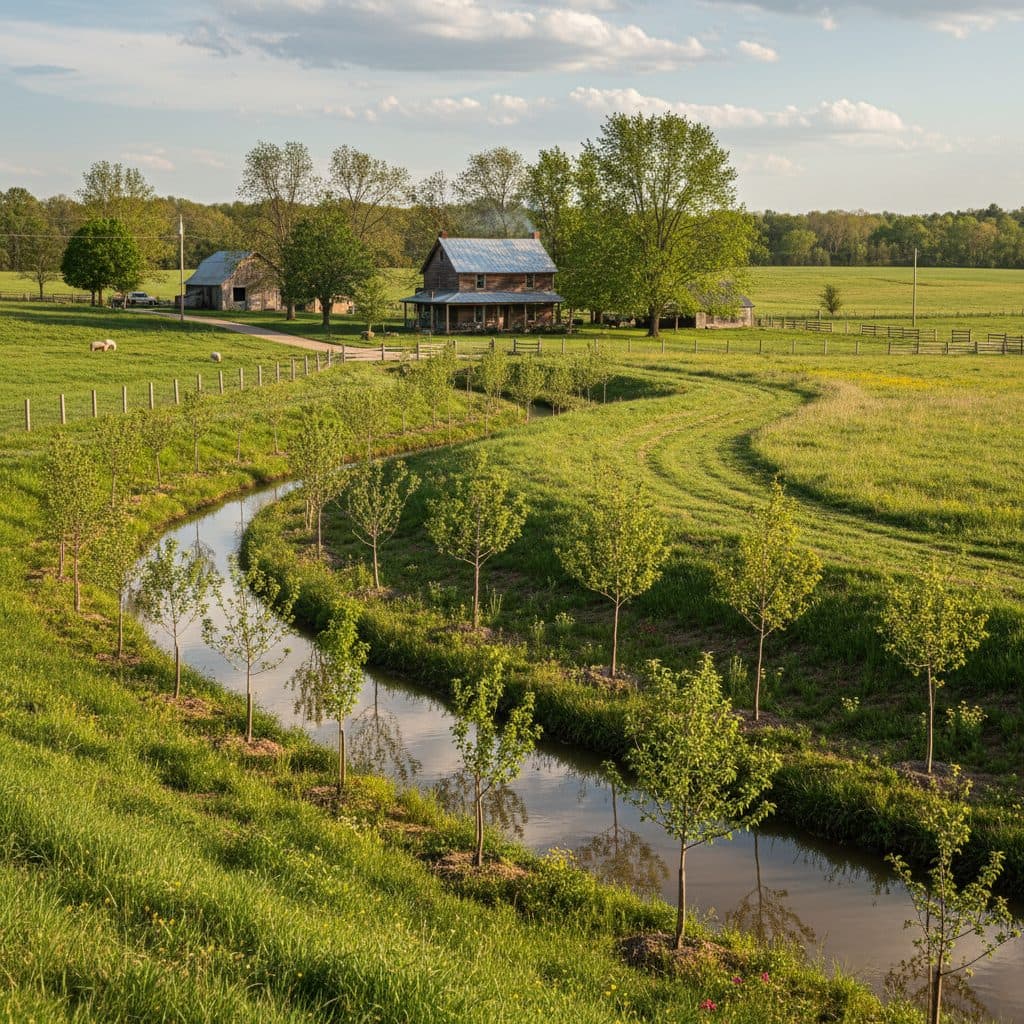
Key takeaways
- Swales are level ditches on contour, designed to slow, spread, and sink water into the landscape, particularly useful on slopes from 2% to 20%.
- Berms are raised mounds of earth that can divert water, create microclimates, or prevent erosion, often built with a 30:1 side slope for stability.
- French drains are subsurface trenches filled with gravel and a perforated pipe, designed to collect and redirect excess groundwater away from structures or saturated areas.
- Choosing the right earthwork depends on your specific site conditions, including soil type, slope gradient, and the primary water management goal.
- Integrating these systems can create a comprehensive water management plan that improves soil moisture retention and reduces runoff.
- Proper installation, including careful surveying and material selection, is crucial for the long-term effectiveness and maintenance of any earthwork.
Quick answer: Homestead water management involves passive earthworks like swales, berms, and French drains. These systems slow, spread, and sink water, enhance soil moisture, and redirect excess runoff, improving property resilience.
In many parts of the United States, from the arid plains of eastern Colorado to the humid hills of Appalachia, managing water is a constant challenge for growers. Whether you are dealing with too much runoff after a 2-inch rainstorm or struggling to keep plants hydrated during a 30-day dry spell, understanding how to work with your land’s hydrology is fundamental. Passive irrigation earthworks — like swales, berms, and French drains — offer durable solutions that can significantly improve your property’s water retention and drainage without relying on complex, energy-intensive systems.
These structures, when properly designed and installed, can transform a problematic landscape into a productive one. For instance, a homestead in USDA zone 7 with a moderate slope might benefit from a combination of these techniques to capture seasonal rainfall and direct excess water away from foundations. Each method serves a distinct purpose, and selecting the right one for your specific soil type, slope, and water challenges is key to long-term success on your land.
Swales: sinking water into the landscape
Swales are level ditches dug along the contour of a slope, designed to intercept runoff and allow it to slowly infiltrate the soil. They are particularly effective in regions like the Pacific Northwest, where annual rainfall can exceed 40 inches, or in drier areas of the Southwest, where every drop of water is precious. A typical swale might be 18 inches deep and 3 feet wide, with the excavated soil piled on the downhill side to form a berm. This berm can then be planted with water-loving trees or shrubs, creating a productive guild that benefits from the stored moisture.
designing and building a swale
When planning a swale, accurate contouring is paramount; even a 1% deviation from level can cause water to flow rather than soak in, potentially leading to erosion. Using an A-frame level or a transit, you can mark points along the contour every 10 to 15 feet. For optimal water retention and stability, the swale’s bottom should be flat, and the berm’s side slopes should be gentle, often a 3:1 ratio for planting. The capacity of a swale can be substantial; a 100-foot swale 2 feet deep and 4 feet wide can hold over 800 cubic feet of water, which is approximately 6,000 gallons. Rainwater harvesting on this scale can significantly reduce irrigation needs for nearby crops.
- Contour accuracy: Essential for even water distribution and infiltration.
- Berm planting: Utilize the downhill berm for trees, shrubs, or perennial crops like fruit bushes.
- Infiltration rate: Consider your soil type; sandy soils absorb water faster than clay soils, which might require wider swales.
- Overflow management: Design an overflow spillway for heavy rain events, typically a broad, vegetated path.
- Spacing: On steeper slopes (e.g., 10% grade), swales may need to be spaced closer, perhaps every 15 to 20 feet vertically, to effectively manage runoff.
Berms: shaping your landscape for water control
Berms are raised mounds of earth that serve various purposes, from directing water flow to creating microclimates. In a garden setting, a berm might be 1 to 3 feet high and several feet wide, often used to define planting beds or create pathways. For larger-scale water management, such as preventing erosion on a hillside in USDA zone 5, berms can be constructed with specific dimensions and materials. According to [2], mathematical analyses of landside seepage berms from 1984 point to stable side slopes as important, often recommending a 30:1 ratio for long-term integrity, particularly in areas with high water tables.
types and uses of berms
Beyond simple garden beds, berms can be designed as diversion berms to redirect runoff away from structures or sensitive areas, or as infiltration berms that work in conjunction with swales to hold more water. In a homestead in central Texas, for example, a diversion berm might be built 12 inches high and 4 feet wide to protect a home from flash flooding after a 5-inch rain. Berms can also act as windbreaks, protecting young plants from harsh winds that can reduce soil moisture by up to 35%. Buying land for homesteading often involves assessing existing slopes and considering how berms might enhance the property’s resilience.
- Diversion: Redirects surface runoff away from buildings or cultivated areas.
- Infiltration: Works with swales to increase water absorption into the soil.
- Microclimate creation: Provides shelter from wind or sun, influencing temperature by several degrees Fahrenheit.
- Erosion control: Stabilizes slopes and prevents soil loss, particularly on grades exceeding 5%.
- Access and pathways: Can define garden zones and provide elevated access in wet areas, often 24 inches wide for foot traffic.
French drains: managing subsurface water
Unlike swales and berms that primarily deal with surface water, French drains are designed to manage subsurface water, mitigating issues like waterlogged yards or damp basements. These drains consist of a trench, typically 6 to 24 inches wide and 18 to 36 inches deep, filled with gravel and often containing a perforated pipe. They are particularly useful in areas with heavy clay soils, common in states like Ohio or Georgia, where water can accumulate and create saturated conditions. According to [3], French drains are a common and effective solution for mitigating groundwater in residential areas.
installation and components of a french drain
The key to an effective French drain is proper grading; the trench must have a continuous downhill slope, usually at least 1% (a drop of 1 foot over 100 feet), to ensure water flows away efficiently. The perforated pipe, often 4 or 6 inches in diameter, is laid at the bottom of the trench, wrapped in a filter fabric to prevent silt and soil from clogging the perforations. The trench is then filled with clean gravel, typically 0.5 to 1.5 inches in size, and often topped with a layer of landscaping fabric and then soil or sod. A well-installed French drain can effectively lower the water table in a saturated area by several feet, protecting foundations and allowing for better plant growth. Expandable hoses can be useful for flushing out debris from outlet pipes if needed, though proper installation minimizes this.
- Trench depth: Typically 18 to 36 inches deep, depending on the water problem and soil type.
- Perforated pipe: 4-inch or 6-inch diameter pipe, ensuring adequate flow capacity for typical groundwater volumes.
- Filter fabric: Prevents soil particles from entering and clogging the pipe system, extending its lifespan by decades.
- Gravel fill: Provides drainage pathways and supports the trench structure, usually 0.5 to 1.5 inch aggregate.
- Outlet: Must drain to a lower, appropriate area, such as a dry well, storm drain, or a non-sensitive part of the landscape at least 20 feet from any structure.
Choosing the right earthwork for your site
Selecting between swales, berms, and French drains — or deciding to combine them — hinges on a careful assessment of your specific site conditions and water management goals. For instance, if you live in a region like central California with a pronounced dry season and moderate slopes (5% to 15%), swales are an excellent choice for maximizing water infiltration and supporting drought-tolerant plantings. They help retain the 15 to 25 inches of annual rainfall, making it available to plants over longer periods. On the other hand, if your property in coastal Oregon experiences persistent groundwater issues and a perpetually damp yard, a French drain is likely the most effective solution to move excess water away from foundations and prevent root rot in garden beds.
site assessment and integration strategies
Begin by observing your land during and after rainfall. Where does water pool? Where does it flow too quickly, causing erosion? Consider your soil type; sandy soils absorb water quickly but don’t hold it, while clay soils absorb slowly but retain it for longer. For example, a heavy clay soil in USDA zone 6 might benefit from a network of shallow swales to encourage infiltration, coupled with a French drain near a perpetually wet area. Berms can then be used to define planting areas or create windbreaks for sensitive crops. Integrating these systems, perhaps with solar water pumps for wells and irrigation to supplement passive systems during extended dry periods, creates a durable, resilient water management strategy. A thorough site survey, including elevation mapping, can save hundreds of hours of labor and thousands of dollars in materials by ensuring correct placement and sizing for these structures.
- Slope analysis: Swales are best for gentle to moderate slopes (2% to 20%), while French drains are effective on flatter ground or where subsurface flow is the issue.
- Soil type: Permeable soils benefit from swales; impermeable soils often need French drains for drainage.
- Water source: Is the problem surface runoff (swales/berms) or groundwater (French drains)?
- Purpose: Water retention (swales), diversion/microclimate (berms), or drainage (French drains)?
- Budget and labor: Swales and berms can be built with hand tools for smaller projects, while French drains often require excavation equipment for depths over 2 feet.
Comparison of Swales, Berms, and French Drains
Feature | Swales | Berms | French Drains |
|---|---|---|---|
Primary Function | Water infiltration and retention | Water diversion, erosion control, microclimates | Subsurface drainage and groundwater mitigation |
Typical Location | Along contours on slopes (2-20% grade) | On slopes or flat land, around structures | Waterlogged areas, near foundations, under lawns |
Water Type Managed | Surface runoff | Surface runoff | Subsurface groundwater |
Key Components | Level ditch, downhill berm | Raised earth mound | Gravel-filled trench, perforated pipe, filter fabric |
Installation Depth | 12-24 inches | 12-36 inches | 18-36 inches |
Slope Requirement | Level bottom, 2-20% land slope | Variable, often 30:1 side slope for stability | Minimum 1% continuous downhill grade for pipe |
Benefit Example | Retains 6,000 gallons of water per 100 feet | Protects structures from 5-inch rain events | Lowers water table by several feet in saturated areas |
Swale Capacity: A 100-foot swale, 2 feet deep and 4 feet wide, can hold approximately 6,000 gallons of water, significantly reducing irrigation needs in dry periods.
Berm Stability: For long-term stability and to prevent collapse, berms, especially seepage berms, are often designed with gentle side slopes, such as a 30:1 ratio, as studied in 1984 [2].
French Drain Slope: An effective French drain requires a continuous downhill slope of at least 1% (1 foot drop per 100 feet) to ensure proper water flow and prevent clogging.
Frequently asked questions
What is the primary difference between a swale and a berm?
A swale is a level ditch designed to collect and infiltrate surface water into the soil, typically with a downhill berm. A berm, conversely, is a raised mound of earth primarily used to divert water, control erosion, or create microclimates. For example, a swale might be 18 inches deep to hold water, while a berm could be 3 feet high to block wind.
Can French drains be used in conjunction with swales or berms?
Yes, these earthworks can be integrated for comprehensive water management. A French drain might address a persistent groundwater issue in a low-lying area, while swales on an adjacent slope capture and infiltrate surface runoff. This combined approach can manage both surface and subsurface water effectively, protecting a structure from 2 inches of rain and a high water table simultaneously.
How much slope is needed for a French drain to be effective?
An effective French drain requires a continuous downhill slope of at least 1%, meaning a drop of 1 foot for every 100 feet of length. This ensures that collected groundwater flows consistently through the perforated pipe and exits the system, preventing standing water and potential clogs.
What kind of maintenance do these earthworks require?
Swales and berms generally require minimal maintenance once established, primarily checking for sediment buildup in swales or erosion on berms after heavy rain (e.g., 3-inch downpours). French drains need periodic inspection of their outlets to ensure they remain clear of debris, perhaps once or twice a year, to maintain optimal flow and prevent clogging over decades of use.
Are there specific plants recommended for swales and berms?
Yes, for swale berms, deep-rooted, water-tolerant plants like fruit trees (e.g., apples, pears) or nitrogen-fixing shrubs (e.g., goumi, Siberian pea shrub) are excellent choices, benefiting from the stored moisture. Berms can host a wider variety of plants depending on their purpose, from drought-tolerant native grasses for erosion control to garden vegetables in raised beds, often increasing yields by 20% due to improved drainage.
References
- Berms without Calibration (2025). Berms without Calibration.
- Mathematical Analyses of Landside Seepage Berms (1984). Mathematical Analyses of Landside Seepage Berms.
- French Drains to Mitigate Groundwater in Residential Areas (2005). [French Drains to Mitigate Groundwater in Residential Areas](https://doi.org/10.1061/40792(173)382).
- Remaining Sites Verification Package for the 118-C-3:3, 105-C French Drains, Waste Site Reclassification Form 2006-016 (2006). Remaining Sites Verification Package for the 118-C-3:3, 105-C French Drains, Waste Site Reclassification Form 2006-016.
- French Drains to Mitigate Groundwater in Residential Areas (2002). [French Drains to Mitigate Groundwater in Residential Areas](https://doi.org/10.1061/40644(2002)49).
- USDA Natural Resources Conservation Service (2024). USDA Natural Resources Conservation Service.